
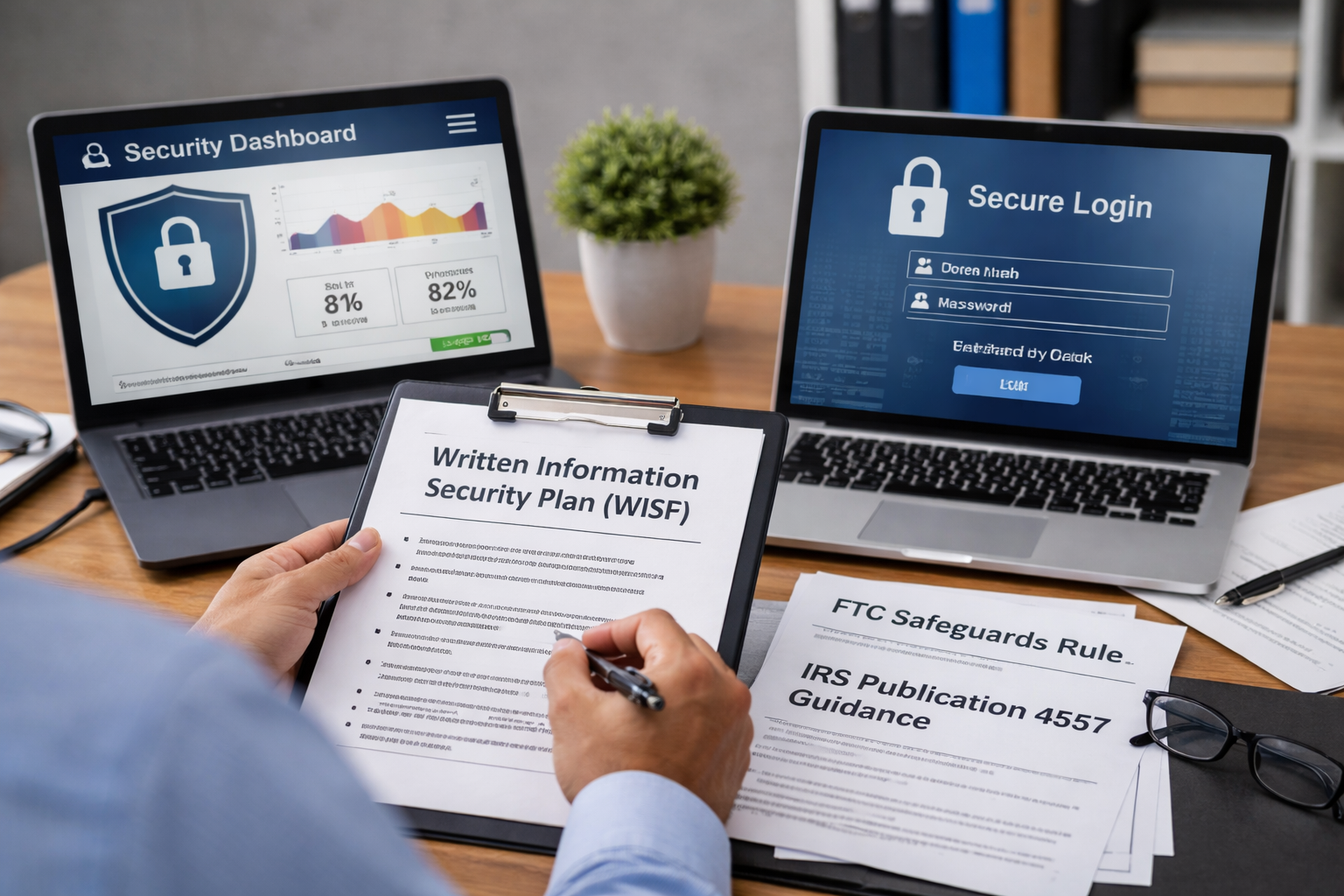
IT Compliance for Accounting Firms: FTC and IRS Requirements
IT compliance for accounting firms is no longer optional. It is a legal and operational requirement for firms that prepare tax returns, manage financial accounts, or handle sensitive client financial data.
If your firm stores Social Security numbers, bank details, payroll records, tax documents, or other personally identifiable financial information, you are responsible for protecting that data. That responsibility does not end with good intentions or a basic antivirus subscription. It requires real safeguards, documented policies, staff training, and an ongoing process for monitoring risk.
For many CPA firms, tax preparers, and accounting offices, that is where the challenge starts. The rules are detailed. The technical language is dense. The implementation burden is real. Most firms are already stretched by deadlines, client expectations, seasonal staffing, and the daily pressure of keeping operations moving.
That is why IT compliance for accounting firms is best approached as an ongoing program instead of a one-time project. A strong program helps protect client data, reduce legal exposure, support audit readiness, and keep your firm from scrambling when regulators, clients, or partners ask whether your safeguards are actually in place.
Da-Com IT Pros helps accounting firms across St. Louis, Columbia, and Southern Illinois build practical compliance programs that include technical controls, documentation, monitoring, and support. The goal is simple. Help firms stay secure and compliant without forcing them to become cybersecurity experts themselves.
What IT Compliance for Accounting Firms Means
At its core, IT compliance for accounting firms means proving that your firm has appropriate safeguards in place to protect sensitive client information.
That includes administrative safeguards such as policies, training, and vendor oversight. It includes technical safeguards such as encryption, multi-factor authentication, patching, endpoint protection, and access controls. It also includes physical safeguards, secure disposal practices, and incident response planning.
This is important because accounting firms sit on a high-value mix of financial and personal data. A compromised accounting firm does not just risk one bad day. It risks tax fraud, identity theft, financial loss, regulatory scrutiny, and long-term damage to client trust.
Compliance is also not static. Threats change. Regulations evolve. Your staff changes. Your systems change. Cloud software, remote access, and seasonal hiring all change the risk picture over time. That is why a compliance program has to be maintained, reviewed, and improved on an ongoing basis.
For most firms, the two most important federal frameworks are the FTC Safeguards Rule and IRS Publication 4557, along with the expectation that tax professionals maintain a Written Information Security Plan, or WISP.
Who Needs IT Compliance for Accounting Firms?
Many firms assume these requirements only apply to large CPA groups or firms with dedicated internal IT staff. That is not the case.
These requirements can apply to:
- CPA firms
- tax preparation firms
- enrolled agents
- bookkeeping practices that handle taxpayer information
- payroll providers
- multi-office accounting firms
- solo practitioners who store or transmit client financial data
If your firm handles nonpublic financial information or taxpayer data, you should assume that security and compliance obligations apply.
This matters even more for small and mid-size firms because they often have fewer internal controls, fewer dedicated IT resources, and more informal workflows. Those gaps are exactly where attackers and compliance failures tend to show up.
FTC Safeguards Rule Requirements for Accounting Firms
The FTC Safeguards Rule requires covered financial institutions to develop, implement, and maintain an information security program that protects customer information.
For accounting and tax firms, this is not just a paperwork exercise. It is a requirement to put real safeguards in place and to manage those safeguards over time.
What the rule actually requires
A compliant program generally includes:
- a qualified individual to oversee the information security program
- a written risk assessment
- safeguards based on the risks identified
- access controls for systems and data
- encryption of customer information where appropriate
- multi-factor authentication or equivalent controls
- regular testing and monitoring of safeguards
- staff security training
- oversight of service providers and vendors
- a written incident response plan
- periodic reporting to firm leadership
This is where many accounting firms get stuck. The rule tells firms what must be accomplished, but it does not hand them a step-by-step setup guide for how to do it in their own environment.
That means firms need to make sound decisions about technology, documentation, vendors, and risk management. Those decisions are much easier when a managed IT partner helps design and maintain the program.
Why small firms still have to take it seriously
Small firms sometimes assume regulators only focus on major enterprises. In reality, smaller firms are often more exposed because they have fewer controls, less formal oversight, and more dependence on basic shared systems.
A firm with ten employees can still suffer a phishing attack, a ransomware event, a stolen laptop, a compromised email account, or an accidental disclosure of taxpayer information. If the required safeguards are missing, the size of the firm does not make the consequences go away.
IRS Publication 4557, WISP, and Tax Preparer Security Requirements
In addition to the FTC Safeguards Rule, tax professionals also face IRS security expectations.
IRS Publication 4557 outlines safeguarding requirements for taxpayer information and explains the importance of maintaining a Written Information Security Plan. For accounting firms, this is one of the most important operational documents in the compliance process.
What a WISP is
A WISP is a formal document that explains how your firm protects client data. It should describe your policies, technical safeguards, staff responsibilities, risk management approach, incident response planning, and procedures for reviewing and updating the program.
A WISP is not just a form to file away. It should reflect what your firm is actually doing.
Why a template alone is not enough
The IRS offers WISP resources, which is helpful. But using a template without implementing the controls behind it creates a false sense of security.
If your WISP says you use encryption, role-based access, secure backups, and staff training, those things need to be real. If your document says incidents are logged and reviewed, there should be logs and reviews. If your plan says user access is controlled, there should be evidence that the controls are active.
That is where many firms fall short. They create a document because they know it is required, but they do not build the supporting program behind it.
The Technical Controls Behind IT Compliance for Accounting Firms
The technical side of compliance matters because documentation without implementation is not enough.
A real compliance program depends on technical safeguards that reduce risk and create evidence that your firm is taking reasonable steps to protect client information.
The most important controls often include:
Encryption
Sensitive client data should be encrypted both at rest and in transit. That helps protect information if devices are stolen, emails are intercepted, or files are accessed improperly.
Multi-factor authentication
Passwords alone are not enough. MFA helps reduce the chance that a stolen or reused password can open the door to client records, tax software, or email accounts.
Access controls and role-based permissions
Not every employee should have access to every client file or system. Limiting access by role helps contain damage if an account is compromised and reduces the likelihood of inappropriate internal access.
Endpoint protection and patching
Workstations, laptops, and servers should be kept up to date and protected with layered security tools. Unpatched systems remain one of the easiest ways for attackers to get in.
Audit logs and monitoring
Firms need visibility into who accessed what, when access happened, and whether unusual activity took place. Logs also help support investigations and demonstrate that monitoring is part of the security program.
Secure backups and recovery planning
Backups matter for both security and business continuity. If ransomware or system failure interrupts operations during peak season, recovery speed becomes critical.
Secure disposal
Old drives, workstations, and storage media need to be wiped or destroyed properly. Throwing out hardware without secure disposal can create major compliance exposure.
For a supporting internal link in this section, add cybersecurity protections for SMBs here: https://da-com.com/managed-it/cybersecurity-for-smbs-essentials/
IT Compliance for Accounting Firms: Quick Checklist
If you want a fast way to evaluate your current position, start with this checklist:
- Written risk assessment completed
- Qualified person assigned to oversee the security program
- WISP documented and current
- Multi-factor authentication enabled on key systems
- Encryption used for sensitive data
- Access rights limited by role
- Endpoint protection in place
- Patch management active
- Staff training documented
- Vendor oversight documented
- Incident response plan written and reviewed
- Backups tested
- Audit logs collected and monitored
- Secure disposal procedures documented
- Annual review process established
If several of these items are incomplete, your firm likely has a compliance gap that needs attention.
Common IT Compliance Mistakes Accounting Firms Make
The biggest compliance failures are often not dramatic. They are everyday oversights that compound over time.
Relying on a template without real controls
A WISP template is useful, but it is not proof that your firm is secure. Policies must reflect real implementation.
Skipping MFA on critical systems
If email, tax software, cloud file storage, or remote access tools do not use MFA, your risk remains higher than it should be.
Giving broad access to shared files
When too many employees can access too much data, a single compromised account can expose far more information than necessary.
Treating training as a one-time event
Security awareness needs repetition, especially for firms that add seasonal staff during busy filing periods.
Ignoring vendor risk
If outside providers touch client data, they become part of your risk picture. Vendor oversight cannot be ignored.
Failing to test incident response
An incident response plan that has never been reviewed or practiced often fails under pressure.
What Happens When Firms Are Not Compliant
The cost of non-compliance can show up in several ways.
First, there is regulatory exposure. If a regulator finds that required safeguards are missing, the firm may face enforcement action, penalties, corrective obligations, or deeper scrutiny.
Second, there is operational risk. An accounting firm that loses access to systems during tax season or suffers a serious breach can face missed deadlines, broken workflows, delayed filings, and major internal disruption.
Third, there is client risk. Clients trust their accountant with some of their most sensitive information. If that data is exposed because the firm failed to use reasonable safeguards, trust is hard to rebuild.
Finally, there is reputational damage. In a profession built on confidentiality and judgment, clients do not easily forget security failures.
For tax-focused firms, security issues can also create problems tied to IRS reporting expectations and e-file operations. That makes compliance a business continuity issue, not just a legal one.
How Managed IT Makes Compliance More Practical
This is where many firms find relief. They do not need to become full-time compliance specialists. They need a partner who can help translate requirements into real systems, processes, and documentation.
A managed IT provider can help by:
- assessing compliance gaps
- implementing missing technical controls
- documenting the security program
- monitoring systems continuously
- supporting patching, backups, and endpoint security
- helping maintain vendor and policy documentation
- supporting annual reviews and updates
- providing guidance when regulations or risks change
For accounting firms, that support is especially valuable because the business already runs on deadlines. Compliance work tends to get delayed when the team is buried in client work. Managed IT helps move security from reactive to systematic.
You can also add managed IT cost for financial firms in this section where you discuss budgeting and service scope: https://da-com.com/managed-it/managed-it-cost-for-financial-services/
Building a Compliance Culture in Your Firm
Technology matters, but people still shape the day-to-day risk picture.
A strong compliance culture means staff understand what is expected of them. They know how to handle sensitive files. They know how to report suspicious emails. They know why password sharing is dangerous. They know what to do if a laptop is lost or a client email looks suspicious.
This matters even more in accounting because many firms bring on temporary or seasonal workers during high-pressure periods. When deadlines are tight, employees are more likely to take shortcuts unless the secure path is also the clear path.
That is why good compliance culture includes:
- regular security awareness training
- simple, easy-to-follow written procedures
- clear rules for remote access and personal devices
- accountability for handling client data correctly
- leadership support for secure habits
The best compliance programs are not built on fear. They are built on clarity, consistency, and practical habits that people can actually follow.
Why This Matters for Accounting Firms in St. Louis, Columbia, and Southern Illinois
Local firms face the same federal requirements as firms in any major market, but many regional practices do not have large internal IT teams or in-house compliance staff.
That means partners, office managers, and operations leaders often carry the burden of making sure the firm stays secure while still serving clients and keeping up with busy season demands.
For accounting firms in St. Louis, Columbia, and Southern Illinois, the right support can make compliance far more manageable. Instead of piecing together policies, software, and outside advice from multiple directions, firms can build a clearer, more coordinated program that supports both security and day-to-day operations.
Frequently Asked Questions
What is the FTC Safeguards Rule for accounting firms?
The FTC Safeguards Rule requires covered financial institutions to create, implement, and maintain an information security program to protect customer information. For accounting firms, that often includes documented safeguards, risk assessments, access controls, training, and incident response planning.
Do accounting firms need a WISP?
Yes. Firms that handle taxpayer information are generally expected to maintain a Written Information Security Plan that explains how they protect client data and respond to security risks.
Does IRS Publication 4557 apply to CPA firms?
It applies to tax professionals and firms that handle taxpayer data. CPA firms involved in tax preparation or the handling of taxpayer information should take it seriously.
What technical controls help accounting firms stay compliant?
Common controls include multi-factor authentication, encryption, role-based access, endpoint protection, patch management, secure backups, audit logs, and incident response planning.
Can a managed IT provider help with compliance documentation?
Yes. A managed IT provider can help firms document policies, implement controls, maintain monitoring, and keep compliance programs current as requirements and risks change.
If your accounting firm is trying to meet FTC and IRS security requirements without turning compliance into a full-time internal burden, Da-Com IT Pros can help. We support firms with managed IT services, practical cybersecurity controls, documentation support, and ongoing monitoring built for real-world accounting environments. To learn more about managed IT and compliance support for your St. Louis or Southern Illinois firm, contact Da-Com IT Pros here.


Leave A Comment