
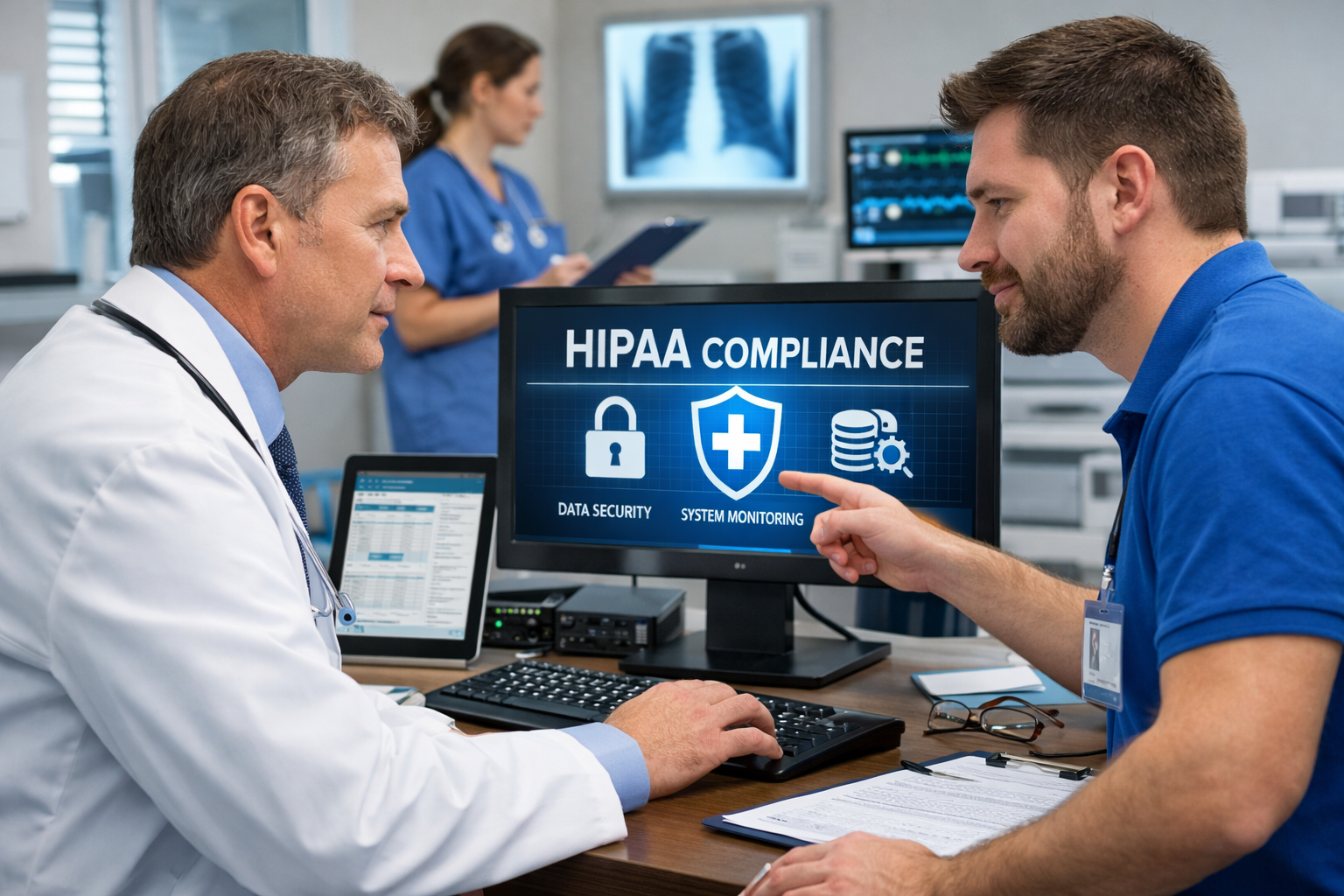
Why IT Support for Medical Practices Matters More Than Ever
IT support for medical practices is no longer just about fixing computers, resolving printer issues, or resetting passwords. In today’s healthcare environment, technology is directly tied to patient care, daily operations, regulatory compliance, and long-term business stability. From electronic health records and billing systems to email, scheduling platforms, secure messaging, and cloud applications, nearly every critical process inside a medical office depends on reliable and secure IT systems.
For medical practices with 10 to 100 employees, the stakes are especially high. These organizations often need enterprise-level security and compliance support without having a large in-house IT department. That gap creates risk. When systems are poorly managed, outdated, or only addressed after something breaks, the consequences can affect much more than productivity. Technology failures can interrupt patient scheduling, delay documentation, disrupt billing, expose sensitive data, and create serious compliance concerns.
That is why IT support for medical practices must be structured, proactive, and built around the realities of healthcare. Medical offices need more than reactive troubleshooting. They need a managed IT partner that understands HIPAA, cybersecurity, operational continuity, and the importance of keeping clinical and administrative systems running smoothly.
This article explains what medical practices should expect from modern IT support, why HIPAA requirements shape IT decisions, and how the right managed IT program can help protect patient data while supporting growth.
Why IT Support for Medical Practices Must Be HIPAA Focused
Medical practices operate in one of the most highly regulated environments in business. The Health Insurance Portability and Accountability Act, or HIPAA, establishes standards for protecting patient health information and requires organizations to maintain safeguards for electronic protected health information. In practical terms, that means your IT systems cannot simply be functional. They must also be secure, controlled, documented, and maintained in a way that supports compliance.
For medical practices, HIPAA-focused IT support should help enable:
-
Access controls that limit who can view patient records
-
Encryption for data in transit and at rest
-
Audit logging and system activity tracking
-
Regular risk assessments
-
Incident response planning
-
Secure and reliable backups
Many smaller healthcare organizations assume compliance is mostly about policies, staff acknowledgment forms, and annual training. Those elements matter, but a large portion of HIPAA risk comes down to how technology is configured and managed. Weak passwords, missing updates, unprotected endpoints, unsecured remote access, poor backup practices, and inconsistent user permissions can all create avoidable exposure.
Effective IT support for medical practices helps align technical controls with compliance requirements. It turns broad regulatory expectations into practical safeguards that protect patient data while supporting everyday workflows.
What Should IT Support for Medical Practices Include?
Not every IT provider is prepared to support healthcare environments. IT support for medical practices goes beyond break-fix service and includes the systems, processes, and security measures needed to reduce risk over time. A strong healthcare IT support model should combine responsiveness with prevention.
1. Help Desk Support and Continuous Monitoring
Even if your office is only open during business hours, your systems are always working. Servers, backup jobs, cloud services, firewalls, email systems, and remote access tools do not stop mattering when the front desk closes. If a critical system fails overnight or over a weekend, the impact may be felt immediately when staff return and patient appointments begin.
Reliable IT support for medical practices should include:
- Ongoing monitoring of servers, networks, and key systems
- Fast response to critical outages
- Clear escalation procedures
- Documentation of support activity and issue resolution
Downtime in a medical practice affects more than internal efficiency. It can interfere with patient scheduling, charting, intake, communication, referrals, and billing. A proactive support model reduces disruption by identifying problems early instead of waiting for staff to report them after operations are already impacted.
2. Endpoint Protection Across Every Device
Every workstation, laptop, tablet, and mobile device connected to a medical practice creates both productivity value and security risk. Clinical workstations, provider laptops, front office machines, and remote devices used by administrators all need consistent protection. A single unmanaged endpoint can open the door to malware, ransomware, credential theft, or unauthorized access.
Strong IT support for medical practices should include:
-
Advanced antivirus and anti-malware tools
-
Centralized device security management
-
Automatic patching and update enforcement
-
Encryption where appropriate
-
Standardized protection across all users and locations
Endpoint protection is one of the most important building blocks of a healthcare cybersecurity program. Without it, even basic user activity such as opening an attachment or clicking a link can create outsized risk.
3. Secure Email and Phishing Protection
Email remains one of the most common paths attackers use to target medical offices. Staff receive appointment requests, insurance-related communications, patient forms, internal updates, vendor messages, and external inquiries every day. In a busy environment, it only takes one convincing phishing email to trigger credential theft or malware installation.
That is why IT support for medical practices should include:
-
Advanced email filtering
-
Malicious link and attachment scanning
-
Suspicious login monitoring
-
Ongoing user awareness reinforcement
Protecting email is not just about blocking spam. It is about reducing one of the most common causes of breaches in healthcare environments. A secure email environment helps defend both patient information and day-to-day operations.
4. Backup and Disaster Recovery Planning
Medical practices rely on fast, consistent access to patient records and operational systems. When data is lost, servers fail, or a cyber incident occurs, the ability to restore systems quickly becomes essential. Backups are not optional in healthcare. They are a foundational requirement for continuity, resilience, and risk reduction.
A strong backup and disaster recovery approach should include backups that are:
-
Automated
-
Securely stored
-
Tested regularly
-
Designed for rapid restoration
Many organizations assume they are protected simply because they have backups in place. But backups that are never tested can create a false sense of security. Medical practices need confidence that systems can actually be restored within acceptable recovery time objectives. In a healthcare setting, recovery planning is not just an IT concern. It directly affects patient service, revenue flow, and business continuity.
The Financial and Legal Risks of Inadequate IT Support
When IT support for medical practices is reactive, inconsistent, or underfunded, risks increase quickly. The consequences can extend far beyond technical inconvenience. A weak IT environment can lead to:
-
Regulatory fines
-
Mandatory breach notifications
-
Legal liability
-
Loss of patient trust
-
Operational disruption or shutdowns
There are also indirect costs that often go overlooked. When systems are down, appointments may be delayed or canceled. Staff productivity drops. Billing cycles slow down. Communication becomes fragmented. Providers may lose access to key clinical information when they need it most. Over time, the cost of poor IT oversight often exceeds the cost of a structured managed IT program.
For medical practices, the real question is not whether security, compliance, and continuity matter. The question is whether your current IT model is actually supporting them.
How Proactive IT Support for Medical Practices Reduces Risk
A proactive IT model is built around prevention rather than reaction. Instead of waiting for something to break, proactive support uses monitoring, maintenance, planning, and documentation to reduce problems before they affect the practice. That shift is especially valuable in healthcare, where even small interruptions can have broad operational consequences.
Proactive IT support for medical practices may include:
-
Routine vulnerability assessments
-
Scheduled patch management
-
Ongoing review of user access permissions
-
Monitoring for unusual system behavior
-
Documentation that supports compliance readiness
This kind of structured approach helps medical practices demonstrate due diligence while also improving day-to-day reliability. It creates fewer emergencies, more predictable costs, and stronger alignment between IT operations and healthcare requirements.
The Role of a Virtual CIO in Healthcare IT Strategy
Many medical practices do not need a full-time internal Chief Information Officer, but they still need strategic IT guidance. Technology decisions affect budgeting, compliance, growth, vendor relationships, cybersecurity, and long-term planning. Without leadership in those areas, practices often make isolated technology decisions that solve one immediate problem while creating bigger issues later.
A Virtual CIO can help by providing guidance on:
-
Technology roadmaps
-
IT budgeting and prioritization
-
Risk assessments
-
Compliance-focused planning
-
Evaluating new infrastructure or software investments
For medical practices, this strategic layer matters. It helps ensure that IT decisions support both operational goals and regulatory obligations. Instead of making choices one ticket at a time, the practice gains a clearer path for scaling securely.
Supporting EHR and Clinical Software Environments
Electronic health records and other clinical applications are central to modern healthcare operations. These systems are often the backbone of scheduling, charting, billing, referrals, patient communication, and internal workflows. Because of that, IT support for medical practices must include the ability to work alongside EHR vendors and maintain secure, stable environments for these applications.
Key responsibilities often include:
-
Maintaining secure server environments
-
Managing updates and compatibility
-
Coordinating with vendors during upgrades
-
Monitoring system performance and availability
Poor coordination between IT support and software vendors can lead to downtime, failed updates, workflow disruption, and user frustration. In medical environments, those problems can quickly affect both patient service and staff efficiency. A healthcare-aware IT provider helps bridge that gap and keep critical platforms operating as expected.
Securing Remote Access and Hybrid Work Environments
Remote access has become a normal part of many healthcare operations. Providers, billers, administrators, and managers may need to access systems from home, while traveling, or between locations. That flexibility can support productivity, but it also introduces additional security and compliance concerns.
Secure remote IT support for medical practices should include:
-
Encrypted remote connections
-
Multi-factor authentication
-
Role-based access restrictions
-
Monitoring of remote sessions
Remote access should never be treated as a convenience feature alone. In healthcare, it must be designed as a controlled, secure extension of the practice environment. Done correctly, it supports flexibility without exposing patient data unnecessarily.
Why Medical Practices Choose Da-Com IT Pros
Medical practices choose Da-Com IT Pros because healthcare IT requires more than generic technical support. It requires a structured, compliance-aware, and security-focused approach built around the realities of healthcare operations. Your technology partner should understand not only how systems work, but also how downtime, weak security, or poor communication can affect patient care and administrative performance.
Da-Com IT Pros provides:
-
Structured IT support for medical practices with 10 to 100 employees
-
Fast help desk response and proactive monitoring
-
HIPAA-aligned security controls
-
Endpoint and email protection strategies
-
Backup and disaster recovery planning
-
Strategic guidance through a dedicated Virtual CIO
-
Local support across St. Louis and Southern Illinois
Just as important, Da-Com emphasizes clear communication. In healthcare environments, leaders need practical guidance, not unnecessary technical jargon. That means translating complex IT concepts into clear recommendations that providers, office managers, and administrators can understand and act on.
How to Evaluate Your Current IT Support for Your Medical Practice
If you are not sure whether your current provider is delivering the right level of support, start with a few simple questions. Medical practices should be able to clearly understand how their IT program supports both security and compliance. Consider asking:
-
Are HIPAA security requirements mapped to technical controls?
-
Are backups tested and documented regularly?
-
Is system activity monitored continuously?
-
Are response times clearly defined in the service agreement?
-
Is there a documented incident response process?
If the answers are vague, inconsistent, or difficult to verify, your practice may be carrying more risk than you realize. A reliable managed IT program should provide clarity, not confusion.
Final Thoughts on IT Support for Medical Practices
IT support for medical practices must do more than keep devices online. It must support compliance, strengthen cybersecurity, improve system reliability, and help practices operate with confidence. In healthcare environments, technology problems do not stay confined to the IT department. They affect patient care, staff efficiency, regulatory standing, and financial performance.
That is why a structured managed IT approach matters. By combining proactive monitoring, endpoint and email protection, backup and disaster recovery, strategic planning, and HIPAA-aware support, medical practices can reduce risk and improve operational stability. They can spend less time reacting to technical issues and more time focusing on patients.
For healthcare organizations that want a more secure and dependable technology foundation, the right IT partner can make a measurable difference.
Contact Da-Com IT Pros
If your practice is looking for IT support for medical practices in St. Louis or Southern Illinois, Da-Com IT Pros can help you improve compliance readiness, reduce cybersecurity risk, and build a more reliable technology environment for long-term growth. Contact us today!


Leave A Comment