
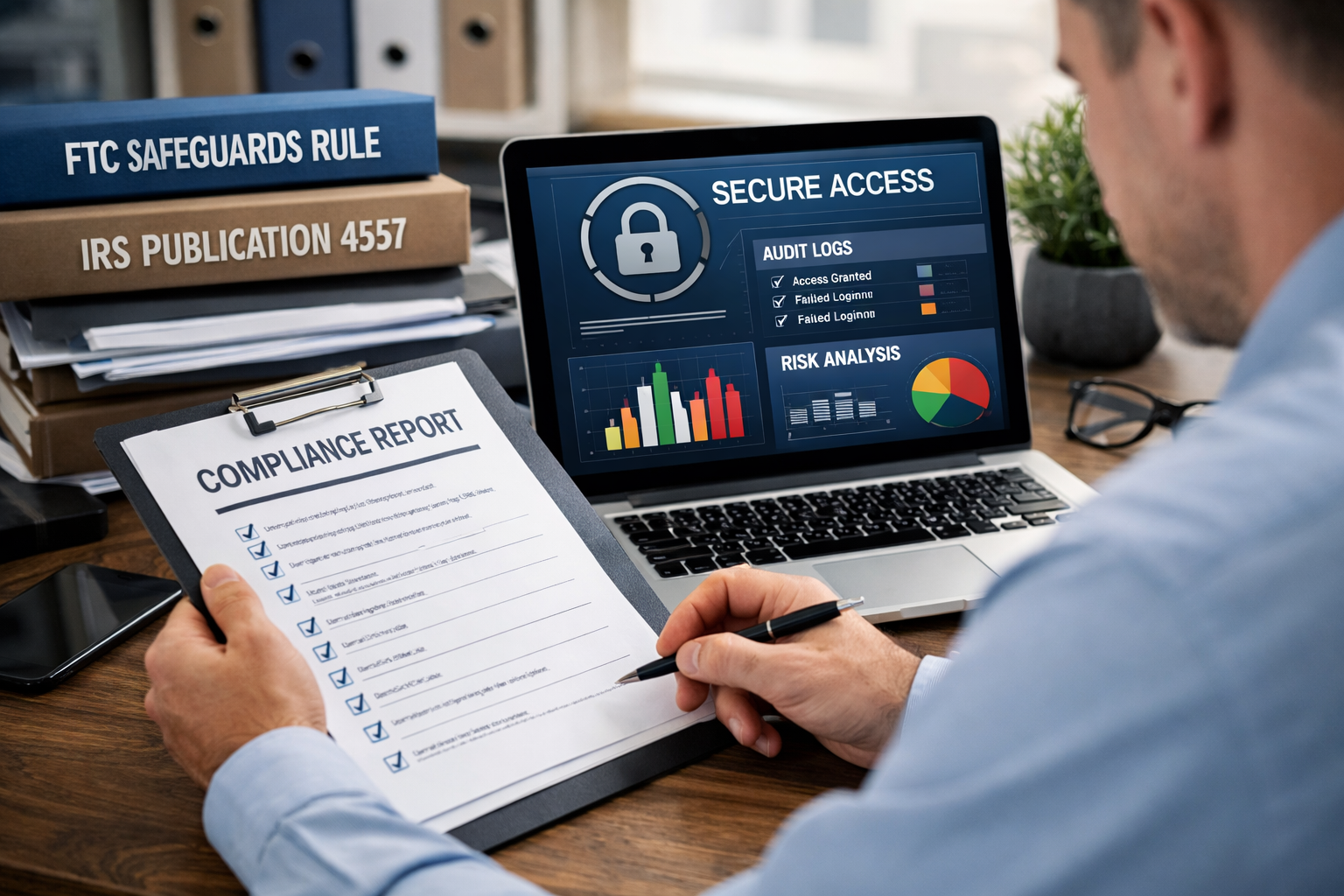
IT Compliance for Accounting Firms: FTC and IRS Rules
IT compliance for accounting firms is no longer optional. For tax preparers, CPAs, and accounting firms that handle sensitive client financial information, compliance is now tied directly to how data is stored, accessed, protected, and monitored. If your firm prepares tax returns, manages financial accounts, or stores taxpayer data, you are expected to maintain security safeguards that can stand up to regulatory scrutiny.
That expectation creates a real challenge for many firms. The rules are detailed. The language can be technical. The standards often require a mix of documented policies, implemented security controls, vendor oversight, staff training, and ongoing monitoring. Most firms are already busy serving clients, meeting deadlines, and managing peak-season workloads. Very few want to spend their time interpreting federal security guidance or building a compliance program from scratch.
This is where it compliance for accounting firms becomes more than a paperwork issue. It becomes an operational and business issue. Clients trust your firm with some of their most sensitive data, including tax returns, Social Security numbers, payroll details, business financials, and bank account information. Regulators expect you to protect that data appropriately. If you do not, the result can include enforcement action, breach reporting obligations, reputational damage, and major disruption during the busiest times of the year.
Da-Com IT Pros helps tax and accounting firms across St. Louis, Columbia, and Southern Illinois implement the technical controls, documented safeguards, and ongoing support needed to make compliance manageable. Instead of expecting your team to become compliance experts, the right managed IT partner helps turn regulatory requirements into practical steps that protect your firm and your clients.
Why IT Compliance for Accounting Firms Matters More Now
The compliance burden on accounting firms has become more visible because the risks have become more visible. Attackers increasingly target firms that store large amounts of financial and identity data. At the same time, federal agencies have made it clear that firms handling this type of information are expected to protect it through documented and maintained security programs.
For accounting firms, that means compliance is not separate from cybersecurity. The two work together. A firm cannot claim strong compliance if its controls are weak, inconsistent, or only documented on paper. It also cannot build strong cybersecurity without considering the regulatory expectations tied to taxpayer and customer financial information.
IT compliance for accounting firms matters for several reasons:
- clients expect proof that their data is protected
- regulators expect safeguards that are documented and maintained
- insurers increasingly care about security controls before issuing or renewing coverage
- one weak process can expose many clients at once
- a compliance failure during tax season can create major disruption
The firms that handle this well are usually not the firms with the biggest internal teams. They are the firms that treat compliance as an ongoing program rather than a once-a-year review.
What the FTC Safeguards Rule Requires
One of the most important regulations affecting many accounting and tax firms is the FTC Safeguards Rule. The FTC states that covered financial institutions must develop, implement, and maintain a written information security program with administrative, technical, and physical safeguards that are appropriate for the organization’s size, complexity, and the sensitivity of the customer information it handles.
For accounting firms, the practical takeaway is clear: compliance is not satisfied by a vague policy or a general promise to keep data safe. The rule expects real security planning and real controls.
A compliant program commonly includes:
A qualified person overseeing the security program
Someone must be responsible for coordinating and overseeing the information security program. For smaller firms, this often becomes much more realistic with managed IT support and vCIO-style oversight.
A written risk assessment
The firm needs to identify reasonably foreseeable internal and external risks to customer information and evaluate whether current safeguards are sufficient.
Safeguards tied to identified risks
This can include access controls, encryption, secure authentication, role-based permissions, secure disposal, and monitoring.
Ongoing testing and monitoring
Security controls must be reviewed and tested to confirm they are actually working.
Vendor oversight
If service providers handle or can access customer information, the firm needs to evaluate and oversee those vendors appropriately.
A written incident response plan
The organization should have a documented plan for detecting, responding to, and recovering from a security event.
Ongoing review and updates
The program should be adjusted as the business changes, technologies change, or new risks emerge.
This is one reason Da-Com has a good opening for this article. Your site already speaks to compliance-driven cybersecurity in regulated industries, but not yet in a focused accounting-firm article centered on Safeguards Rule obligations.
IRS Publication 4557 and the WISP for Tax Professionals
The IRS also places clear security expectations on tax professionals. For firms that prepare returns or handle taxpayer data, IRS Publication 4557 and the expectation for a Written Information Security Plan, or WISP, are central.
This matters because it compliance for accounting firms is not only about broad financial-data protection. It is also about specifically protecting taxpayer information and maintaining procedures that show your firm takes that responsibility seriously.
A WISP should describe how your firm protects taxpayer data through policies, procedures, and security controls. That can include:
- how systems and devices are protected
- how access is limited
- how passwords and MFA are handled
- how staff are trained
- how files are stored and transmitted securely
- how incidents are detected and reported
- how vendors and service providers are reviewed
The challenge is that many firms stop at the document. They create a template, save it, and assume that is enough. It is not. A WISP only helps if the controls it describes are actually implemented and maintained. That is where managed IT becomes valuable. A provider can help align the written plan with the real technical environment so the firm is not relying on paperwork alone.
IT Compliance for Accounting Firms Requires Real Technical Controls
One of the strongest parts of your draft is the focus on technical implementation, and that should stay front and center. IT compliance for accounting firms is not satisfied by documentation by itself. Regulators, auditors, insurers, and clients increasingly expect real evidence that security controls are in place.
A strong compliance program typically includes the following technical controls:
Multi-factor authentication
MFA should be enabled for email, cloud applications, remote access, and any system that contains sensitive financial or taxpayer data. This reduces the risk of account compromise when passwords are stolen or reused.
Access controls and role-based permissions
Employees should only have access to the data and systems they need to perform their jobs. This limits the damage that can occur if one account is compromised.
Encryption
Sensitive data should be protected both in transit and at rest where appropriate. Encryption helps reduce exposure if a device is lost, stolen, or intercepted.
Patch management and vulnerability reduction
Outdated software creates obvious entry points for attackers. Compliance-minded IT management requires regular patching, vulnerability review, and prompt remediation.
Logging and monitoring
Audit trails, access logs, endpoint monitoring, and alerts help firms detect suspicious behavior and demonstrate that safeguards are operating as intended.
Secure backup and recovery readiness
A compliant environment should not only protect data from unauthorized access, but also support recovery when systems fail or are attacked.
Secure data disposal
Old hardware, drives, and digital media should be retired in a way that prevents residual data exposure.
Incident response readiness
A written plan matters, but so does the ability to carry it out. Firms should know who responds, how containment happens, how communication is handled, and what obligations may apply after an incident.
This technical layer fits naturally with Da-Com’s current public messaging around managed IT, cybersecurity, and business continuity, which gives this article a strong internal-link structure.
What Happens When an Accounting Firm Is Not Compliant
A compliance gap is not always visible until something goes wrong. That is part of the risk. The firm may believe it is fine because nothing bad has happened yet, while underlying weaknesses continue to build.
When it compliance for accounting firms is not handled properly, the consequences can include:
Regulatory and legal exposure
A firm that does not implement reasonable safeguards may face regulatory scrutiny or legal action after a security incident.
Operational disruption
If an incident affects email, tax software, shared files, or remote access during tax season, the practical disruption can be severe.
Loss of client trust
Clients expect confidentiality and security from their accounting firm. A preventable incident can damage relationships that took years to build.
Insurance complications
Insurers increasingly ask about MFA, endpoint protection, access control, backups, and security policies. Weak controls can affect claims or premiums.
Reputation damage
Professional services depend heavily on trust. A public or widely known incident can follow a firm long after the technical cleanup is finished.
This is why the compliance message should not be framed only as “avoid fines.” It should also be framed as “protect continuity, trust, and firm reputation.”
How Managed IT Makes Compliance More Practical
Most accounting firms do not have the time or in-house resources to interpret regulatory expectations, implement technical safeguards, document procedures, train staff, monitor systems, and keep everything current year-round. That is why a managed approach is often the most practical answer.
Da-Com already positions its services around proactive IT management, compliance-driven cybersecurity, and support for regulated businesses and financial firms. That makes this article a natural bridge between existing service pages and a more specific accounting-industry use case.
Managed IT can help by:
- assessing current gaps against security expectations
- building or supporting a WISP and related documentation
- implementing MFA, encryption, monitoring, and access controls
- maintaining patching and vulnerability management
- overseeing backup and business continuity measures
- documenting processes and evidence for reviews
- training staff on safe handling of client data
- updating the program as requirements and risks evolve
For many firms, the biggest benefit is not just technical. It is clarity. Instead of asking, “What are we supposed to do?” leadership gets a roadmap and ongoing support.
Building a Compliance Culture Inside the Firm
Technology alone does not create compliance. Policies alone do not create compliance either. Staff behavior matters, especially in an accounting environment where client files, email attachments, approvals, and data exchanges are a daily reality.
That is why it compliance for accounting firms should also include a culture component.
A stronger compliance culture usually includes:
Regular training
Staff should understand phishing, secure data handling, password hygiene, MFA expectations, and reporting procedures.
Clear, simple policies
Policies should be practical enough for real employees to follow during busy periods.
Accountability
Everyone who handles client information should understand their role in protecting it.
Secure workflows
The easiest way to complete a task should also be the secure way. If secure processes are too clumsy, employees will work around them.
Reinforcement over time
Security awareness should be revisited regularly, especially before and during busy season.
This is especially important for accounting firms that use part-time or seasonal staff. Compliance breaks down quickly when expectations are not clear or secure processes are not built into the daily workflow.
Frequently Asked Questions About IT Compliance for Accounting Firms
What is IT compliance for accounting firms?
IT compliance for accounting firms means implementing and maintaining the policies, technical controls, and monitoring needed to protect sensitive financial and taxpayer data in line with applicable requirements.
Does every accounting firm need to worry about the FTC Safeguards Rule?
Many firms that handle customer financial information, including tax preparation firms, should review whether the rule applies to them and what safeguards are expected. The FTC’s framework centers on a written security program and appropriate safeguards.
What is a WISP for accountants?
A WISP is a Written Information Security Plan. It documents how a firm protects sensitive taxpayer and financial information through policies, procedures, and technical safeguards.
Is a written plan enough to be compliant?
No. A written plan helps, but compliance also depends on whether the described controls are actually implemented, monitored, and maintained.
How can managed IT help with compliance?
Managed IT can help firms assess gaps, implement controls, support documentation, train staff, monitor systems, and maintain a more consistent compliance posture throughout the year.
Final Thoughts
IT compliance for accounting firms is not a side project. It is a core part of protecting client trust, maintaining business continuity, and meeting the expectations that now come with handling financial and taxpayer data. The firms that do this well are the ones that treat compliance as an ongoing operational discipline rather than a last-minute paperwork exercise.
If your firm is unsure whether its current safeguards, documentation, and security controls are enough, now is the right time to review the gaps. Waiting until an audit, incident, or insurer questionnaire forces the issue is a much more expensive way to learn where the weaknesses are.
To learn more about managed IT and compliance support for your St. Louis or Southern Illinois accounting firm, contact Da-Com IT Pros. We help financial firms build secure, documented, and sustainable IT environments that support compliance without overwhelming internal teams.





Leave A Comment