
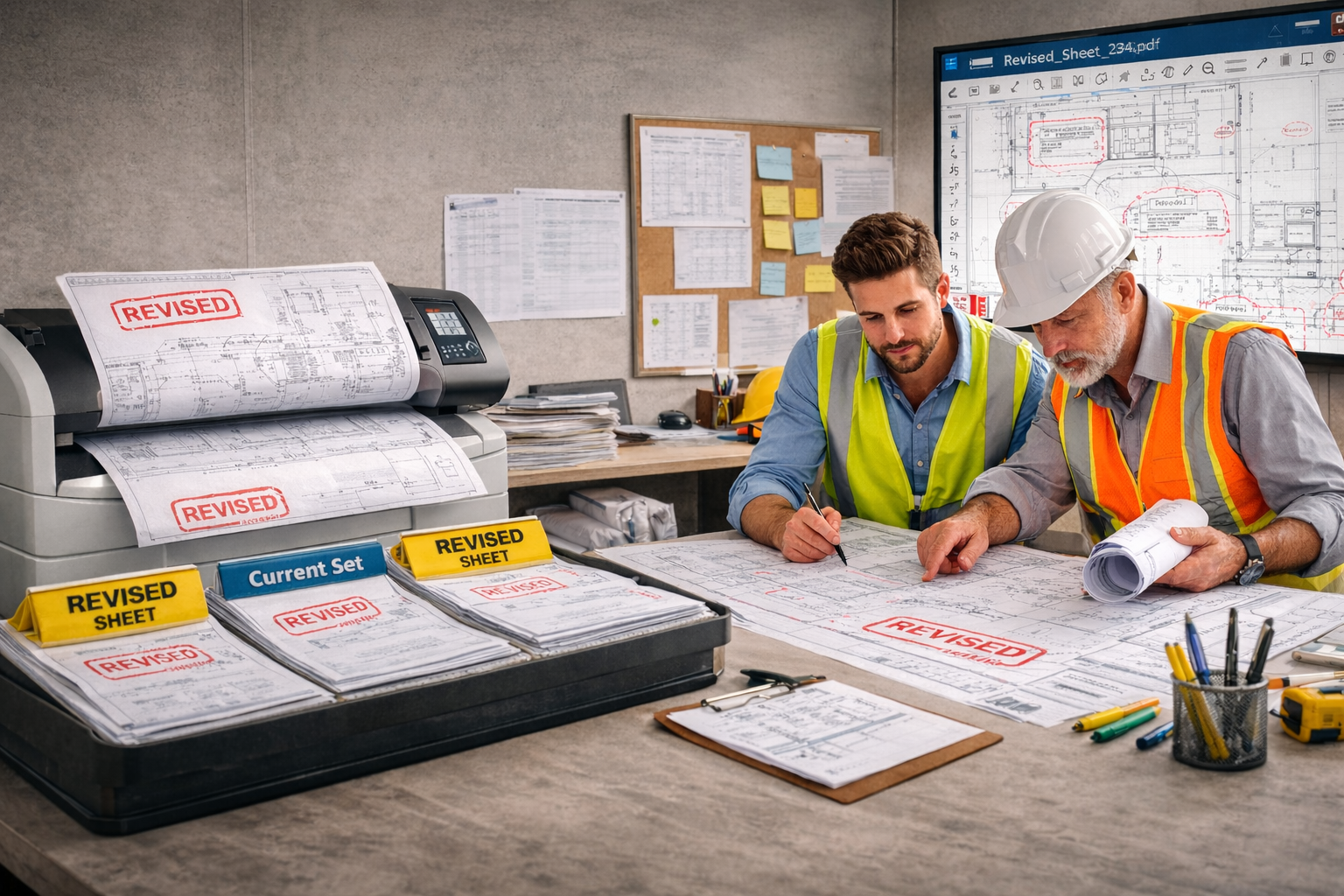
How Wide Format Printing Reduces Construction Risk
Wide format printing reduces construction risk when it is treated as part of a controlled document workflow instead of a last-minute office task.
That may sound simple, but it matters more than most teams realize.
In construction, risk is usually discussed in terms of labor, contracts, weather, safety, schedule pressure, and change orders. Those are real issues. But one of the most preventable forms of risk often gets overlooked. It starts when the wrong drawings stay in circulation, revised sheets do not reach the right people, or current sets drift out of sync between the office, trailer, and field.
That is where wide format printing can either help or hurt.
If the print workflow is slow, disorganized, or disconnected from revision control, even a small plan change can create confusion. If the workflow is structured, fast, and tied to a documented process, it can protect the schedule, reduce rework, and help project leaders stay in control.
I have seen this play out more than once. A field crew is moving fast. The project manager thinks the update went out. The superintendent has a partial set in the trailer. Someone else is carrying an older sheet in the truck. Then one detail gets built from the wrong version. Nobody meant for it to happen. But now you have wasted labor, material questions, owner frustration, and one more preventable problem on a team that was already carrying enough pressure.
That is why this topic matters.
Wide format printing is not just about producing large sheets.
It is about helping AEC teams build from the right information.
Why Construction Risk Often Starts With Document Control
Most construction teams do not lose control all at once.
They lose it one small miss at a time.
An addendum arrives late.
A bulletin gets printed but not swapped.
A foreman keeps an older page in the truck.
A revised detail goes to one site but not the second.
A permit correction makes it into email but not into the binder.
Now the job has multiple versions of reality.
This is exactly why document control sits closer to risk management than many firms admit. You are not buying print for print’s sake. You are buying speed under revision pressure, version certainty, field usability, compliance, and coordination. You want revision-safe workflows, sheet-level reprints, current set support, and delivery that does not miss because reputation is on the line when details slip. That is the real risk picture.
One outdated sheet can create:
- demolition and rebuild work
- material waste
- labor overrun
- inspection delays
- resequencing problems
- owner frustration
- field confusion
- credibility damage for the project team
Building from the wrong sheet usually comes from fragmented communication, inconsistent sheet swaps, unclear ownership of the current set, and weak distribution discipline. The cost is not just financial. It is operational and reputational too.
So when we talk about how wide format printing reduces construction risk, we are really talking about how the print process supports better decisions under pressure.
Why Wide Format Printing Still Matters in Construction Risk Management
It is easy for people outside the industry to assume that digital platforms have made printed sets less important.
That is not what field reality looks like.
Printed drawings are still heavily used for construction sets, partial reprints, bid packages, addenda, site logistics plans, permitting exhibits, and record drawings. Wide format printing remains embedded in field and stakeholder workflows even as BIM and cloud collaboration continue to grow.
That makes sense when you think about how a job actually runs.
Crews still spread out sheets on a table.
Superintendents still mark up hard copies.
Estimators still need printed takeoff sets.
Permit reviewers still deal with physical plan documents.
Owners and stakeholders still review boards and exhibits.
Field teams still need something they can grab, read, and trust.
The question is not whether print still matters.
The better question is whether your print process reduces risk or adds to it.
When wide format printing is aligned with revision control, it supports:
- clearly dated revised sheets
- efficient sheet-level reprints instead of unnecessary full sets
- organized set assembly
- cleaner distribution to multiple recipients
- readable and scalable field documents
- faster recovery when late changes hit
That is where equipment, service, and workflow start to matter together.
A wide format solution should not create extra handling, extra confusion, or extra waiting when the project is already moving fast.
It should make the process cleaner.
8 Ways Wide Format Printing Reduces Construction Risk
There are a lot of small ways a good workflow helps. But in practical terms, I would boil it down to eight.
1. It supports sheet-level reprints instead of unnecessary full sets
Reprinting an entire drawing package every time one or two sheets change adds handling volume and opens the door to mistakes.
More pages mean more chances to mix outdated sheets with revised ones.
A wide format print workflow that supports clean sheet-level reprints helps teams update only what changed. That reduces waste, speeds up turnaround, and lowers the risk of old and new versions getting mixed together. Your revision hub already points to this directly as a core advantage in revision-heavy environments.
This matters a lot when addenda hit late in the day.
Nobody wants to sort through unnecessary paper at 6:15 PM.
2. It makes revision identification clearer
Risk increases when teams have to guess whether a sheet is the latest version.
A disciplined print workflow helps make revision dates, revision numbers, and update markers easier to verify. That may sound basic, but it saves real time in the trailer and in the field.
When someone asks, “Is this the latest C5.1?” the answer should be immediate.
Not a debate.
Not a scavenger hunt through email.
A clear printed revision trail lowers uncertainty, and lower uncertainty leads to fewer bad decisions.
3. It helps maintain a true current set in the trailer
One of the most important ways wide format printing reduces construction risk is by supporting a clean current set process.
Current set management is one of the strongest defenses against revision confusion.
Printing matters here because a current set only stays current if revised sheets can be produced, organized, and swapped without friction.
If updates are slow or messy, trailer discipline breaks down.
That is when risk starts to rise.
4. It improves distribution accuracy across office, trailer, and field
A lot of costly drawing confusion comes from uneven distribution.
The office has the right page.
The trailer has most of it.
The second site never got it.
A subcontractor is still using a previous issue.
That is not unusual on active jobs.
A wide format workflow that supports organized output, grouped revision sheets, and cleaner set assembly helps reduce distribution errors.
That is not glamorous.
It is just the kind of thing that keeps projects from drifting into avoidable confusion.
5. It protects schedule reliability when revisions hit late
Construction teams do not need perfect timing.
They need recovery speed.
Wide format printing reduces construction risk when it helps the team recover from those moments quickly.
The faster the update can move from approved file to organized printed set, the lower the odds of field work continuing from the wrong information.
6. It improves readability and scale confidence in the field
Field decisions are only as good as the documents people can read.
If dimensions are hard to see, markups are muddy, or scaling is inconsistent, the risk is not just annoyance. It affects interpretation.
A dependable wide format workflow helps produce readable, properly scaled sheets that support takeoffs, coordination, and field use. This is especially important for civil, utility, and site work where detail clarity can affect staking, layout, phasing, and permit coordination.
In other words, readable output is not about polish.
It is about fewer judgment errors.
7. It supports cleaner documentation history and reorders
Risk goes up when teams cannot quickly verify what was issued, when it was issued, and who received it.
That is why archival retrieval, print queue logging, revision logs, and organized reorder history all matter. The existing source content on revision control points to print queue logging, documentation history, and archival retrieval as practical tools for strengthening control in revision-heavy firms.
A strong print workflow helps teams answer questions like:
- When did this revision go out?
- Was this sheet reprinted or part of a full set?
- Which site received it?
- Do we have the previous issue archived?
Those answers become very important when there is a dispute, an inspection question, or a need to reproduce a past issue cleanly.
8. It supports operational calm instead of chaos
This last point matters more than some people realize.
Construction risk is not only technical.
It is emotional.
That means wide format printing reduces construction risk not only by producing accurate sheets, but by lowering the chaos surrounding them.
When revisions are handled cleanly, project leaders feel covered.
That matters.
What AEC Buyers Should Look for in a Risk-Reducing Print Workflow
If an AEC firm wants to know whether its print environment is reducing risk or increasing it, there are a few practical questions worth asking.
- Can we produce sheet-level reprints quickly when revisions arrive?
- Are revision dates and issue markers easy to verify on printed sheets?
- Do we have a documented sheet swap process?
- Can we maintain a current set in the trailer without confusion?
- Can updated sheets be grouped and distributed cleanly to multiple recipients?
- Can we reorder from history without digging through old emails?
- Is project billing clear and cost coded correctly?
- Do we have reliable local service support if output slows or fails?
That is why the conversation should never stop at printer specs.
The real issue is workflow confidence.
This is also where managed print services can matter. A support model that helps maintain uptime, supply continuity, service response, and consistent output standards does more than keep machines running. It supports operational stability on active jobs.
How KIP Digital Displays Strengthen Risk Control
Printed drawings still matter.
But print is not the only part of the risk picture anymore.
KIP Digital Displays support the part of the process that happens before and around the printed sheet. Coordination meetings, plan review sessions, markups, visual walkthroughs, and team alignment all influence whether the final paper set goes out cleanly.
Used the right way, a digital display does not replace the field set.
It strengthens the review process behind it.
That can help teams:
- review revisions before printing
- mark up details collaboratively
- align disciplines faster
- reduce miscommunication in coordination meetings
- keep a cleaner visual trail of changes
- support office and trailer review workflows together
Print and digital review work better together than they do in isolation.
Why This Matters in St. Louis and Southern Illinois
In quieter environments, some firms can hide weak print processes for a while.
In this market, those weaknesses show up faster.
That is why wide format printing should be viewed as part of project risk control, not just an admin function.
Questions Construction Leaders Should Ask Right Now
If you are trying to reduce risk on active jobs, start with a few direct questions.
- Where does our drawing workflow break down when revisions hit?
- Are we still printing full sets when only a few sheets changed?
- Who owns the current set in the trailer?
- Do all active locations receive updates consistently?
- Can we prove what was issued and when?
- Are our field teams ever forced to guess which version is current?
- Do our print tools and support model help us recover quickly from late changes?
- Are we using digital review tools to reduce confusion before paper hits the field?
If those answers feel fuzzy, there is probably more risk in the workflow than leadership realizes.
That is not a reason to panic.
It is a reason to tighten the system.
Frequently Asked Questions About How Wide Format Printing Reduces Construction Risk
How does wide format printing reduce construction risk?
Wide format printing reduces construction risk by helping teams distribute accurate drawings, reprint revised sheets quickly, maintain current sets, improve readability, and reduce version confusion between office, trailer, and field.
Is construction risk from printing really that significant?
Yes. The print step is often where revision control becomes visible in the real world. If the wrong sheets stay in circulation or updated drawings do not reach the right people, the result can be rework, delays, and credibility damage.
Why are sheet-level reprints important for risk control?
Sheet-level reprints help teams update only what changed. That reduces waste, lowers handling volume, and makes it easier to keep outdated sheets from mixing with revised ones.
How do digital displays help reduce drawing-related risk?
Digital displays support plan review, markups, and coordination before paper sets are redistributed. That can help teams align faster and reduce confusion earlier in the workflow.
Final Thoughts
Wide format printing reduces construction risk when it supports a disciplined process.
Not when it is treated as an afterthought.
The firms that stay cleaner under pressure are usually not the ones with the flashiest equipment language. They are the ones with tighter control.
They know where their current set lives.
They know how revisions get identified.
They know how sheet swaps happen.
They know who received the update.
They know their print workflow can keep up when the day gets messy.
They want one less preventable problem.
They want a system that helps them look prepared.
They want the field covered.
That is the real value of wide format printing in construction.
If your AEC firm in St. Louis, Columbia, or Southern Illinois is looking for a cleaner way to reduce drawing-related risk, support revision control, and keep active jobs moving, Da-Com can help with wide format solutions, managed print services, and practical AEC workflows built for real field pressure. To evaluate your current process and tighten the weak points, contact Da-Com today.

Leave A Comment