
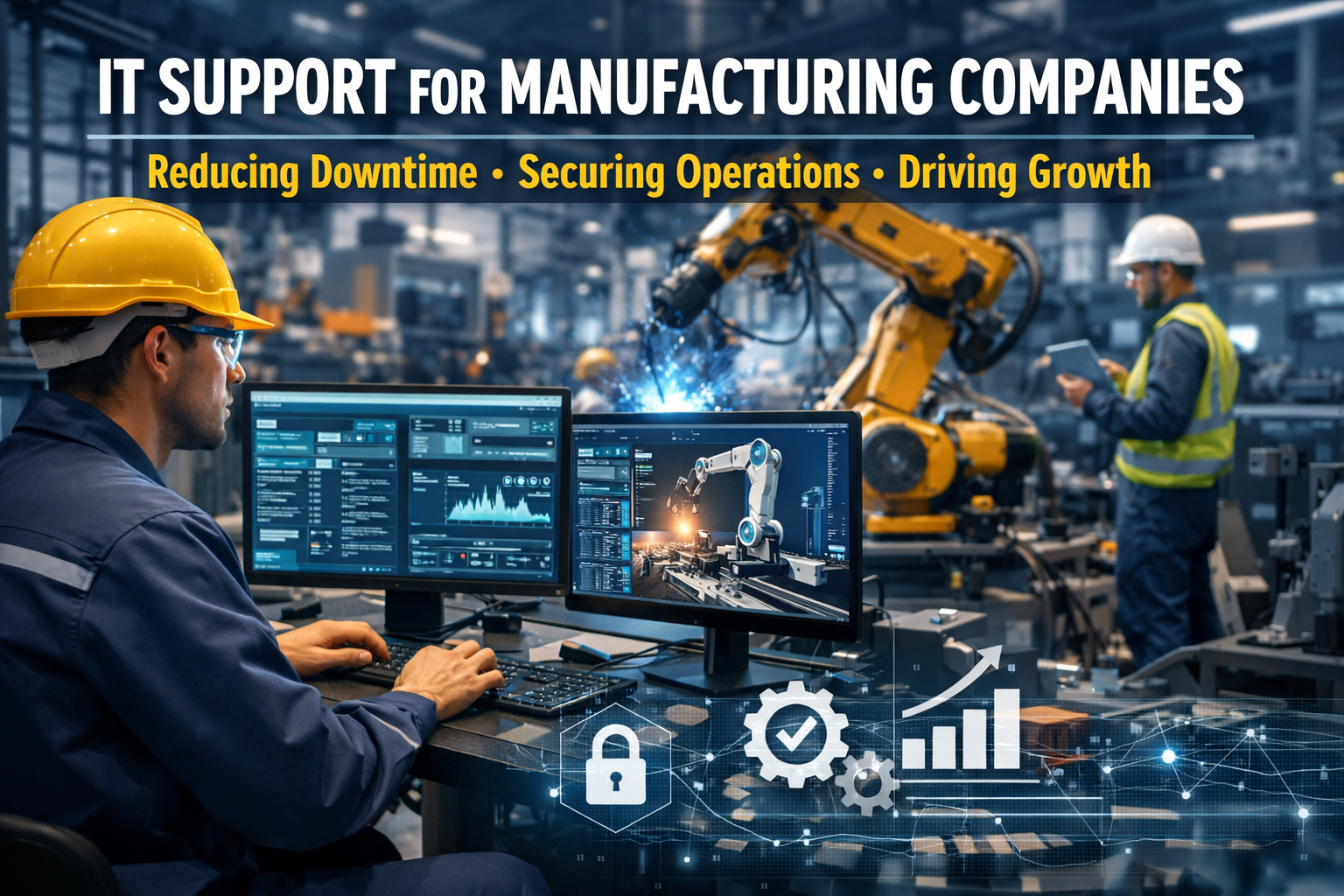
IT Support for Manufacturing Companies: 9 Ways to Reduce Downtime
IT support for manufacturing companies has to do more than reset passwords or troubleshoot email. In a production environment, technology directly affects uptime, scheduling, quality control, shipping, vendor coordination, and customer satisfaction. When a server fails, a switch goes down, or ransomware reaches a production-related system, the cost is immediate. Orders stall, employees wait, overtime rises, and customers feel the impact.
For many manufacturers with 20 to 100 employees, the technology environment has grown faster than the IT strategy behind it. Office systems, ERP platforms, CAD files, vendor portals, warehouse tools, and production-connected devices all need to work together. At the same time, those systems have to stay secure, recoverable, and scalable. That is why manufacturers need structured, proactive support instead of reactive break-fix service.
In this guide, we will cover the biggest technology risks manufacturers face, what strong IT support should include, and how the right managed IT strategy can reduce downtime, protect operations, and support growth.
Why IT Support for Manufacturing Companies Requires a Different Approach
Manufacturing businesses operate in an environment where business systems and operational workflows are tightly connected. A delay in one area often creates a chain reaction elsewhere. A network issue can slow production reporting. A server outage can disrupt scheduling. A permissions problem can block access to design files. Even a small security incident can interrupt operations across departments.
This is why IT support for manufacturing companies should be designed around operational continuity, not just day-to-day help desk tasks. Manufacturers often depend on a mix of systems such as ERP and production planning platforms, inventory and warehouse systems, CAD and design software, quality control databases, shop floor workstations, vendor and customer portals, and network-connected machinery or industrial devices.
Because these systems support revenue-producing work, manufacturers need an IT partner that understands response priorities, maintenance windows, backup requirements, cybersecurity controls, and long-term infrastructure planning.
The Real Cost of Downtime in Manufacturing
Downtime is one of the most expensive business risks manufacturers face. In many industries, even a brief interruption can create a backlog that takes days to unwind. Production delays affect labor, delivery timelines, customer trust, and cash flow all at once.
The cost of downtime can show up in several ways: lost production output, idle employees and overtime expenses, late shipments and missed deadlines, customer dissatisfaction, contract penalties, delayed invoicing and revenue recognition, and supply chain disruption.
When leaders evaluate IT support for manufacturing companies, the question should not be how much IT costs. It should be how much preventable downtime costs the business. Proactive monitoring, lifecycle planning, redundancy, documented recovery procedures, and fast escalation paths all help manufacturers reduce that risk.
Cybersecurity Risks Manufacturers Cannot Ignore
Manufacturers are attractive targets for cybercriminals because they store valuable information and depend on continuous operations. Design files, pricing data, supply chain records, customer information, and production schedules all have value. In many cases, attackers know a manufacturer may feel pressure to pay quickly if operations stop.
Common threats include phishing, credential theft, ransomware, unpatched systems, insecure remote access, and flat networks that allow malware to spread. In manufacturing environments, the damage is not limited to office productivity. An incident can disrupt production scheduling, access to quality records, shipping coordination, or visibility into inventory.
CISA and NIST both emphasize the importance of foundational security controls, secure remote access, network segmentation, and recovery planning for environments that support operations. Those recommendations align closely with what strong managed IT should deliver for smaller manufacturers.
What Strong IT Support for Manufacturing Companies Should Include
Proactive Monitoring and Maintenance
Continuous monitoring helps identify failing hardware, abnormal network behavior, storage issues, backup problems, and performance bottlenecks before they turn into outages. This is especially important in environments where production depends on stable connectivity and reliable access to shared systems.
A proactive support plan should include server and workstation monitoring, network device health monitoring, patch management, capacity planning, firmware and hardware lifecycle reviews, and alerting with escalation for critical issues. When maintenance is planned instead of delayed, manufacturers can reduce emergency downtime and avoid more expensive repairs later.
Network Segmentation and Secure Architecture
Manufacturing environments should not treat every system as if it belongs on one flat network. Office users, guest devices, production workstations, remote vendor access, servers, and sensitive systems should be separated where appropriate. Segmentation limits lateral movement, improves visibility, and reduces the blast radius of security incidents.
For manufacturers, this matters because a compromise in one area should not be able to spread unchecked into systems tied to production or sensitive data. Network architecture should support both security and operational reliability.
Endpoint Protection and Policy Enforcement
Every endpoint in a manufacturing environment creates risk, whether it is a front office desktop, an engineering laptop, a shipping workstation, or a ruggedized floor device. Consistent protections reduce the chance that one weak system becomes the entry point for a larger incident.
That usually includes managed antivirus and endpoint detection, device management and policy enforcement, controlled local admin rights, multi-factor authentication, secure baseline configurations, and logging or alerting for suspicious behavior.
Backup and Disaster Recovery
Backups are essential, but backups alone are not enough. Manufacturers also need clear recovery goals, documented restoration priorities, and regular testing. If a system fails, leaders need to know what can be restored first, how long it should take, and what business processes depend on that recovery order.
For manufacturing companies, backup and recovery planning often needs to cover file servers and shared drives, ERP or line-of-business systems, accounting and purchasing data, CAD and engineering files, virtual machines, cloud data, and configuration information for critical systems. A solid backup and continuity plan helps reduce chaos during an outage and supports faster recovery after ransomware, hardware failure, or human error.
Operational Technology Coordination
Operational technology and business IT increasingly overlap in modern manufacturing. Even when specialized vendors manage certain machines or applications, manufacturers still need clear processes for secure remote access, vendor accountability, change control, and system visibility.
IT support for manufacturing companies should help coordinate secure vendor access for production-related systems, change windows that avoid production disruption, documentation of connected systems and dependencies, monitoring for production-related infrastructure, and communication between operations, leadership, and external vendors. This coordination reduces finger-pointing during incidents and helps ensure that production-supporting systems are not overlooked.
How Manufacturers Can Reduce Downtime With Better IT Strategy
Reducing downtime is not about a single tool. It comes from a mature operating model. Manufacturers that improve uptime usually do a few things consistently well: they standardize systems, document dependencies, replace aging hardware before failure, and align IT priorities with production needs.
A strong strategy often includes standardized devices and configurations across locations, planned hardware refresh cycles, clear service priorities for production-impacting issues, reliable wireless coverage where operations need it, documented vendor contacts, and routine review of recurring incidents with root-cause analysis.
This is where executive-level guidance becomes important. A reactive provider can close tickets, but a strategic partner can identify patterns, set priorities, and create a roadmap that supports operational stability.
The Role of a vCIO in Manufacturing Growth
Many small and midsized manufacturers do not need a full-time internal CIO, but they still need strategic technology leadership. A vCIO can help leadership evaluate risk, budget for upgrades, plan expansion, and align technology decisions with business goals.
For manufacturers, that can include building an IT roadmap tied to production goals, budgeting for network, server, and security upgrades, evaluating cloud and software investments, planning for new sites or acquisitions, reviewing cybersecurity and compliance obligations, and coordinating long-term vendor strategy.
This kind of planning is especially valuable when a manufacturer is growing. Without it, technology investments often become reactive, fragmented, and more expensive over time.
Compliance, Insurance, and Customer Requirements
Manufacturers increasingly face outside pressure to strengthen security and document controls. Some have customer security questionnaires. Others must meet cyber insurance requirements or comply with contract-driven standards. Defense-related manufacturers may also need to align with frameworks such as CMMC, while many others still need stronger documentation and baseline security to win business.
That is another reason IT support for manufacturing companies must go beyond technical fixes. Documentation, policy alignment, asset visibility, access controls, backup validation, and incident readiness all matter when outside stakeholders start asking hard questions.
Why Manufacturers Choose Da-Com IT Pros
Manufacturers choose Da-Com IT Pros because they need a partner that understands how technology affects operations, not just office productivity. In production-driven environments, reliability, communication, and planning matter as much as technical skill.
Da-Com IT Pros supports manufacturers with proactive monitoring and maintenance, cybersecurity controls designed to reduce risk, network design and segmentation guidance, backup and business continuity planning, strategic planning through vCIO leadership, and local support across St. Louis and Southern Illinois.
The goal is not simply to close tickets. It is to reduce disruption, protect systems that support production, and help manufacturers build a more resilient technology foundation.
Questions Manufacturers Should Ask Their Current IT Provider
If a manufacturing company is unsure whether its current provider is the right fit, leadership should ask practical questions such as whether production-supporting systems are separated from office networks where appropriate, whether backups are tested regularly instead of just reported as successful, whether there is a documented incident response process, whether aging switches, servers, and firewalls are being tracked before failure, whether remote vendor access is controlled and reviewed, and whether cybersecurity controls are improving year over year.
The answers often reveal whether the provider is operating strategically or simply reacting to the latest issue.
Frequently Asked Questions About IT Support for Manufacturing Companies
What makes IT support for manufacturing companies different from standard office IT support?
IT support for manufacturing companies must account for production uptime, connected equipment, ERP dependencies, secure vendor access, and faster recovery priorities. In many cases, the environment includes both office systems and production-supporting technology, so the impact of downtime is broader and more immediate than in a typical office.
When should a manufacturer replace break-fix support with managed IT?
A manufacturer should consider managed IT when recurring outages, aging hardware, inconsistent backups, cybersecurity concerns, or growth plans start affecting operations. Structured IT support for manufacturing companies becomes especially valuable when leadership needs better visibility, documented processes, and a roadmap for reducing downtime.
Final Thoughts
IT support for manufacturing companies should protect uptime, secure operations, and support growth. Manufacturers cannot afford technology that is only addressed after something breaks. They need structure, visibility, planning, and a support model built around operational continuity.
With the right strategy, manufacturers can reduce downtime, protect design data, improve resilience, and make better long-term decisions about infrastructure and security.
To learn more about IT support for manufacturing companies in St. Louis and Southern Illinois, contact Da-Com IT Pros today. We can help you reduce downtime, strengthen cybersecurity, and build a technology strategy that supports long-term operational growth.


Leave A Comment