
Construction Revision Control Best Practices: How to Avoid Building from the Wrong Sheet
In construction, costly mistakes rarely happen because teams are careless. More often, they happen because information moves faster than field controls can keep up.
A revised drawing is issued. A new detail is added. An addendum changes a sheet late in the day. A permit correction comes through after the current set has already been distributed. On paper, these updates seem manageable. In practice, even one outdated drawing can lead to rework, wasted labor, material loss, schedule delays, and avoidable tension across the entire project team.
That is why construction revision control best practices matter so much. When a project team lacks a clear system for managing revisions, outdated sheets can remain in binders, job trailers, shared folders, or field packets long after they should have been removed. Once that happens, the risk is no longer theoretical. Crews can start building from the wrong sheet, and the consequences can move quickly from inconvenience to expensive correction.
For architecture, engineering, and construction firms across St. Louis, Columbia, and Southern Illinois, this challenge is especially relevant. Transportation projects, municipal work, commercial development, and infrastructure upgrades all generate a steady flow of drawing changes. RFIs, ASIs, bulletins, addenda, and permit comments create revision activity that has to be controlled in a disciplined way.
This article explores why teams still build from outdated drawings, the real cost of revision confusion, and the construction revision control best practices that help AEC firms reduce risk. It also shows where wide format printing fits into the process and why document control should be treated as an operational priority, not just an administrative task.
Why Teams Still Build from the Wrong Sheet
Most drawing-related mistakes are not caused by one dramatic failure. They are usually the result of small process gaps that stack up over time.
One of the biggest issues is revision volume. Construction documentation changes constantly, especially on active projects with multiple stakeholders. Requests for Information, Architect Supplemental Instructions, bid clarifications, addenda, permit corrections, and delta set revisions all create updated sheets that must be distributed accurately. The faster revisions move, the more important construction revision control best practices become.
Another challenge is fragmented communication. Updated drawings may be shared through email attachments, project platforms, shared drives, or even text messages and verbal notice. When there is no clearly maintained source of truth, teams can end up with multiple “current” versions of the same sheet. One person may be working from a revised file, while another is relying on an older printed set that was never fully replaced.
Inconsistent file naming makes the problem worse. If sheet numbers, revision numbers, and dates are not standardized, teams are left to interpret what is current based on assumptions. That increases the likelihood of outdated construction drawings staying in circulation long after they should have been retired.
Then there is the issue of physical handoff. Some firms print only revised sheets, which is efficient, but they do not always confirm that the old sheets were actually removed from the active field set. Others reprint complete sets for small revisions, which creates extra handling and more opportunity for mix-ups. In both cases, the absence of a documented sheet swap procedure creates risk.
Finally, many firms do not assign true ownership of the current set. When no one is clearly responsible for maintaining the active field binder or job trailer set, outdated drawings can remain in place simply because everyone assumes someone else handled it. That is how version confusion turns into field error.
The Real Cost of Building from the Wrong Sheet
When teams talk about drawing mistakes, the first concern is usually rework. That concern is valid, but it is only part of the picture.
The direct cost of building from outdated drawings can be substantial. Materials may need to be removed and replaced. Labor hours are wasted. Equipment schedules may need to be shifted. Trade partners may be forced to stop, wait, or redo work. Even a relatively small error can create a chain reaction that impacts multiple scopes.
Schedule disruption is another major issue. Construction is a sequencing business. When one phase is built incorrectly because the wrong sheet was used, other trades and follow-on activities may also be delayed. Inspections can be pushed back. Milestones may slip. Project managers can lose valuable time solving a problem that should never have occurred in the first place.
There is also a less visible but equally important consequence: credibility. Owners, inspectors, subcontractors, and internal leadership all notice when documentation control breaks down. Repeated confusion around outdated sheets can make a team appear disorganized, reactive, or unprepared. In a relationship-driven industry, that loss of confidence matters.
This is one reason construction revision control best practices should be viewed as part of operational excellence, not just document administration. Strong revision control helps reduce rework, but it also protects trust, project rhythm, and internal confidence.
On top of that, preventable drawing errors increase stress on project leadership. Project managers and operations leaders are already managing schedules, budgets, labor, communication, and client expectations. When outdated drawings remain in use, they add another layer of avoidable pressure. A stronger revision control system does not just save money. It creates stability.
Construction Revision Control Best Practices Start with a Current Set System
The foundation of effective revision control is a clearly maintained current set. Without that, everything else becomes harder.
A strong current set system begins with a single source of truth. All active drawing files, revision history, and archived versions should be stored in one centralized location with clear access controls. Teams should know exactly where the latest approved documents live and should not have to guess whether a folder, attachment, or local copy is current. One trusted repository is the starting point for construction revision control best practices.
Naming conventions also matter more than many firms realize. Files should follow a consistent structure that includes the project identifier, sheet number, revision number, and revision date. This makes it easier for office teams, field teams, and subcontractors to identify the correct version quickly. Construction drawing version control becomes far more reliable when naming is standardized across every project.
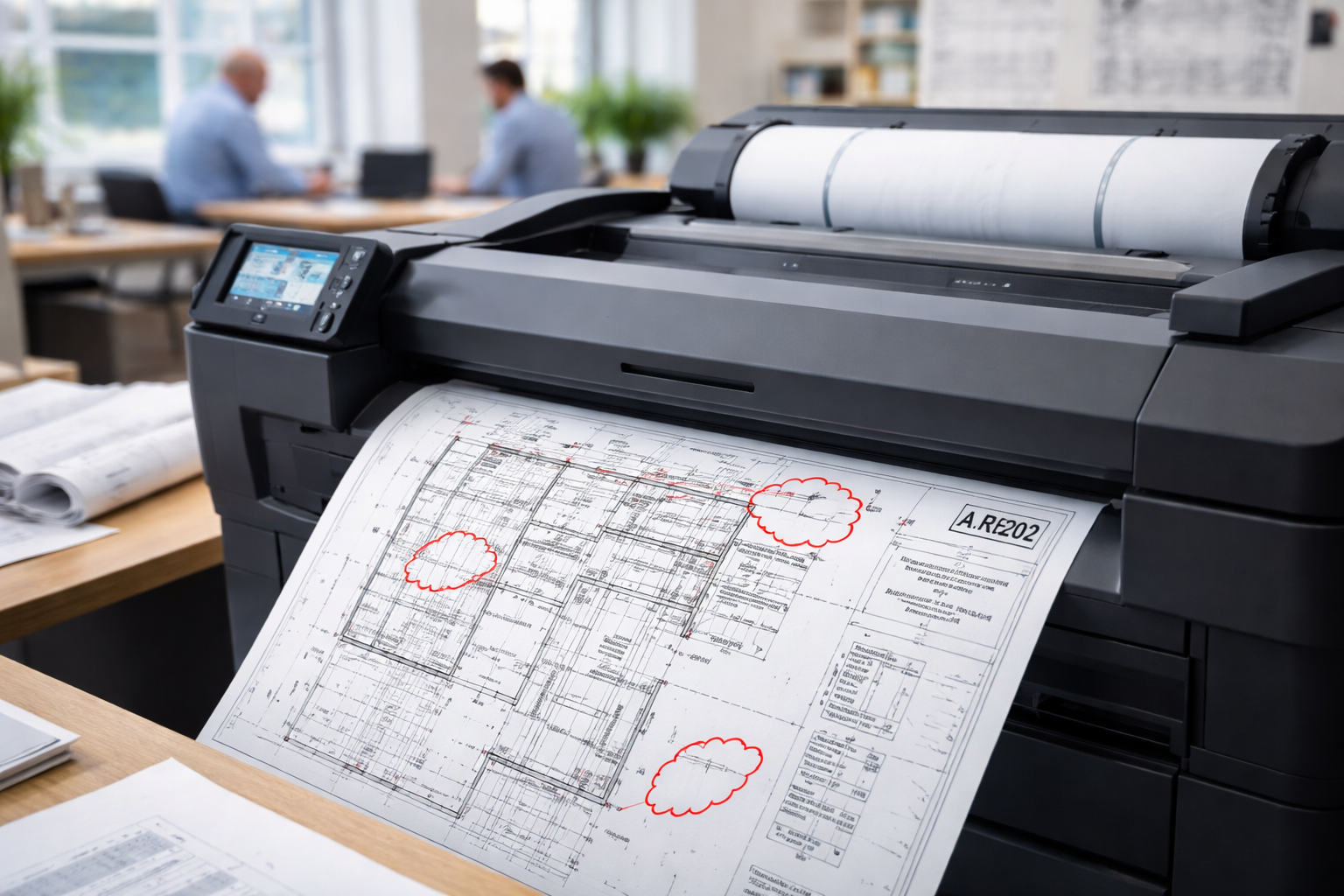
Revisions should also be visually obvious. Whether in digital or printed form, updated sheets should clearly display the revision number, revision date, and any issue markers or clouds that help the field understand what changed. If a revised sheet looks too similar to the previous version at a glance, the chances of confusion go up.
Ownership is another essential element. Someone should be clearly responsible for receiving revised drawings, updating the current set, removing outdated pages, and confirming that active field binders or trailer sets are accurate. This does not have to be a complicated role, but it does need to be explicit. One of the simplest and most effective construction revision control best practices is making sure there is no ambiguity about who maintains the live set.
When these controls are in place, firms are much better positioned to avoid building from the wrong sheet and to keep revision activity from becoming operational chaos.
How to Avoid Building from the Wrong Sheet with a Defined Sheet Swap Process
The problem is often not the revision itself. The problem is the swap.
A revised sheet can be issued correctly, printed correctly, and distributed correctly, yet still fail to protect the field if the previous version remains in the active set. That is why a standard sheet swap process is one of the most practical ways to avoid building from the wrong sheet.
A strong process should begin with identifying exactly which sheets were revised and confirming their approved issue status. From there, only the affected sheets should be printed, rather than triggering unnecessary full-set reprints. Once the new sheets are produced, the outdated versions should be physically removed from field binders, plan racks, or job trailer sets. Those removed pages should then be archived, not left loose where they might accidentally be reintroduced later.
The update should also be documented. A simple revision log can track when the change was received, which sheets were replaced, who handled the update, and who received the new version. This does not have to be burdensome. Even basic documentation adds traceability and reduces the likelihood of disputes or uncertainty later.
Most importantly, the process should require verification. Too often, teams assume a swap happened because a file was emailed or a print was delivered. But assumption is not control. A sheet is not truly updated until the old version is no longer in use.
This is one of the most overlooked areas in revision control in construction. Firms that define and enforce sheet swap procedures are far less likely to experience outdated construction drawings causing field errors.
Managing Addenda in Construction Without Creating More Confusion
Addenda often introduce some of the highest-risk revision moments on a project.
They frequently arrive under deadline pressure. They may affect multiple sheets at once. They may be issued during bid activity or just before major coordination decisions. And because they often come through quickly, teams may treat them as exceptions instead of routing them through a consistent process.
That is a mistake.
Managing addenda in construction should follow the same disciplined workflow every time. First, the addendum should be logged. Next, the affected sheets should be identified clearly. Then the centralized document repository should be updated so there is no confusion about the current version. Revised sheets should be printed, outdated sheets should be removed, and the distribution list should be notified. Finally, recipients should confirm that they received the revisions and replaced the superseded pages.
This confirmation step is important. AEC document control is not just about sending information. It is about ensuring the information was received and integrated correctly.
When addenda are handled inconsistently, they create one of the fastest paths to field confusion. When they are managed through a repeatable process, they become much easier to control. That is why construction revision control best practices should specifically include a standard addendum workflow rather than treating addenda as one-off events.
Where Wide Format Printing Fits into Revision Control in Construction
Wide format printing does not solve revision confusion by itself. Process always comes first. But equipment and print workflow absolutely influence how well a firm can execute its revision control strategy.
One of the biggest advantages in revision-heavy environments is the ability to produce efficient sheet-level reprints. When minor changes affect only a few pages, reprinting entire sets creates unnecessary handling, waste, and opportunity for error. Sheet-level reprints support more controlled updates and help teams replace only what changed.
This matters because the more paper a team has to move, sort, and redistribute, the more likely it becomes that outdated sheets remain mixed in with revised sets. A cleaner, more targeted print approach supports better construction revision control best practices by reducing the physical complexity of the update.
Output organization also plays a role. Grouped stacking, clear labeling, and orderly handoff make distribution more reliable. On projects where revised drawings need to reach job trailers, office archives, estimators, subcontractors, and project managers, clean print output can make the difference between a controlled revision process and a confusing one.
Multi-site projects raise the stakes even further. If drawing updates are moving to several locations, every step in the print and delivery process has to support clarity. Wide format printing for construction works best when it is treated as part of an overall revision control workflow, not as a standalone production task.
In other words, equipment should reinforce the system. It should make it easier to execute current set management, sheet swap procedures, and distribution accuracy consistently.
Technology That Supports Better Construction Drawing Version Control
Digital tools can strengthen revision control, but only when they support a disciplined process.
Document management platforms can help centralize files and reduce the spread of duplicate versions. Controlled access permissions make it easier to ensure that teams are working from approved documents rather than downloading and circulating disconnected copies.
Automated version history is also helpful. It gives teams a record of what changed and when, reducing reliance on memory or inconsistent naming habits. Construction drawing version control becomes more reliable when the technology itself supports traceability.
Print queue logging and archival records can also add value. When firms can see what was printed, when it was produced, and which revision was distributed, they gain more accountability and a better historical record. That can be useful not only for internal process improvement but also for resolving confusion later.
Still, digital systems alone are not enough. A flawless document platform does not protect the field if an outdated printed sheet remains clipped into the trailer binder. That is why the strongest construction revision control best practices combine digital control with physical set discipline. Both matter.
What to Look for in Equipment if Your Firm Handles Frequent Drawing Revisions
For firms operating in revision-heavy construction environments, equipment decisions should be tied directly to workflow needs.
Print speed matters when revised sheets need to move quickly. Accurate scaling matters because even small inconsistencies can create downstream issues. Network reliability matters because delays in production can slow the update process. Organized output matters because distribution becomes harder when revised sheets are difficult to sort and hand off.
Service support also deserves more attention than many firms give it. In a busy environment, printer downtime is not just an inconvenience. It can interfere with current set management, delay sheet replacement, and create additional operational pressure.
That is why firms evaluating wide format printing for construction should think beyond hardware specs alone. The real question is whether the system supports the speed, consistency, and reliability needed to execute construction revision control best practices in the real world.
Construction Revision Control Checklist for AEC Firms
Firms that want to strengthen document accuracy can use the following checklist to evaluate their process:
-
A centralized document repository is in place
-
File naming conventions are standardized
-
Revision numbers and dates are clearly displayed
-
A documented sheet swap process exists
-
One person owns the active current set
-
Addendum handling follows a defined workflow
-
Distribution confirmations are required
-
Outdated sheets are archived after removal
-
Revision activity is reviewed regularly
-
Wide format print workflow supports sheet-level reprints
-
Service expectations are defined for print uptime
This kind of checklist helps move teams from reactive correction to proactive control. It also gives leadership a simple way to spot gaps before they create field risk.
Frequently Asked Questions
What does it mean to build from the wrong sheet?
It means a crew is working from an outdated, superseded, or incorrect drawing rather than the latest approved version. This often happens when older printed sheets remain in active field sets after revisions have already been issued.
What are the most important construction revision control best practices?
The most important construction revision control best practices include maintaining a single source of truth, assigning ownership of the current set, standardizing file naming, making revisions visually obvious, documenting sheet swaps, and confirming that outdated pages were removed from active use.
How can wide format printing help reduce revision errors?
Wide format printing can support revision control by enabling fast sheet-level reprints, improving output organization, and making it easier to distribute updated sheets cleanly to the right people and locations.
Why is current set management important in construction?
Current set management helps ensure that field teams, project managers, and subcontractors are all working from the same approved information. It reduces rework, improves coordination, and protects schedule integrity.
How often should construction drawing workflows be reviewed?
Most firms benefit from reviewing their revision workflow regularly, especially on active projects with frequent updates. Monthly audits are a strong baseline, with additional review after major revision activity or repeated version confusion.
Conclusion
Most firms benefit from reviewing their revision workflow regularly, especially on active projects with frequent updates. Monthly audits are a strong baseline, with additional review after major revision activity or repeated version confusion.
Avoiding costly mistakes in construction is not just about printing faster or distributing more copies. It is about creating a system that makes the right information visible, current, and verifiable at every stage of the project.
Firms that follow construction revision control best practices are better positioned to reduce rework, maintain schedule stability, and protect trust across owners, subcontractors, inspectors, and internal teams. In active construction markets like St. Louis, Columbia, and Southern Illinois, revision activity is only becoming more common. That means document control cannot remain informal.
The firms that perform best are the ones that treat current set management as a real operational discipline. They standardize naming conventions. They define sheet swap procedures. They manage addenda consistently. They align wide format printing with the realities of revision-heavy work. And they make sure someone owns the process.
If your team wants to avoid building from the wrong sheet, the answer is not more guesswork. It is a better system.
If your AEC firm in St. Louis, Columbia, or Southern Illinois is reviewing how it handles drawing updates, sheet swaps, and current set management, Da-Com provides wide format printing solutions, managed print support, and local service designed for construction environments.
To evaluate your current workflow and reduce revision risk, contact Da-Com today.


Leave A Comment