
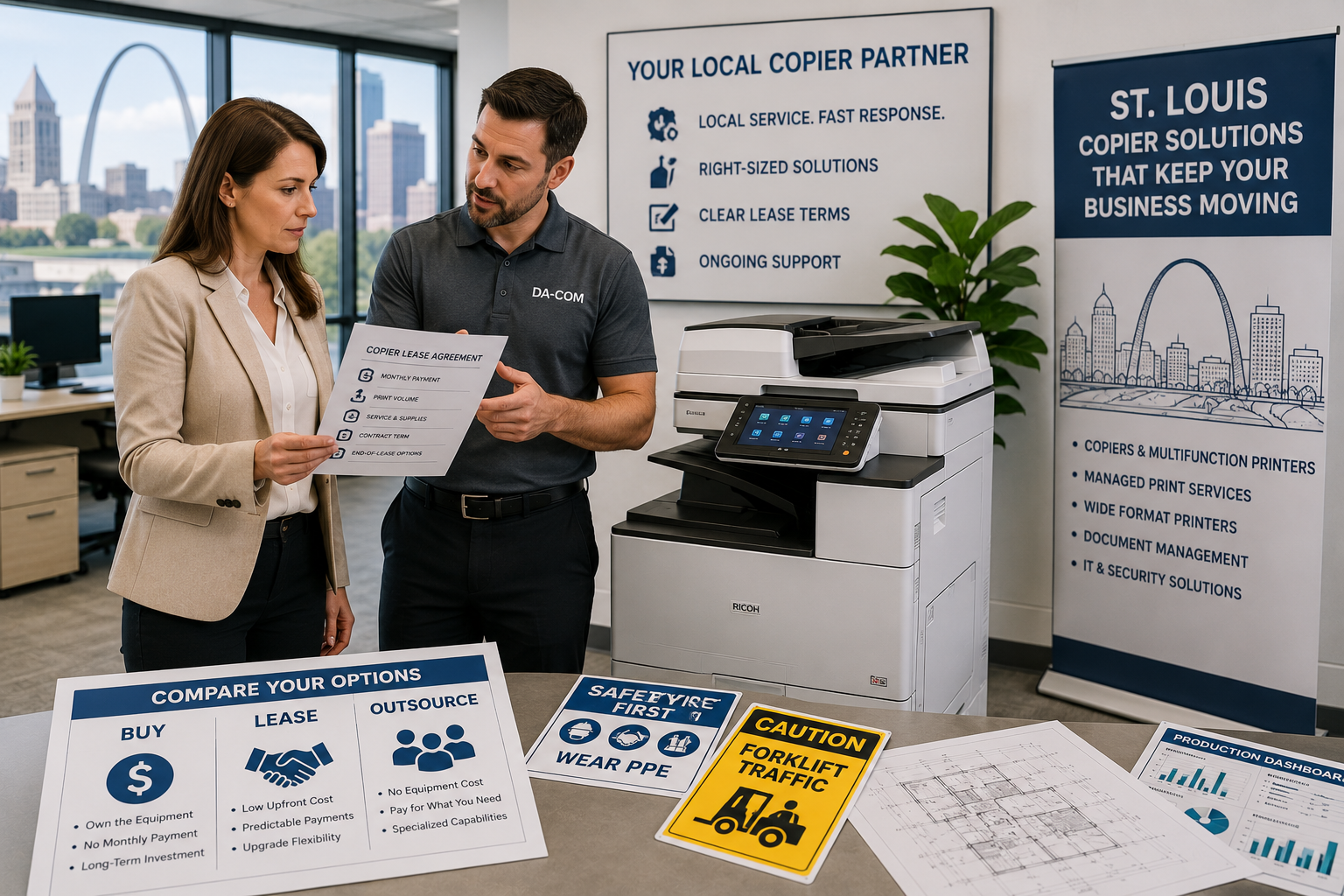
St. Louis Copier Company: What to Look for Before You Sign a Lease
St. Louis copier company decisions should not be based on the monthly lease payment alone. A copier lease can look simple on the surface, but the provider you choose will affect your service experience, support response, supply management, document workflows, security settings, lease flexibility, and daily office productivity for years.
For many businesses across St. Louis, St. Charles, the Metro East, Southern Illinois, and the Midwest, the copier is one of the most-used pieces of office equipment. Employees print forms, scan contracts, copy packets, route invoices, send documents, support customers, and manage daily administrative work through the same device.
When the copier works, nobody thinks about it.
When it does not, everyone notices.
The receptionist cannot print intake forms. Accounting cannot process invoices. HR cannot scan employee documents. A legal team cannot prepare client packets. A school office cannot copy materials. A medical office cannot scan records. An office manager starts fielding calls from every direction.
Suddenly, what looked like a copier problem becomes a productivity problem.
That is why choosing the right copier company matters just as much as choosing the right machine. The best provider should help you understand the lease, choose the right equipment, avoid unnecessary costs, protect office productivity, and get responsive support when something goes wrong.
This guide explains what to look for before signing a copier lease, which questions to ask, how to compare local and national providers, and why long-term service quality can matter more than the lowest monthly payment.
Quick Answer: What to Look for in a St. Louis Copier Company
The best St. Louis copier company will provide responsive local service, clear contract terms, right-sized equipment recommendations, reliable support after installation, and a proven track record of helping businesses stay productive.
Before signing a copier lease agreement, look for:
- Local technicians and responsive service.
- Clear lease terms with no confusing surprises.
- A service agreement that explains maintenance, labor, parts, toner, and response expectations.
- Equipment recommendations based on actual office usage.
- Support for printing, copying, scanning, document workflows, and security.
- Transparent discussion of overage charges, color costs, installation, delivery, and end-of-lease terms.
- A provider that stays involved after the copier is installed.
- Positive customer reviews that mention service, communication, and reliability.
A copier lease should make your office easier to run. It should not create years of frustration, service delays, unclear invoices, or equipment that does not fit your team.
Da-Com’s office equipment solutions include copiers, printers, multifunction printers, wide format printers, and production printers for Missouri businesses that need dependable workplace technology and support.
The Copier Lease Is Not the Only Decision
Choosing a copier lease may seem like a simple equipment purchase, but it is really a long-term service decision. Your business is not only choosing a device. You are choosing the company that will support that device when deadlines, employees, customers, and daily workflows depend on it.
Most major copier manufacturers build reliable equipment. The bigger difference usually appears after installation.
Who answers the phone when something goes wrong? Who services the device? How quickly does a technician respond? Are supplies delivered on time? Does the provider explain contract questions clearly? Does the equipment match your actual print and scan volume? Are employees trained on the features they need?
Those questions matter because office equipment becomes part of the workday.
A copier lease that looks inexpensive at first can become frustrating if service is slow, toner ordering is confusing, scans do not route correctly, or employees cannot get help when they need it. On the other hand, a slightly higher monthly payment may be worth it if the provider keeps the device running, communicates clearly, and helps your team avoid downtime.
The U.S. Small Business Administration recommends that businesses consider whether they should buy or lease equipment as part of asset planning. That same principle applies to office technology: the decision should fit your business needs, budget, and long-term operations. You can review the SBA resource here: SBA guide to buying assets and equipment.
Why Businesses Lease Copiers Instead of Buying
Many organizations choose copier leasing because it helps them access the equipment they need without a large upfront purchase. Leasing can also make budgeting easier because costs are often spread across predictable monthly payments.
Businesses often lease copiers to:
- Preserve cash flow.
- Avoid large upfront equipment purchases.
- Access newer copier and multifunction printer technology.
- Bundle maintenance and service.
- Predict monthly expenses.
- Upgrade equipment as needs change.
- Reduce the burden of managing equipment ownership.
- Support multiple departments or locations.
- Improve scanning, printing, copying, and document routing.
For growing businesses, schools, medical offices, law firms, nonprofits, manufacturers, professional service firms, and local government agencies, leasing may make more sense than purchasing outright.
However, not all copier leases are created equal. The lease length, service agreement, monthly print allowances, overage rates, supply coverage, equipment return terms, and upgrade options can vary widely.
That is why it is important to compare the full agreement, not just the payment amount.
Local Service Matters More Than Most People Realize
One of the biggest mistakes businesses make is focusing entirely on equipment specifications. Speed, paper capacity, color quality, finishing options, scan features, and monthly volume ratings matter, but service often matters more over the life of the lease.
A local copier provider can often offer faster communication, stronger accountability, and technicians who understand your office environment. When something goes wrong, you are not just calling a distant support line. You are working with a team that serves local businesses every day.
Before choosing a St. Louis copier company, ask:
- Are your technicians local?
- How quickly do technicians typically respond?
- Is support handled directly or outsourced?
- Can some issues be resolved remotely?
- What happens if the copier goes down during a busy day?
- Do you track recurring problems?
- Will the same service team learn our environment over time?
- How do we request supplies or place a service call?
Response time matters because copier downtime affects the whole office. A low monthly payment loses value quickly if your team waits days for service.
Da-Com’s service and supplies page explains that Da-Com is committed to keeping office technology running at peak performance and provides support for service calls, toner, and supplies.
Review the Copier Service Agreement Carefully
The copier service agreement may become the most important part of the lease. It defines what support is included, what costs are covered, and what your business can expect after installation.
Ask for details before signing.
| Service Question | Why It Matters |
|---|---|
| Is maintenance included? | Helps avoid surprise service expenses |
| Are toner and supplies included? | Supports predictable budgeting |
| Are labor charges included? | Reduces unexpected bills |
| Are parts covered? | Protects long-term costs |
| Are response expectations provided? | Helps minimize downtime |
| Is employee training included? | Improves adoption and reduces frustration |
| Are color and black-and-white rates separate? | Prevents confusion around monthly usage |
| How are overages billed? | Helps avoid unexpected invoice changes |
A lease should be easy to understand. If the language feels confusing, ask questions until it makes sense. A trustworthy provider should welcome those conversations.
Do not assume every copier lease includes the same support. Some agreements include maintenance, parts, labor, and toner. Others may charge separately for certain items. Some have strict page allowances. Some charge different rates for color and black-and-white pages. Some include delivery and installation, while others may separate those costs.
The more clearly you understand the agreement before signing, the fewer surprises you are likely to face later.
Beware of Equipment That Is Too Big or Too Small
Many businesses lease copier equipment that is not aligned with actual usage. Sometimes the machine is too small, which creates bottlenecks, slow print jobs, paper jams, and frustrated employees. Other times the copier is larger than the office needs, which can cost thousands more than necessary over the lease term.
A good copier leasing company should ask about your real workflow before recommending equipment.
They should ask:
- How many employees use the device?
- How many pages do you print monthly?
- How much color printing do you do?
- How much scanning do you perform?
- Do you need secure print release?
- Do you need finishing such as stapling or booklet making?
- Do you scan to email, cloud folders, document systems, or network drives?
- Do you have compliance or security requirements?
- Do multiple departments share the same device?
- Are remote or hybrid employees part of the workflow?
- Do you expect your team to grow during the lease?
The goal is not the biggest machine. The goal is the right machine.
For example, a small accounting office may need strong scanning and reliable black-and-white output. A law firm may need secure document handling and fast scanning. A school office may need high-volume copying and simple user access. A medical office may need privacy-conscious scanning and dependable service. A marketing team may need strong color output.
The right St. Louis copier company should recommend equipment based on how your business actually works, not just what is available in inventory.
Understand the Total Cost of a Copier Lease
The monthly payment is only one part of the total copier lease cost. Businesses should review all cost categories before signing.
Ask about:
- Monthly lease payment.
- Service agreement cost.
- Black-and-white cost per page.
- Color cost per page.
- Monthly page allowance.
- Overage charges.
- Delivery fees.
- Installation costs.
- Training costs.
- Network setup costs.
- Supply coverage.
- Paper costs.
- Early termination penalties.
- End-of-lease return fees.
- Upgrade options.
- Buyout options.
A low monthly lease price may not be the lowest total cost if overage charges, service exclusions, or color print rates are high.
ENERGY STAR’s imaging equipment resource notes that businesses procuring multifunction copiers, printers, or digital duplicators can use best practices to maximize energy savings and reduce environmental impact. You can review the resource here: ENERGY STAR imaging equipment.
Energy use is not the only cost factor, but it is one more reason to evaluate the total operating impact of your office equipment.
Ask What Happens at the End of the Lease
End-of-lease terms are easy to overlook when signing a new agreement, but they matter. Businesses should understand what happens when the lease ends before they commit.
Ask:
- Can we purchase the copier at the end of the lease?
- Can we upgrade to a newer model?
- What are the return procedures?
- Who pays for return shipping or pickup?
- Does the lease automatically renew?
- How much notice is required before the lease ends?
- What happens if we want to terminate early?
- Are there data removal or hard drive procedures?
Automatic renewal terms are especially important. Some leases may renew if notice is not provided within a specific window. Your office manager or operations team should know these dates and document them.
A good provider should explain end-of-lease options clearly and help your business plan ahead, rather than letting the lease surprise you later.
Compare Local Copier Companies and National Providers
National providers can offer scale, but many businesses value the accountability and relationship that come with a local copier company. The best choice depends on your needs, locations, and service expectations.
| Factor | Local Copier Company | National Provider |
|---|---|---|
| Response time | Often faster and more personal | Can vary by region and contract |
| Local accountability | High | Often less direct |
| Familiar technicians | More common | Less consistent |
| Personalized service | Often stronger | Often more standardized |
| Community focus | Local or regional | National focus |
| Relationship building | Usually stronger | May feel more transactional |
Many businesses find that local support feels different when something goes wrong. You know who to call. You know who is showing up. They know your office, your devices, your workflows, and your expectations.
For organizations across St. Louis, St. Charles County, Jefferson County, the Metro East, Belleville, Edwardsville, Collinsville, and Southern Illinois, a local provider can help make service feel less distant and more accountable.
Look for a Copier Leasing Company That Does Not Oversell
A trustworthy copier leasing company should recommend what fits, not what increases the invoice.
Overselling can happen in several ways. A business may be pushed into a copier with more speed than it needs. A team may lease color equipment when most output is black and white. A small office may get a machine designed for much higher volume. A business may pay for finishing features that employees rarely use.
Right-sized recommendations should be based on data and conversation.
A good provider should review:
- Current monthly print volume.
- Expected growth.
- Current pain points.
- Color usage.
- Scanning needs.
- Security requirements.
- Number of users.
- Number of devices.
- Department workflows.
- Budget expectations.
The right copier lease should match the way your office works today while allowing room for reasonable growth.
Da-Com’s managed print services help businesses gain visibility and control over printing processes, which can support right-sized equipment planning and cost management.
Modern Copier Leases Should Support Document Workflows
Today’s multifunction copiers do much more than print and copy. Many businesses rely on them for scanning, routing, archiving, secure access, and workflow automation.
Modern copier features may include:
- Secure document scanning.
- Scan-to-email.
- Scan-to-folder.
- Cloud integrations.
- Mobile printing.
- Secure print release.
- User authentication.
- Cost tracking.
- Document routing.
- Workflow automation.
- OCR support.
- Integration with document management systems.
When evaluating a St. Louis copier company, ask how they help businesses improve workflows, not just printing. A copier may be the front door to a larger document process.
For example, invoices may be scanned and routed to accounts payable. HR documents may need secure storage. Customer forms may need to be indexed. Legal files may need to be scanned into matter folders. Local government records may need to follow retention rules.
AIIM’s information management resources explain that organizations need to find value in unstructured data and improve information management through processes, compliance, and modern technology. You can review AIIM’s resource center here: AIIM intelligent information management resources.
Da-Com’s document management solutions help organizations classify, store, distribute, and retrieve documents through more structured workflows.
Do Not Ignore Copier Security
Copiers and multifunction printers are connected office devices. They may process sensitive documents, store temporary data, scan to email, connect to networks, and support user authentication. That means security should be part of the lease conversation.
Ask your provider about:
- User authentication.
- Secure print release.
- Hard drive security.
- Data overwrite or removal.
- Firmware updates.
- Network configuration.
- Scan destination controls.
- Address book management.
- Device access permissions.
- End-of-lease data handling.
NIST’s Cybersecurity Framework 2.0 provides guidance that organizations can use to better understand, assess, prioritize, and communicate cybersecurity risk. You can review the framework here: NIST Cybersecurity Framework 2.0.
Your copier provider should not replace your cybersecurity team or IT provider, but they should understand that connected office equipment needs responsible configuration and support.
Signs of a Copier Company You Can Trust
The best copier providers share several traits. They are clear, practical, responsive, and focused on long-term fit.
They Explain Things Clearly
You should not need a technical dictionary to understand your lease. A provider should explain equipment options, contract terms, page allowances, service coverage, and end-of-lease steps in plain language.
They Stay Involved After Installation
The sales process should not be the last time you hear from your representative. A good provider checks in, monitors satisfaction, supports training, and helps resolve issues before they become larger problems.
They Have Strong Customer Reviews
Look for consistent review themes such as fast support, helpful technicians, smooth installations, long-term relationships, reliable service, and clear communication.
They Ask Good Questions
A strong provider should ask about your workflow before recommending a device. If they make a recommendation before understanding your usage, that is a warning sign.
They Help You Plan for the Future
Your business may grow, consolidate, relocate, or change how documents move through the office. The right provider helps you plan for those changes.
Why Copier Service Is Often More Important Than Copier Price
Many buyers focus heavily on monthly lease costs. That is understandable, but the true cost of a copier often shows up later.
A copier that is down can impact:
- Productivity.
- Customer service.
- Employee satisfaction.
- Deadlines.
- Billing.
- Records processing.
- Document scanning.
- Revenue.
- Office morale.
A slightly higher monthly payment with excellent support can often save far more time and frustration than a lower payment with poor service.
Think about it this way: a copier lease is not just equipment. It is an ongoing service relationship.
The right provider helps keep your office moving. The wrong provider can turn a routine device into a daily frustration.
Questions Every Business Should Ask Before Signing
Before signing a copier lease, ask a complete set of questions. Do not wait until after installation to discover what was not included.
What Is the Total Lease Cost?
Look beyond the monthly payment. Ask about overage charges, color print rates, delivery fees, installation costs, training costs, early termination penalties, and end-of-lease terms.
What Support Is Included?
Support often becomes the most valuable part of the agreement. Ask whether maintenance, labor, parts, toner, and remote support are included.
How Long Has the Company Been in Business?
Longevity can signal stability, experience, service infrastructure, and long-term customer relationships.
What Happens When the Lease Ends?
Understand purchase options, upgrade options, return procedures, renewal terms, and required notice periods.
Who Will Train Our Employees?
Training helps employees use features correctly and reduces support requests. Ask whether training is included after installation.
How Are Service Calls Handled?
Ask how to request service, how quickly technicians respond, and how recurring issues are tracked.
Why St. Louis Businesses Value Local Accountability
Across St. Louis, St. Charles County, Jefferson County, the Metro East, Belleville, Edwardsville, Collinsville, Southern Illinois, and throughout the Midwest, organizations often prefer working with companies that understand local business needs.
When support is local, communication is easier. Relationships are stronger. Decisions often happen faster. Accountability is clearer.
That local connection becomes most valuable when unexpected issues arise.
If your copier stops working before a board meeting, tax deadline, school registration day, medical intake rush, grant submission, or customer presentation, you want to know who to call. You want a provider that understands the urgency and can respond.
Da-Com’s About Da-Com page explains that Da-Com has been a customer-focused, family-owned company for more than 75 years. That local experience can matter when your business needs responsive service, practical recommendations, and long-term support.
Frequently Asked Questions
How long is a typical copier lease?
Most copier leases range from 36 to 60 months. The best term depends on your budget, equipment needs, expected growth, and technology preferences.
Is leasing better than buying?
For many businesses, leasing provides predictable costs, easier upgrades, and less upfront investment. Buying may be a better fit for organizations that want ownership and have stable long-term equipment needs.
Can I upgrade during my copier lease?
Many copier leasing programs offer upgrade options depending on usage, contract structure, and lease terms. Ask about upgrade flexibility before signing.
What is included in a copier service agreement?
Most agreements may include maintenance, labor, parts, toner, and technical support, but coverage varies. Always ask what is included and what is billed separately.
How do I choose the best copier company in St. Louis?
Look for strong reviews, responsive service, clear contracts, local support, right-sized recommendations, long-term stability, and a provider that helps with workflows instead of only selling equipment.
What is the biggest mistake businesses make when leasing a copier?
The biggest mistake is choosing based only on monthly price instead of evaluating service quality, total cost, contract terms, equipment fit, and long-term support.
Should copier security be part of the lease conversation?
Yes. Multifunction copiers are connected devices that may process sensitive documents. Ask about user authentication, secure print, hard drive security, firmware updates, and end-of-lease data handling.
The Bottom Line Before You Sign
Most office managers, operations leaders, administrators, and business owners are not looking for another vendor. They are looking for fewer problems.
The right copier lease should help your team stay productive, reduce interruptions, and give you confidence that help is available when you need it.
Before you sign a lease, look beyond the equipment. Look at the people. Look at the service. Look at the relationship. Look at the agreement. Look at whether the provider understands how your office actually works.
A copier company should not just sell you a machine. It should help make your office easier to run.
If you are comparing copier lease agreements or looking for a responsive local copier company, contact Da-Com today. Da-Com helps organizations throughout St. Louis, St. Charles, Columbia, Belleville, Edwardsville, Springfield, the Metro East, and Southern Illinois find right-sized copier solutions backed by local support, managed print expertise, and practical technology guidance.



Leave A Comment