
KIP Large Format Printers and the Real In-House vs Outsourced Question
I have never met a project manager who gets excited about printing.
I have met a lot of project managers who are terrified of one thing.
Building from the wrong sheet.
That is why the in-house vs outsourced plan printing conversation matters. It is not a “printer” conversation. It is a risk conversation. It is a schedule conversation. It is a reputation conversation.
And it usually shows up at the worst possible time.
Late afternoon. Addendum drops. The bid is in the morning. The trailer needs a current set before the 7:00 AM huddle. Two subs need copies. Someone needs a half-size set for the foreman truck. You are not thinking about toner. You are thinking about control.
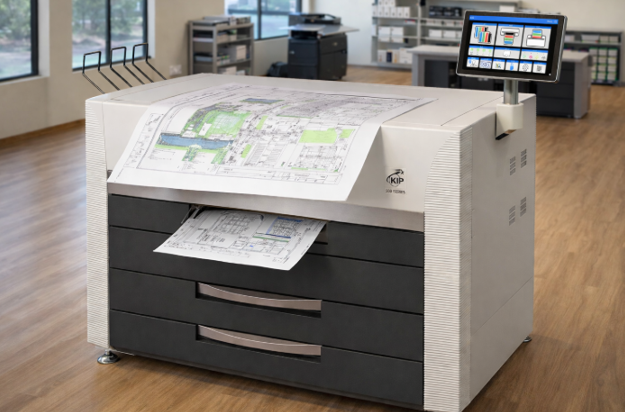
That is where KIP large format printers can fit, if you pick the right setup and you run it like a system, not like a piece of office equipment.
Let’s walk through it the way the field actually lives it.
The Moment That Forces the Decision
Here is the scene.
You are staring at an email subject line that starts with “Addendum” or “ASI” or “Bulletin.”
You already issued for construction. Now the revision velocity spikes. Sheet swaps start coming fast. You have multiple sites. Multiple stakeholders. The field is asking, “Is this the current set?”
If your print process is sloppy, you feel exposed.
If your print process is tight, you feel calm.
That calm is what you are really buying.
In heavy construction regions like the St. Louis bi-state market, corridor work and constant project movement keep documentation pressure high. MoDOT’s posted construction updates are a good snapshot of how much is always in motion.
So the question is not, “Should we print?”
The question is, “Where do we print so that we stay revision-safe and on time?”
What KIP Large Format Printers Are Built to Do
KIP systems are designed for high-volume, workgroup wide-format production. Not hobby printing. Not occasional plotting. Real output. Real throughput.
A few capabilities matter in construction specifically:
- Speed that does not flinch when files are complex.
When your set is full of raster-heavy civil sheets, exhibits, or dense backgrounds, you cannot have a printer that slows down and turns your evening into a babysitting session. KIP’s positioning around consistent production speed is built for that kind of load. - Multi-roll flexibility.
If you run different stocks, different sizes, or you need to keep common sizes loaded, roll capacity matters. The KIP 900 Color Series is specified with 4 rolls plus cut sheet capacity and substantial total paper capacity. - Durable output options for field reality.
Field sets get handled. They get folded. They get marked up. They get dragged across tailgates. KIP’s color and black and white dry toner output is described as UV resistant and waterproof in the KIP 900 Color Series specifications. That matters when plans have to survive the jobsite. - Real file compatibility.
Construction printing is not just PDFs. It is DWF. It is HPGL/2. It is multipage sets. The KIP 900 Color Series lists compatibility across common raster and vector formats, including PDF and Autodesk DWF. - Accounting and cost centers.
This one is big and it gets ignored until accounting gets angry. KIP systems can support job tracking and cost allocation through accounting and cost center options.
That last point connects directly to the in-house vs outsourced question, because invoicing pain is one of the fastest ways to lose trust internally.
In-House Construction Plan Printing: When It Wins
In-house printing wins when you have three conditions:
1) You have consistent volume and predictable urgency
If you are printing sets every week, not every quarter, it can make sense to own the engine and keep it ready.
This is especially true when your team is dealing with:
- Frequent bulletins
- Daily sheet swaps
- Short-turn bid packages
- Ongoing permit resubmittals
In those environments, in-house construction plan printing is not a luxury. It is a pressure valve.
2) You have someone who owns the workflow
This is the part people miss.
A printer in the corner is not a system. It is a liability.
You need a simple owner, even if that owner is an office manager or a project engineer rotating the duty. Someone has to manage:
- Naming conventions
- “Current set” rules
- Revision stamping expectations
- Output settings locked down
- Reprint history and accountability
If you already run Procore or Autodesk, you understand the concept. These platforms are built around version control and publishing discipline, because the industry is constantly trying to avoid wrong-revision work.
Printing should follow that same mindset.
3) Your risk tolerance is low
If one wrong revision can cost you weeks, relationships, or real money, then controlling output becomes part of risk mitigation.
That is where KIP large format printers are often a fit. They are built to be production tools, not finicky devices that require constant fiddling.
The Hidden Costs of In-House That Nobody Puts on the Spreadsheet
People love to compare “price per sheet.”
That is not where the real costs hide.
Here is where they hide:
Downtime at the exact wrong time
If your plotter goes down at 4:45 PM, you are not just missing prints.
You are missing tomorrow.
If in-house is your strategy, service response and parts availability become part of the strategy. Your equipment partner matters as much as the model.
Training drift
The person who knows how to run the printer leaves. Or gets promoted. Or just stops caring.
Then your workflow degrades slowly. Settings get changed. Wrong paper gets loaded. Scaling mistakes creep in.
The printer did not fail. The system failed.
Untracked printing turns into internal conflict
When prints are not cost-coded, printing becomes a silent overhead bucket. Then leadership pushes back. Then field teams get told to “print less.” Then the next revision hits and chaos returns.
That is why cost centers and reporting features matter if you are going to run wide-format in-house.
Outsourced Construction Plan Printing: When It Wins
Outsourcing wins when the real need is not “printing.”
The real need is capacity, finishing, logistics, and error-catching.
Here are the strongest use cases.
1) Peak volume and deadline spikes
Your in-house device can handle daily work, but it cannot handle “everyone needs sets tonight.”
That is where a print partner earns their keep.
Outsourcing gives you surge capacity without buying a second engine that sits idle half the year.
2) Finishing and field packaging
Most in-house setups do not fold perfectly, label consistently, assemble cleanly, and package by drop site without someone losing half a day.
Outsourced construction plan printing shines when you need:
- Folded sets by subcontractor
- Cover sheets and transmittals
- Job trailer-ready packets
- Multiple delivery addresses
- Early morning drop times
You are not outsourcing ink. You are outsourcing coordination.
3) You want a second set of eyes
A good plan room team catches mistakes.
Missing pages. Wrong scale. Mixed revisions. Cropping issues.
That “catch” can save you from being the person who looks unprepared in front of an owner or an inspector.
4) You need clean project-based billing
Outsourcing can simplify accounting if your vendor bills by project, cost code, and set type in a predictable way.
That one detail can remove a ton of friction inside your company.
The Best Answer Is Usually Hybrid
Most contractors and A/E firms land on a hybrid model.
Here is what that looks like in the real world:
In-house for:
- Same-day sheet swaps
- One-off reprints
- Quick half-size sets
- Daily internal coordination prints
- “I need it now” moments
Outsourced for:
- Full bid sets
- Multi-site distribution
- Folding, binding, and labeling
- High-volume bursts
- Presentation boards and exhibit packages
This is where KIP large format printers become the backbone, and a print partner becomes the overflow, finishing, and logistics arm.
That is also where your stress drops, because you are no longer forcing one solution to do every job.
A Simple Decision Framework I Use With Teams
If you want a clean way to decide, use these questions.
Question 1: How often do revisions hit late?
If “late-day addenda” is common, in-house capability is worth serious consideration.
Question 2: How many delivery points do you support?
If you routinely deliver to multiple trailers, multiple offices, or multiple subs, outsourcing logistics may be non-negotiable.
Question 3: How painful is a wrong sheet?
If the answer is “career painful,” then you need revision-safe workflows on both sides, in-house and outsourced.
Modern document platforms emphasize versioning and controlled distribution for a reason. The industry is full of expensive examples of what happens without discipline.
Question 4: Who owns printing internally?
If the answer is “nobody,” do not pretend in-house will run itself.
Either assign ownership, or lean more heavily on a managed approach.
Question 5: Do you need cost coding?
If accounting is already frustrated, build cost coding into the solution from day one. KIP’s accounting and reporting options are meant for this type of environment.
What To Look For If You Choose KIP for In-House
Not every “wide format printer” belongs in construction operations.
If you are evaluating KIP large format printers for in-house use, here are practical checkpoints that matter in the field.
Print speed that matches your reality
The KIP 900 Color Series is specified for high production output, including up to 20 D-size prints per minute in black and white and 16 D-size prints per minute in color, plus production rates expressed in square feet per hour.
You do not need to memorize specs. You need to ask, “Will this keep up when we are under pressure?”
Roll configuration that matches what you actually print
If you swap between bond, heavier stocks, and different sizes, multiple rolls reduce mistakes and reduce downtime.
Job tracking and reporting
If you cannot answer “who printed what and for which job,” you will eventually pay for it in confusion.
Workflow tools your team will actually use
Touchscreen usability, job history, and simple reprints matter when someone is trying to get out the door.
KIP’s materials emphasize touchscreen workflow and job history access as part of daily productivity.
What To Demand From an Outsourced Print Partner
If you outsource any portion of plan production, set standards.
Do not accept “we’ll do our best.”
Here is what I would put on a simple service expectation list:
- Confirmed receipt, with delivery plan
- Sheet-level printing and swaps, not forced full sets
- Revision dates clearly visible
- Packaging labeled by project and drop location
- Reliable early delivery options
- Project-based billing that maps to job costing
- Reorder-from-history capability
You are not being picky.
You are protecting the job.
Market Context: Why This Matters Even More When Budgets Tighten
When design and construction cycles soften, teams get leaner and tolerance for waste drops.
The AIA’s Architecture Billings Index is widely used as a leading indicator for market conditions and planning, because it reflects shifts in billings and can signal what is coming next.
In those cycles, two things usually happen at the same time:
- Price sensitivity increases
- Vendor consolidation increases
That is why the hybrid model is so common. It reduces waste without giving up responsiveness.
My Bottom Line
If your projects move fast and your revisions hit late, you need control.
If your distribution is complex and your volume spikes, you need capacity.
Most teams need both.
That is why I like a hybrid approach: KIP in-house for speed and certainty, paired with outsourced construction plan printing for finishing, overflow, and jobsite logistics.
It is not about being “in-house” or “outsourced.”
It is about being revision-safe.
It is about having the current set where it needs to be, before your field meeting, without drama.
If you are trying to decide whether KIP large format printers belong in your office, or whether a hybrid plan printing approach makes more sense, Da-Com can help you map it to your real workflow.
To learn more about wide format printing solutions and construction plan printing for your St. Louis and Southern Illinois jobs, contact Da-Com today.



Leave A Comment