
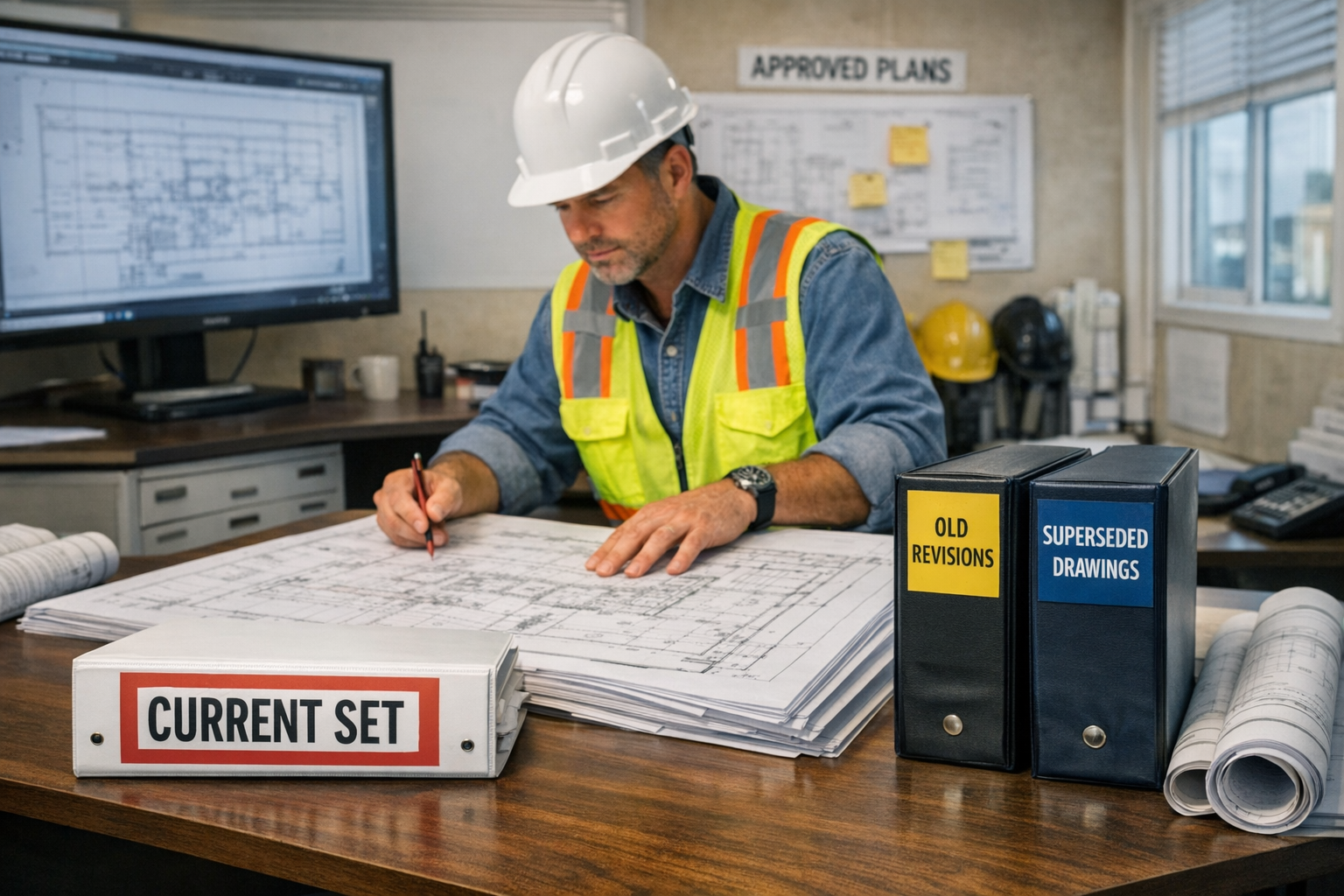
Current Set System for Your Job Trailer
A current set system is one of the simplest ways to reduce confusion on a jobsite.
Most costly drawing mistakes do not start with careless people. They start with bad handoff. One crew has one sheet. Another crew has a different one. Someone printed the latest revision, but nobody pulled the old page from the trailer set. Then a field question comes up, everyone grabs paper, and now the whole team is burning time trying to figure out what is current.
That is not a printing problem.
That is a control problem.
And on a busy project, control is everything.
If you run multiple jobs, deal with addenda late in the day, or manage crews across St. Louis, Metro East, and Southern Illinois, you already know the pressure. AEC buyers in this region are not really buying print. They are buying speed, certainty, coordination, and accountability.
A strong current set system does one thing really well.
It makes sure the right sheets are in the right place when the field needs them.
That sounds basic. It is not.
Why a Current Set System Matters
If someone walks into your trailer and asks, “Is this the current set?” there should be one answer.
Yes.
Not “I think so.”
Not “let me check the email.”
Not “hold on, I think we swapped that sheet yesterday.”
Just yes.
That kind of certainty protects more than labor. It protects reputation.
Every project manager, superintendent, and project engineer knows the feeling when revision confusion starts to creep in. You do not just worry about cost. You worry about looking unprepared in front of your owner, inspector, superintendent, or boss.
A current set system reduces that pressure.
It creates one field version that people trust.
It gives your team a repeatable way to handle revised sheets.
It lowers the odds of building from an outdated plan.
It also makes addenda, bulletins, permit corrections, and partial reprints far easier to manage.
What a Current Set System Actually Is
A current set system is not just a binder in a trailer.
It is a process.
At minimum, it should include:
- one designated field set that is recognized as the current set
- one person who owns that set
- one naming standard for revised sheets
- one method for removing superseded pages
- one place to log what changed and when
- one process for distributing updates to everyone who needs them
That is the key. One.
The more versions floating around, the more risk you create.
A current set system is the documented process used to keep the latest approved project drawings organized, visible, and verifiable at the job trailer and in the field.
If you can verify what changed, when it changed, who received it, and whether the outdated sheet came out, you are in much better shape.
If you cannot, you are relying on memory.
Memory is not a system.
Why Current Set Systems Break Down
Most breakdowns happen for the same few reasons.
Nobody owns the trailer set
When everyone assumes someone else updated the set, nobody really owns it.
That is where trouble starts.
The fastest fix is assigning one role. On some projects that is the project engineer. On others it is the superintendent, office coordinator, or lead admin supporting the team. The title matters less than the accountability.
One person owns the set.
One backup owns it when they are out.
Everybody else knows who that is.
Revised sheets arrive through too many channels
Some drawings come by email.
Some come through the project platform.
Some get texted.
Some get printed by the office.
Some get sent directly from an architect or civil engineer.
Now you have multiple possible truths.
Your current set system needs a single source of truth before anything gets printed or filed. If not, it is only a matter of time before the trailer and the office drift apart.
Teams print revised sheets but do not pull old ones
This is one of the most common failures.
A new C5.1 comes in. It gets printed. It gets clipped to the top of the set. Everyone feels like the revision was handled.
But the outdated C5.1 is still buried in the binder.
That means your trailer now contains two realities.
A real current set system includes sheet removal, not just sheet delivery.
Revisions are not marked clearly
If the rev date, revision number, or change marker is hard to spot, your field team has to stop and interpret. That is wasted time on a good day and a mistake on a bad one.
Nobody logs distribution
If updated sheets go to the trailer, office, subcontractors, and a second site, there has to be confirmation somewhere. Otherwise you end up with one location using the right page and another still building from the wrong one.
The 7-Part Current Set System I Recommend
Here is the framework I would use.
1. Create one official current set location
Pick the physical home of the set.
That might be:
- the main trailer plan rack
- a labeled binder station
- a wall rack for active sheets
- a protected drawer or cabinet near the superintendent’s desk
What matters is that everyone knows this is the official set.
Not one of the sets.
The set.
Label it clearly: CURRENT SET FOR FIELD USE.
2. Assign one current set owner
This person does not have to print the drawings.
They do have to verify the process.
Their job is to:
- confirm revised sheets were received
- confirm the right pages were printed
- remove superseded sheets
- file revised sheets in the correct order
- update the revision log
- confirm distribution to the right people
This is where many firms get better fast. Not because they bought better equipment. Because they assigned ownership.
3. Standardize sheet naming and revision labeling
Every revised sheet should be easy to identify at a glance.
Use a naming standard that includes:
- project name or job number
- sheet number
- revision number or letter
- revision date
Example:
Project 2417 – C3.2 – Rev 4 – 03-24-2026
That same structure should show up in the digital file, on the printed transmittal, and in the revision log.
4. Use a formal sheet swap process
This is the heart of the system.
When a revision comes in:
- identify affected sheets
- verify the latest approved source file
- print revised sheets only if a full reissue is not needed
- remove outdated sheets from the current set
- archive the removed sheets in a superseded file
- insert revised sheets in the right location
- update the revision log
- confirm distribution
That is the discipline that keeps your trailer clean.
5. Keep a visible revision log in the trailer
This can be simple.
A printed log sheet in the front of the binder works. A whiteboard works. A shared digital log works too, as long as the trailer team can see it fast.
Track:
- date received
- source of revision
- affected sheet numbers
- who updated the set
- who received distribution
- notes if special handling was needed
6. Separate current sheets from superseded sheets
Do not keep old sheets mixed into the live binder.
Archive them in a clearly labeled folder or box: SUPERSEDED – DO NOT BUILD FROM.
That keeps the field set clean and gives you a record if someone later needs to confirm what changed.
7. Confirm distribution beyond the trailer
A current set system does not stop at the trailer door.
You may also need current sheets at:
- a second trailer
- the office
- an estimating team
- a prefab team
- key subcontractors
- a field foreman truck set
- a plan room or wall display
The more active the job, the more important this gets.
How Wide Format Printing Supports the System
A wide format printer does not create revision control by itself.
But it can either support a clean system or make a messy one worse.
If your team is forced into full reprints for small changes, or if revised sheets are slow to output, hard to organize, or difficult to distribute, your process gets heavier every time an addendum lands.
That is why production workflow matters.
For in-house AEC environments, KIP wide format systems and Canon imagePROGRAF technical document platforms can support revision-heavy work by making sheet-level reprints, repeatable output, and scaled technical documents easier to manage. Canon’s TZ line is built around productivity and mixed technical drawing and poster output. Canon’s TX MFP platforms support scan, save, share, and print workflows for architects, engineers, construction, and GIS users.
The goal is not more technology.
The goal is fewer mistakes.
Where KIP Digital Displays Fit
A printed current set still matters. That is not going away for active field use any time soon.
But a digital review station can strengthen the system.
Think about what usually happens before revised sheets hit the binder:
- coordination meeting
- plan review
- markup discussion
- owner or inspector clarification
- discipline check
- visual walk-through with field leadership
That is where KIP Digital Displays fit well.
They support tabletop review, plan desk collaboration, digital markups, synced updates, and shared visual coordination. In practice, that gives teams a way to review markups, confirm changes, and align people before the revised paper set gets inserted into the trailer binder.
That is the right way to think about digital displays in AEC.
Not as a replacement for every printed sheet.
As a coordination tool that helps your printed current set stay cleaner.
What a Good Current Set System Looks Like in Real Life
Here is what good feels like on a real project.
The addendum comes in late.
The affected sheets are identified fast.
Only the changed sheets get printed.
The current set owner swaps out the outdated pages.
The revision log gets updated.
The superintendent sees the rev date clearly.
The second site gets its copy.
The office gets confirmation.
Nobody wonders what is current the next morning.
That is what your buyer actually wants.
Not a speech.
Not a product pitch.
Just a clean process.
Questions to Ask if Your Current Set System Feels Loose
If your firm is not sure whether its trailer process is solid, start here:
- Who owns the current set right now?
- Where is the official field set kept?
- How do we confirm which file is the latest approved version?
- Do we remove outdated sheets every time?
- Where do superseded sheets go?
- How do we log revisions?
- Who confirms that other sites and subs received updated sheets?
- Are we reprinting full sets when only a few sheets changed?
- Can our current print workflow handle sheet swaps cleanly?
- Do we have a better way to review markups before paper gets redistributed?
If those questions are hard to answer, the system needs tightening.
A Simple Current Set Checklist
- Official current set location defined
- Current set owner assigned
- Backup owner assigned
- Revision naming standard documented
- Rev date clearly visible on printed sheets
- Sheet swap process documented
- Superseded sheet archive location labeled
- Revision log active in trailer
- Distribution confirmation process in place
- Office and field using the same source of truth
- Sheet-level reprint workflow available
- Print and digital review tools aligned to the process
Why This Matters for St. Louis and Southern Illinois AEC Teams
In quieter markets, some firms can limp along with informal habits for a long time.
This market is not built for that.
St. Louis and Southern Illinois stay active with public work, corridor pressure, permit packages, utility coordination, and civil-heavy documentation. That means more updates, more stakeholders, more opportunities for version confusion, and less margin for sloppy handoff.
So if you want one improvement that lowers stress fast, start with the current set.
Not because it is flashy.
Because it works.
Frequently Asked Questions About a Current Set System
What is a current set in construction?
A current set is the latest approved collection of project drawings that field teams should rely on for active work. It should be clearly identified, regularly updated, and separated from superseded sheets.
Who should own the current set at the trailer?
Most firms assign ownership to a project engineer, superintendent, or office coordinator. The important part is clear accountability, not the job title.
Should teams reprint full sets every time a drawing changes?
Not always. Many revisions can be handled with sheet-level reprints if the firm has a disciplined sheet swap process and clear revision controls.
How do digital displays help with revision control?
Digital displays can support markup review, coordination meetings, and shared visual collaboration before updated paper sheets are redistributed. They help reduce confusion earlier in the workflow.
Final Thoughts
A current set system is not paperwork.
It is jobsite protection.
It protects the schedule.
It protects the budget.
It protects credibility.
It protects your field team from working off the wrong page.
When revision pressure is high, the answer is not more scrambling. It is more structure.
The firms that handle this best are not always the biggest. They are usually the ones with the clearest process.
One owner.
One official set.
One log.
One swap process.
No guessing.
That is how you keep the trailer current.
That is how you keep the field covered.
If your AEC team in St. Louis, Columbia, or Southern Illinois is tightening up revision control and looking for a better way to support your trailer workflow, Da-Com can help with wide format solutions, managed print services, and practical AEC document workflows built around real construction pressure. To talk through your current process and where it is breaking down, contact Da-Com today.


Leave A Comment