
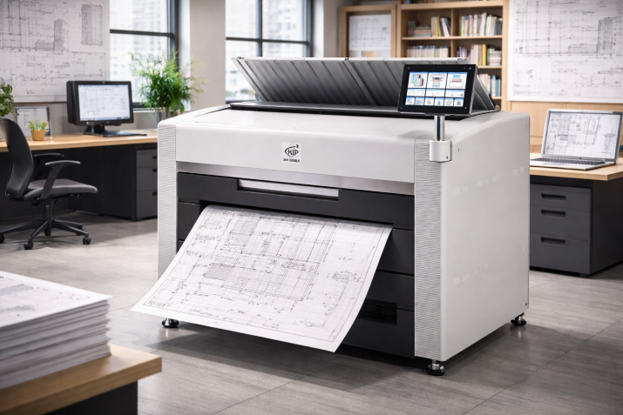
Why Large Format Printing Still Matters in AEC
KIP Large Format Printers are widely recognized in the architecture, engineering, and construction industry for their reliability and production capabilities.
While digital collaboration tools such as BIM, Bluebeam, and cloud-based document management platforms continue to evolve, wide format printing remains deeply embedded in construction workflows. Field coordination meetings, permit submissions, bid packages, addenda distribution, and record drawing sets still rely heavily on printed plans.
In infrastructure-heavy regions such as St. Louis and Southern Illinois, transportation projects, municipal capital improvements, and corridor development remain active . That activity generates extensive documentation and frequent revision cycles.
For AEC firms operating in this environment, wide format equipment is not just an office convenience. It is a production tool that directly impacts speed, accuracy, and coordination.
This article examines why KIP Large Format Printers are often considered a strong fit for AEC firms and how they align with construction-specific requirements.
The Role of Large Format Printing in Modern Construction Workflows
Despite increased digitization, construction remains a hybrid environment.
Wide format documents are routinely used for:
- 24×36 and 36×48 construction plan sets
- Bid packages and addenda
- Civil, structural, architectural, and MEP drawings
- Site logistics and phasing plans
- Traffic control drawings
- Permit exhibits and agency submissions
- As-built and record drawings
- Public meeting and stakeholder presentation boards
Industry reporting continues to reflect strong infrastructure investment activity in the bi-state region . These projects generate significant documentation volume and revision activity.
Even with tablets and digital markup tools available on job sites, large-scale printed drawings remain essential for:
- Group coordination meetings
- Superintendent field use
- Visual plan review
- Wall-mounted reference sets
- Inspector and agency review
As a result, production-level wide format equipment remains a critical operational asset.
What AEC Firms Require From a Wide Format Printer
When evaluating equipment, AEC firms typically prioritize operational reliability over aesthetic features.
Key requirements often include:
-
Accurate Scaling and Line Clarity
Construction drawings must print precisely to scale. Line weight clarity is critical for legibility in both field and office environments.
-
High-Volume Output
Mid-size general contractors and engineering firms may manage multiple concurrent projects, requiring consistent daily output of large plan sets and partial revisions.
-
Fast First-Page-Out Speed
When addenda are issued late in the day, the ability to begin printing immediately matters.
-
Multi-User Accessibility
Estimating teams, project managers, and administrative staff may all access the device during peak periods.
-
Partial Set and Sheet-Level Printing
Reprinting entire plan sets due to minor revisions increases cost and waste. Efficient sheet-level reprints reduce overhead and improve revision control.
KIP Large Format Printers are designed specifically for high-speed monochrome production environments. That design aligns closely with the predominant needs of construction plan printing.
Why Monochrome Production Remains Dominant
Although color wide format devices have a place in presentation and marketing applications, the majority of construction documentation remains monochrome.
Civil and structural drawings, mechanical and electrical plans, and bid packages typically prioritize:
- Line accuracy
- Clarity
- Efficiency
- Cost control
High-speed monochrome production systems such as KIP devices offer advantages including:
- Lower cost per print
- Faster output speeds
- Consistent line reproduction
- Reduced toner complexity
For firms producing significant monthly plan volumes, these operational efficiencies contribute to measurable cost savings.
Managing Revision Cycles More Effectively
One of the most significant risks in construction is working from outdated documentation.
Revision cycles often include:
- RFIs
- ASIs
- Bulletins
- Addenda
- Permit corrections
- Sheet swaps
When revision velocity increases, particularly in infrastructure-heavy regions , the ability to manage document updates efficiently becomes critical.
Production-grade wide format systems support:
- Fast partial reprints
- High-capacity stacking for organized distribution
- Clear sheet labeling and indexing
- Multi-copy distribution without slowing workflow
By enabling quick sheet-level updates rather than full-set reproduction, firms can reduce waste while maintaining revision accuracy.
Supporting Cost Control and Accountability
In addition to operational reliability, AEC firms increasingly seek visibility into printing costs.
National architecture billing cycles have experienced periods of softening , which can heighten cost sensitivity and vendor consolidation efforts.
In-house production systems such as KIP Large Format Printers can provide:
- Usage tracking
- Department-level reporting
- Project-based allocation
- Cost-per-sheet analysis
This data allows accounting and operations teams to allocate printing expenses accurately to specific jobs or departments.
Clear cost visibility contributes to improved project margin tracking and financial predictability.
In-House Production vs. Outsourced Printing
AEC firms typically evaluate wide format solutions within three models:
- Fully outsourced printing
- Fully in-house production
- Hybrid environments that combine both approaches
KIP systems are commonly implemented in:
- Mid-size general contractor offices
- Civil engineering firms
- Transportation design firms
- Municipal architecture practices
In-house production offers:
- Immediate turnaround capability
- Greater control over revision cycles
- Reduced dependency on third-party cutoffs
- Internal coordination flexibility
However, successful implementation depends on reliable service support, preventative maintenance, and supply management.
Without strong service infrastructure, in-house equipment can introduce operational risk rather than reduce it.
Evaluating Service and Support Considerations
When assessing a wide format solution, hardware specifications represent only part of the decision.
Service considerations should include:
- Guaranteed response times
- Preventative maintenance schedules
- Toner and supply automation
- On-site training
- Workflow configuration support
In a region with ongoing transportation and municipal development activity , downtime during peak construction season can impact productivity.
Local service availability and consistent maintenance protocols are critical components of a successful deployment.
Ideal Use Cases for KIP Large Format Printers
Based on industry application, KIP systems are particularly well suited for:
- General contractors managing multiple active jobs
- Civil engineering firms producing high-volume plan sets
- Infrastructure design firms
- Survey and land development practices
- Municipal and institutional architecture firms
These organizations typically require:
- Daily plan production
- Frequent revision updates
- Multi-set distribution
- Reliable, repeatable output
For firms with moderate to high monthly wide format volume, production-oriented monochrome systems often deliver better long-term efficiency than entry-level plotters.
Key Questions to Ask Before Investing
AEC leaders evaluating wide format equipment should consider the following:
- What is our average monthly plan volume?
- How often do we reprint partial sets?
- How many concurrent users require access?
- Do we need project-based cost tracking?
- What level of service response do we require?
- How does this integrate with our digital document workflow?
These questions ensure the solution aligns with operational needs rather than focusing solely on equipment features.
Conclusion: Wide Format as Operational Infrastructure
Wide format printing remains a foundational component of construction operations.
In active infrastructure regions such as St. Louis and Southern Illinois , project pipelines continue to generate high documentation volume.
KIP Large Format Printers are designed specifically for high-volume monochrome environments common in AEC firms.
When supported by strong service infrastructure and aligned with structured workflows, they can improve:
- Revision management
- Speed under deadline pressure
- Cost visibility
- Operational consistency
For AEC organizations evaluating wide format upgrades, the decision should focus on production reliability, workflow integration, and long-term service support.
If your AEC firm is evaluating wide format production equipment, Da-Com provides wide format printing solutions, managed print services, and local support throughout St. Louis, Columbia, and Southern Illinois.
To discuss your wide format needs or schedule a consultation, contact Da-Com today.




Leave A Comment