
AI Cybersecurity Threats 2026: What Small Businesses Need to Know
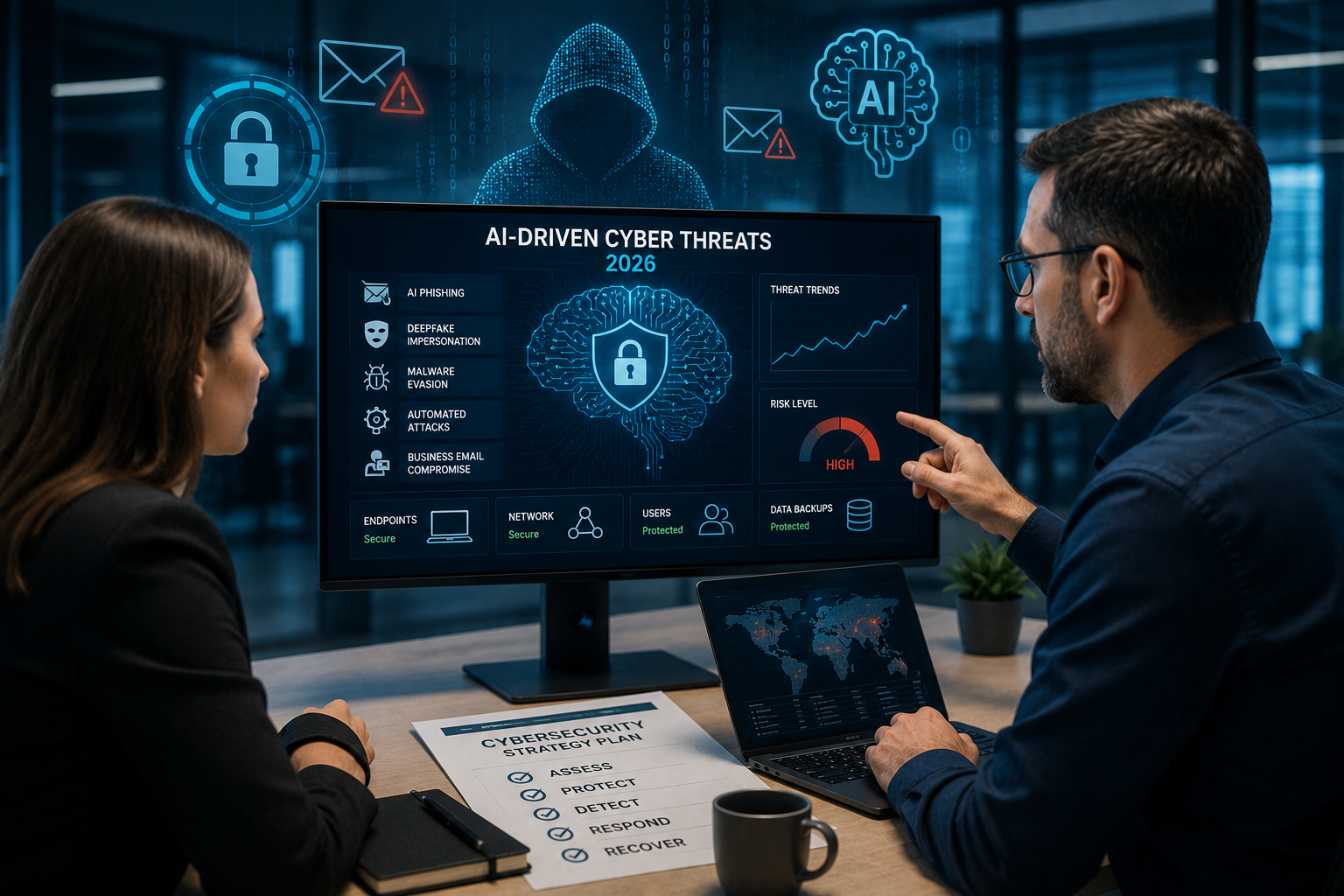
AI cybersecurity threats 2026 are changing the way small and midsize businesses need to think about risk. Cybersecurity threats have always evolved, but artificial intelligence is making attacks faster, more convincing, more personalized, and easier to scale. That means businesses can no longer rely on old warning signs like obvious typos, strange formatting, or messages that “just look fake.”
For years, many small businesses assumed they were too small to be targeted. That assumption is risky. Attackers do not always care about company size. They care about which businesses have weak defenses, distracted employees, exposed systems, poor password habits, missing updates, untested backups, or no clear incident response plan.
Artificial intelligence does not replace traditional cybercrime. It amplifies it. Phishing emails can sound more natural. Vendor impersonation can look more believable. Social engineering can be more personalized. Malware can be modified faster. Reconnaissance can be automated. Attackers can create more attempts with less effort.
For businesses in St. Louis, St. Charles, Chesterfield, Clayton, the Metro East, Belleville, Edwardsville, Collinsville, and Southern Illinois, the response should not be panic. The response should be stronger fundamentals, better visibility, updated employee training, layered security, reliable backups, and a clear plan for what happens if something goes wrong.
This guide explains what has changed, why small businesses are still a target, which AI-driven threats matter most, and what practical cybersecurity steps businesses should take in 2026.
Quick Answer: What Are AI Cybersecurity Threats in 2026?
AI cybersecurity threats 2026 are cyber risks that use artificial intelligence to make attacks faster, more believable, more targeted, or easier to automate. These threats may include AI-written phishing emails, business email compromise, deepfake voice or video impersonation, automated reconnaissance, faster malware variation, password attacks, vendor impersonation, and social engineering that uses publicly available information about a company or employee.
AI cybersecurity threats in 2026 can affect small businesses because AI makes it easier for attackers to:
- Create professional, error-free phishing emails.
- Personalize messages using public company information.
- Impersonate vendors, executives, clients, or coworkers.
- Generate more convincing fake invoices or payment requests.
- Automate research on employees and business relationships.
- Modify malware or scripts faster.
- Scale attacks against more companies at once.
- Use voice or video impersonation in social engineering attempts.
The best defense is not one single tool. Businesses need a layered approach that includes employee training, email security, endpoint protection, multi-factor authentication, patching, backups, network monitoring, access control, and incident response planning.
Da-Com IT Pros provides cybersecurity services for businesses that need practical protection, monitoring, employee risk reduction, backup alignment, and support from a local technology partner.
What Has Changed About Cybersecurity in 2026?
The biggest change is not that cybercriminals suddenly have brand-new goals. The goals are familiar: steal money, steal credentials, access systems, impersonate trusted people, lock files, pressure victims, and exploit weak defenses. What has changed is how easily attackers can make those attempts look real.
AI can help attackers create polished messages, summarize public information, imitate tone, test variations, and scale outreach. That makes it harder for employees to rely on quick visual clues.
In the past, employees were often told to look for:
- Typos.
- Awkward wording.
- Strange formatting.
- Generic greetings.
- Obvious fake email addresses.
Those clues still matter, but they are no longer enough. AI-written phishing attempts may be grammatically clean, specific to the business, and written in a tone that sounds familiar. An email may appear to reference a real vendor, an actual employee, a recent company event, or a believable invoice process.
NIST’s phishing guidance notes that artificial intelligence can be used to craft increasingly convincing phishing attacks, which makes it more important to take extra care with messages that ask users to click links, download files, transfer funds, log into accounts, or submit sensitive information. You can review the NIST resource here: NIST Small Business Cybersecurity: Phishing.
That shift means cybersecurity training and business policies need to change. Employees should not only ask, “Does this email look suspicious?” They should also ask, “Is this request expected, verified, and consistent with our process?”
AI Phishing Attacks Are Harder to Spot
Phishing is still one of the biggest risks for small and midsize businesses. AI makes phishing more dangerous because it can remove many of the warning signs employees were trained to notice.
An AI-assisted phishing email may:
- Use polished business language.
- Reference a real vendor or client.
- Imitate a leadership tone.
- Match a company’s industry or workflow.
- Avoid obvious grammar mistakes.
- Create urgency without sounding sloppy.
- Generate many variations to avoid detection.
- Personalize messages for different employees.
For example, an employee may receive an email that appears to come from a vendor asking for an updated payment method. The message may be written clearly, use the right terminology, reference a real project, and include a professional-looking signature. The danger is that nothing about it feels obviously fake.
The Federal Trade Commission warns that phishing messages may appear to come from a familiar source, such as a vendor, client, coworker, or company leader. The FTC recommends confirming requests through a known phone number rather than using contact information inside the suspicious message. You can review the FTC resource here: FTC Cybersecurity for Small Business.
That verification step matters more in 2026. The more believable phishing becomes, the more businesses need clear internal rules for payment changes, password requests, sensitive data sharing, and urgent executive requests.
Business Email Compromise Gets More Convincing
Business email compromise, often called BEC, is one of the most damaging forms of social engineering. In a BEC attack, a criminal impersonates a trusted person or organization to trick the business into sending money, changing payment details, sharing sensitive information, or approving a fraudulent request.
AI can make BEC attempts more convincing by helping attackers:
- Research company leadership.
- Identify vendors and clients.
- Write messages in a believable tone.
- Create fake invoice language.
- Personalize requests to job roles.
- Draft follow-up messages quickly.
- Remove obvious spelling and grammar mistakes.
Small businesses may be especially vulnerable because many do not have formal payment verification procedures. If employees are used to handling requests quickly by email, an attacker may only need one convincing message to create a major financial loss.
To reduce business email compromise risk, businesses should create internal verification policies for:
- New vendor payment details.
- Bank account changes.
- Wire transfer requests.
- ACH updates.
- Executive requests for gift cards or urgent payments.
- Password or access requests.
- Requests to share payroll, W-2, or employee information.
The rule should be simple: sensitive requests must be verified outside the email thread using a known, trusted phone number or approved process.
Deepfake Voice and Video Raise the Stakes
AI-generated voice and video tools are creating new risks for businesses. Deepfakes do not need to be perfect to be effective. They only need to be convincing enough in the moment, especially if the request is urgent, emotional, or appears to come from a leader.
Possible deepfake-related risks include:
- A fake voice message from an executive approving a payment.
- A spoofed phone call asking for credentials.
- A video impersonation used during a meeting or call.
- A fake voicemail requesting a confidential document.
- A social engineering attempt that combines email and voice.
Small businesses should not assume this only affects large enterprises. AI tools lower the cost of impersonation. A short public video, podcast clip, webinar recording, or social media post may provide enough material for an attacker to imitate a person’s voice or style.
The defense is process, not paranoia. Employees should be trained to verify unusual requests, especially when money, credentials, access, or sensitive data are involved.
Good verification habits include:
- Calling back using a known number.
- Using a pre-approved payment change process.
- Requiring two-person approval for financial changes.
- Using code words or internal verification steps for urgent requests.
- Documenting approvals inside approved systems, not only email.
AI Makes Attacks More Targeted, Not Just More Frequent
Older phishing campaigns often relied on volume. Attackers sent the same generic message to thousands of people and waited for someone to click. Those attacks still happen, but AI makes it easier to create more targeted attempts at scale.
Attackers can use public information from websites, LinkedIn, social media, press releases, job postings, vendor pages, and public records to make messages more believable.
An AI-assisted attacker may identify:
- Who handles accounting.
- Who approves purchases.
- Who manages IT.
- Who works with vendors.
- What software the company may use.
- Which locations the company serves.
- Which executives are public-facing.
- Which employees recently changed jobs.
- Which events, projects, or partnerships are public.
That information can be used to create a message that feels specific. For example, a fake vendor email may mention a real department. A fake HR message may reference a real employee role. A fake Microsoft 365 login alert may be sent to a user who actually uses Microsoft 365 every day.
This is why cybersecurity awareness training needs to move beyond “spot the typo.” Employees need to understand how social engineering works and why believable requests can still be fraudulent.
Malware and Ransomware Are Still Serious Risks
AI can help attackers work faster, but the most damaging outcomes remain familiar: ransomware, malware, credential theft, data exposure, and business disruption.
Ransomware can begin with a phishing email, stolen password, unpatched system, exposed remote access tool, or compromised vendor. Once inside, attackers may attempt to encrypt files, steal data, pressure the business, or disrupt operations.
The FTC notes that ransomware can start with phishing emails, malicious attachments, exploited vulnerabilities, infected websites, online ads, or exposed remote access tools. It recommends keeping security up to date, backing up important files, training staff, and having a plan to keep the business operating after an attack. You can review the FTC resource here: FTC Cybersecurity for Small Business.
For small businesses, ransomware planning should include:
- Endpoint protection.
- Email security.
- Patch management.
- Multi-factor authentication.
- Backup monitoring.
- Off-network or protected backups.
- Incident response planning.
- Employee reporting procedures.
- Vendor and cyber insurance contacts.
Da-Com’s guide to backup and continuity planning explains why businesses need recovery strategies that account for downtime, data loss, system availability, and operational disruption before an incident occurs.
Why Small Businesses Are Still a Target
Small businesses sometimes believe attackers only want large companies. That is not how modern cybercrime works. Automated tools allow attackers to scan, test, and target many organizations at once. They may not care whether a company is large or small. They care whether it is vulnerable.
Small businesses may be targeted because they often have:
- Limited internal IT resources.
- Employees with multiple responsibilities.
- Less formal approval processes.
- Older systems or unpatched software.
- Weak password habits.
- No dedicated security team.
- Backups that are not regularly tested.
- Limited network monitoring.
- Little cybersecurity awareness training.
- Vendor access that is not closely reviewed.
CISA provides cyber guidance for small businesses and encourages organizations to use practical steps to reduce risk and improve resilience. You can review the resource here: CISA Cyber Guidance for Small Businesses.
The good news is that small businesses do not need to solve every cybersecurity problem at once. They need to prioritize the right fundamentals and improve consistently.
Employee Training Needs to Change in 2026
Employee awareness training still matters, but it needs to reflect the reality of AI-driven attacks. Training that only says “look for spelling mistakes” is outdated. Employees need to know that modern phishing may look clean, professional, and specific.
Cybersecurity awareness training in 2026 should teach employees to watch for:
- Unexpected requests.
- Pressure to act quickly.
- Requests to bypass normal procedures.
- Payment changes.
- Password or MFA code requests.
- Links to login pages.
- Attachments they were not expecting.
- Requests for sensitive company or employee information.
- Messages that appear to come from executives but feel unusual.
- Vendor requests that cannot be verified through known channels.
Training should also explain what employees should do when they are unsure. A good training program gives employees permission to slow down, ask questions, and report suspicious messages without embarrassment.
Businesses should create a culture where reporting is encouraged. If one employee receives a phishing email, others may receive it too. Fast reporting helps the business respond before more people click.
Layered Security Matters More Than Any Single Tool
No single cybersecurity tool catches everything. AI cybersecurity threats in 2026 make layered security even more important because attacks can arrive through email, web links, attachments, remote access, stolen credentials, vendor accounts, exposed systems, or social engineering.
A layered security approach may include:
- Email filtering.
- Endpoint detection and protection.
- Multi-factor authentication.
- Firewall management.
- Patch management.
- Network monitoring.
- Backup monitoring.
- Security awareness training.
- Access control.
- Vendor risk review.
- Incident response planning.
The National Institute of Standards and Technology Cybersecurity Framework helps organizations understand and improve how they manage cybersecurity risk. You can review the framework here: NIST Cybersecurity Framework.
Da-Com’s guide to proactive IT monitoring explains how monitoring server health, backups, network performance, patch status, and security alerts can help businesses catch warning signs before they turn into downtime or larger risk.
Patch and Update on a Real Schedule
AI-assisted attacks can help criminals find and exploit known vulnerabilities faster. That makes patching and updates more important, not less.
Businesses should have a clear process for updating:
- Operating systems.
- Web browsers.
- Business applications.
- Security tools.
- Firewalls.
- Firmware.
- Remote access tools.
- Servers.
- Endpoints.
The challenge is that patching cannot be random. Updates should be planned, tested when needed, and scheduled around business operations. For manufacturers, healthcare offices, professional services, and other time-sensitive businesses, maintenance windows matter.
Da-Com’s guide to managed network services explains how network monitoring, firewall management, Wi-Fi support, internet failover planning, and reporting can help businesses reduce surprise outages and improve visibility.
Incident Response Planning Before You Need It
One of the biggest differences between a stressful cyber incident and a controlled response is planning. Businesses that recover faster usually know who to call, what to shut down, what systems matter most, where backups are, who communicates with employees, and what outside resources are involved.
An incident response plan should answer:
- Who is responsible for cybersecurity decisions during an incident?
- Who should employees contact if they suspect phishing or compromise?
- Who handles IT containment?
- Who contacts cyber insurance?
- Who contacts legal counsel if needed?
- Who communicates with employees?
- Who communicates with customers or vendors if needed?
- Which systems are most critical to restore?
- Where are backups stored?
- How are backups tested?
- What is the process for resetting credentials?
An incident response plan does not need to be overly complicated, but it should be written, reviewed, and understood before an emergency happens.
Signs Your Business May Be Unprepared for AI Cybersecurity Threats
Your business may need a cybersecurity review if any of the following sound familiar:
- Employees have not received updated phishing training.
- MFA is not used everywhere it should be.
- Backups are assumed to work but not regularly tested.
- Security patches are handled inconsistently.
- There is no written incident response plan.
- Leadership is unsure what cybersecurity tools are active.
- Employees do not know how to report suspicious emails.
- Vendor payment changes are handled by email alone.
- Remote access tools have not been reviewed.
- Cyber insurance requirements feel confusing.
- No one is monitoring network or endpoint alerts.
- There has not been an outside cybersecurity assessment.
If several of these apply, the business does not need panic. It needs prioritization. An outside cybersecurity assessment can help identify the most important gaps and create a practical improvement plan.
What Businesses Should Do About AI Cybersecurity Threats in 2026
AI cybersecurity threats in 2026 are serious, but the defense does not have to be mysterious. The fundamentals still matter. The difference is that skipping them has become riskier.
Practical next steps include:
- Update employee awareness training for AI-generated phishing.
- Use multi-factor authentication wherever possible.
- Create verification policies for payment changes and sensitive requests.
- Review email security settings.
- Keep systems patched and updated.
- Monitor endpoints, backups, networks, and security alerts.
- Protect backups from ransomware risk.
- Review remote access and vendor access.
- Create or update an incident response plan.
- Run a cybersecurity assessment to identify blind spots.
Da-Com IT Pros can help businesses evaluate current protections, identify gaps, improve monitoring, strengthen backup and recovery planning, update employee security practices, and create a cybersecurity strategy that fits the size and risk level of the organization.
Common Mistakes Businesses Make With AI Cybersecurity
Assuming AI Threats Only Affect Large Companies
AI lowers the cost of creating convincing attacks. Smaller businesses can still be targeted, especially if defenses are weaker.
Relying Only on Employee Judgment
Training matters, but employees should not be the only defense. Email security, MFA, endpoint protection, monitoring, and policies provide additional layers.
Skipping Verification Procedures
If payment changes, wire requests, or sensitive data requests can be approved by email alone, the business is exposed.
Assuming Backups Are Working
Backups should be monitored and tested. A backup that fails silently may not help during ransomware, deletion, or system failure.
Waiting Until After an Incident to Make a Plan
Incident response planning should happen before a breach, not during one.
Frequently Asked Questions About AI Cybersecurity Threats 2026
What are AI cybersecurity threats in 2026?
AI cybersecurity threats in 2026 are cyber risks that use artificial intelligence to make attacks more convincing, targeted, scalable, or automated. Examples include AI-written phishing, vendor impersonation, business email compromise, deepfake voice scams, faster malware variation, and automated reconnaissance.
How does AI make phishing more dangerous?
AI can help attackers write polished, personalized phishing emails without obvious spelling or grammar mistakes. That makes phishing harder for employees to identify based only on appearance.
Are small businesses really targeted by AI cyberattacks?
Yes. Small businesses can be targeted because attackers often look for weak defenses, not just large companies. Automated tools make it easier to test many businesses at once.
What is the best defense against AI phishing?
The best defense is layered. Businesses should combine employee training, email filtering, multi-factor authentication, verification policies, endpoint protection, patching, monitoring, and clear reporting procedures.
Do businesses need new cybersecurity tools because of AI?
Some businesses may need stronger tools, but the first step is usually reviewing the basics: MFA, patching, email security, backups, endpoint protection, monitoring, access control, and incident response planning.
How should employee training change in 2026?
Training should teach employees that phishing may now look polished and legitimate. Employees should verify unexpected requests, be cautious with links and attachments, and report suspicious messages quickly.
Can AI create fake voice or video scams?
Yes. AI-generated voice and video can be used for impersonation. Businesses should verify unusual requests involving money, access, credentials, or sensitive information through approved channels.
What should a small business do first?
Start with a cybersecurity assessment. Then prioritize MFA, patching, backups, email security, employee training, monitoring, verification policies, and incident response planning.
The Bottom Line: AI Raises the Cost of Skipping the Basics
AI has not changed the fundamentals of good cybersecurity. It has made them more urgent.
Phishing, ransomware, business email compromise, impersonation, malware, and credential theft are not new. What is new is how easily attackers can make those attempts look professional, personal, and believable. That means small and midsize businesses need to take cybersecurity basics seriously in 2026.
The best response is practical and layered: train employees, verify sensitive requests, use MFA, patch systems, monitor networks and endpoints, protect backups, review access, and create an incident response plan before something goes wrong.
To learn more about AI cybersecurity threats 2026 and how to strengthen protection for your St. Louis, St. Charles, Chesterfield, Clayton, Metro East, Belleville, Edwardsville, Collinsville, or Southern Illinois business, contact Da-Com today. Da-Com IT Pros can help you assess your current security posture, identify gaps, prioritize improvements, and build a cybersecurity plan that keeps pace with modern threats.




Leave A Comment