
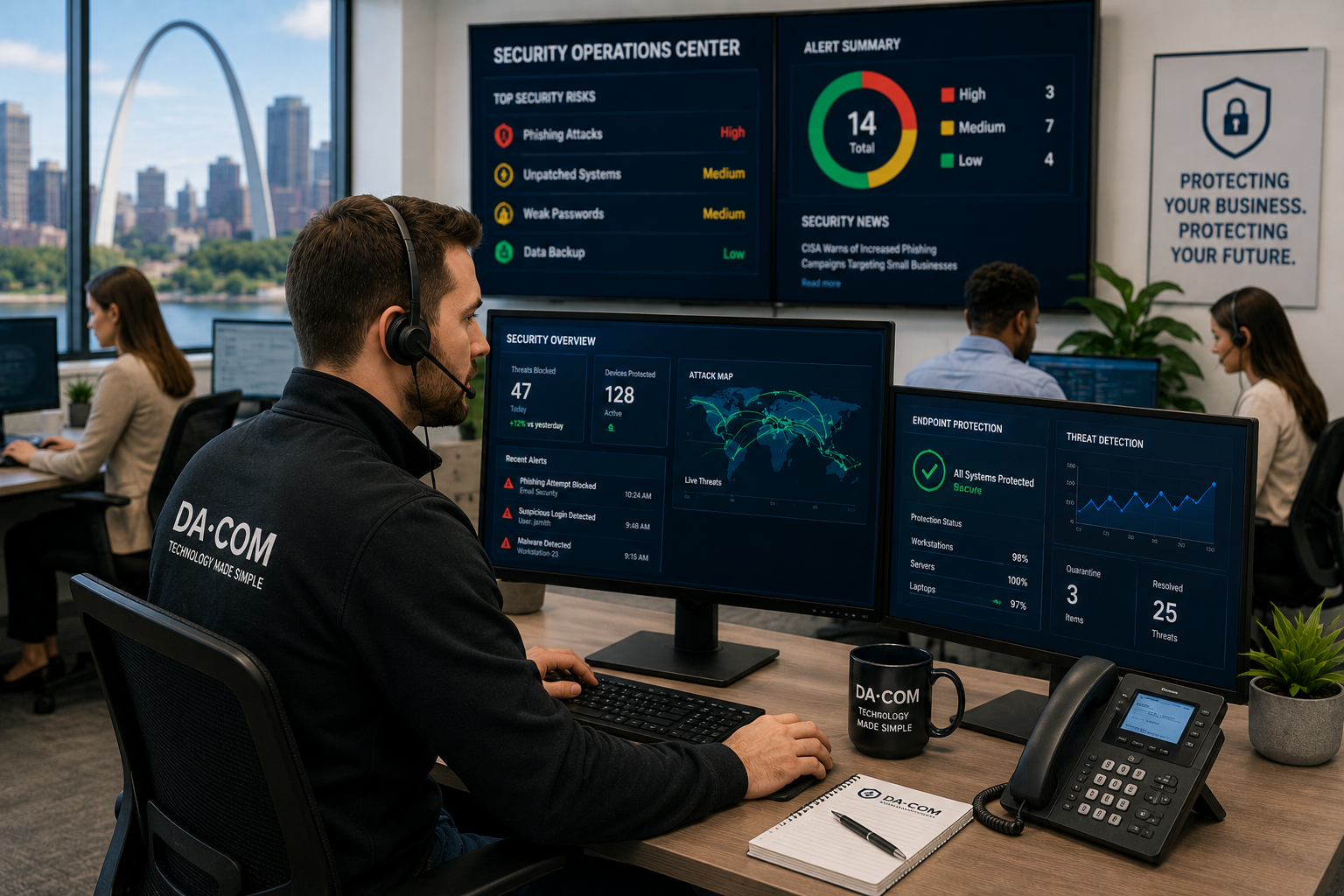
Cybersecurity Support St. Louis: Small Business Guide
Cybersecurity Support St. Louis businesses rely on should do more than install antivirus software and hope for the best. Small businesses need practical protection for their networks, employee devices, email systems, cloud applications, passwords, backups, sensitive data, and daily operations.
Many small business owners and office leaders still wonder whether they are really a target. They may think cybercriminals only care about large corporations, healthcare systems, banks, or government agencies. Unfortunately, small and midsize businesses are often attractive targets because they may have valuable information, busy employees, limited IT resources, and fewer dedicated cybersecurity experts.
A cyberattack can quickly become more than a technology problem. Employees may lose access to files. Invoices may stop processing. Customer data may be exposed. Email accounts may be compromised. Operations may slow down. Leaders may face difficult questions from customers, vendors, insurance providers, and internal teams.
That is why cybersecurity support is now a business continuity issue, not just an IT issue.
For small businesses across St. Louis, St. Charles, Clayton, Chesterfield, Columbia, the Metro East, Belleville, Edwardsville, Collinsville, and Southern Illinois, the right local cybersecurity provider can help reduce risk, improve preparedness, strengthen employee awareness, and respond faster when something suspicious happens.
This guide explains what cybersecurity support includes, why small businesses need it, which threats to watch for, how managed IT and cybersecurity work together, and what to look for in a local cybersecurity company.
Quick Answer: What Is Cybersecurity Support?
Cybersecurity support helps small businesses monitor, protect, and secure technology systems against cyber threats. It can include threat monitoring, endpoint protection, email security, backup and recovery, employee awareness training, cybersecurity consulting, risk reviews, incident response planning, and managed IT support.
The best cybersecurity providers combine practical tools with clear guidance. They help small businesses understand their risks, prioritize improvements, detect threats earlier, and recover faster if an incident occurs.
Strong cybersecurity support may include:
- Cybersecurity risk assessment.
- Endpoint protection for computers and servers.
- Email security and phishing protection.
- Multi-factor authentication guidance.
- Security awareness training.
- Data backup and recovery planning.
- Dark web or credential monitoring.
- Patch management.
- Cloud security support.
- Incident response planning.
- Business continuity planning.
- Managed IT and cybersecurity support.
The goal is not perfection. No provider can promise that a business will never face a cyber threat. The goal is resilience: reduce risk, detect problems early, limit damage, and help the business keep operating with more confidence.
Da-Com’s cybersecurity for SMBs guide explains why small and midsize businesses need layered protection, including monitoring, endpoint security, email protection, patching, and incident response planning.
Why Small Businesses Need Cybersecurity Support St. Louis Providers Can Deliver Locally
Small businesses often run lean. The same person may manage operations, vendors, office technology, invoices, employee questions, and customer deadlines. Cybersecurity can feel like one more complicated responsibility competing for attention.
That is exactly why local cybersecurity support matters.
Small businesses may not have:
- A full-time cybersecurity specialist.
- A dedicated internal IT team.
- Formal incident response procedures.
- Regular security training.
- Tested data backups.
- Clear user access controls.
- Advanced monitoring tools.
- Documented recovery plans.
That does not mean the business is careless. It means cybersecurity has become more complex than most small teams can manage alone.
Cybersecurity Support St. Louis businesses use should help close that gap. A local provider can help monitor systems, support employees, explain risk in plain language, and provide practical recommendations based on the company’s size, industry, budget, and compliance needs.
CISA notes that small businesses have valuable information cyber criminals seek and often have fewer resources dedicated to cybersecurity. That combination makes small and midsize businesses important targets and important parts of the broader supply chain. You can review CISA’s small and medium business resource here: CISA Small and Medium Businesses.
Cybersecurity Is About More Than Technology
When people hear the word cybersecurity, they often think about firewalls, antivirus software, passwords, and technical alerts. Those tools matter, but cybersecurity is really about protecting the business.
Cybersecurity helps protect:
- Business operations.
- Employee productivity.
- Customer information.
- Financial data.
- Vendor relationships.
- Confidential files.
- Business continuity.
- Compliance obligations.
- Revenue.
- Reputation.
A cyberattack is rarely isolated to the IT department. It can affect accounting, sales, customer service, HR, production, leadership, and operations. That is why cybersecurity support should be discussed in business terms, not only technical terms.
For example, a phishing email may look like a simple inbox problem. But if an employee enters their password into a fake login page, attackers may gain access to email, invoices, file sharing tools, customer communication, or payment instructions.
A ransomware attack may begin with one infected device. But it can quickly affect shared files, operations, customer service, and recovery costs.
A weak backup plan may not seem urgent until files are deleted, encrypted, or unavailable.
The best cybersecurity support helps leaders understand these risks before they become emergencies.
What Happens When a Cyberattack Impacts a Small Business?
The effects of a cyberattack can move quickly. A business may start with one suspicious email, one compromised password, one infected device, or one unusual login attempt. Then the issue can spread into a larger operational problem.
Common impacts include:
- Employees lose access to files or systems.
- Email accounts are compromised.
- Customer information becomes unavailable or exposed.
- Invoices stop processing.
- Payments are delayed or misdirected.
- Operations slow down.
- Leaders have to notify customers, vendors, or insurance providers.
- Internal teams lose confidence in technology systems.
- Recovery becomes stressful and expensive.
Even a short disruption can create significant stress for organizations already managing busy workloads.
This is why preparation matters. Cybersecurity Support St. Louis businesses choose should focus on prevention, monitoring, response, and recovery. The provider should help answer practical questions before an incident occurs.
Questions such as:
- Who responds if something suspicious happens?
- Are our backups working?
- How quickly could we recover files?
- Which employees have access to sensitive data?
- Are email accounts protected with multi-factor authentication?
- Have employees been trained to spot phishing?
- Do we know which devices are connected to our network?
- Do we have a written response plan?
When those answers are unclear, the uncertainty itself is a warning sign.
Common Cybersecurity Threats Facing St. Louis Small Businesses
Cyber threats continue evolving, but several risks remain especially common for small businesses.
Phishing Emails
Phishing emails are designed to trick employees into clicking links, opening attachments, entering passwords, or approving fraudulent requests. These messages may look like they come from a bank, vendor, coworker, delivery service, payroll platform, Microsoft 365 login page, or executive.
A single click can lead to credential theft, malware infections, payment fraud, or unauthorized access.
Ransomware
Ransomware attacks encrypt company files and demand payment. Without reliable backups and a recovery plan, recovery can become difficult and expensive.
Ransomware can affect shared drives, servers, cloud files, employee devices, and business-critical applications.
Business Email Compromise
Business email compromise happens when attackers impersonate executives, vendors, employees, or trusted contacts to steal money or sensitive information. These attacks often involve invoice changes, payment rerouting, fake wire requests, or urgent messages that pressure employees to act quickly.
Weak Passwords
Weak or reused passwords remain one of the easiest ways attackers gain access. If an employee uses the same password across multiple platforms, one compromised account can create wider exposure.
Unpatched Systems
Outdated software can create vulnerabilities that attackers actively seek. Patch management helps close known security gaps before they are exploited.
Lost or Unsecured Devices
Laptops, phones, tablets, and remote work devices can create risk when they are not encrypted, secured, monitored, or managed properly.
Cybersecurity support helps businesses reduce exposure to these risks through layered protection, monitoring, training, and planning.
What Should Cybersecurity Services Include?
Not all cybersecurity programs provide the same level of protection. Some providers focus mainly on tools. Others combine tools, monitoring, strategy, training, and response planning.
A strong cybersecurity program should include several core layers.
Threat Monitoring
Threat monitoring helps identify suspicious activity before it becomes a larger problem. This may include monitoring endpoints, networks, cloud accounts, user activity, and security alerts.
Endpoint Protection
Computers, laptops, and servers are common entry points for cyberattacks. Endpoint protection helps defend those devices from malware, ransomware, suspicious behavior, and unauthorized activity.
Email Security
Many attacks begin through email. Email security can help reduce phishing, malicious links, spoofing, malware attachments, and suspicious messages.
Data Backup and Recovery
Reliable backups help businesses recover faster when files are deleted, corrupted, encrypted, or lost. A backup is only useful if it is current, protected, and recoverable.
Da-Com’s backup continuity plan guide explains why businesses need a plan to minimize downtime, reduce data loss, and recover from cyberattacks, disasters, or system failures.
Security Awareness Training
Employees remain one of the most important parts of cybersecurity. Training helps reduce human error by teaching employees how to recognize phishing emails, suspicious links, fake login pages, password risks, and social engineering attempts.
Incident Response Planning
Preparation helps organizations respond quickly and confidently when a cybersecurity incident occurs. A response plan should identify roles, communication steps, escalation paths, recovery priorities, and outside partners.
NIST’s Cybersecurity Framework 2.0 provides guidance that organizations can use to manage cybersecurity risk, understand outcomes, assess priorities, and communicate cybersecurity efforts. You can review the framework here: NIST Cybersecurity Framework 2.0.
Cybersecurity Support St. Louis Businesses Need Should Be Proactive
Many organizations still think about cybersecurity reactively. Something suspicious happens, then they call for help. A device becomes infected, then they ask what to do. A backup fails, then they realize it was never being monitored. An employee falls for a phishing email, then training becomes urgent.
That reactive approach creates stress.
Proactive cybersecurity support helps reduce surprises. It focuses on identifying risks early, improving controls, monitoring activity, training users, and preparing response plans before an incident occurs.
| Reactive Security | Proactive Security |
|---|---|
| Respond after incidents occur | Reduce risk before incidents happen |
| Limited visibility | Continuous monitoring |
| Higher recovery costs | Lower long-term risk |
| More downtime | Better business continuity |
| Greater uncertainty | Improved preparedness |
| Emergency response focus | Prevention and resilience focus |
Most business leaders prefer proactive cybersecurity because it creates confidence. They want to know someone is watching for warning signs, helping patch vulnerabilities, reviewing backup health, and guiding security improvements before problems become business disruptions.
This is where managed cybersecurity services can help.
Cybersecurity and Managed IT Work Better Together
Cybersecurity and managed IT services often work best when they are connected. Many cybersecurity incidents begin with everyday technology issues: unpatched devices, weak passwords, unmanaged endpoints, outdated software, poor backup practices, or unclear user permissions.
Managed IT and cybersecurity together can help organizations:
- Improve visibility across devices and users.
- Reduce vulnerabilities through updates and patching.
- Strengthen access controls.
- Protect email and cloud applications.
- Monitor backups and recovery readiness.
- Respond faster to suspicious activity.
- Simplify vendor management.
- Plan technology improvements.
- Support employees more effectively.
Da-Com’s managed IT support is designed to help businesses maintain, secure, and leverage technology with proactive support, cybersecurity, backup, business continuity, and strategic planning.
When cybersecurity and IT support operate separately, gaps can appear. One provider may handle devices, another may handle security tools, and another may handle backups. When something goes wrong, it can become unclear who owns the issue.
A coordinated approach makes it easier to identify risks, assign responsibility, and respond quickly.
Why Local Cybersecurity Support Matters
Technology can often be managed remotely, but relationships still matter. Many organizations appreciate working with a local cybersecurity company that understands their business, employees, industry, compliance needs, and operational challenges.
Cybersecurity Support St. Louis providers can offer local advantages that national or remote-only providers may not always deliver.
Faster Response During Critical Situations
When a cybersecurity incident occurs, time matters. Every minute counts. A local provider can often respond more quickly, escalate concerns faster, coordinate recovery efforts efficiently, and provide on-site assistance when necessary.
Better Communication
Cybersecurity can feel overwhelming. Business leaders need explanations that make sense. The best providers explain risks clearly and offer practical recommendations without unnecessary technical jargon.
Greater Accountability
Local providers build long-term relationships. Their reputation depends on helping businesses succeed within the communities they serve. That accountability often leads to stronger partnerships and more personalized support.
Better Understanding of Local Industries
A local cybersecurity provider may already understand the needs of medical practices, law firms, manufacturers, schools, nonprofits, financial firms, construction companies, and local government offices in the region.
That experience can help turn cybersecurity from a generic checklist into a practical plan.
Signs Your Business May Need Stronger Cybersecurity Support
You may benefit from additional cybersecurity resources if your organization is unsure about its current protection level.
Warning signs include:
- Employees have never received security awareness training.
- Backup systems have not been tested recently.
- Cybersecurity responsibilities are unclear.
- Compliance requirements are increasing.
- You rely heavily on email and cloud applications.
- Security incidents have occurred in the past.
- You are unsure how quickly you could recover from an attack.
- Passwords are reused across systems.
- Multi-factor authentication is not consistently enabled.
- Devices are not monitored or patched regularly.
- Leadership does not have a clear incident response plan.
- Employees do not know how to report suspicious messages.
Many organizations discover that uncertainty itself is a warning sign. If nobody can answer who is monitoring threats, testing backups, reviewing access, or responding to alerts, the business may need a stronger support model.
Small Business Cybersecurity and Employee Training
Employees play a major role in cybersecurity. Even strong tools can be weakened by one rushed click, one reused password, or one convincing email impersonation.
Security awareness training helps employees understand common risks in plain language. It can teach teams to watch for:
- Urgent payment requests.
- Fake password reset emails.
- Suspicious attachments.
- Unexpected file-sharing links.
- Requests to bypass normal approval processes.
- Messages from lookalike email domains.
- Unusual vendor payment changes.
- Fake Microsoft 365 login pages.
- Social engineering phone calls.
The FTC provides cybersecurity resources for small businesses, including guidance on common cyberattacks, securing networks, protecting information, and training employees. You can review the resource here: FTC Cybersecurity for Small Business.
Training should not be a one-time activity. Cyber threats change, employees get busy, and attackers update their tactics. Regular training and reminders help keep cybersecurity visible.
Industries That Benefit From Cybersecurity Support
Every business that uses email, cloud tools, payment systems, customer data, employee records, or networked devices can benefit from cybersecurity support. Some industries feel the need more urgently because of compliance requirements, sensitive data, or operational risk.
Healthcare
Healthcare offices need to protect patient information, maintain access to systems, and support compliance requirements.
Financial Services
Financial organizations need to safeguard sensitive financial data, customer trust, and transaction information.
Legal Offices
Law firms handle confidential client information, contracts, case files, and sensitive communications.
Manufacturing
Manufacturers need to secure operational systems, vendor communication, business-critical data, production information, and employee access.
Education
Schools and educational organizations need to protect student records, administrative systems, devices, and staff accounts.
Nonprofits
Nonprofits often operate with lean teams but still need to protect donor data, grant information, employee records, and program operations.
Local Government
Local government offices need to support public services, protect citizen data, and maintain access to records and systems.
No matter the industry, the goal remains the same: keep the organization running safely.
Why Businesses Across St. Louis and Southern Illinois Are Prioritizing Cybersecurity
Business leaders are increasingly recognizing that cybersecurity is no longer optional. The question is not whether technology risks exist. The question is how prepared the organization is to manage them.
Across St. Louis, Clayton, Chesterfield, St. Charles, Columbia, Belleville, Edwardsville, Collinsville, the Metro East, and Southern Illinois, organizations are investing in cybersecurity because they want:
- Less uncertainty.
- Better protection.
- Faster recovery.
- Stronger compliance support.
- Better employee awareness.
- Clearer accountability.
- Greater peace of mind.
Cybersecurity Support St. Louis businesses choose should support local realities. A small law office does not need the same plan as a manufacturer. A nonprofit does not need the same roadmap as a healthcare provider. A school does not need the same strategy as a construction company.
The right provider should help each organization prioritize what matters most.
Da-Com’s document management solutions help organizations classify, store, distribute, and retrieve documents through more structured workflows, which can support stronger information governance and more reliable access to business-critical files.
Why Organizations Trust Da-Com
Businesses want more than tools. They want confidence that someone will respond when support matters most.
Organizations throughout St. Louis and Southern Illinois consistently value cybersecurity and IT partners that provide:
- Fast response times.
- Technicians who explain issues clearly.
- Same-day support when needed.
- Long-term relationships.
- Proactive service and monitoring.
- Friendly, knowledgeable local teams.
- Accountability that comes from local ownership and regional service.
Da-Com’s About Da-Com page explains that Da-Com has been a customer-focused, family-owned company for more than 75 years and helps organizations with document management and information technology needs throughout Missouri and Illinois.
That kind of local experience matters because cybersecurity is not only about software. It is about trust, responsiveness, planning, communication, and knowing who to call when something unexpected happens.
Frequently Asked Questions About Cybersecurity Support St. Louis
What is cybersecurity support?
Cybersecurity support helps businesses monitor, protect, and secure their technology systems against cyber threats. It may include threat monitoring, endpoint protection, email security, backups, employee training, incident response planning, and cybersecurity consulting.
Do small businesses need cybersecurity services?
Yes. Small businesses are frequently targeted because attackers often view them as easier targets than large enterprises. Small businesses also may have valuable data and fewer dedicated security resources.
What does a cybersecurity provider do?
A cybersecurity provider helps protect networks, devices, email systems, cloud environments, and business data through monitoring, prevention, response, training, and planning services.
What is the difference between managed IT and cybersecurity?
Managed IT focuses on maintaining technology systems, supporting users, and keeping daily operations running. Cybersecurity focuses on protecting those systems from threats and reducing risk. The two services often work best together.
How often should cybersecurity be reviewed?
Cybersecurity should be monitored continuously and reviewed regularly as threats, technologies, regulations, employees, and business needs change.
Why choose a local cybersecurity company?
A local cybersecurity company often provides faster response times, stronger relationships, better communication, regional knowledge, and greater accountability.
Can cybersecurity support help with compliance?
Yes. Cybersecurity support can help businesses identify security gaps, document controls, improve access management, monitor systems, strengthen backups, and prepare for industry-specific compliance requirements. The exact support needed depends on the organization and industry.
What is the first step for improving cybersecurity?
A good first step is a cybersecurity risk review. This helps identify vulnerabilities, prioritize improvements, evaluate backups, review employee access, and create a practical plan for reducing risk.
The Bottom Line: Cybersecurity Is Business Protection
Most business leaders are not cybersecurity experts, and they should not have to be. Their focus should be running the business, serving customers, supporting employees, and growing the organization.
The right cybersecurity partner helps make that possible by reducing risk, improving preparedness, providing guidance, and being there when something unexpected happens.
Cybersecurity is not only about preventing attacks. It is about helping your business continue operating with confidence.
If you are looking for Cybersecurity Support St. Louis businesses can trust, contact Da-Com today. Da-Com helps organizations throughout St. Louis, St. Charles County, Columbia, the Metro East, Belleville, Edwardsville, Collinsville, and Southern Illinois strengthen cybersecurity through proactive monitoring, cybersecurity planning, backup and recovery solutions, employee awareness training, managed IT support, and responsive local service.
“`



Leave A Comment