
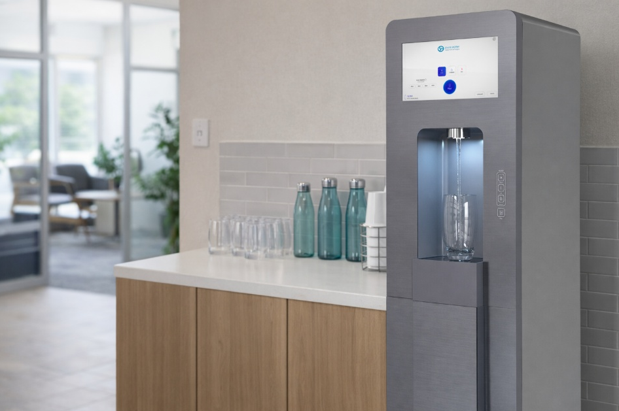
Office water service decisions usually come down to one question: Do you want to keep managing bottled deliveries… or do you want water to be “always on” without anyone thinking about it? If you’re the person responsible for office operations, facilities, HR, or admin, you already know the pain points: heavy jugs, storage clutter, missed deliveries, employees complaining when the cooler is empty, and that recurring “who’s ordering water?” email thread.
This article is built to help you make the decision clearly: bottled delivery vs. bottleless purification. We’ll break down the two main options, the hidden costs people don’t see on the invoice, and what to ask vendors so you don’t end up with a solution that looks good on day one but becomes a headache by month three. You’ll also see how Da-Com’s Purity Source program supports organizations across St. Louis, and Southern Illinois, with a managed, bottle-free approach designed to keep water (and ice, if you want it) consistent, clean, and hassle-free.
Office water services: Your two main options
When people search office water services St Louis, they’re typically comparing two models:
- Bottled water delivery (jug service)
- Bottle-free purification (point-of-use / plumbed-in systems)
Both can “work.” The right choice depends on your office size, how much your team drinks, how much time you want to spend managing it, and what experience you want employees and guests to have.
Option 1: Bottled delivery model (jug service)
This is the traditional setup most workplaces start with:
- A vendor delivers 3- or 5-gallon bottles
- You store full bottles and empties
- Someone swaps bottles as they run out
- You reorder based on usage (and hope you guessed right)
Where bottled delivery can make sense
- Very small teams with low usage
- Temporary spaces
- Locations where plumbing access is difficult (rare, but it happens)
Where it usually breaks down
- Growing teams
- High-traffic breakrooms
- Multi-tenant offices with limited storage
- Any workplace that’s tired of managing “water inventory”
Option 2: Bottle-free purification model (plumbed-in)
Bottle-free systems connect to your building’s water line and treat the water on-site. This is often called:
- bottleless
- point-of-use (POU)
- plumbed-in purification
You still get cold water (and often hot water), but you remove the delivery/storage/lifting loop.
Where bottle-free shines
- Most small-to-mid sized offices
- Clinics and client-facing spaces
- Warehouses/light industrial
- Multi-site organizations (standardize across locations)
If you’re reading this because you’re fed up with bottles, you’re not alone. Most organizations don’t switch because they “love new equipment.” They switch because they want to stop spending time on a basic necessity.
The hidden costs of water delivery (beyond the invoice)
The invoice is only part of the cost of delivery service. The rest is the operational drag, the time, clutter, interruptions, and occasional “fire drills” when you run out.
Here’s what shows up in the real world.
Ordering and admin time (the recurring tax)
On paper, ordering water seems minor. In practice, it’s a repeating workflow:
- Track usage
- Guess the right order quantity
- Receive deliveries
- Fix mistakes (wrong quantity, delayed drop-off)
- Handle billing questions
Even if it’s 10 minutes a week, it’s still a cost, and it usually lands on someone who already has too many tasks.
Storage and clutter (and the breakroom always looks “busy”)
Delivery requires:
- Space for full bottles
- Space for empties
- Space for cups, accessories, “extras”
In multi-tenant buildings, storage is often the first pain point. In smaller offices, it’s the reason the breakroom never feels clean, even when it is.
Running out and employee frustration (the fastest way to kill adoption)
When you run out, people don’t just go without water, they form new habits:
- buying bottled drinks
- using vending machines
- grabbing soda or energy drinks
Once a team stops trusting the station, usage drops. And then you’re paying for something that isn’t doing the job you intended.
Lifting risk and minor injuries (keep it practical)
Swapping a heavy bottle isn’t complicated, but it’s one more “non-core” physical task in the workplace. Spills, awkward lifts, and repetitive swapping add risk, especially in offices where people aren’t trained for manual handling.
That’s not scare talk; it’s just reality: every recurring physical task becomes an opportunity for something to go wrong.
Bottle-free purification: predictable spend, fewer headaches
If your goal is to make hydration simple, bottle-free is often the model that gets you there. Because it replaces inventory management with a managed system.
What you pay for (equipment + service)
Our bottle-free programs include:
- the unit (water dispenser and/or ice system)
- filtration/purification components
- service visits and maintenance
- parts and labor (depending on plan structure)
Instead of paying for “bottles delivered,” you’re paying for continuous treated water + ongoing performance.
What you stop paying for (delivery logistics)
When you move away from delivered bottles, you reduce or eliminate:
- recurring bottle orders
- storage of full and empty bottles
- time spent swapping bottles
- “emergency orders” when you misjudge usage
In other words, you stop paying (in both dollars and time) for the logistics of moving heavy water around.
How employees experience it (taste + availability)
The best way to think about bottle-free is this:
- It creates consistency.
- It creates trust.
- It removes interruptions.
Employees stop wondering:
- “Is there water?”
- “Does it taste weird today?”
- “Do we have cups?”
- “Is the ice okay?”
And that’s the point: if hydration requires thinking, most people won’t do it consistently.
A note on water quality confidence
Many employees ask about water because they see headlines about water quality or they’ve experienced bad taste in older buildings. A practical way to educate your team (without turning it into a debate) is to reference objective resources like EPA Consumer Confidence Reports, which explain how annual water quality reporting works.
How to choose the right provider (questions to ask)
Whether you’re selecting a traditional delivery provider or a bottle-free program, you want predictable service and a setup that stays reliable. This section is intentionally “vendor-neutral,” because the questions matter more than the marketing.
1) What’s the service response expectation?
Ask:
- What happens when the unit needs service?
- Who do we call and what’s the typical response window?
- Do you have local technicians for our area?
This matters even more if you serve multiple sites—especially if you have locations in both Missouri and Southern Illinois.
2) What’s included (filters, labor, parts)?
This is where many buyers get surprised later.
Ask the provider to list:
- filter replacements (included or extra?)
- labor for service calls (included or extra?)
- common parts (included or extra?)
- preventive maintenance visits (scheduled or “as needed”?)
A “low monthly price” can turn expensive fast if every fix becomes an add-on.
3) How do you size the unit (headcount, traffic, shift patterns)?
Sizing is not just headcount. It’s:
- how many people use the station during peak windows
- whether you have shifts
- whether it’s guest-facing (more usage during meetings)
- whether you want ice + water combined
A good provider should ask questions before recommending equipment.
4) Hygiene features: what matters vs what’s just “nice to have”
For many workplaces, hygiene is a priority, not because the breakroom is dirty, but because shared-touch surfaces add friction and concern.
Ask about:
- touch-free dispensing (reduces shared contact points)
- sanitization features (varies by system)
- cleaning responsibilities (what you do vs what the provider does)
For general shared-space hygiene practices, CDC guidance on cleaning and disinfecting facilities is a useful reference point.
5) What filtration standards or certifications are relevant?
You don’t need to become a water scientist, but it helps to understand basic filtration standard categories (especially if a vendor makes broad claims).
NSF provides an accessible overview of common filtration system standards like NSF/ANSI 42, 53, and 401 and what those standards generally cover.
Prospecting shortlist:
If you’re evaluating office water service providers, ask:
- What’s included in the monthly plan (filters, parts, labor)?
- What is the typical service response timeline?
- How do you size the system for our usage?
- What hygiene features are included?
- What’s the process for installation and ongoing maintenance?
- Can you support multiple sites (MO + Southern IL)?
Those questions protect you from signing up for a solution that becomes your responsibility.
Purity Source office water services, what Da-Com handles for you
If you want the simplest path forward, the best model is the one where you don’t “add a new project” to your plate. Purity Source is designed to be the opposite of that.
Here’s how Da-Com approaches office water service St Louis and Southern Illinois organizations can count on:
Right-size + install (so it fits your space and your people)
Purity Source starts with a quick walkthrough to determine:
- best location (visibility + traffic flow)
- water line access
- electrical needs
- whether ice makes sense for your team
- the right capacity based on usage patterns
The goal isn’t just “install a unit.” It’s to create a station people actually use, every day.
Ongoing service included (so performance doesn’t drift)
Most workplace water problems show up after install:
- taste changes
- filters overdue
- slow flow
- inconsistent temperature
- people stop using it
A managed approach keeps the system performing so you don’t backslide into emergency bottled orders.
Simple next step: site walk + recommendation
If you’re comparing options, the cleanest next step is straightforward:
- quick site walk
- right-fit recommendation
- clear monthly plan options
- install and ongoing support
You should never feel like you have to “guess” your way into the right setup.
FAQ: Office water service in St. Louis and beyond
What’s the average monthly range for office water service?
It varies based on whether you choose delivered bottles or bottle-free purification, how many people you serve, whether you add ice, and what level of service is included. The most accurate answer comes from a quick walkthrough to size the system correctly.
Do you service multi-tenant buildings?
Yes, multi-tenant buildings are a common fit for bottle-free systems because storage and delivery coordination can be challenging.
What if we have multiple locations?
If you have sites across St. Louis and Southern Illinois, standardizing your water setup can reduce vendor complexity and keep employee experience consistent across locations.
How fast can service happen if something breaks?
Ask any provider for clear expectations. With a managed program, you should have a defined support path, so you’re not stuck troubleshooting equipment internally.
Want office water handled, without the bottle drama?
If you’re ready to simplify your businesses office water service with one your team can depend on, Da-Com can help you compare delivery vs bottle-free, recommend the right-fit setup, and maintain it with ongoing support.
For office water service across St. Louis City and Southern Illinois, contact Da-Com to get a recommendation and a fixed monthly plan.



Leave A Comment