
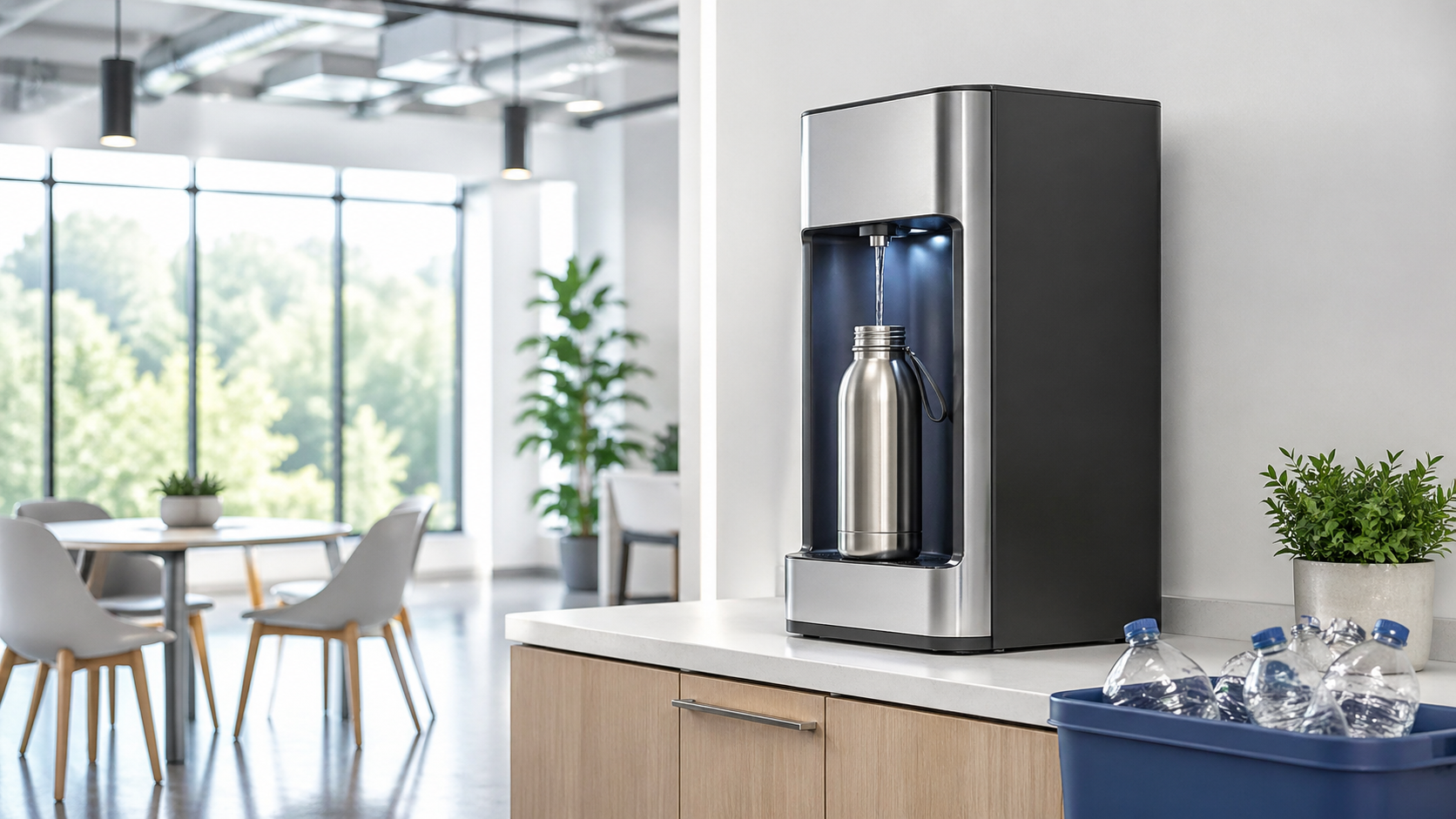
Bottleless Office Water: What’s Really in Bottled Water?
Here’s what I see: most offices do not choose bottled water because it is perfect. They choose it because it is familiar.
A few jugs in the corner. A few cases in the closet. A delivery schedule that has been there for years. It feels simple enough until someone has to lift a heavy bottle, chase down a delivery, clean up around the cooler, find storage space, or explain why the office is still burning through plastic every week.
That is where bottleless office water starts to make sense.
This is not about scaring anyone. Bottled water is regulated. It can serve a purpose. But for many workplaces, bottled water creates a long list of quiet problems: plastic waste, storage, delivery interruptions, lifting risk, recurring costs, and growing concern about microplastics.
Your employees may not say all of that out loud. They may just say, “The water tastes funny,” or “We are out again,” or “Why do we still use all these plastic bottles?”
Those small comments matter.
For businesses in St. Louis, Columbia, Southern Illinois, and surrounding areas, the question is not only, “Do we have drinking water?” The better question is, “Do we have a clean, reliable, modern water system that fits the way our workplace operates now?”
Let me walk you through it.
Why Bottled Water Became the Default Office Choice
Bottled water became common in offices because it solved an obvious problem. People wanted cold drinking water without depending on the tap, the sink, or an old drinking fountain in the hallway.
For a long time, that felt like progress.
Bottled water gave offices a simple way to offer hydration to employees, guests, patients, customers, and visitors. The system was easy to understand. A vendor dropped off bottles. Someone placed one on the cooler. People filled a cup.
But what once felt convenient now feels dated in many workplaces.
Today’s offices care more about sustainability, employee wellness, hygiene, space, predictable expenses, and vendor reliability. A stack of plastic jugs in the breakroom does not always match that standard.
And smaller single-use bottles create their own problem. They look convenient on a conference table, in a waiting room, or in a jobsite cooler. But they also create daily plastic waste. They fill trash cans. They require restocking. They send a subtle message that the company is still relying on disposable habits.
That is why more businesses are taking a second look at bottleless office water.
A bottleless system connects to your building’s water line, filters the water at the point of use, and gives your team fresh drinking water without recurring plastic bottle delivery. For many offices, it is not just a water upgrade. It is a cleaner way to run the breakroom.
For a deeper breakdown of system types, placement, and office fit, see Da-Com’s guide to bottleless water coolers.
The Plastic Waste Problem Hiding in Plain Sight
Plastic waste is one of those problems that becomes invisible because we see it every day.
One bottle in a trash can does not look like much. A few cases in the supply closet do not feel like a major environmental issue. A few 5-gallon jugs waiting for pickup may seem harmless.
But multiply that by weeks, months, years, and locations. The picture changes.
The EPA reports that plastic containers and packaging represented more than 14.5 million tons of municipal solid waste in 2018. That category includes PET bottles and jars, HDPE bottles, bags, wraps, and other packaging. You can review the EPA plastics waste data for more detail.
For an office, this does not mean your team is personally responsible for a national waste problem. That is not the point. The point is simpler.
Every business has places where it can reduce waste without making life harder.
Water is one of those places.
When a workplace replaces recurring plastic bottles or jugs with bottleless office water, it can reduce the amount of plastic moving through the building. That matters in offices that are trying to support sustainability goals, improve their workplace experience, or simply stop dealing with the clutter.
Plastic is not just a trash issue
Plastic bottles do not only create waste after someone drinks the water.
They also affect storage space, delivery traffic, handling and lifting, inventory management, breakroom appearance, recycling confusion, and recurring vendor coordination.
That is a lot of work for something as basic as drinking water.
And here is the part I want facilities leaders and office managers to hear clearly: you should not have to babysit water.
You already have enough moving parts. Employees, customers, vendors, equipment, repairs, supplies, schedules, budgets, and complaints all compete for your attention. Bottled water adds another small chore that never really goes away.
A managed bottleless office water system helps remove that chore from the daily list.
What Microplastics Mean for Bottled Water
Now let’s talk about the word that has been showing up more often in water conversations: microplastics.
Microplastics are tiny plastic particles. Nanoplastics are even smaller. Scientists are still studying what these particles may mean for human health, and it is important not to overstate what is known.
But it is also fair to say this: people are paying attention.
NIH summarized research on plastic particles in bottled water showing that a liter of bottled water contained, on average, about 240,000 tiny plastic particles. About 90 percent of those fragments were nanoplastics. The study used newer detection methods that identified much smaller particles than earlier research could measure.
That does not mean every bottle of water is dangerous. It does not mean people should panic. It does mean bottled water may not feel as simple and “pure” as people once assumed.
That matters for business leaders because employee expectations are changing.
Workers are reading the same headlines. Patients and guests are more aware of environmental health issues. Parents are asking better questions. Younger employees often care deeply about sustainability and single-use plastic reduction.
So when an office still relies heavily on bottled water, it may create a trust gap.
The water may look clean. The label may look polished. But people are starting to wonder what else comes with the bottle.
Why microplastics matter in office water decisions
People are not only searching for office water coolers anymore. They are asking better questions.
They want to know if bottled water has microplastics. They want to know if their business can reduce plastic waste. They want to know if filtered water is a better everyday option for the workplace.
Those questions matter because they show a shift in how buyers think.
The conversation is no longer just about having cold water in the breakroom. It is about health, trust, sustainability, and whether the system fits the company’s values.
That is where bottleless office water belongs.
For additional background on how researchers are studying this issue, see the EPA microplastics research page.
The Hidden Office Cost of Bottled Water
Bottled water costs more than the invoice.
The invoice may show delivery fees, bottle rental, cooler rental, fuel charges, deposits, or case costs. But the hidden cost shows up in daily operations.
Someone has to check inventory, move bottles, replace empty jugs, store full containers, stack empty containers, call when deliveries are missed, clean up spills, deal with clutter, and answer employee complaints.
None of that shows up as a neat line item. But it takes time.
And time is not free.
For small and mid-sized businesses, this can become especially frustrating. The office manager, practice manager, facilities lead, or owner is usually already wearing too many hats. They do not need another vendor to chase or another supply closet to monitor.
Bottled water also creates inconsistency.
One week, the office has plenty. The next week, the last bottle is empty at 2:00 p.m. on a Tuesday. Someone flips the jug, spills water on the floor, and now a simple breakroom task becomes a safety and cleanup issue.
That is not dramatic. That is real office life.
For a side-by-side look at cost and logistics, see Da-Com’s office water delivery vs. bottleless water comparison.
Bottleless systems help make water predictable
A strong bottleless office water program changes the rhythm.
Instead of ordering and storing bottles, your team gets a system installed at the point of use. The right provider helps size the unit, place it correctly, maintain it, and service it over time.
That means the question changes from, “Did anyone order water?” to “Is the system being maintained properly?”
That is a better question because it can be handled through a service plan.
The goal is not just water. The goal is confidence.
Bottleless Office Water Supports Employee Wellness
Most people know they should drink more water.
The hard part is making it easy.
Employees are busy. They move from calls to meetings to service work to patient rooms to production floors. When water is hard to access, tastes off, or runs out, people grab whatever is nearby.
That may be soda. It may be coffee. It may be an energy drink. It may be nothing at all.
A clean, easy-to-use water station helps remove friction. When fresh water is cold, tastes good, and is easy to access, people are more likely to drink it.
That supports a better workplace experience.
For offices, clinics, schools, warehouses, nonprofit spaces, and customer-facing businesses, hydration is not a luxury. It is part of basic care for the people in the building.
OSHA also requires employers to provide potable water in the workplace. OSHA defines potable water as water that meets drinking water standards from the state or local authority, or EPA National Primary Drinking Water Regulations. You can review the OSHA workplace drinking water requirements for more information.
That requirement is the floor. A better experience is the ceiling.
Bottleless office water helps companies move beyond basic access and toward a more thoughtful hydration experience.
Better water can improve the feel of the whole breakroom
A breakroom says something.
It tells employees whether the company pays attention to their daily experience. It tells guests whether the business is organized. It tells job candidates whether the workplace is modern or patched together.
A bottleless system can make the space feel cleaner and more intentional.
No stacks of bottles. No empty jugs. No cases under the table. No “who forgot to order water?” notes. No heavy bottle flips.
Just fresh water, available when people need it.
That is a small change people notice.
What Bottleless Office Water Actually Means
Let’s keep this simple.
Bottleless office water usually means a point-of-use water system connected directly to your building’s water supply. Instead of delivering water in plastic bottles or jugs, the system filters and dispenses water where your employees use it.
Depending on the system, options may include cold water, hot water, ambient water, sparkling water, touchless dispensing, bottle filling, advanced filtration, reverse osmosis, and ice and water combinations.
The right choice depends on the workplace.
A dental office may care most about patient comfort, touchless use, and a clean look in the waiting area.
A warehouse may need high-capacity water access for multiple shifts.
A professional office may want a sleek hydration station near the conference room.
A school, church, or nonprofit may care most about budget predictability and simple service.
A medical practice may want documented service, cleaner common areas, and fewer shared handling points.
This is why sizing matters. You do not want to guess. You want a system that fits the number of people, the traffic pattern, the available utilities, and the type of experience you want to create.
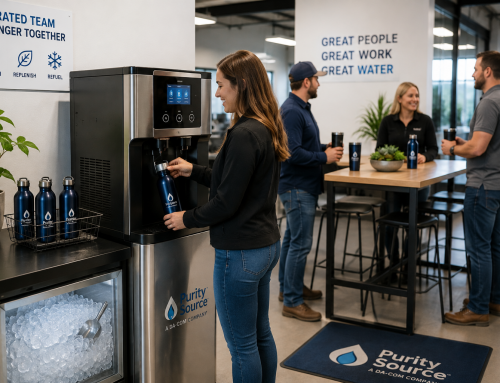
Purity Source purified water solutions are designed for businesses that want more than a machine. The real value is the combination of equipment, filtration, installation, service, and local support.
Why “Set It and Forget It” Matters to Office Managers
Most office managers and facilities leaders do not want a science project.
They do not want to compare confusing filtration claims for weeks. They do not want to read fine print about every replacement filter. They do not want to manage a cooler that becomes another thing on the complaint list.
They want something that works.
This is where the managed service mindset matters.
A good bottleless office water program should answer practical questions up front:
- What system fits our employee count?
- Where should it be installed?
- What utilities are needed?
- How often are filters changed?
- Who handles service?
- What happens if the unit has an issue?
- Can we support multiple locations?
- What does the monthly cost include?
- What documentation is available?
Those answers matter because the buyer is not just buying water. They are buying fewer headaches.
And frankly, that is what many workplaces need.
Not another vendor who drops something off and disappears. Not another piece of equipment that someone in the office has to manage manually. Not another plastic-heavy system that feels out of step with the company’s values.
They need a partner who owns the outcome.
How Bottleless Office Water Helps Reduce Clutter
Clutter has a cost.
It may not show up in your budget, but it changes how a space feels and functions.
Bottled water delivery often brings clutter with it:
- Full bottles near the cooler
- Empty bottles waiting for pickup
- Cases stacked in closets
- Loose bottles in meeting rooms
- Cardboard trays
- Plastic wrap
- Crowded breakroom corners
In a busy office, that clutter becomes normal. People stop seeing it. But guests notice. New employees notice. Facility leaders notice when they are trying to make the space safer, cleaner, or more professional.
A bottleless system helps clean up the visual noise.
That is one reason it works well in reception areas, conference spaces, clinics, dental practices, and modern breakrooms. It gives the workplace a more finished look.
And it does not require a dramatic renovation. Sometimes the biggest upgrades are the simple ones that remove daily friction.
The Sustainability Message Your Employees Can See
Some sustainability efforts happen behind the scenes. Energy contracts, lighting upgrades, vendor consolidation, and recycling programs may matter, but employees do not always see them.
Water is different.
People see the bottles. They see the waste. They see the stack in the corner.
When a business switches to bottleless office water, the sustainability message becomes visible. Employees can understand it immediately.
Less plastic coming in. Less plastic going out. Fewer deliveries. Less storage. More reusable bottle filling. Cleaner daily habits.
That is not just good for the environment. It is good for culture.
People like working in places that make thoughtful decisions. They like seeing that leadership cares about details. They like small improvements that make the day easier.
A modern water system is one of those improvements.
Is Bottled Water Always Bad?
No.
Bottled water has a place.
Emergency situations, outdoor events, disaster planning, remote sites, and temporary locations may still need bottled water. No responsible water provider should pretend otherwise.
The issue is not whether bottled water should exist.
The issue is whether bottled water should be the everyday default for offices that have better options.
For many businesses, the answer is no.
If your team uses water every day in the same location, a bottleless system is often cleaner, more efficient, and easier to manage. It also helps reduce plastic waste and supports a more modern employee experience.
That is the practical middle ground.
No panic. No guilt. Just a better way to solve a daily need.
Questions to Ask Before Replacing Bottled Water
Before switching from bottled water to bottleless office water, ask a few simple questions.
How many people use water each day?
Count employees, visitors, patients, customers, vendors, and guests. A 15-person office and a 150-person facility need different systems.
Where do people actually drink water?
Breakroom? Lobby? Warehouse floor? Conference area? Patient waiting room? The best location is not always the most obvious one.
Do you need hot, cold, sparkling, or ice?
Some offices only need cold water. Others need hot water for tea, sparkling water for employee amenities, or ice and water in one unit.
Who manages service today?
Be honest. If no one really owns filter changes, cooler cleaning, or water ordering, that is a sign you need a managed program.
What problem are you trying to solve?
Plastic waste? Bad taste? Delivery hassles? Cost control? Employee complaints? Sustainability goals? A good provider should help you match the system to the real problem.
Why St. Louis-Area Businesses Are Looking at Better Water Options
Businesses across St. Louis, Columbia, Southern Illinois, and nearby communities are paying closer attention to workplace water.
Some are trying to reduce plastic waste. Some are tired of bottled delivery. Some want a better breakroom experience. Some are responding to employee expectations. Some want a more polished option for visitors and clients.
And some simply want to stop managing one more small, annoying thing.
That last reason is more important than it sounds.
Most business leaders are not sitting around thinking about water all day. They think about it when something goes wrong. When the jug is empty. When the delivery is late. When the cooler leaks. When the breakroom looks messy. When an employee complains. When the supply closet fills up again.
A good bottleless office water solution helps make water quiet.
Not invisible. Not ignored. Just handled.
That is the goal.
The Case for Bottleless Office Water
When you put it all together, the case is clear.
Bottled water may be familiar, but it brings along waste, clutter, handling, storage, recurring deliveries, and growing questions about plastic particles.
Bottleless office water gives businesses a cleaner path.
- It helps reduce plastic waste.
- It simplifies daily operations.
- It supports employee hydration.
- It improves the look and feel of the breakroom.
- It can reduce delivery dependence.
- It helps create a more modern workplace experience.
- It gives office managers one less thing to chase.
And when the system is backed by proper installation, filtration, maintenance, and local service, it becomes more than a cooler.
It becomes a managed hydration solution.
That is what Purity Source, a Da-Com company, is built to provide.
Ready to Move Beyond Bottled Water?
If your office is still relying on plastic bottles, heavy jugs, or recurring water deliveries, this may be the right time to look at a better option.
Purity Source helps businesses replace bottled water with clean, great-tasting bottleless office water solutions that are easier to manage and better suited for modern workplaces.
To learn more about purified office water solutions for your St. Louis, Columbia, or Southern Illinois business, contact Da-Com today.
FAQ
Is bottleless office water better than bottled water?
For many workplaces, yes. Bottleless office water can reduce plastic waste, eliminate bottle storage, simplify service, and provide fresh filtered water without recurring bottled deliveries. Bottled water may still be useful for emergencies or temporary locations, but it is often not the best everyday system for a fixed office.
Does bottled water contain microplastics?
Research has found tiny plastic particles in bottled water, including microplastics and nanoplastics. Scientists are still studying the health impact, but the findings have increased interest in reducing single-use plastic and choosing filtered water options.
How does bottleless office water reduce plastic waste?
Bottleless office water connects to the building’s water supply and filters water at the point of use. Because water is not delivered in plastic bottles or jugs, the office can reduce the amount of plastic packaging used for daily hydration.
Is bottleless office water good for small businesses?
Yes. Small businesses often benefit because they can reduce delivery hassles, free up storage space, improve the breakroom, and give employees fresh water without assigning someone to manage bottled water inventory.
What businesses are a good fit for bottleless office water?
Good fits include offices, clinics, dental practices, schools, churches, nonprofits, warehouses, manufacturing facilities, professional service firms, and customer-facing businesses that want reliable drinking water with less plastic and less daily management.



Leave A Comment