
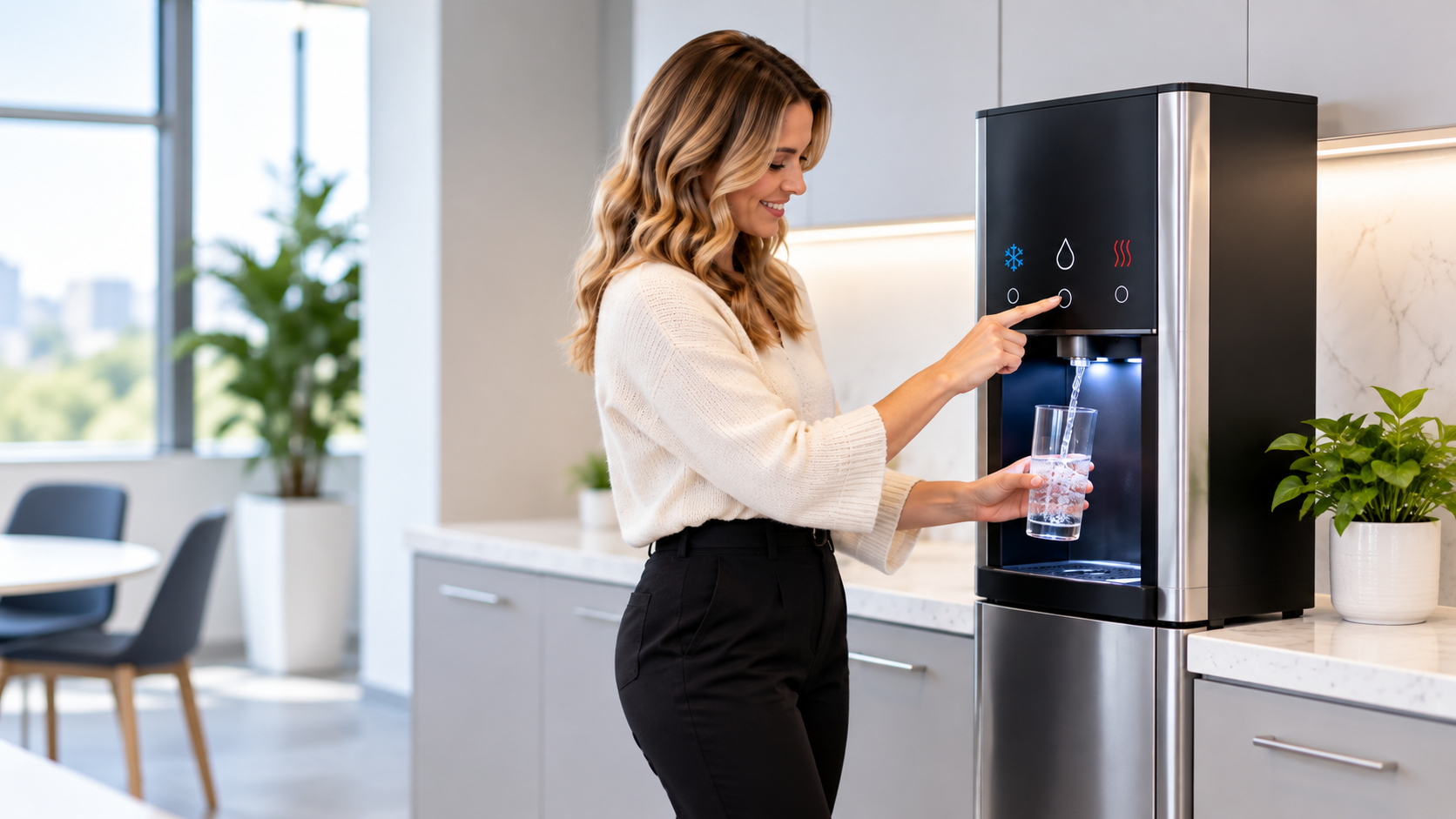
Reverse Osmosis Water With Minerals: What Offices Should Know
Reverse osmosis water with minerals combines two different parts of drinking-water treatment: purification through a reverse osmosis membrane and a mineral filtration stage that may add selected minerals back into the treated water.
For businesses comparing office water dispensers, that distinction can raise a reasonable question: if reverse osmosis removes dissolved minerals, why would a drinking-water system add some of them back?
The answer often comes down to the desired water treatment process and taste.
Reverse osmosis, commonly called RO, is designed to reduce dissolved substances in water. Mineral filtration, sometimes called remineralization, may be used afterward to adjust the mineral content and flavor of the finished water.
These processes serve different purposes. One focuses on purification, while the other modifies characteristics of the treated water.
Neither approach automatically makes drinking water healthier or safer in every situation. The suitability of any system depends on the incoming water quality, equipment configuration, verified performance claims, and maintenance.
Purity Source, a Da-Com company, provides bottleless purified water systems for offices and commercial workplaces throughout St. Louis, St. Charles, Chesterfield, O’Fallon, the Metro East, Belleville, Edwardsville, Collinsville, and Southern Illinois.
In this guide, we will explain how reverse osmosis works, what happens to naturally occurring minerals, how mineral filters differ from traditional filtration stages, and what businesses should ask before selecting a commercial drinking-water system.
Quick Answer: Does Reverse Osmosis Remove Minerals From Water?
Yes. Reverse osmosis can reduce dissolved minerals, including calcium and magnesium, along with many other dissolved substances. A reverse osmosis water with minerals system uses a separate mineral filtration or remineralization stage to introduce selected minerals after the RO process, depending on its design.
The important distinction is that minerals are not necessarily added back in the same amounts or proportions originally present in the untreated water.
For offices choosing a water system, the most useful questions are:
- Does the system use reverse osmosis?
- Which filtration stages are included?
- Is a mineral filter installed after the RO membrane?
- Which minerals does that stage add or affect?
- How does the final water taste?
- Which contaminant-reduction claims are independently verified?
- How often are filters and membranes serviced?
The right decision should be based on the specific system, not simply whether a dispenser is advertised as purified, mineral-enhanced, or filtered.
How Does Reverse Osmosis Water Filtration Work?
Reverse osmosis is a treatment process that uses pressure to move water through a semipermeable membrane.
The membrane allows treated water to pass through while reducing many dissolved substances. The process also produces a separate stream containing rejected substances.
The U.S. Environmental Protection Agency’s guide to point-of-use reverse osmosis systems explains the treatment process, system performance, and water-efficiency considerations.
In a commercial bottleless water dispenser, reverse osmosis may be one stage within a larger filtration system.
Other stages can prepare the incoming water for the membrane or improve characteristics of the finished water.
Stage 1: Sediment Pre-Filtration
Sediment filtration is generally designed to reduce suspended particles such as dirt, rust, silt, and other debris.
This stage helps protect downstream treatment components from unnecessary particle buildup.
Different sediment filters have different particle-size ratings, so the exact filter selected for a system matters.
For an office water dispenser, sediment filtration is part of maintaining appropriate treatment performance over time. It is not a substitute for other treatment stages that target dissolved substances.
Stage 2: Activated Carbon Filtration
Activated carbon filtration is commonly used to address chlorine-related taste and odor concerns.
Some certified carbon filters can reduce additional substances, depending on their design and verified performance claims.
However, it is important not to assume all carbon filters remove the same contaminants.
The Centers for Disease Control and Prevention’s water filter selection guide explains why filtration methods should be selected according to the substances a user wants to address.
For businesses, activated carbon can be an important part of a multi-stage water treatment system, particularly when taste and odor are significant concerns.
Stage 3: Reverse Osmosis Membrane
The reverse osmosis membrane reduces dissolved substances in the water.
Depending on the system and its tested capabilities, reverse osmosis may reduce substances such as dissolved salts and certain metals.
The exact contaminants reduced and the extent of reduction depend on the membrane, system configuration, incoming water, operating conditions, and relevant certifications.
For reverse osmosis water with minerals, this is the purification stage that generally occurs before optional mineral treatment.
Stage 4: Final Carbon or Polishing Filtration
Some systems include an additional carbon filter after reverse osmosis.
This stage may help address taste or odor characteristics that could be affected by storage or other components within the treatment process.
The term “polishing” describes the role of the filter in the treatment sequence. It does not mean the water has automatically met every possible purification standard.
Stage 5: Optional Mineral Filtration
Some systems include a mineral filter after the primary purification stages.
Depending on its composition, the filter may introduce selected minerals into the finished drinking water.
This stage is often intended to influence the water’s taste and mineral profile.
Not every reverse osmosis system includes mineral filtration, and not every mineral filter uses the same material or produces the same finished-water characteristics.
That is why buyers should review the exact system rather than assuming all mineral-enhanced water is identical.
Reverse Osmosis vs. Mineral-Enhanced Drinking Water
Reverse osmosis and mineral-enhanced water are not necessarily competing technologies.
A system can use both.
The reverse osmosis stage reduces dissolved substances, while a later mineral filtration stage may adjust selected characteristics of the treated water.
| Factor | Reverse Osmosis Water | Reverse Osmosis With Mineral Filtration |
|---|---|---|
| Main treatment approach | Reduces dissolved substances through an RO membrane. | Uses RO treatment followed by a mineral stage. |
| Mineral content | Generally reduces many dissolved minerals. | May introduce selected minerals after treatment. |
| Taste | Depends on incoming water and system performance. | May have a different taste due to the final mineral profile. |
| Equipment | Requires RO membrane and associated components. | Requires RO components plus a mineral stage. |
| Maintenance | Requires scheduled filter, membrane, and system service. | Requires the same, plus service for the mineral stage. |
| Contaminant reduction | Depends on the tested RO system and its claims. | Depends on the tested RO system; added minerals do not establish additional contaminant removal. |
| Best evaluation method | Review certifications, water quality, taste, performance, and service. | Review those factors plus the purpose and composition of mineral treatment. |
Businesses should avoid interpreting this comparison as proof that one approach is universally healthier than the other.
Both systems should be judged on their verified performance, intended application, and the needs of the workplace.
Why Would a Water System Add Minerals Back After Reverse Osmosis?
If a reverse osmosis system removes dissolved minerals, it may seem unusual to introduce them later.
The reason is that water treatment goals can involve more than one characteristic.
One goal may be to reduce selected dissolved substances.
Another may be to provide drinking water with a preferred taste or mineral profile.
A mineral filtration stage can help manufacturers pursue both goals through different parts of the treatment process.
For example, calcium and magnesium are naturally occurring minerals found in many drinking-water supplies. They can also influence water hardness and taste.
Some mineral filters use media designed to introduce one or more minerals into treated water.
However, the amount added depends on the filter, water conditions, flow, media composition, and service life.
Does Mineral Filtration Make Drinking Water Healthier?
Not automatically.
Minerals are essential nutrients, but a claim that a specific water filter provides meaningful health benefits would require appropriate evidence about the actual minerals and quantities delivered.
A commercial water dispenser should not be marketed as preventing illness, improving medical conditions, or producing guaranteed health outcomes simply because it includes a mineral filter.
For workplace buyers, mineral filtration is better evaluated as a system feature that may affect the finished water’s characteristics and taste.
If a manufacturer makes a specific nutritional or health claim, request the supporting documentation before repeating it.
Does Reverse Osmosis Water Taste Different?
Water taste can be affected by naturally occurring minerals, dissolved substances, treatment processes, temperature, and equipment maintenance.
Reverse osmosis reduces many dissolved substances that contribute to the original water’s composition.
As a result, treated water may taste different from the untreated supply.
Some people describe highly purified water as mild or neutral. Others prefer a taste profile associated with some remaining or reintroduced minerals.
Taste preferences are subjective.
A reverse osmosis water with minerals configuration may appeal to businesses that want the treatment benefits of RO while exploring a different finished-water taste.
However, an added mineral filter does not guarantee that every employee will prefer the result.
How Should an Office Compare Water Taste?
Instead of relying only on descriptions such as “crisp,” “pure,” or “refreshing,” consider a practical tasting demonstration.
When possible, compare water at similar temperatures using clean, identical glasses.
Ask several employees whether they notice a difference and which option they prefer.
Use representative water from the actual equipment configuration rather than a sample that does not reflect the proposed installation.
This can help businesses determine whether the mineral filter provides a noticeable benefit for their particular workplace.
What Is the Difference Between Water Minerals and Water Hardness?
Mineral content and water hardness are related, but they are not identical terms.
Hardness is primarily associated with dissolved calcium and magnesium.
Other dissolved substances can also be present in drinking water without contributing to hardness in the same way.
Total dissolved solids, often abbreviated as TDS, is another measurement used in water treatment discussions.
TDS reflects the total concentration of dissolved substances measured or estimated through an appropriate testing method. It does not identify every individual substance or establish whether water is safe to drink.
That distinction matters when interpreting filtration claims.
A low TDS measurement does not automatically mean a system has removed every harmful contaminant. Likewise, a higher mineral content does not automatically mean the water is unsafe.
When evaluating reverse osmosis water with minerals, businesses should consider whether the provider is discussing hardness, TDS, taste, or a specific contaminant-reduction claim.
These measurements and claims should not be treated as interchangeable.
Does Adding Minerals Back Undo Reverse Osmosis Purification?
Adding selected minerals after reverse osmosis does not inherently reverse the entire treatment process.
However, the mineral stage can change the finished water’s composition, including its dissolved-mineral content.
The effect depends on the media used, the design of the system, the incoming treated water, and operating conditions.
For this reason, buyers should ask whether the final treated-water performance has been evaluated with the mineral filter installed.
Do not assume a system with an additional stage has the same finished-water characteristics as an otherwise identical system without that stage.
The equipment provider should be able to explain the intended purpose of each filtration component and distinguish tested claims from general descriptions.
Understanding Water Filtration Certifications
Water filtration certifications can help buyers evaluate performance claims, but certification should be understood carefully.
Different standards address different aspects of a drinking-water treatment system.
For example, NSF/ANSI 58 addresses reverse osmosis drinking-water treatment systems, including structural requirements, materials, total dissolved solids reduction, and specific contaminant-reduction claims.
According to NSF, some contaminant-reduction claims under this standard are optional and require separate verification.
That means a product’s certification to a standard should not be interpreted as evidence that it removes every contaminant listed under that standard.
Common Water Treatment Standards to Know
| Standard or Program | General Purpose | Important Buyer Question |
|---|---|---|
| NSF/ANSI 42 | Aesthetic effects such as certain taste and odor reduction claims. | Which exact aesthetic claims are certified? |
| NSF/ANSI 53 | Specific contaminant-reduction claims related to health effects. | Which contaminants were tested and certified? |
| NSF/ANSI 58 | Reverse osmosis drinking-water treatment systems. | Which RO performance and reduction claims apply? |
| EPA WaterSense for eligible RO systems | Specified efficiency and performance criteria for qualifying point-of-use RO systems. | Does the exact system qualify for the program? |
NSF provides additional guidance through its water treatment standards overview.
For a commercial dispenser, request documentation for the exact model, filter, or treatment configuration being proposed.
A certification for one component should not automatically be described as certification of an entire multi-stage system.
Is Reverse Osmosis Water Efficient for an Office?
Reverse osmosis can produce a reject-water stream as part of the purification process.
The amount varies by system and operating conditions.
As a result, businesses evaluating office reverse osmosis equipment should ask about water efficiency rather than assuming that all RO systems use the same amount of water.
The EPA’s WaterSense information for point-of-use RO systems explains efficiency considerations and the program’s performance requirements for eligible equipment.
For an office buyer, useful questions include:
- How much treated water does the system produce?
- What is the expected reject-water volume?
- Does the system require a drain connection?
- What equipment or design features affect efficiency?
- Does the specific product have applicable efficiency certification?
- How does local water pressure affect operation?
- What maintenance is required to preserve performance?
Do not assume a commercial water dispenser has an EPA WaterSense label merely because it uses reverse osmosis.
Program eligibility and certification must be verified for the exact product.
How Does Purity Source Approach Multi-Stage Water Purification?
Purity Source uses a multi-stage purification approach in its bottleless drinking-water solutions.
Da-Com’s Purity Source product page describes filtration that can include sediment pre-filtration, carbon filtration, reverse osmosis, and final polishing filtration.
Purity Source’s product information also discusses mineral filter technology as an available treatment concept.
However, the exact stages and available options depend on the equipment and configuration being proposed.
Businesses considering reverse osmosis water with minerals should ask the Purity Source team to identify which filtration stages apply to their specific system.
Questions to Ask About the Purity Source Mineral Filter
- Is a mineral filter available for the selected dispenser?
- Is it included in the standard configuration or offered as an option?
- Which mineral media are used?
- What is the intended purpose of the mineral stage?
- How does it affect the finished water’s taste?
- What supporting performance information is available?
- How often does the mineral filter require replacement?
- Is that replacement included in the service agreement?
The answers help buyers understand the actual equipment rather than relying on a broad description of purification or mineral enhancement.
Where Does Reverse Osmosis Water With Minerals Fit in the Workplace?
Commercial reverse osmosis systems can support a variety of workplace drinking-water applications.
The right system should match the number of users, the location, the available utilities, and the services employees expect.
Professional Office Breakrooms
A bottleless water dispenser can provide employees with convenient drinking water without relying on large delivered jugs.
For businesses comparing filtration options, mineral-enhanced RO may be worth discussing when employees have strong taste preferences.
Client and Guest Hospitality Areas
Law firms, accounting offices, real estate agencies, showrooms, and other professional workplaces may provide purified drinking water to guests.
The station should be easy to use, appropriately sized, and supported by a clear cleaning and maintenance process.
Employee Lounges and Shared Staff Areas
Workplaces with multiple departments may need one or more dispensers located near common break areas.
Water treatment configuration is one part of the decision. Tank capacity, temperature options, bottle clearance, and employee traffic also matter.
Meeting and Training Spaces
Training facilities and conference spaces may experience brief periods of increased demand.
The system should provide enough water for typical use, and the office should plan for larger events if demand exceeds normal conditions.
Mineral filtration does not replace the need to select a dispenser with suitable water storage and recovery performance.
Can Mineral-Enhanced Reverse Osmosis Water Be Used for Office Coffee?
Water chemistry can influence the taste of coffee and tea, as well as the needs of connected beverage equipment.
However, the best water composition for a particular coffee machine is not necessarily the same as the preferred drinking-water composition.
Some beverage equipment manufacturers specify acceptable water hardness, mineral content, or other water-quality ranges.
Businesses should follow those requirements rather than assuming that all reverse osmosis or mineral-enhanced water is appropriate for every machine.
A Purity Source drinking-water dispenser may support a broader beverage station, but the water treatment needs of specialized coffee equipment should be evaluated separately.
Da-Com’s business technology blog includes additional workplace beverage content, including guidance about purified water for office coffee.
When planning a shared water-and-coffee station, ask the equipment providers whether the proposed configuration meets the needs of both applications.
Why Maintenance Matters for Reverse Osmosis and Mineral Filters
Every filtration stage has a maintenance requirement.
Sediment filters can collect particles. Carbon filters have a finite service life. Reverse osmosis membranes require appropriate operating conditions and eventual replacement. Mineral filters may also require scheduled replacement.
When maintenance is delayed, equipment performance or finished-water characteristics may change.
For a business, the important question is not simply how often the filters need to be replaced. It is who is responsible for monitoring, scheduling, and performing the work.
Questions for a Commercial Water Service Agreement
- Who changes the sediment filters?
- Who changes the carbon filters?
- Who checks the reverse osmosis membrane?
- Who maintains the optional mineral stage?
- Are parts and labor included?
- How are filter replacement intervals determined?
- What happens when water flow becomes slower?
- Who responds to changes in taste or odor?
- What should employees clean between service visits?
- How does the office request technical support?
Purity Source offers managed workplace water solutions with ongoing service and maintenance arrangements.
Exact included services depend on the selected equipment and agreement.
For additional guidance, read Da-Com’s Office Water Filter Changes Guide.
A workplace water station should reduce responsibilities for office staff rather than leave filtration maintenance to chance.
How Much Does Reverse Osmosis Water With Minerals Cost?
The cost of a reverse osmosis water with minerals system depends on the dispenser, treatment configuration, installation requirements, water usage, and ongoing service terms.
A system with optional mineral filtration may have different equipment or maintenance requirements from an otherwise similar RO system without that stage.
When comparing commercial water solutions, review the complete arrangement.
| Cost Area | What to Confirm |
|---|---|
| Water dispenser | The exact model, available temperatures, and capacity. |
| Filtration configuration | Which sediment, carbon, RO, and mineral stages are included. |
| Installation | Water connections, electrical requirements, drainage, and placement. |
| Filter changes | Replacement schedules, responsibility, and included services. |
| Membrane maintenance | Inspection, service intervals, and replacement coverage. |
| Service | Parts, labor, technical assistance, and exclusions. |
| Contract terms | Rental period, ongoing payments, and end-of-term responsibilities. |
Do not assume that a higher equipment price guarantees better water quality or a preferred taste.
Ask for a recommendation based on the actual treatment goals, usage patterns, and desired finished-water characteristics.
Da-Com’s Office Water Delivery vs. Bottleless Guide explains the broader service differences for businesses considering a point-of-use water system.
How to Choose Reverse Osmosis Water With Minerals for Your Office
Use this checklist before selecting a commercial drinking-water system.
- Identify the workplace’s drinking-water needs.
- Confirm the incoming water source and available water-quality information.
- Ask which treatment stages the proposed system includes.
- Review the purpose of the RO membrane.
- Confirm whether mineral filtration is available.
- Ask which minerals the filter is intended to introduce.
- Request verified contaminant-reduction and certification information.
- Ask whether finished-water testing is available.
- Compare water taste using the actual proposed configuration where possible.
- Review water efficiency and installation requirements.
- Confirm dispenser capacity and temperature options.
- Discuss filter and membrane maintenance.
- Review service, parts, labor, and rental terms.
- Choose a configuration suited to the workplace rather than relying on broad marketing claims.
Common Mistakes When Comparing Reverse Osmosis and Mineral Filtration
Assuming Reverse Osmosis Removes Every Contaminant
Reverse osmosis can reduce many dissolved substances, but specific claims should be supported by applicable testing and certification for the selected system.
Assuming All Mineral Filters Are the Same
Mineral media differ in composition and performance. Ask which minerals the specific filter introduces and how the final water is characterized.
Confusing Mineral Content With Water Safety
Mineral content alone does not determine whether water is safe. Safety depends on the complete water-quality picture and any applicable standards.
Using TDS as the Only Water Quality Measurement
Total dissolved solids is one measurement, not a complete contaminant analysis.
Assuming Mineral Filtration Guarantees Health Benefits
A mineral stage may change the water’s composition and taste, but specific health or nutritional claims require appropriate evidence.
Ignoring Reverse Osmosis Water Efficiency
RO systems can generate reject water. Ask about the specific system’s efficiency and water requirements.
Forgetting About Ongoing Service
Filtration performance depends on proper maintenance. Confirm who services the system and which tasks are included.
Frequently Asked Questions About Reverse Osmosis Water With Minerals
Does reverse osmosis remove minerals from drinking water?
Yes. Reverse osmosis can reduce dissolved minerals such as calcium and magnesium. The amount removed depends on the system and operating conditions. Some RO systems include a separate mineral filtration stage that may add selected minerals to the treated water.
What is reverse osmosis water with minerals?
Reverse osmosis water with minerals is water that has been treated through an RO process and then passed through a mineral filtration or remineralization stage, depending on the system. That additional stage may change the finished water’s mineral content and taste.
Is reverse osmosis water without added minerals safe to drink?
RO-treated water is not inherently unsafe simply because dissolved minerals have been reduced. However, drinking-water safety should be evaluated based on source water, treatment performance, maintenance, and applicable water-quality requirements rather than mineral content alone.
Does remineralization improve the taste of reverse osmosis water?
It can change the taste. Some people prefer water with certain dissolved minerals, while others prefer a more neutral taste. The result depends on the mineral filter and individual preferences.
Does a mineral filter remove contaminants?
A mineral filter used for remineralization is not automatically a contaminant-removal filter. Any contaminant-reduction claims should be verified for the specific product and treatment configuration.
Is mineral-enhanced water the same as mineral water?
Not necessarily. Mineral-enhanced water describes water whose composition has been adjusted by a treatment process. Products legally labeled as mineral water may be subject to different definitions and requirements. The terms should not be used interchangeably without confirming their meaning.
Does reverse osmosis use more water than ordinary filtration?
RO systems produce a reject-water stream as part of their process. The amount varies by system. Businesses should compare the equipment’s efficiency specifications and any applicable certifications before choosing a configuration.
Does every Purity Source dispenser include mineral filtration?
Do not assume so. Purity Source offers different drinking-water systems and treatment configurations. Ask the team whether a mineral filter is included or available for the exact model being considered.
How often should an office reverse osmosis system be serviced?
Service intervals depend on the equipment, filter specifications, incoming water quality, and use. Follow the manufacturer’s requirements and confirm which maintenance tasks are included in the provider’s service agreement.
Can Purity Source help businesses compare RO and mineral-enhanced water?
Yes. Purity Source, a Da-Com company, can help businesses in St. Louis, St. Charles County, the Metro East, and Southern Illinois discuss reverse osmosis filtration, available mineral treatment options, water taste, equipment selection, and ongoing service.
Find the Right Office Water Filtration System With Purity Source
Reverse osmosis water with minerals is one way to combine drinking-water purification with a selected finished-water mineral profile.
For businesses, the important decision is not whether the words “reverse osmosis” or “mineral-enhanced” sound more appealing.
It is whether the specific treatment system meets the workplace’s needs and whether the provider can clearly explain its performance, configuration, and maintenance requirements.
Purity Source can help your business evaluate:
- Multi-stage commercial water filtration.
- Reverse osmosis purification.
- Available mineral filter options.
- Drinking-water taste preferences.
- Verified treatment performance information.
- Water dispenser capacity and placement.
- Filtration service and maintenance.
- Bottleless water rental arrangements.
For offices and commercial businesses in St. Louis, St. Charles, Chesterfield, O’Fallon, the Metro East, Belleville, Edwardsville, Collinsville, and Southern Illinois, Purity Source offers local water solutions supported by Da-Com’s service-focused approach.
Whether you are replacing delivered water jugs, upgrading an older dispenser, or exploring mineral-enhanced purified water for your office, the right system should fit your people, space, water quality needs, and budget.
Contact Da-Com today to discuss reverse osmosis, mineral filter options, and Purity Source bottleless drinking-water solutions.
Explore Purity Source Bottleless Water Systems, our Office Water Filter Changes Guide, and our Office Water Delivery vs. Bottleless Guide to learn more about choosing and maintaining a workplace drinking-water system.


Leave A Comment