
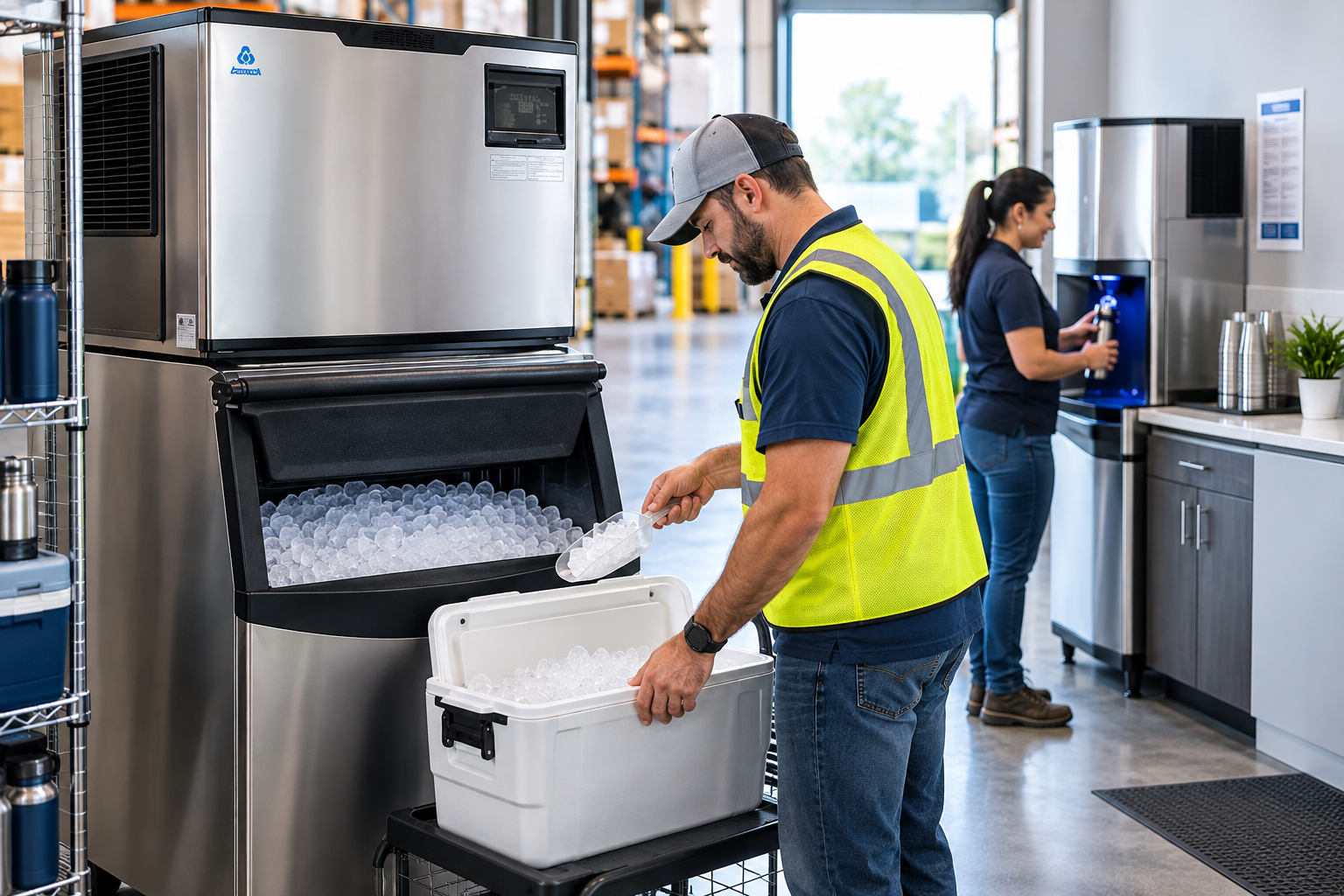
Commercial Ice Machine Storage Capacity Explained: Production vs. Bin Size
Commercial ice machine storage capacity is one of the most important details to understand before choosing a workplace ice machine. It is also one of the easiest details to misunderstand.
Many businesses compare ice machines by looking at how many pounds of ice a machine can produce per day. That number matters, but it does not tell the whole story. A machine that produces 700 pounds of ice per day does not necessarily have 700 pounds of ice available at one time. Daily production and storage capacity are two different measurements, and both affect whether an ice machine can keep up with real workplace demand.
This matters in offices, warehouses, service departments, schools, customer waiting areas, employee breakrooms, manufacturing-adjacent spaces, and other busy workplaces where people use ice in concentrated windows. If the machine can produce enough ice over 24 hours but does not store enough ice before lunch, shift change, a customer rush, or a hot afternoon, employees may still run out.
Purity Source, a Da-Com company, provides purified water and ice solutions for businesses that want clean, great-tasting water and ice backed by practical service and support. For workplaces in St. Louis, St. Charles, the Metro East, Belleville, Edwardsville, Collinsville, Bethalto, and Southern Illinois, Purity Source can help compare daily ice production, storage capacity, access style, placement, filtration, service, and workplace demand before you choose a machine.
Quick Answer: What Is Commercial Ice Machine Storage Capacity?
Commercial ice machine storage capacity is the amount of ice a machine can hold in its bin or dispenser at one time. It is different from daily production, which is how much ice the machine can make over a 24-hour period. Storage capacity matters because employees, guests, or crews may use ice faster than the machine can make it during peak periods.
For example, a workplace may have an ice machine that produces a large amount of ice per day, but if the bin only stores a smaller amount at once, the machine may run short during lunch, meetings, shift changes, service rushes, or hot weather.
Workplaces should compare both numbers:
- Daily production: How much ice the machine can make in a day.
- Storage capacity: How much ice is ready to use at one time.
- Peak demand: When the most people need ice within a short window.
- Access style: Whether users get ice through a touchless dispenser, standard dispenser, undercounter bin, or larger scoop bin.
- Placement: Where the machine is located and how easily people can use it.
The right commercial ice machine should have enough production to keep up over the day and enough storage to support your busiest usage periods.
Production vs. Storage: The Difference Buyers Miss
The biggest mistake many buyers make is assuming that pounds per day and pounds stored mean the same thing. They do not.
Daily production describes how much ice the machine can make in a 24-hour period under proper operating conditions. Storage capacity describes how much ice is available in the bin, dispenser, or storage area at a given time.
Think of production as the machine’s ability to refill. Think of storage as the amount of ice ready before people arrive to use it.
| Measurement | What It Means | Workplace Example |
|---|---|---|
| Daily production | The amount of ice the machine can make in a full day. | A 550 lb/day machine can produce ice throughout the day as long as conditions and demand allow. |
| Storage capacity | The amount of ice available in the bin or dispenser at one time. | A storage bin may hold 80, 130, 220, 300, or 500 pounds depending on configuration. |
| Peak demand | The busiest ice-use window. | A warehouse crew may use a large amount of stored ice during one shift-change period. |
| Access style | How people retrieve ice. | Touchless, dispensable, undercounter, and scoop-bin setups all support different usage patterns. |
This difference matters because workplace ice demand is not always evenly spread across the day. A machine may make enough ice overall, but the available stored ice may still disappear quickly if many people use it at once.
Da-Com’s commercial ice machine size guide explains how daily production, storage, headcount, shift patterns, visitor use, and workplace type work together when choosing an ice machine.
Why Storage Capacity Matters During Peak Use
Commercial ice machine storage capacity matters most during peak use. Peak use is the period when the most people need ice within a short amount of time.
Peak demand may happen during:
- Morning shift starts.
- Lunch breaks.
- Afternoon heat.
- Shift changes.
- Customer waiting room traffic.
- Employee appreciation events.
- Meetings and trainings.
- Service department rushes.
- Warehouse cooler filling.
- Outdoor or physically active work periods.
A quiet office may use ice steadily throughout the day. A warehouse may use a large amount of ice in 20 minutes. A dealership may see ice and water demand spike when the service waiting area is full. A school office may see more demand during events or staff meetings. A service department may use more ice during warm months when technicians and employees are moving between indoor and outdoor work.
That is why average headcount is not enough. A workplace with fewer employees may still need more storage if ice demand happens all at once.
Da-Com’s high-traffic water station guide explains why busy workplaces should size water and ice around peak demand, placement, service, and daily usage, not only the number of people on site.
Small Storage Dispensers: When 7 to 15 lbs Works
Some touchless nugget ice dispensers store a smaller amount of ice but produce more throughout the day. In Purity Source’s product planning, the 206HID is referenced at 220 lbs/day with 7 lbs of storage, while the 315HID is referenced at 330 lbs/day with 15 lbs of storage.
That smaller storage capacity can work well when people use the machine gradually. It may be a good fit for:
- Office breakrooms.
- Smaller employee areas.
- Staff lounges.
- Customer waiting rooms.
- Administrative offices.
- Healthcare-adjacent office spaces.
- School staff areas.
- Shared bottle-filling areas.
These units may be especially useful when the workplace wants touchless-style access, nugget ice, and a cleaner shared experience. Employees can fill cups or reusable bottles without needing to open a bin or use a scoop.
However, small storage dispensers may not be the right fit for every environment. They may struggle if many people need ice at the same time or if employees regularly fill large coolers. In those cases, daily production may look strong on paper, but the stored ice may not be enough during peak windows.
Undercounter Storage: When 80 lbs Works
An undercounter commercial ice machine can be a strong middle-ground option for workplaces that need more stored ice than a small dispenser but do not have room for a large floor-standing bin.
Purity Source’s planning guide references the 280UC as an undercounter scoop ice option at 280 lbs/day with 80 lbs of storage. That can be useful for workplaces where space is limited but employees still need a practical supply of ice available.
An 80 lb storage setup may fit:
- Office kitchenettes.
- Small back-of-house spaces.
- Conference and training areas.
- Customer hospitality areas.
- Smaller service departments.
- Staff breakrooms.
- Workplaces with moderate scoop ice needs.
Undercounter ice can be helpful when the workplace wants stored ice without dedicating floor space to a larger unit. It may also work well when ice use is steady but not extreme.
The key question is whether the workplace needs ice for cups and bottles or whether employees are filling coolers, large containers, or many bottles within a short time. If larger containers are common, a bigger storage bin may be a better fit.
Mid-Range Storage: When 130 to 220 lbs Works
Mid-range storage can be useful for workplaces that need more ice available during peak periods but still want a dispensable or controlled-access setup.
Purity Source’s planning guide references 350C + HD130B and 550C + HD220B or 700C + HD220B style configurations for higher-output dispenser-style needs. These options can help businesses balance stronger daily production with more available stored ice than smaller touchless dispensers.
Mid-range storage may fit:
- Busy employee breakrooms.
- Service departments.
- Large office spaces.
- Customer waiting areas with heavier use.
- Smaller warehouses.
- Dealership service lounges.
- Training centers.
- Multi-use employee and guest spaces.
This range can be helpful when a workplace wants the user experience of a dispenser but needs more storage than a compact unit provides.
A commercial ice machine storage capacity of 130 to 220 lbs may support moderate peak demand, but it still needs to be matched to actual use. A busy warehouse shift may drain that storage faster than a steady office environment.
Large Bin Storage: When 300 to 500 lbs Works
Large bin storage is often the better choice when a workplace needs more ice ready at one time. Purity Source’s planning guide references scoop-only commercial ice options such as 350C + B300, 550C + B500, and 700C + B500 for larger storage-bin needs.
A large commercial ice storage bin may fit:
- Warehouses.
- Distribution centers.
- Manufacturing-adjacent spaces.
- Service departments.
- Back-of-house employee areas.
- Large breakrooms.
- Multi-shift teams.
- Workplaces that fill coolers.
- High-demand summer environments.
Large storage bins are not always the prettiest option for a lobby or customer-facing space, but they can be the right choice when practicality matters most. If employees need to fill coolers, load large containers, or access a lot of ice before going to work, storage capacity can matter more than touchless access.
Da-Com’s commercial ice machine for warehouses guide explains why warehouses and distribution centers often need to size ice equipment around shift changes, hot work areas, cooler use, bottle filling, and employee demand rather than treating ice like a standard office convenience.
Why Dispensers Often Store Less Ice Than Scoop-Bin Systems
Dispensers and scoop-bin systems are designed for different types of use. A dispenser focuses on controlled access. A scoop-bin system often focuses on larger available storage.
A dispenser may be better when:
- Employees mostly fill cups or reusable bottles.
- The machine is in a shared office breakroom.
- The space is visible to customers or visitors.
- The workplace wants a cleaner-looking access style.
- Open-bin handling is not preferred.
- The unit is part of a commercial ice and water station.
A scoop-bin system may be better when:
- Employees need to fill coolers.
- Storage capacity matters more than presentation.
- Ice demand happens in large waves.
- The machine is in an employee-only or back-of-house area.
- The workplace needs more ice ready before production catches up.
Da-Com’s guide to dispensable vs. scoop commercial ice machines explains how access style affects storage, traffic flow, employee experience, customer spaces, warehouses, and service departments.
How Workplace Type Changes Storage Needs
Different workplaces need different storage capacity because people use ice in different ways.
| Workplace Type | Typical Ice Use | Storage Capacity Consideration |
|---|---|---|
| Small office | Cups, bottles, meetings, employee use. | Small dispenser or undercounter storage may be enough if use is steady. |
| Large office | Breakrooms, guests, meetings, reusable bottles. | May need higher dispenser storage or multiple stations depending on traffic. |
| Warehouse | Bottles, coolers, hot work areas, shift changes. | Larger storage bins may be needed for concentrated peak demand. |
| Service department | Employees, technicians, customer areas, seasonal use. | May need both customer-facing dispenser access and back-of-house storage. |
| School or training facility | Staff areas, events, meetings, visitors. | Storage should account for event days and group-use periods. |
| Customer waiting area | Cups, bottles, guest beverage service. | Dispensable or touchless access may matter more than large bin storage. |
Da-Com’s workplace ice quality guide explains why taste, odor, filtration, cleaning, and service affect whether employees and guests trust the ice available at work. As storage increases and more people rely on the machine, those service details become even more important.
How to Plan for Refilling Cycles and Peak Periods
A commercial ice machine does not make all its ice at once. It produces ice over time. That means storage capacity has to bridge the gap between how quickly people use ice and how quickly the machine can replace it.
When planning storage capacity, consider:
- How full the bin is before the busiest period.
- How much ice employees use during peak windows.
- How long the machine has to recover before the next peak period.
- Whether demand is steady or concentrated.
- Whether ice use increases during hot weather.
- Whether the workplace has multiple shifts.
- Whether employees fill large bottles or coolers.
- Whether one machine serves multiple departments or spaces.
A machine with strong daily production may work well if use is spread out. A machine with the same production may struggle if people empty the storage bin several times a day during concentrated demand periods.
This is why Purity Source sizing conversations should include production, storage, placement, access style, and usage patterns together.
Service, Filtration, and Storage Go Together
Storage capacity is not only about how much ice the bin can hold. It is also about whether the ice remains something employees and guests trust.
Workplace ice should be supported by proper filtration, cleaning, and service. If employees notice off-taste, odor, visible debris, inconsistent production, or a poorly maintained area, they may stop using the machine even if the storage capacity is technically correct.
Service planning should answer:
- Who changes the filters?
- How often are filters changed?
- Who cleans and maintains the machine?
- Who handles service requests?
- What happens if ice production slows down?
- What happens if the ice tastes or smells off?
- Who checks the surrounding area for spills or mess?
- How does the service plan change as usage increases?
NSF notes that water treatment systems should use the proper replacement cartridge and have filters changed at the recommended interval to support performance. NSF guidance on changing water filters
Da-Com’s office water filter changes guide explains why filter schedules, service ownership, and maintenance planning matter for workplace water systems. For commercial ice, that support becomes part of the overall employee experience.
Storage Capacity Checklist for Facility Managers
Use this checklist when comparing commercial ice machine storage capacity options.
- Identify the busiest ice-use windows.
- Determine whether ice use is steady or concentrated.
- Estimate how many people use ice during peak periods.
- Review whether employees fill cups, bottles, coolers, or large containers.
- Consider hot weather and seasonal demand.
- Account for multiple shifts if applicable.
- Compare daily production and storage capacity together.
- Decide whether touchless, dispensable, undercounter, or scoop-bin access fits best.
- Review whether the machine will be customer-facing or employee-only.
- Confirm available space, plumbing, and electrical access.
- Plan service, cleaning, and filter changes before installation.
- Consider whether one central machine or multiple smaller stations will work better.
- Choose storage based on real usage, not just the largest number on a product sheet.
Common Storage Capacity Mistakes to Avoid
Assuming Production Equals Storage
A 700 lb/day machine does not mean 700 lbs of ice are available at one time. Always compare daily production and storage capacity separately.
Choosing a Small Dispenser for Large Peak Demand
A compact dispenser may be a great fit for steady use, but it may not support heavy shift-change demand or cooler filling.
Choosing a Large Bin for a Customer-Facing Space
A large scoop bin may be practical, but a cleaner-looking dispenser may be a better fit for lobbies, waiting rooms, and shared guest areas.
Ignoring Refilling Time
After employees use stored ice, the machine needs time to produce more. Workplaces with repeated peak periods should think carefully about recovery time.
Forgetting About Service
The right storage capacity will not matter if the machine is not cleaned, filtered, maintained, and supported properly.
Frequently Asked Questions About Ice Storage Capacity
What is ice machine storage capacity?
Ice machine storage capacity is the amount of ice available in the bin, dispenser, or storage area at one time. It tells you how much ice is ready for employees or guests before the machine needs to make more.
Is storage capacity the same as daily production?
No. Daily production is how much ice the machine can make in a 24-hour period. Storage capacity is how much ice the machine can hold at one time. A workplace should compare both when choosing a commercial ice machine.
How much ice storage does a workplace need?
The right amount of ice storage depends on headcount, peak demand, shift changes, bottle filling, cooler use, meetings, visitors, hot weather, and whether the ice station is customer-facing or employee-only.
Why do dispensers store less ice than bin machines?
Dispensers are often designed for controlled cup or bottle access, while larger scoop-bin systems are designed to make more ice available for higher-volume use. A dispenser may be better for shared spaces, while a bin may be better for warehouses or cooler filling.
When is 7 to 15 lbs of ice storage enough?
Seven to 15 lbs of storage may be enough for smaller breakrooms, offices, staff lounges, or shared spaces where people use ice gradually throughout the day. It may not be enough for heavy shift-change demand or cooler filling.
When does a workplace need 300 to 500 lbs of ice storage?
A workplace may need 300 to 500 lbs of storage when it has high peak demand, multiple shifts, warehouse crews, service teams, cooler filling, hot work areas, or heavy employee use during short windows.
Can Purity Source help compare ice storage options?
Yes. Purity Source helps businesses in St. Louis, St. Charles, the Metro East, Belleville, Edwardsville, Collinsville, Bethalto, and Southern Illinois compare ice production, storage capacity, access style, placement, filtration, service, and workplace demand.
Should I choose a larger bin or a dispenser?
Choose a larger bin when storage capacity and cooler filling matter most. Choose a dispenser when controlled access, shared use, and a cleaner-looking employee or customer experience matter more. Some workplaces may benefit from both in different areas.
Choose a Commercial Ice Machine That Stores Enough Ice
Commercial ice machine storage capacity can make the difference between a machine that looks right on paper and a machine that actually works during the busiest part of the day.
Daily production tells you how much ice the machine can make. Storage capacity tells you how much ice is ready when people need it. Both numbers matter, but storage is often the detail that determines whether employees, customers, or crews run out during peak demand.
Purity Source can help your team compare:
- Daily ice production.
- Ice storage capacity.
- Touchless nugget ice options.
- Undercounter storage.
- Dispensable commercial ice setups.
- Scoop-only commercial ice storage bins.
- Placement and traffic flow.
- Filter changes, cleaning, service, and support.
- Whether one machine or multiple stations makes more sense.
To compare commercial ice machine storage capacity for your St. Louis, St. Charles, Metro East, Belleville, Edwardsville, Collinsville, Bethalto, or Southern Illinois workplace, contact Da-Com today. Purity Source can help your team choose an ice setup that stores enough ice for real demand, not just average usage.
Explore Purity Source purified water solutions, our commercial ice machine size guide, and our high-traffic water station guide to learn more about choosing a better workplace water and ice setup.


Leave A Comment