

In-House Wide Format Printing for Manufacturers
In-house wide format printing can help manufacturing teams reduce downtime by making critical information available when production changes happen. In a manufacturing environment, waiting for updated drawings, safety signage, workflow boards, facility labels, or production graphics can create delays that ripple across the plant.
A machine goes down. A production line changes. A facility layout gets updated. An engineer revises a CAD drawing. A safety concern needs immediate attention. A contractor needs installation instructions. A supervisor needs a new workflow board before the next shift starts.
Suddenly, people are waiting.
They are waiting for information. They are waiting for approvals. They are waiting for documents. They are waiting for signs. They are waiting for revised visuals that explain what changed. While everyone waits, production can slow down.
That is why many manufacturing leaders are looking at in-house wide format printing differently than they did a few years ago. They are not simply investing in a printer. They are investing in faster communication, faster response times, and more control over critical operational information.
When used correctly, in-house wide format printing can help reduce delays, improve workflow visibility, support Lean manufacturing, strengthen safety communication, and keep operations moving when changes happen.
This guide explains how manufacturing teams can use in-house wide format printing to reduce downtime, support engineering and maintenance teams, improve facility communication, and respond faster to plant changes.
Quick Answer: How In-House Wide Format Printing Reduces Downtime
In-house wide format printing reduces manufacturing downtime by giving teams immediate access to the large-format materials they need to communicate changes quickly.
Instead of waiting on outside production and delivery, manufacturing teams can produce key materials on demand, including:
- Engineering drawings.
- CAD documents.
- Safety signage.
- Facility labels.
- Workflow boards.
- Production graphics.
- Lean manufacturing visuals.
- Temporary project signage.
- Quality control displays.
- Training graphics.
- Maintenance maps.
- Facility layouts.
For manufacturers, speed matters. When a team can print a revised drawing, temporary sign, workflow board, or facility map immediately, it can remove one more delay from the production process.
That does not mean every project should be printed internally. Some specialized graphics, complex installations, large campaigns, or unusual materials may still make sense to outsource. But for daily engineering prints, fast signage updates, Lean boards, production visuals, and temporary facility communication, in-house wide format printing can give manufacturers more control.
Da-Com’s wide format printer solutions support organizations that need large-scale output for signs, posters, graphics, technical drawings, maps, plans, and facility communication materials.
Why Downtime Often Starts With Missing Information
Most people think downtime begins when equipment fails. Sometimes it does. But in many manufacturing facilities, delays begin earlier because people cannot find or access the information they need.
The drawing is outdated. The safety sign has not been updated. The workflow board no longer reflects the actual process. The installation team is waiting on prints. Maintenance is looking for revised documentation. Quality is waiting for approved visuals. A contractor is standing near a production area without a clear site map or work-zone sign.
The problem is not always mechanical. Sometimes the problem is communication.
Manufacturing teams need information to be visible, current, and easy to understand. When information is missing, people stop and ask questions. Supervisors repeat instructions. Contractors wait for clarification. Engineers re-send files. Maintenance teams search for documents. Operators rely on memory instead of current visual guidance.
In-house wide format printing helps close that gap by making information visible when and where people need it. It gives teams the ability to create or revise large-format materials without waiting days for outside production.
In a fast-moving plant, that flexibility can help reduce hidden downtime caused by communication delays.
Engineering Drawings Without Production Delays
One of the biggest reasons manufacturers invest in in-house wide format printing is faster access to engineering drawings.
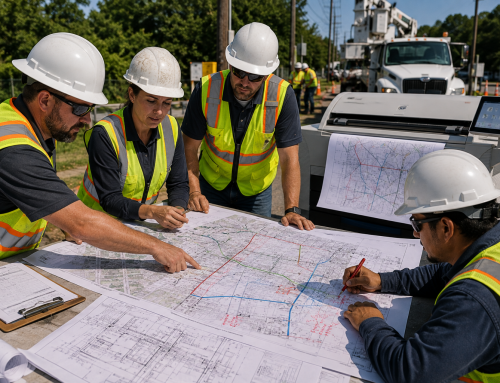
Large-format CAD drawings remain essential for manufacturing teams because many plant projects require details that are difficult to review on a small screen. Engineers, maintenance teams, production supervisors, contractors, and facility managers often need oversized drawings they can mark up, compare, carry, post, or review near the equipment.
Common engineering print applications include:
- Facility layouts.
- Equipment installations.
- Maintenance projects.
- Utility maps.
- Electrical plans.
- Mechanical plans.
- Process changes.
- Line expansions.
- Machine relocations.
- Production cell layouts.
- Contractor coordination drawings.
- Plant improvement plans.
When teams rely entirely on outside printing services, even small delays can create bottlenecks. An engineer updates a drawing. The file gets sent out. The team waits. Then someone notices one more revision. The process starts again.
With in-house wide format printing, updated drawings can be available within minutes. That keeps projects moving and reduces unnecessary interruptions.
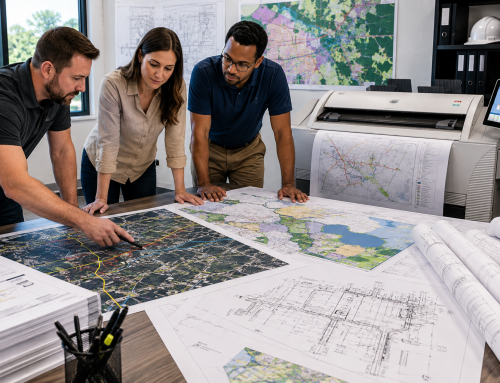
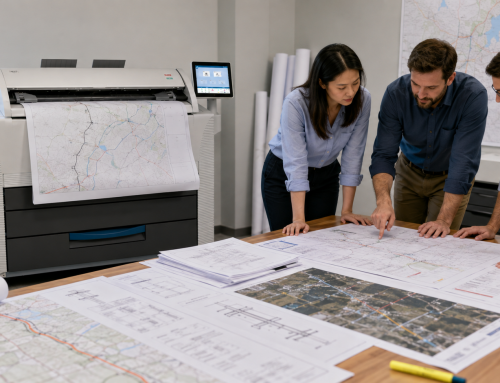
Printed CAD drawings can also improve communication during group review. A team can stand around a full-size drawing, mark up changes, identify clearance concerns, compare options, and make decisions faster than they might on a small screen.
Da-Com’s article on large-format printing for engineering projects explains how oversized drawings support readability, field use, revisions, and communication. Those same principles apply to manufacturers that depend on engineering prints, equipment layouts, and facility plans.
Faster Facility Changes Mean Less Production Disruption
Manufacturing facilities change constantly. A workstation moves. A new production cell gets added. A forklift route changes. A storage area gets relocated. A temporary project area opens. A department expands. A customer visit requires a cleaner route through the plant.
When signage and graphics fall behind those changes, confusion follows.
Employees may not know:
- Where materials belong.
- Which path to follow.
- Which area has changed.
- Where equipment has moved.
- Which temporary route is active.
- Where visitors should report.
- Which department owns a space.
- Which work zone is restricted.
In-house wide format printing allows facilities to create temporary signs, updated labels, department identifiers, directional graphics, safety notices, and facility maps as changes happen. Not days later. Not weeks later. Immediately.
That speed helps reduce confusion and keeps production flowing.
For example, if a storage area changes, the facility team can print updated labels and directional signs the same day. If a temporary construction area blocks a normal walking path, the team can print rerouting signs immediately. If a department moves, the plant can update wayfinding graphics before the next shift arrives.
These updates may seem small, but small delays can add up quickly in a manufacturing environment. The faster employees and visitors understand the new layout, the faster they can move through the facility without interrupting others.
Safety Updates Can Happen Right Away
Safety communication should not be delayed because someone is waiting on printed materials. Manufacturing environments move quickly, and when a hazard changes, communication should change with it.
In-house wide format printing can help teams produce safety materials quickly, including:
- PPE signs.
- Restricted-area graphics.
- Lockout/tagout visuals.
- Hazard notices.
- Temporary warning signs.
- Forklift traffic signs.
- Pedestrian route signs.
- Emergency exit reminders.
- First aid location signs.
- Chemical area signs.
- Machine safety reminders.
- Visitor safety instructions.
OSHA’s Hazard Communication resources explain that chemical hazard information must be available and understandable to workers through labels, safety data sheets, and training. You can review OSHA’s resource here: OSHA Hazard Communication.
OSHA also has specifications for accident prevention signs and tags. OSHA defines signs as surfaces prepared to warn or provide safety instructions for workers or members of the public who may be exposed to hazards. You can review OSHA’s accident prevention sign and tag requirements here: OSHA 1910.145 accident prevention signs and tags.
ANSI Z535 also provides guidance for safety signs, colors, symbols, labels, tags, and safety information. Consistent safety colors and symbols can help employees recognize important messages faster. You can review ANSI’s safety signage resource here: ANSI Z535 Safety Collection.
In-house wide format printing does not replace a safety program, policy, training, or compliance review. But it can help manufacturing teams communicate safety updates faster and more visibly.
That can be especially useful during temporary projects, equipment changes, contractor work, audits, customer visits, or emergency corrective actions.
Lean Manufacturing Depends on Visual Communication
Many Lean manufacturing initiatives depend on visual communication. If information is difficult to see, it is harder to act on. If standards are hidden in binders or digital folders, employees may rely on memory. If improvement goals are not visible, teams may lose focus.
In-house wide format printing supports Lean tools such as:
- KPI boards.
- Production dashboards.
- Process maps.
- Shift communication boards.
- 5S graphics.
- Kaizen project displays.
- Standard work visuals.
- Quality boards.
- Continuous improvement walls.
- Shadow board graphics.
- Material flow maps.
When information is visible, teams spend less time asking questions. They can quickly understand priorities, performance, and expectations. That supports faster decision-making and fewer delays.
NIST MEP’s Lean and Process Improvement resource explains that MEP Center experts help manufacturers implement Lean process improvements to increase efficiency and value added at manufacturing operations. You can review the resource here: NIST MEP Lean and Process Improvement.
Visual management is not only about making the plant look organized. It is about helping people understand the current condition. Are we on target? Where are the constraints? What changed since the last shift? Which action items are open? What needs attention today?
In-house wide format printing gives teams the ability to update those visuals quickly. That matters because Lean communication should reflect the current reality of the plant, not last month’s process.
Reducing Contractor and Maintenance Delays
Maintenance and facility projects often involve outside contractors. Those contractors need information before they can work efficiently. They need plans, layouts, wayfinding, safety instructions, equipment details, and project boundaries.
Without clear communication, projects slow down.
In-house wide format printing helps manufacturing teams provide:
- Site maps.
- Installation drawings.
- Temporary signs.
- Work-zone graphics.
- Safety instructions.
- Utility maps.
- Equipment placement drawings.
- Contractor entrance signs.
- Restricted-area notices.
- Temporary traffic flow graphics.
The faster contractors receive information, the faster projects can move forward. This is especially important when contractors are working around active production. Every unclear instruction or missing drawing can create another pause.
For maintenance teams, immediate printing can also reduce delays during repairs. If a technician needs an updated equipment layout, wiring diagram, utility map, or marked-up drawing, waiting for outside production may not be practical.
In-house wide format printing supports faster access to the documents and visuals maintenance teams need to keep work moving.
Better Communication During Equipment Installations
Equipment installations create many opportunities for downtime. Teams often need layout drawings, utility diagrams, safety graphics, process instructions, training visuals, temporary wayfinding, and updated workflow boards.
Waiting for printed materials can slow implementation.
In-house wide format printing allows teams to make revisions and print updated materials immediately. That flexibility becomes especially valuable during large projects when changes happen frequently.
For example, a new production line installation may require:
- Machine placement drawings.
- Electrical and utility diagrams.
- Temporary safety signage.
- Contractor work-zone signs.
- Updated walkway markings.
- Training posters for operators.
- Workflow boards for the new process.
- Material staging labels.
- Quality control visuals.
- Updated facility maps.
If every change requires outside printing, the project may lose time waiting on revisions. With in-house wide format printing, the team can respond as the project changes.
This does not eliminate every installation delay. But it can remove one common bottleneck: waiting for the visual materials needed to explain the change.
Supporting Audit Readiness Without the Rush
Manufacturing leaders often see the same pattern. An audit gets scheduled. A customer tour is added. Leadership announces a facility walk-through. Suddenly everyone notices outdated signs, old boards, missing graphics, and facility visuals that no longer match the current process.
Then the rush begins.
In-house wide format printing helps facilities respond faster by producing:
- Updated signage.
- Department graphics.
- Visitor routing.
- Compliance visuals.
- Training materials.
- Safety reminders.
- Production boards.
- Quality boards.
- Facility maps.
- Temporary banners.
The goal is not simply to prepare faster. The goal is to stay prepared.
When visual communication can be updated easily, facilities are less likely to fall behind. A quarterly visual communication review can help leaders identify outdated signs, incorrect maps, old safety notices, and boards that no longer reflect the current operation.
This keeps the plant looking organized and helps employees work from current information.
For manufacturers managing recurring print needs, Da-Com’s managed print services can help organizations gain visibility and control over print processes, usage, supplies, and support needs.
Comparing In-House Printing and Outsourced Printing
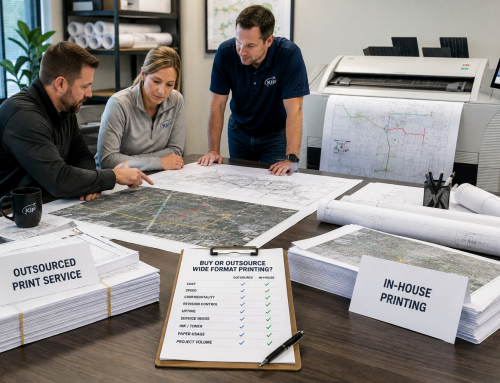
In-house wide format printing and outsourced printing both have value. The right strategy depends on the facility’s volume, urgency, materials, staffing, and application needs.
| Factor | In-House Printing | Outsourced Printing |
|---|---|---|
| Turnaround time | Immediate or same day | Often days or longer |
| Revision flexibility | High | More limited after production begins |
| Emergency updates | Strong fit | May be slower |
| Daily engineering prints | Efficient for frequent use | Less efficient for constant revisions |
| Specialized materials | Depends on equipment and supplies | Often better for complex applications |
| Installation services | Internal responsibility | Often available through specialty providers |
| Control over priorities | High | Dependent on vendor schedule |
| Best use case | Daily operational prints and urgent updates | Specialty graphics, large campaigns, and complex installs |
Many manufacturers use a hybrid strategy. They keep in-house wide format printing available for daily operational needs, CAD drawings, temporary signage, Lean boards, and urgent updates. Then they outsource specialty projects that require advanced finishing, installation, unusual materials, or high-volume production.
This approach gives the plant speed and flexibility while still allowing access to specialized support when needed.
When In-House Wide Format Printing Makes the Most Sense
In-house wide format printing often works best when facilities regularly produce large-format materials that support daily operations.
It may be a strong fit if your team frequently needs:
- CAD drawings.
- Engineering documents.
- Workflow boards.
- Safety signage.
- Production graphics.
- Temporary project materials.
- Facility labels.
- Training posters.
- Lean manufacturing visuals.
- Quality displays.
- Maintenance diagrams.
- Process maps.
The more frequently these materials are needed, the more valuable immediate access becomes. Manufacturing teams benefit most when speed and flexibility directly affect operations.
In-house wide format printing can be especially valuable for facilities that are expanding, changing workflows, running multiple shifts, supporting customer audits, implementing Lean initiatives, or managing frequent engineering revisions.
Da-Com’s office equipment solutions can support businesses that need dependable print, scan, and document technology to reinforce workflows across office and production environments.
Why Manufacturing Leaders Want More Control
The strongest reason many leaders bring printing in-house is not only cost. It is control.
Manufacturing leaders want to know they can respond quickly. They want information available when people need it. They want fewer delays, fewer bottlenecks, and fewer surprises. They want to avoid waiting on an outside schedule when a production issue needs an immediate update.
In-house wide format printing supports that goal by making visual communication easier to create, update, and deploy throughout the facility.
That control can matter during:
- Machine downtime.
- Line changes.
- Facility moves.
- Safety updates.
- Equipment installations.
- Customer audits.
- Training rollouts.
- New employee onboarding.
- Lean improvement events.
- Contractor projects.
- Emergency repairs.
When communication improves, downtime often decreases. Employees can see the update. Maintenance can access the drawing. Contractors can follow the correct route. Supervisors can post the revised workflow. Safety teams can update the sign. Engineering can print the new layout.
One fast print job may not solve every problem, but it can remove a delay that would otherwise slow the team down.
Why St. Louis and Southern Illinois Manufacturers Are Investing in Faster Printing
Manufacturing operations throughout St. Louis, St. Charles, the Metro East, and Southern Illinois continue to evolve. Facilities are expanding operations, modernizing production, supporting aerospace programs, implementing Lean initiatives, hiring new employees, and upgrading equipment.
All of these changes increase demand for visual communication.
Manufacturers need information that is current, visible, and easy to access. They need engineering drawings available for revisions. They need safety communication that can change as hazards change. They need workflow boards that reflect today’s process. They need facility signage that keeps up with movement, growth, and reorganization.
The National Association of Manufacturers reports that manufacturing contributes trillions of dollars to the U.S. economy and supports millions of jobs. You can review NAM’s manufacturing data here: NAM Facts About Manufacturing.
For local manufacturers, speed matters because production environments do not stand still. The ability to print critical materials on demand helps organizations stay agile while supporting productivity and operational control.
Choosing the Right In-House Wide Format Printing Strategy
Before investing in a device or changing the print workflow, manufacturers should evaluate what they actually need to print and how often they need it.
Useful questions include:
- How often do we print engineering drawings?
- How often do drawings change?
- Do we need color, black-and-white, or both?
- Which departments will use the equipment?
- Do we need scanning as well as printing?
- What sizes do we print most often?
- Which materials do we need for signage and graphics?
- Who will manage supplies?
- Who will support the equipment?
- What happens if the device goes down?
- Which projects should still be outsourced?
- How will we control file versions?
- How will we keep approved templates organized?
A strong strategy should match the plant’s real workflow. A facility that prints CAD drawings every day may need a different setup than a facility that mainly prints occasional safety graphics. A manufacturer with several departments may need access controls, file templates, and clear ownership. A plant with frequent production changes may need faster color output and reliable supplies.
The right solution should reduce friction, not create another burden for the team.
Frequently Asked Questions
How does in-house wide format printing reduce downtime?
It allows manufacturers to print engineering drawings, signs, labels, workflow boards, safety visuals, and facility graphics immediately instead of waiting for outside production and delivery. Faster access to information helps teams respond more quickly when changes happen.
What materials can manufacturers print internally?
Common applications include CAD drawings, facility maps, workflow boards, safety signs, production graphics, process maps, training posters, temporary project signage, quality displays, and Lean manufacturing visuals.
Is in-house printing better than outsourcing?
It depends on volume and application. Many manufacturers use in-house wide format printing for daily needs and urgent updates, while outsourcing specialized graphics, unusual materials, installation-heavy projects, or large campaigns.
Which departments benefit from wide format printing?
Engineering, maintenance, operations, safety, quality, facilities, training, HR, and leadership teams can all benefit from faster access to visual communication tools.
Can in-house printing support Lean manufacturing?
Yes. Visual management tools such as KPI boards, process maps, 5S graphics, standard work posters, and continuous improvement displays are commonly produced using wide format printers.
How often should facility visuals be updated?
Facility visuals should be updated whenever equipment moves, workflows change, safety requirements are revised, departments relocate, production priorities shift, or old visuals no longer match current operations.
Build a Faster Manufacturing Communication Workflow
Manufacturing teams cannot afford unnecessary delays. People need information. Projects need drawings. Safety updates need visibility. Facility changes need communication. The faster those things happen, the easier it is to keep production moving.
That is why many manufacturers view in-house wide format printing as more than a printer. They see it as a tool for reducing downtime, improving communication, supporting Lean manufacturing, and helping the facility stay ready when changes happen.
When information is available exactly when it is needed, the entire operation works better. Employees stop guessing. Supervisors repeat fewer instructions. Contractors receive clearer direction. Engineering teams review changes faster. Safety teams update communication sooner. Production stays more aligned.
If you are evaluating in-house wide format printing solutions for your manufacturing facility in St. Louis, Columbia, or Southern Illinois, contact Da-Com today. From engineering printing and workflow boards to facility graphics, safety signage, and production visuals, Da-Com can help manufacturers build a printing strategy that supports productivity, reduces downtime, and improves operational efficiency.


Leave A Comment