

Wide Format Printing for Manufacturers: Best Uses
Wide format printing for manufacturers is one of the most practical ways to improve communication across a busy plant. Manufacturing facilities change quickly. A new production line gets added. A machine moves. A workflow changes. A safety initiative launches. A customer tour gets scheduled. A department expands. Before long, the signs, labels, boards, floor graphics, and drawings that once made sense no longer match the way the facility actually operates.
That creates confusion. Employees stop and ask questions. Supervisors repeat the same instructions. Visitors get lost. Contractors enter the wrong area. Materials sit where they do not belong. Production goals are posted in one location while the work happens somewhere else. Engineering drawings are stuck on a screen when a team needs to review them near the equipment.
This is where wide format printing becomes much more than a print project. It becomes part of how a manufacturing facility communicates.
The best visual tools help people understand where to go, what to do, what to avoid, and what information matters most. In a plant environment, that clarity supports safety, productivity, training, continuous improvement, audit readiness, and a more professional facility experience.
For manufacturers across St. Louis, St. Charles, the Metro East, and Southern Illinois, wide format printing for manufacturers can help turn complicated plant information into visible, practical communication. From manufacturing floor graphics and workflow boards to industrial banners, CAD drawings, safety signage, and Lean manufacturing visuals, these applications help facilities reduce guessing and keep work moving.
Quick Answer: Best Uses of Wide Format Printing for Manufacturers
The best uses of wide format printing for manufacturers include floor graphics, workflow boards, CAD drawings, safety signage, Lean manufacturing visuals, production boards, department signs, wayfinding graphics, training displays, and facility banners.
These tools help manufacturing teams communicate information at the point of need. Instead of relying only on meetings, emails, binders, or verbal reminders, facilities can place critical information where employees, supervisors, contractors, auditors, and visitors can see it.
Common applications include:
- Manufacturing floor graphics for walkways, staging areas, and traffic flow.
- Workflow boards for production priorities, KPIs, and shift communication.
- CAD drawing printing for engineering reviews, equipment layouts, and facility planning.
- Safety signage for PPE, hazards, restricted areas, and emergency information.
- Lean manufacturing graphics for 5S, process flow, standard work, and visual management.
- Industrial banners for milestones, values, campaigns, and temporary announcements.
- Department signs and wayfinding graphics for navigation and visitor control.
- Training graphics for SOPs, equipment instructions, and onboarding support.
Each application has a different purpose, but the goal is the same: make information easier to see, understand, and act on.
Da-Com’s wide format printer solutions support organizations that need large-scale output for signs, posters, graphics, technical drawings, maps, plans, and facility communication materials.
Why Visual Communication Matters in Manufacturing
Manufacturing facilities are busy environments. People move through production areas, maintenance zones, shipping docks, receiving areas, warehouses, labs, tool rooms, offices, and customer-facing spaces. Every day, employees make hundreds of small decisions that affect safety, quality, speed, and communication.
Good visual communication helps people quickly understand:
- Where to go.
- What route to follow.
- Where materials belong.
- What hazards exist.
- What PPE is required.
- How a process should work.
- Which team owns an area.
- Where visitors should report.
- What goals or metrics matter today.
- Which drawing, instruction, or workflow applies.
When information is visible, employees spend less time guessing. That helps create a safer, more consistent, and more productive workplace.
This is especially important as manufacturing environments become more complex. Facilities may operate across multiple shifts, use temporary labor, support customer audits, train new employees, manage multilingual teams, and coordinate contractors or vendors. Visual workplace tools help create a shared language across departments and shifts.
Wide format printing for manufacturers supports that communication on a plant-wide scale. Instead of limiting information to paper handouts or small office signs, manufacturers can create durable visuals that fit the physical environment: floors, walls, windows, work cells, maintenance areas, training rooms, engineering spaces, and production boards.
The National Association of Manufacturers reports that manufacturing contributes trillions of dollars to the U.S. economy and employs millions of people, which underscores why plant productivity, safety, and operational clarity matter at both the local and national level. You can review NAM’s manufacturing data here: NAM Facts About Manufacturing.
Da-Com’s managed print services help businesses gain visibility and control over print processes, which can be valuable for manufacturers managing recurring print needs across offices, production floors, warehouses, and departments.
Manufacturing Floor Graphics for Traffic, Safety, and Flow
Manufacturing floor graphics are one of the most effective applications of wide format printing for manufacturers because they make traffic flow visible. A well-marked floor can help employees, forklift operators, contractors, and visitors understand movement patterns without needing constant verbal direction.
Floor graphics can identify:
- Pedestrian walkways.
- Forklift routes.
- Material staging areas.
- Shipping zones.
- Receiving zones.
- Inspection areas.
- Safety buffer zones.
- Emergency paths.
- Tool return areas.
- Quality hold areas.
- Waste and recycling points.
- Visitor-safe paths.
Instead of relying only on signs posted at eye level, the floor itself becomes part of the communication system. This is useful because plant employees naturally look at the work area around them. A clear floor marking can guide movement at the exact point where the decision is made.
Benefits of Manufacturing Floor Graphics
| Benefit | Result |
|---|---|
| Improved safety | Reduces confusion around pedestrian, forklift, and material movement |
| Better organization | Defines work zones, storage locations, and staging areas |
| Faster movement | Helps employees and visitors navigate more easily |
| Lean support | Improves workflow visibility and supports 5S practices |
| Audit readiness | Shows that the facility has organized, visible operational controls |
The best floor graphics are designed for the environment. Manufacturing floors may face forklift traffic, foot traffic, cleaning procedures, oils, dust, chemicals, and temperature changes. Materials and placement should be chosen carefully so graphics remain useful and professional over time.
For example, a walkway marking in a light-use office hallway is very different from a floor graphic in a busy production aisle. A plant should consider surface condition, cleaning schedule, traffic volume, installation timing, and safety requirements before choosing materials.
Workflow Boards Keep Teams Aligned Across Shifts
Workflow boards are another high-value use of wide format printing for manufacturers because they help teams stay aligned. Manufacturing leaders often spend significant time making sure the right information reaches the right people at the right time. A clear board can make that information easier to see and easier to update.
Wide format printing can support:
- Production boards.
- KPI boards.
- Shift communication boards.
- Quality boards.
- Performance dashboards.
- Maintenance status boards.
- Continuous improvement boards.
- Project tracking boards.
- Safety scoreboards.
- Team huddle boards.
- Visual scheduling boards.
These boards help employees quickly see priorities, goals, status, and progress. Instead of searching through email or waiting for a supervisor to explain the day’s focus, teams can gather around a board and review the same information.
Workflow boards are especially useful in multi-shift environments. When one shift ends and another begins, information can get lost. A clear communication board provides a consistent place for updates, issues, goals, and follow-up items.
What Makes a Workflow Board Effective?
A good workflow board is easy to read, easy to update, and placed near the work. It should not be buried in a conference room if the work happens on the production floor.
Strong workflow boards usually include:
- A clear title.
- Simple sections.
- Large text.
- Color-coded categories where helpful.
- Space for updates.
- Metrics that matter to the team.
- Ownership or responsibility indicators.
- Current status, not outdated information.
The board should support action. If employees cannot tell what changed, what needs attention, or what success looks like, the board may need to be simplified.
CAD Drawing Printing Supports Real-World Review
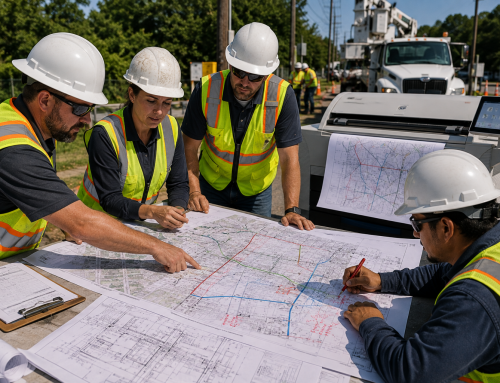
CAD drawing printing is a core part of wide format printing for manufacturers. Even as manufacturing becomes more digital, printed CAD drawings remain essential. Engineers, maintenance teams, contractors, production personnel, and facility managers often need large-format documents that are easy to review in real-world environments.
CAD and engineering prints are commonly used for:
- Facility layouts.
- Machine installations.
- Process designs.
- Utility maps.
- Construction plans.
- Equipment modifications.
- Production line planning.
- Plant expansions.
- Electrical and mechanical plans.
- Maintenance planning.
- Contractor coordination.
Digital files are useful, but large printed drawings still have advantages. A team can stand around a full-size drawing, mark up changes, compare equipment layouts, check clearances, and discuss installation details without zooming in and out on a small screen.
This is especially valuable when multiple people need to review the same plan. A maintenance lead, engineer, safety manager, production supervisor, and outside contractor may all see different concerns. A printed drawing gives them a shared reference point.
Printed CAD drawings can also support field work. A technician near a machine may need a large drawing that can be reviewed quickly. A contractor may need a set that can travel with the project. A facility manager may need a wall map to compare utilities, production areas, or planned changes.
Da-Com’s article on large-format printing for civil engineering projects explains how oversized drawings support readability, field use, revisions, and communication. Those same principles apply to manufacturing teams that depend on engineering prints and facility layouts.
Lean Manufacturing Graphics Support Visual Management
Lean manufacturing depends heavily on visibility. If a process is hard to understand, it is harder to improve. If standards are hidden, they are harder to follow. If tools, materials, and responsibilities are unclear, employees lose time searching or asking for help.
Lean manufacturing graphics help make the workplace easier to understand. NIST MEP supports manufacturers through operational improvements, risk reduction, growth, and competitiveness resources. You can review NIST MEP’s manufacturing support resource here: NIST Manufacturing Extension Partnership.
Popular Lean visual management applications include:
5S Boards
5S boards help maintain organization and accountability. They can show area ownership, cleaning standards, audit results, before-and-after visuals, and action items.
Shadow Boards
Shadow boards clearly show where tools belong. They reduce search time and make missing tools easier to identify.
Process Maps
Process maps show how work should flow. They can help new employees, cross-trained employees, and visitors understand how a cell or department operates.
KPI Dashboards
KPI dashboards show performance targets, production goals, quality metrics, safety metrics, and improvement progress.
Continuous Improvement Walls
Continuous improvement boards or walls can support Kaizen initiatives, employee suggestions, project tracking, and team engagement.
When Lean visuals are well-designed, they do not just decorate a wall. They help employees see the standard and improve the work. This is one reason wide format printing for manufacturers is so useful for continuous improvement programs.
Da-Com’s office equipment solutions can support businesses that need dependable print, scan, and document technology to reinforce operational workflows across office and production environments.
Safety Signage Is a Core Manufacturing Application
Safety signage is one of the most important uses of wide format printing for manufacturers. Signs are not decoration. They are part of how the operation communicates risk, expectations, and emergency information.
Safety signage can support:
- PPE requirements.
- Hazard communication.
- Restricted areas.
- Lockout/tagout reminders.
- Emergency exits.
- First aid locations.
- Fire equipment identification.
- Chemical handling instructions.
- Machine safety reminders.
- Visitor safety instructions.
- Forklift traffic warnings.
- Noise protection areas.
OSHA’s Hazard Communication resources explain that the Hazard Communication Standard provides a common and coherent approach to classifying chemicals and communicating hazard information on labels and safety data sheets. You can review OSHA’s resource here: OSHA Hazard Communication.
ANSI Z535 provides guidance for safety colors, signs, symbols, labels, tags, and safety information. Using consistent safety colors and symbols can help make hazard communication easier to recognize across a facility. You can review ANSI’s safety signs and symbols resource here: ANSI Z535 Safety Collection.
What Makes Manufacturing Safety Signage Work?
Effective safety signage is clear, visible, durable, and placed where the information is needed. A sign that is hidden behind equipment or printed too small does not help much. A sign that fades, peels, or becomes outdated can also create confusion.
Before printing safety signage, manufacturers should consider:
- Viewing distance.
- Lighting conditions.
- Language needs.
- Symbol use.
- Material durability.
- Indoor or outdoor placement.
- Chemical or moisture exposure.
- Whether the sign supports an existing safety procedure.
The goal is to make important safety information visible before someone needs to ask.
Industrial Banners Create Flexible Facility Communication
Industrial banners are sometimes overlooked, but they can be very useful for temporary or seasonal messaging. Unlike permanent signs, banners can be changed as priorities shift.
Common industrial banner applications include:
- Safety milestones.
- Employee recognition.
- Production achievements.
- Company values.
- Workforce initiatives.
- Recruiting campaigns.
- Open house events.
- Customer visits.
- Plant anniversaries.
- Quality campaigns.
- New product launches.
Banners can be placed in breakrooms, plant entrances, production areas, warehouses, training rooms, or visitor pathways. They are especially useful when a message needs visibility for a defined period of time.
For example, a plant may use a banner to celebrate one year without a recordable incident, promote an employee referral campaign, welcome a customer audit team, or highlight a quality initiative. These messages help build culture and reinforce priorities without requiring permanent signage.
Because priorities change quickly in manufacturing, banners are a flexible part of wide format printing for manufacturers. They allow facility leaders to communicate clearly without committing every message to a permanent sign.
Department Signs and Wayfinding Improve Navigation
Large manufacturing facilities can be difficult to navigate. New employees, contractors, customers, delivery drivers, auditors, vendors, and visitors may not know where to go. Even experienced employees can struggle when facilities expand or departments move.
Wide format printing supports wayfinding and department identification through:
- Department signs.
- Building directories.
- Dock door numbers.
- Parking signage.
- Visitor routing.
- Contractor access signs.
- Warehouse navigation.
- Production area identification.
- Office-to-plant transition signs.
- Temporary routing during construction or maintenance.
Clear wayfinding reduces interruptions. If visitors and contractors know where to report, staff spend less time redirecting people. If employees know where materials, departments, or support functions are located, movement becomes easier.
Wayfinding also affects first impressions. A facility that is easy to navigate feels more organized and professional, especially during customer tours, audits, hiring events, supplier visits, and workforce recruitment events.
Training Graphics Help Build Consistency
Training is one of the biggest challenges facing manufacturers. As facilities hire new employees, cross-train teams, expand shifts, or introduce new equipment, visual training tools become increasingly valuable.
Wide format printing can support training through:
- SOP posters.
- Process graphics.
- Safety reminders.
- Equipment instructions.
- Skills development boards.
- Apprenticeship program displays.
- Orientation materials.
- Quality check visuals.
- Inspection reminders.
- Step-by-step task graphics.
Training graphics help reinforce information long after orientation ends. They place reminders where employees actually perform the work.
For example, a machine area may include a visual setup guide. A quality station may include a defect reference board. A packaging area may show correct pallet configuration. A tool crib may display check-in and check-out steps. These visuals reduce repeated questions and support consistency.
This makes training graphics another strong use case for wide format printing for manufacturers, especially in plants that are hiring, expanding, or standardizing processes across shifts.
Comparing Common Manufacturing Print Applications
| Application | Primary Purpose | Best Location |
|---|---|---|
| Floor graphics | Traffic and safety control | Production floor |
| Workflow boards | Team communication | Department work areas |
| CAD drawings | Engineering review | Engineering, maintenance, and project areas |
| Safety signs | Hazard awareness | Throughout facility |
| Banners | Temporary communication | Entrances, common areas, and production zones |
| Process maps | Workflow visibility | Production cells |
| Wayfinding signs | Navigation | Entrances, corridors, docks, and warehouses |
| Training graphics | Skill reinforcement | Training areas and workstations |
This comparison can help manufacturing leaders think through which visual tools matter most. A plant does not need to update everything at once. Many facilities begin with the highest-friction areas: unsafe traffic flow, confusing workflows, outdated safety signs, missing department identification, or hard-to-read engineering drawings.
Planning a Facility Visual Communication Project
A plant-wide visual communication project works best when it starts with operational goals, not just a list of signs.
Before printing, manufacturing leaders should ask:
- Where do employees currently stop and ask questions?
- Where do visitors or contractors get confused?
- Where are safety expectations unclear?
- Which work areas need better identification?
- Which processes need visual support?
- Which boards are outdated?
- Which CAD drawings or facility layouts are used most often?
- Which temporary messages need banners or campaign graphics?
- Which materials need to withstand industrial conditions?
These questions help prioritize the project. A plant may start with traffic flow graphics, then move to safety signs, then update department identification, then create new workflow boards.
The best approach is practical and phased. Start with the visuals that remove the most confusion or support the highest-risk areas. Then build a repeatable process for future updates.
For manufacturers in St. Louis, St. Charles, the Metro East, and Southern Illinois, a phased approach can also help manage budgets and timing. Instead of trying to update the whole plant at once, start with the areas where better visibility would immediately improve safety, workflow, or visitor experience.
Why St. Louis, Columbia, and Southern Illinois Manufacturers Are Expanding Visual Communication
Manufacturing remains an important part of the regional economy throughout St. Louis, the Metro East, and Southern Illinois. Facilities continue to add equipment, expand operations, recruit workers, support customer audits, and manage more complex production environments.
As plants become larger and more sophisticated, visual communication becomes more important. The facilities that perform best often share a few common traits:
- Information is easy to find.
- Employees know where to go.
- Safety expectations are visible.
- Visitors understand the facility.
- Work areas are clearly identified.
- Production goals are easy to see.
- Engineering information is available when teams need it.
- The plant feels organized and under control.
Wide format printing for manufacturers helps make that possible. It gives plants a practical way to turn facility knowledge into signs, boards, graphics, banners, and drawings that support real work.
Da-Com has been a customer-focused, family-owned company for more than 75 years. That local experience matters for manufacturers that need responsive service, practical guidance, and support from a team that understands regional business needs.
Frequently Asked Questions About Wide Format Printing for Manufacturers
What are the most common wide format printing applications in manufacturing?
The most common applications include floor graphics, safety signs, workflow boards, CAD drawings, process maps, department signage, wayfinding graphics, training posters, and banners.
Are manufacturing floor graphics durable enough for plant environments?
Yes, floor graphics can be designed with industrial-grade materials intended for foot traffic, forklift traffic, cleaning procedures, and daily wear. The right material depends on surface condition, traffic level, and plant conditions.
Why do manufacturers still print CAD drawings?
Printed CAD drawings make it easier for teams to review large-scale designs, installation plans, facility layouts, and engineering details in real-world work environments. They are especially useful during group review, installation, maintenance, and contractor coordination.
How do workflow boards improve manufacturing operations?
Workflow boards improve visibility, communication, accountability, and alignment between departments and shifts. They give teams a shared place to review priorities, goals, issues, and progress.
Can wide format printing support Lean manufacturing?
Yes. Lean programs often depend on visual management tools such as 5S boards, process maps, standard work posters, KPI dashboards, shadow boards, and continuous improvement displays.
How often should manufacturing signs and boards be reviewed?
Manufacturing visuals should be reviewed whenever equipment moves, workflows change, safety procedures update, production areas expand, or old boards stop matching current operations. A quarterly or semiannual visual communication review can help keep materials current.
Build a Clearer Manufacturing Facility
The best manufacturing facilities make information easy to find. They remove confusion, reduce guessing, and help people understand what to do before questions arise.
Wide format printing for manufacturers supports that goal in many different ways. From manufacturing floor graphics and workflow boards to industrial banners, safety signs, CAD drawings, training posters, and wayfinding graphics, these tools help plants become safer, more organized, and easier to manage.
When visual communication improves, the entire operation benefits. Employees know where to go. Supervisors repeat fewer instructions. Visitors understand the facility. Teams see priorities faster. Engineering drawings become easier to review. The plant feels more professional and under control.
If you are looking for wide format printing solutions for your manufacturing facility in St. Louis, Columbia, or Southern Illinois, contact Da-Com today. From floor graphics and workflow boards to safety signage, engineering prints, industrial banners, and facility-wide visual communication systems, Da-Com can help manufacturers create environments that are clear, organized, and built for real-world operations.
“`

Leave A Comment