
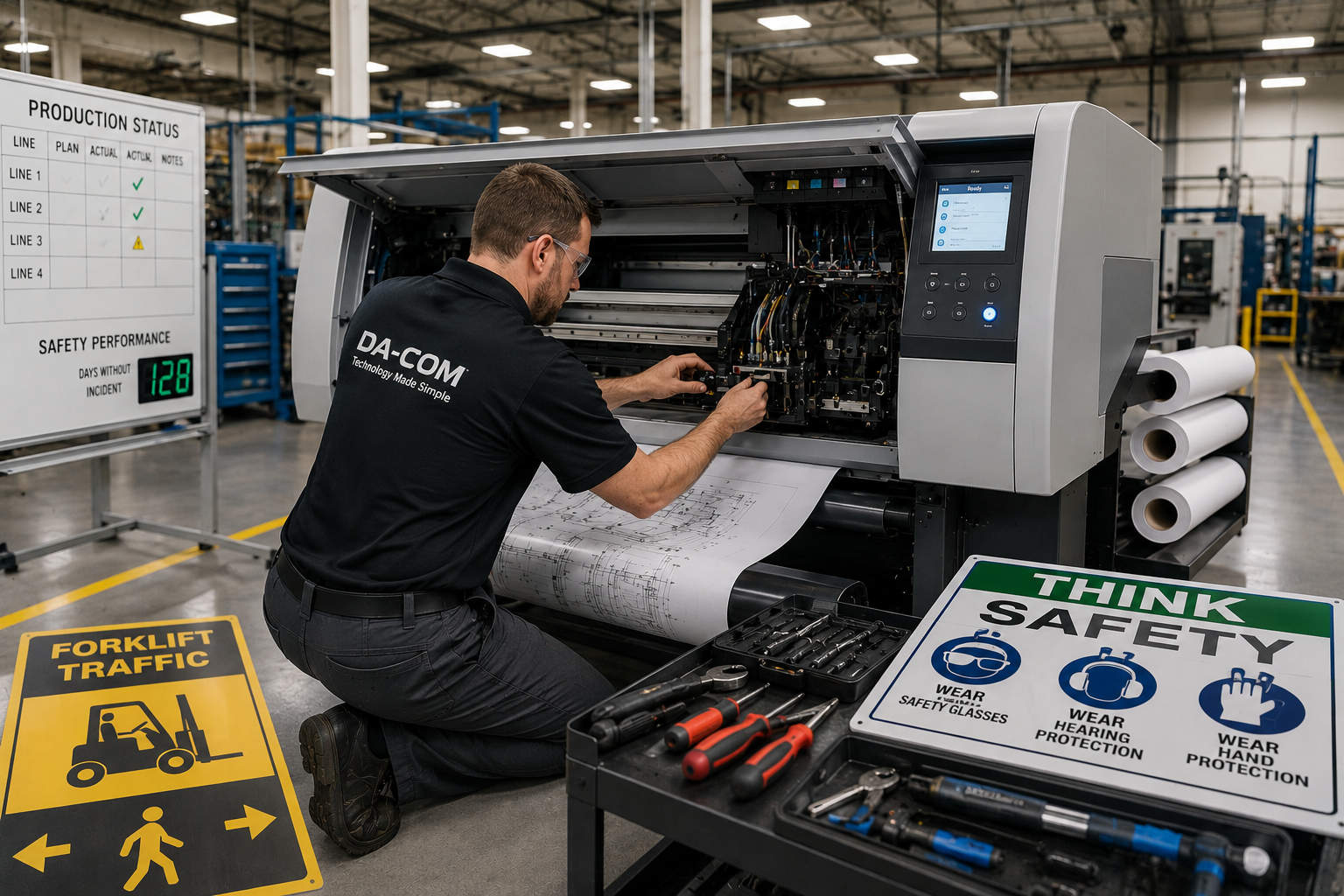
Wide Format Printer Service and Maintenance
Wide format printer service and maintenance matters when manufacturing teams depend on large-format equipment for engineering drawings, safety signage, facility labels, workflow boards, production graphics, and plant communication. When the printer works, teams can respond quickly. When it goes down, the delay can ripple through engineering, maintenance, safety, facilities, production, and quality.
A drawing needs to be printed before a maintenance project starts. A safety sign needs to be updated before the next shift. A production board needs to be ready for a team meeting. A customer visit is coming. A contractor needs revised installation drawings. Then the wide format printer stops working.
Now the team is waiting.
They are waiting for support. Waiting for parts. Waiting for supplies. Waiting for drawings. Waiting for signage. Waiting for a fix that should not have become an operational headache.
That is why manufacturing teams should treat wide format printer service and maintenance as part of operational support, not just an equipment issue. You are not simply maintaining a machine. You are protecting workflow, speed, communication, and the ability to respond when the plant needs something now.
For manufacturers in St. Louis, St. Charles, the Metro East, and Southern Illinois, the right local provider can make the difference between a small delay and a larger disruption. This guide explains what to look for in a local wide format printer service provider, why preventive maintenance matters, how printer support affects manufacturing workflows, and which questions to ask before choosing a partner.
Quick Answer: What to Look for in Wide Format Printer Service and Maintenance
Manufacturers choosing a wide format printer service and maintenance provider should look for fast local response, technicians who understand industrial environments, preventive maintenance plans, strong parts and supply support, clear communication, and help with long-term equipment planning.
A strong local provider should support:
- Wide format printer service.
- Wide format printer maintenance.
- Engineering and CAD printing workflows.
- Manufacturing printer support.
- Industrial printer service needs.
- Preventive printer maintenance.
- Parts and supply planning.
- Remote troubleshooting when possible.
- On-site service when needed.
- Equipment recommendations when devices no longer fit the workflow.
The best provider should make printing easier to manage, not harder. They should help prevent downtime, communicate clearly, support the equipment your team depends on, and understand that wide format printing is often tied to real plant work.
Da-Com’s wide format printer solutions support organizations that need large-scale output for signs, posters, graphics, technical drawings, maps, plans, and facility communication materials.
Why Wide Format Printers Matter in Manufacturing
Manufacturing teams use wide format printers for much more than drawings. These devices often support engineering, facilities, maintenance, safety, quality, production, training, and leadership teams.
Common manufacturing applications include:
- CAD drawings.
- Engineering plans.
- Facility layouts.
- Equipment installation drawings.
- Maintenance diagrams.
- Utility maps.
- Safety signs.
- Floor graphics.
- Workflow boards.
- 5S visuals.
- Production charts.
- Training graphics.
- Equipment labels.
- Compliance graphics.
- Customer tour materials.
When the printer works, the day moves faster. Teams can print revised drawings, update a sign, produce a temporary label, prepare a board, or support a project without waiting on outside production.
When the printer does not work, people start waiting. Waiting creates friction. Friction creates delays. Delays can affect projects, meetings, repairs, audits, and production support.
Manufacturing buyers value accuracy, durability, speed, safety awareness, and repeatability. A sign, label, board, or drawing is not just printed material. It is part of how the plant runs.
That is why wide format printer service and maintenance should be evaluated through a manufacturing lens. The provider should understand that printer uptime can affect real work.
Why Local Wide Format Printer Service Matters
Speed matters when a wide format printer goes down. A national help desk may be fine for some office issues, but manufacturing teams often need faster, more accountable support.
A strong local provider should offer:
- Responsive phone support.
- Remote troubleshooting when possible.
- On-site service when needed.
- Clear service windows.
- Follow-through after the repair.
- Technicians who understand production environments.
- Support for supplies, parts, and maintenance planning.
Local service matters because manufacturing teams cannot always wait several days for a technician to arrive from outside the region. If engineering drawings, safety signage, or production materials are delayed, the equipment issue can become a workflow issue.
A local provider also learns your environment over time. They understand your building, printer usage, print volumes, common issues, access requirements, and plant expectations. That familiarity can make service smoother.
For manufacturers in St. Louis, St. Charles, the Metro East, Madison County, St. Clair County, and Southern Illinois, local accountability matters. A partner with regional technicians, responsive communication, and long-term service relationships can reduce the stress that comes with equipment problems.
Choose a Provider That Understands Manufacturing Workflows
Manufacturing is not the same as a regular office. Your wide format printer may support multiple teams and time-sensitive workflows. A provider should understand how the equipment fits into plant operations.
They should ask questions such as:
- How often are CAD drawings printed?
- Who needs access to the printer?
- Are drawings time-sensitive?
- Are safety signs printed in-house?
- Do reprints need to match previous versions?
- Is uptime critical for production support?
- Does the printer support engineering, maintenance, and facilities?
- Are color graphics needed, or mainly technical documents?
- Are there plant access or PPE rules for service visits?
- Does the device need scanning as well as printing?
- Are supplies managed centrally or by department?
A good provider does not treat your equipment like a simple office device. They understand that print delays can affect real work.
For example, a printer that supports daily engineering drawings may need a different service plan than a device used occasionally for posters. A machine that prints facility graphics and safety signs may need different media support than a printer used mostly for black-and-white CAD documents.
The right provider should help align equipment, maintenance, supplies, and service expectations with the way your plant actually works.
Preventive Printer Maintenance Helps Reduce Surprise Downtime
The best time to service a wide format printer is before it fails. Preventive maintenance helps reduce surprise downtime and gives manufacturing teams more control.
A preventive maintenance plan may include:
- Regular cleaning.
- Printhead inspection.
- Calibration.
- Firmware checks.
- Roll feed inspection.
- Ink or toner system review.
- Paper path checks.
- Parts wear review.
- Usage review.
- Print quality checks.
- Scanner inspection, if the device includes scanning.
- Environmental review for dust, heat, humidity, or production-floor exposure.
Preventive maintenance helps catch small issues before they become larger problems. That matters because wide format devices often support urgent work. A worn part, clogged printhead, paper feed issue, or supply problem can create delays at exactly the wrong time.
NIST research on manufacturing machinery maintenance found that establishments relying more on preventive and predictive maintenance saw measurable performance improvements, including less downtime compared with more reactive maintenance approaches. While that research focuses on manufacturing machinery broadly, the principle applies to critical support equipment too: preventive maintenance helps reduce the risk of unexpected failures.
For wide format printers, preventive maintenance can help protect print quality, reduce repeat service calls, extend equipment life, and make uptime more predictable.
Ask Which Brands and Devices the Provider Supports
Not every service provider supports every wide format printer. Before choosing a provider, ask which brands, models, and device types they sell, service, and maintain.
This matters because wide format printing is service-sensitive. A provider may be comfortable supporting standard office printers but not wide format devices used for CAD drawings, engineering plans, or industrial graphics.
Ask questions such as:
- Do you service our current wide format printer brand?
- Do your technicians have experience with this model?
- Can you support both printing and scanning functions?
- Do you support CAD and engineering workflows?
- Can you help with media and supply selection?
- Do you support color and black-and-white devices?
- Can you advise when a device is no longer the right fit?
- Do you provide replacement recommendations if needed?
Manufacturing teams should also ask whether the provider can support future equipment planning. A service partner who only fixes today’s issue may miss signs that the machine no longer fits the plant’s needs.
If usage has increased, supplies are becoming harder to source, print quality is declining, or service calls are becoming more frequent, the provider should be able to discuss options clearly.
Compare What Local Service Providers Offer
A provider should not just fix problems. They should help prevent them and make print support easier to manage.
| What to Look For | Why It Matters |
|---|---|
| Fast response time | Reduces downtime and waiting |
| Local technicians | Improves accountability and familiarity |
| Preventive maintenance | Helps avoid surprise failures |
| Brand expertise | Supports proper service and troubleshooting |
| Parts access | Speeds up repairs |
| Supply support | Keeps teams from running out of critical materials |
| Remote support | Solves simple issues faster |
| Clear communication | Reduces frustration and uncertainty |
| Equipment planning | Helps avoid wrong-fit machines |
| Manufacturing experience | Helps the provider understand plant urgency |
This comparison can help manufacturing teams choose a provider that supports uptime, not just repairs.
Da-Com’s managed print services help organizations gain visibility and control over print environments, supplies, usage, service needs, and long-term equipment planning.
Look for Clear Communication From Technicians
Plant leaders do not want vague updates when a printer is down. They want clear answers.
They need to know:
- What is wrong?
- Can it be fixed now?
- Do we need a part?
- How long will it take?
- Can we use a workaround?
- What caused the issue?
- What can we do to prevent this again?
A good technician explains the issue in plain language. No runaround. No unnecessary jargon. No making the customer chase updates.
Clear communication is especially important when multiple departments rely on the same device. If engineering, facilities, and safety teams are all waiting, the internal team needs a realistic update they can share.
A strong service provider should also document recurring issues. If the same problem keeps happening, the conversation should move beyond repair and toward root cause. Is the device being overused? Is the environment too dusty? Is the wrong media being used? Is the equipment aging? Is preventive maintenance too infrequent?
The goal is to reduce repeat frustration.
Ask About Supplies, Parts, and Media Support
A wide format printer is only useful if it has what it needs to run. Supply delays can create downtime just like equipment failure.
Ask your provider about support for:
- Ink.
- Toner.
- Paper rolls.
- Specialty media.
- Maintenance kits.
- Replacement parts.
- Service inventory.
- Delivery options.
- Media recommendations.
- Usage tracking.
Manufacturing teams often print a mix of documents and graphics. Engineering may need bond paper for CAD drawings. Safety may need more durable materials. Facilities may need labels or temporary signage. Training teams may need posters. Customer tours may require polished display materials.
A provider should understand which supplies fit which applications. The cheapest media is not always the best choice. Using the wrong media can affect print quality, durability, and equipment performance.
A strong local provider helps you stay ahead of supply needs, so your team is not surprised when a roll runs out before a deadline.
Remote and On-Site Support Both Matter
Not every printer issue requires a service visit. Some problems can be fixed remotely. A technician may be able to walk a team member through a paper path issue, settings adjustment, print queue problem, driver issue, or simple reset.
Remote support can save time.
But when on-site service is needed, your provider should be able to respond. Wide format printer service and maintenance often requires hands-on inspection, cleaning, calibration, parts replacement, or equipment adjustment.
The right partner offers both:
- Remote troubleshooting for faster first response.
- On-site service for issues that require physical repair.
- Clear escalation when remote support is not enough.
- Follow-up to confirm the device is working correctly.
This is one reason local accountability matters. A provider who can troubleshoot remotely and dispatch local technicians when needed gives manufacturing teams a more complete support path.
Choose a Consultative Provider, Not Just a Repair Vendor
A repair vendor fixes what is broken. A consultative provider helps you avoid future problems.
That difference matters for manufacturing teams.
A consultative provider can help answer questions such as:
- Is this printer still right for your needs?
- Is usage higher than expected?
- Are supply costs increasing?
- Would leasing make more sense?
- Should another department have access?
- Is a different model better for CAD drawings, signage, or graphics?
- Should some work be outsourced instead?
- Would a managed print strategy reduce internal burden?
- Is the equipment placed in the right environment?
- Would preventive maintenance reduce service calls?
The goal is not just to own equipment. The goal is to keep work moving.
NIST MEP works with U.S. manufacturers to strengthen competitiveness, productivity, and performance. You can review NIST MEP’s manufacturing support resources here: NIST Manufacturing Extension Partnership.
For manufacturing print environments, a consultative provider should look at the full workflow. That includes equipment, supplies, users, file types, service needs, downtime risk, and future growth.
Watch for Warning Signs When Choosing a Provider
Not every provider is the right fit for manufacturing. Be careful if a provider:
- Takes too long to respond.
- Does not service your equipment brand.
- Cannot explain issues clearly.
- Has weak parts access.
- Only reacts when something breaks.
- Does not offer preventive maintenance.
- Treats your plant like a standard office.
- Does not understand CAD or engineering workflows.
- Cannot support supplies or media planning.
- Pushes equipment without learning your needs.
- Cannot provide clear service expectations.
You need a partner who makes the job easier, not one more vendor to manage.
If your team constantly has to chase updates, order supplies separately, troubleshoot alone, and explain the same workflow needs repeatedly, the provider may not be giving you the support your plant needs.
Why Wide Format Printer Service and Maintenance Matters for Safety Communication
Manufacturing plants often depend on wide format equipment to produce safety signs, labels, warnings, and facility communication materials. If that equipment is unreliable, safety communication can fall behind.
OSHA’s accident prevention sign and tag standard covers the design, application, and use of signs or symbols intended to indicate and define specific hazards that could lead to injury or property damage if not designated. You can review the standard here: OSHA specifications for accident prevention signs and tags.
ANSI’s safety sign and label standards provide definitions and criteria for safety colors and safety symbols to warn against hazards and avoid injury. You can review ANSI’s resource here: ANSI safety signs and labels standards.
Wide format printers do not replace safety programs or regulatory review, but they can support clear and timely communication. If a facility needs to print a new PPE sign, restricted area notice, forklift route sign, or temporary hazard warning, printer reliability matters.
That is another reason wide format printer service and maintenance should be part of a plant’s support strategy.
Why Local Service Matters in St. Louis and Southern Illinois
Manufacturing teams in St. Louis, St. Charles, the Metro East, Madison County, St. Clair County, and Southern Illinois need practical support. Plants, warehouses, aerospace facilities, machine shops, fabrication shops, and industrial sites cannot afford slow service when equipment supports real work.
Local support helps with:
- Faster response.
- Better knowledge of the region.
- Stronger accountability.
- Easier communication.
- Long-term relationships.
- Better understanding of plant needs.
- More consistent service experiences.
The National Association of Manufacturers reports that manufacturing contributes trillions of dollars to the U.S. economy and supports millions of jobs. You can review NAM’s manufacturing data here: NAM Facts About Manufacturing.
For local manufacturers, equipment uptime is not theoretical. It affects the people trying to keep projects, production, maintenance, engineering, and safety communication moving.
Da-Com’s About Da-Com page explains that Da-Com has been a customer-focused, family-owned company for more than 75 years. That local experience matters for manufacturers that need responsive service, practical guidance, and support from a team that understands regional business needs.
Wide Format Printer Service and Maintenance Checklist
Before choosing a provider, ask these questions:
| Question | Why It Matters |
|---|---|
| Do you service our printer brand? | Confirms technical fit |
| How fast is your response time? | Protects uptime |
| Do you offer preventive maintenance? | Reduces surprise failures |
| Do you stock common parts? | Speeds up repairs |
| Can you support CAD workflows? | Helps engineering teams |
| Do you provide supplies? | Prevents supply delays |
| Can you help us evaluate equipment? | Supports long-term planning |
| Are your technicians local? | Improves accountability |
| Do you offer remote support? | Solves issues faster |
| Do you understand manufacturing environments? | Reduces hand-holding and improves fit |
This checklist can help your team compare providers and avoid choosing based only on price. The lowest-cost provider may not be the best value if slow service creates downtime, parts delays, or repeated frustration.
Frequently Asked Questions
How often should a wide format printer be serviced?
It depends on usage, model, environment, and print volume. High-volume manufacturing teams may need regular preventive maintenance to reduce downtime, protect print quality, and keep equipment reliable.
What causes wide format printer downtime?
Common causes include worn parts, clogged printheads, paper feed issues, calibration problems, supply shortages, outdated firmware, driver issues, and lack of maintenance.
Is local printer service better than national support?
For many manufacturers, local support offers faster response, stronger accountability, and technicians who understand regional needs and facility environments. Some manufacturers still use national support when required by equipment contracts, but local service can be valuable when speed matters.
Do wide format printers need preventive maintenance?
Yes. Preventive maintenance helps catch small issues before they turn into major downtime. It can also protect print quality, extend equipment life, and reduce repeat service calls.
Can one provider handle equipment, service, and supplies?
Yes. A single-provider approach can reduce vendor management, simplify support, and make issue resolution easier. This can be especially helpful for manufacturers that want one partner for equipment, supplies, maintenance, and long-term planning.
What departments benefit from wide format printer support?
Engineering, maintenance, facilities, safety, quality, production, training, HR, and leadership teams can all benefit when wide format printers are reliable and well supported.
Keep Your Wide Format Printing Ready When Your Team Needs It
Manufacturing teams already have enough to manage. They should not have to chase printer service too.
Your wide format printer supports real work. Drawings. Signs. Labels. Boards. Facility updates. Safety communication. Engineering revisions. Maintenance projects. Customer visits. Audit preparation.
When the printer goes down, the delay can ripple through the plant.
That is why choosing the right wide format printer service and maintenance provider matters. Look for a local partner who responds quickly, understands manufacturing, communicates clearly, supports your equipment, helps manage supplies, and provides preventive maintenance to reduce problems before they stop the work.
Because when your printer is ready, your team is ready. And that is one less thing on your plate.
If your manufacturing facility needs wide format printer service and maintenance in St. Louis, Columbia, or Southern Illinois, contact Da-Com today. Da-Com supports manufacturers with wide format equipment, service, supplies, maintenance, and practical guidance built around real plant needs.






Leave A Comment