
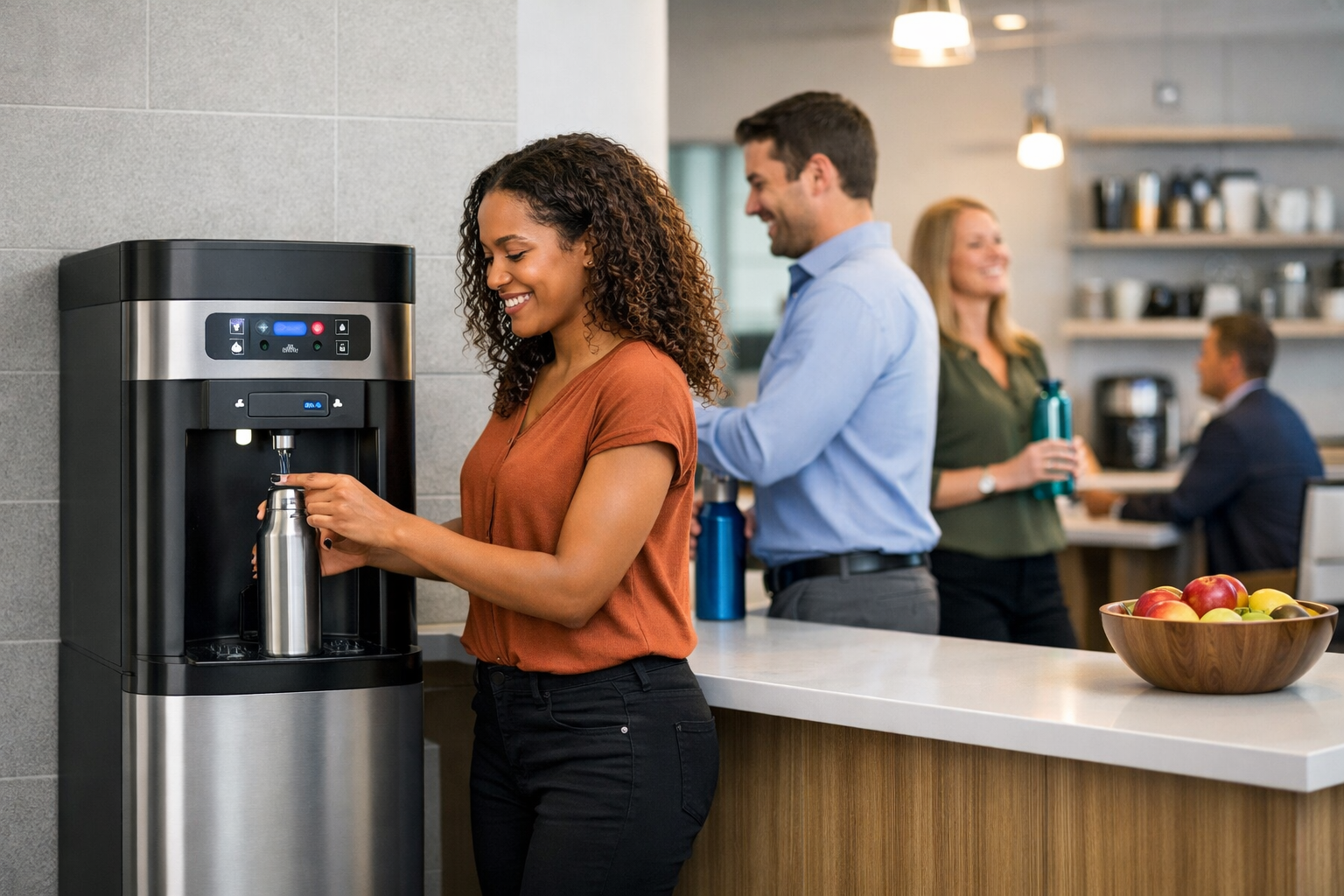
If you’re considering a bottleless water cooler in St. Louis that your businesses can rely on, you’re probably already done with the same old breakroom mess: heavy jugs, missed deliveries, stacks of empties, and that awkward moment when someone says, “We’re out… again.” And if you’re on the Illinois side of the river; Belleville, Edwardsville, Collinsville, Fairview Heights, O’Fallon, or anywhere in the Metro East, the pain is the same: storage, lifting, plastic waste, and inconsistent taste that makes people skip the water station and head for soda.
This guide will walk you through what “bottleless” actually means, what it costs in the real world, the filtration options that matter (carbon, RO, UV), and what installation from Purity Source looks like in a typical workplace. You’ll also get a practical checklist of questions to ask any provider, so you can choose a setup that stays clean, tastes great, and doesn’t become another task your team has to manage. Finally, you’ll see how Da-Com’s Purity Source program takes the entire water-and-ice headache off your plate across St. Louis and Southern Illinois: we size it, install it, and keep it running.
Bottleless water cooler: What “bottleless” actually means
A bottleless water cooler (often called a point-of-use or “POU” cooler) connects directly to your building’s water line instead of relying on 3- or 5-gallon jugs. You still get the familiar “water cooler” experience: cold water on demand, and often hot water too, even ice, but you remove the biggest pain points: deliveries, storage, lifting, and running out.
Whether you’re in St. Louis City, St. Louis County, St. Charles County, or the Metro East in Southern Illinois, the concept is the same: continuous water supply + on-site filtration/purification.
Bottleless Water Cooler vs. Bottled Delivery (simple definitions)
Bottled delivery (Jug Service):
- Vendor drops off full bottles
- You store them, lift them, swap them
- You manage inventory and reorder timing
- You deal with empties and recycling/returns
Bottleless Water Cooler (POU):
- Cooler is plumbed into a water line
- Water is filtered/purified inside the unit
- You get continuous supply, no “out of water” days
- Ongoing performance depends on proper service and filter changes
Common bottleless water cooler setups (what you’ll see most often)
Most organizations in the St. Louis metro and Southern Illinois end up choosing one of these configurations:
1) Cold + Hot dispenser (breakroom staple)
Great for coffee/tea, instant oatmeal, and general workplace hydration.
2) Cold + Hot + Room temperature + bottle-fill area
Ideal when lots of employees bring reusable bottles.
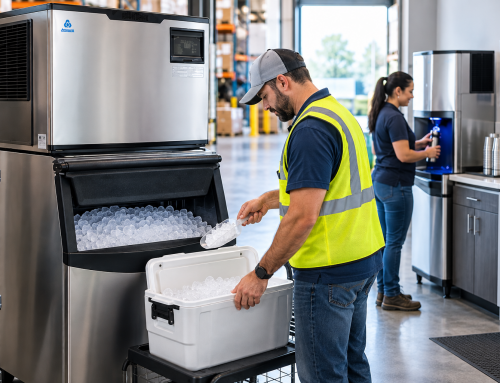
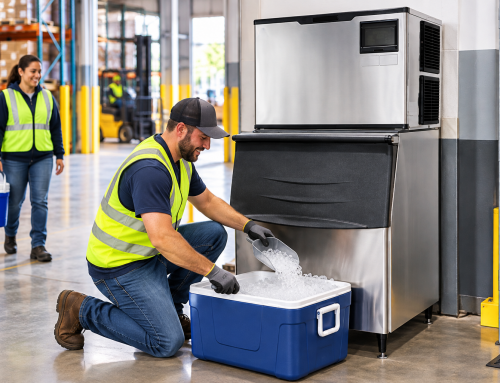
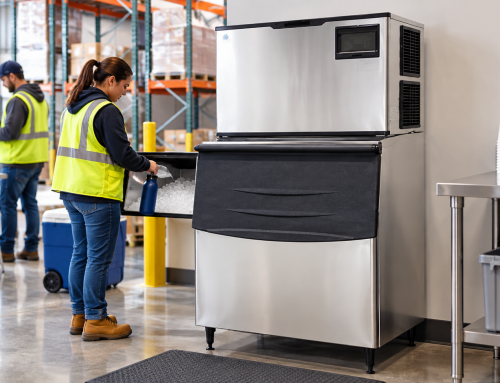
3) Water + ice solutions (the “upgrade” that boosts usage)
In many workplaces, the moment you add quality ice, water consumption goes up because the experience feels better and more “hospitality-grade.”
4) Enhanced hygiene features (touch-free, UV, sanitization tech)
Especially useful in higher-traffic environments, healthcare, clinics, and client-facing spaces.
Who it’s best for:
A bottleless water cooler organizations choose is usually the right move for:
- Small to mid-size offices that want predictable monthly costs
- Multi-tenant offices where deliveries and storage are a constant battle
- Clinics and dental offices where cleanliness and consistency matter
- Warehouses/light manufacturing where volume is higher and “running out” is a productivity hit
- Client-facing businesses that care about first impressions in reception or conference areas
- Multi-location companies with sites in Missouri and Illinois that want one standard approach and vendor
If your people drink water daily (and they do), bottleless water coolers are less about “having water” and more about removing friction so hydration becomes automatic.
The real benefits for St. Louis and Southern Illinois offices (cost, convenience, trust)
When someone asks about “benefits,” they’re really asking:
- Will this be easier for our team?
- Will it taste better?
- Will it cost less, or at least cost predictably?
- Will it stay clean and reliable across busy days?
Predictable monthly spend (and fewer surprise expenses)
One of the biggest wins for bottleless water coolers is budget predictability. With jug delivery, the monthly bill changes based on:
- How many bottles you ordered (and whether you guessed right)
- Seasonal spikes (summer = more water)
- Add-on fees (rentals, service calls, missed delivery issues)
With a managed bottleless program, many businesses prefer a fixed monthly model because it’s easier to forecast, especially for teams managing multiple sites around St. Louis and the Metro East.
No deliveries, storage, lifting, or “empty jug Monday”
This is the silent tax jug service creates:
- Someone has to receive deliveries
- Someone has to store inventory
- Someone has to swap bottles
- Someone has to reorder (or you run out)
And even if it’s only 10 minutes here and there, it becomes a recurring workflow that never ends.
Bottleless water coolers flip that: your water supply isn’t limited by inventory. That’s a big deal for offices in older buildings with limited storage, or warehouses where “just keep extra bottles” becomes a safety and space problem.
Employee adoption: taste + confidence
Employees don’t just want “safe.” They want water they trust and enjoy drinking.
When taste is inconsistent, chlorine smell one week, “flat” water the next.. people stop using the cooler. That’s when you see the office fridge fill up with sugary drinks.
A properly designed filtration setup helps deliver:
- More consistent taste
- Better odor control
- Better cold temperature consistency
- Higher usage (because people actually like it)
Sustainability: less plastic handling, less waste
Bottleless water coolers won’t solve every sustainability initiative, but it reduces plastic bottle/jug handling and the delivery footprint associated with hauling heavy bottles around.
From a practical standpoint, it also cleans up the breakroom: fewer empties, fewer spills, fewer “where do we put this” conversations.
Filtration options that matter (carbon, RO, UV)
This is where buyers get overwhelmed, because the internet turns water into a fear festival.
Let’s keep it practical.
The “right” filtration depends on your goals:
- Taste and odor improvement
- Targeted contaminant reduction
- Hygiene and microbial control
- Consistency across seasons and building plumbing variables
Carbon filtration (the taste-and-odor workhorse)
What it does:
Carbon filters are excellent at reducing chlorine taste and odor and improving “drinkability.” For many workplaces, that’s the single biggest driver of satisfaction.
Best for:
- Offices whose biggest issue is taste/smell
- Locations where employees complain the water “smells like a pool”
- Improving water for coffee/tea
When you’re comparing solutions, look for reputable testing and certification language. NSF explains common filtration standards (like NSF/ANSI 42 and 53) and what they’re designed to address in general terms. (NSF)
Reverse osmosis (RO) (the “deeper purification” option)
What it does:
RO is a membrane process designed to reduce a broad range of dissolved contaminants. It’s often chosen when you want higher confidence in contaminant reduction or when you’re dealing with building-specific concerns.
Best for:
- Businesses that want “premium” purification and consistency
- Locations where employees ask more pointed questions about what’s in the water
- Environments where water quality consistency is a priority (client-facing areas, clinics)
Is RO “necessary” for every workplace? No. But it can be a strong choice when your goal goes beyond taste alone, or when you want a system that delivers a higher, more consistent “finished water” experience.
UV (ultraviolet) (hygiene support, not a magic wand)
What it does (plain English):
UV is used as a hygiene-support tool in many water systems to reduce microbial risk in the treatment pathway. It’s not a substitute for filter changes or cleaning, but it can be part of an overall approach that helps keep systems fresher between service intervals.
Best for:
- Higher-traffic locations
- Healthcare and clinics
- Workplaces that want added confidence around cleanliness
A quick reality check on “certifications”
When you see terms like “certified,” the important thing is what standard and what claim. Look for specifics, not vague “removes everything” language. NSF’s certification education is a good place to understand what various standards generally cover. (NSF)
If you’re shopping for a bottleless water cooler in St Louis or Southern Illinois that your team will love long-term, ask these questions:
- What filtration stages are included, and what is each stage for?
(“Taste/odor,” “particulates,” “membrane purification,” “UV,” etc.) - What certifications or testing support the filtration claims?
Look for specific standards and clear documentation (not marketing hype). (NSF) - What’s the filter-change schedule, and who performs it?
If the answer is “you can do it,” ask who owns it when taste changes or flow slows. - What is included in the monthly cost?
Parts? Filters? Labor? Service calls? Preventive maintenance? - What’s the service response expectation?
If the unit has an issue, what happens next, and how quickly? - Do you offer water + ice options if we want a single solution?
One system, one service plan, fewer vendors.
Installation basics for bottleless systems
Good news: most installs are simpler than people assume. The details depend on your space, your building, and whether you want water-only or water + ice.
What’s needed (in most cases)
- Access to a water line (often under a sink, near a breakroom wall, or in a utility area)
- Electrical (standard outlet for most units)
- Placement planning (so the station is used, not ignored)
This is true in Missouri and Southern Illinois. The biggest variable is typically the specific space layout and where the nearest water line is located.
Timeline: what a site walk typically checks
A good provider won’t guess. They’ll do a quick walkthrough to confirm:
- Best location for maximum usage (not hidden behind a door)
- Water line access and routing plan
- Electrical requirements
- Foot traffic patterns and ADA considerations
- Whether you should add ice, hot water, or touch-free features
This is also where you avoid the “we installed it but nobody uses it” problem.
ADA and traffic-flow tips (small changes = big adoption)
If you want employees to use the system daily:
- Put it on the natural path between desks and the breakroom
- Make bottle filling comfortable (height and clearance matter)
- Avoid creating a bottleneck during peak times
- Consider a location that works for guests without sending them into private areas
A bottleless system is only “better” if it’s used, and layout plays a bigger role than most people think.
Maintenance & service, what you don’t want to manage internally
This is the part that separates a nice idea from a dependable, long-term solution.
Bottleless water cooler systems don’t eliminate maintenance. They make it manageable, as long as someone owns the service schedule and performance.
Filter change cadence (high level)
Every environment is different:
- Higher usage = more frequent service
- Older buildings can introduce variability
- Seasonal changes can affect taste and perception
The key is this: filters must be changed on schedule to keep taste consistent and flow strong.
Signs your system needs service
Your team will tell you, sometimes subtly, sometimes loudly. Watch for:
- Taste or odor changes (the first red flag)
- Slow flow at the dispenser
- Temperature inconsistency (not cold enough / hot fluctuating)
- More dripping or mess around the station
- Employees stop using it (the most expensive signal of all)
Why managed service beats “we’ll handle it”
When maintenance becomes an internal responsibility, here’s what usually happens:
- Filters get delayed because “it still works”
- Then taste changes
- Then usage drops
- Then someone orders bottled water “just for now”
- And suddenly you’re paying for two solutions
Managed service keeps the system performing so you don’t backslide into the old routine.
Why Purity Source is the easiest way to switch in St. Louis and Southern Illinois
This is where Da-Com’s Purity Source program wins: we don’t just drop off equipment. We help you choose the right configuration, install it properly, and keep it running, so you get the benefits of a bottleless water cooler without inheriting a new chore.
“We size it, install it, and keep it running.”
A bottleless water cooler your workplace can depend on has to match:
- Your headcount and usage patterns
- Your breakroom layout
- Your expectations (taste, hygiene features, hot water, ice)
- Your desire for “hands off” support
We start with some simple questions, then recommend a right-fit system for your space and usage, whether you’re in St. Louis, St. Charles, Chesterfield, Clayton, O’Fallon, Belleville, Edwardsville, Collinsville, or beyond.
What’s included
While exact inclusions depend on your plan and unit configuration, Purity Source is built around what most office managers actually want:
- Ongoing filter changes
- Parts and labor coverage
- On-site service and support
- A clear path to fast help if something goes wrong, loaner units if needed
Bottom line: you should be able to say, “This is handled,” and move on with your day.
FAQ: Bottleless water coolers in the St. Louis area and Southern Illinois
Do you install bottleless units in St. Louis County and St. Charles County?
Yes! Check out St. Louis to see all of the counties we service!
Do you also serve Southern Illinois (Metro East)?
Yes—Da-Com supports many workplaces across Southern Illinois, including the Metro East. Check out all of the counties in Southern Illinois that we service!
How much does a bottleless cooler cost per month?
Monthly cost depends on the unit type (water-only vs. water + ice), capacity, filtration configuration, and service plan.
How long does installation take?
Many office installs can be completed quickly once placement and connections are confirmed. The timeline depends on water line access, electrical needs, and whether you’re adding ice or additional features.
What happens if the unit needs service?
With a managed program like Purity Source, service isn’t “good luck and a phone number.” You have a clear support path so issues get handled without your team troubleshooting equipment, and we’ll have a local tech out to you in no time!
Helpful resources:
If you want to go deeper (or you’re fielding employee questions), these are solid resources:
- EPA information on Consumer Confidence Reports (annual water quality reports)
- NSF overview of filtration standards and certification concepts
- OSHA guidance on employer obligations to provide potable drinking water access: OSHA potable water
Ready to ditch bottles for good?
If you want a bottleless water cooler your employees actually use (and stop complaining about), Da-Com can help you choose the right Purity Source setup, install it cleanly, and keep it performing with ongoing service.
To learn more about purified bottleless water coolers for your workplace, contact Da-Com to request our Benefits and Pricing Guides!



Leave A Comment