
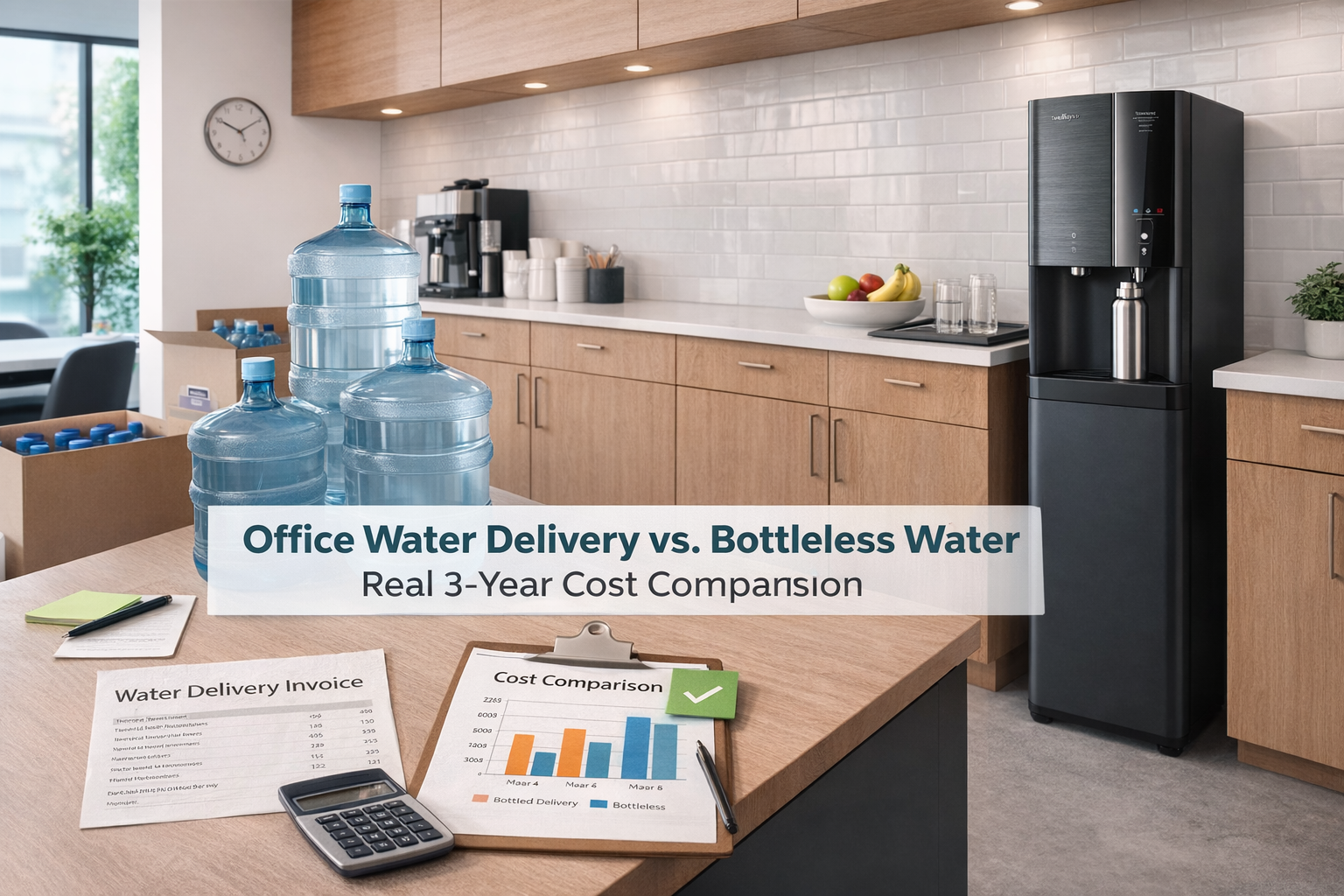
Office Water Delivery vs. Bottleless Water: Real 3-Year Cost Comparison for Businesses
When businesses compare office water delivery vs bottleless water, they often start with the monthly bill. That makes sense, but it rarely gives the full picture.
A better comparison looks at the real cost over time. That includes not only the visible invoice, but also the practical costs that build up in the background: bottle deliveries, storage, reordering, employee time, breakroom clutter, and the risk of running out when demand spikes.
That is why more businesses are shifting the conversation away from “Which option has the lowest monthly price?” and toward “Which option makes more sense for our office over the next few years?”
In many cases, bottleless water becomes the stronger long-term option when the comparison is stretched across three years. A point-of-use system can reduce delivery dependence, remove bottle storage issues, create a cleaner breakroom, and provide a more predictable service model.
For businesses evaluating workplace hydration, a true office water delivery vs bottleless water comparison should focus on total value, not just short-term price.
Why a 3-Year Comparison Matters
Short-term pricing can make two options look closer than they really are.
A bottled delivery setup may feel familiar because the process is already in place. But over time, recurring deliveries, bottle handling, emergency reorders, storage needs, and wasted staff time all start to add up. Those costs may not always appear clearly on an invoice, but they still affect the business.
A bottleless system is often easier to evaluate over a longer period because the cost structure is usually more stable. Instead of repeatedly paying for delivery logistics, businesses are paying for equipment, filtration, and ongoing service.
Three years is a useful comparison window because it is long enough to show real patterns. Businesses can see whether they are paying for habit, paying for convenience, or investing in a solution that works better over time.
What a Real Office Water Delivery vs Bottleless Water Comparison Should Include
A useful office water delivery vs bottleless water comparison should include more than the equipment fee or monthly service charge. It should reflect the day-to-day realities of using the system in a working office.
1. Bottle delivery costs
This includes the recurring cost of 3-gallon or 5-gallon bottle deliveries, service frequency, and any price increases that may happen over time.
2. Bottle storage costs
Full bottles and empty bottles take up space. In some offices, that is more than an inconvenience. It means losing useful storage or breakroom space that could be used for something else.
3. Employee time and labor
Someone has to accept deliveries, move bottles, swap empties, monitor supply, and place reorders. Even if that labor is not tracked separately, it still has a cost.
4. Risk of running out
A bottleless system is connected to the water line, while bottled delivery depends on forecasting usage correctly and getting refills on time. If office usage changes unexpectedly, bottled service can come up short before the next delivery.
5. Breakroom presentation
Stacks of bottles, empties, and plastic racks can make a breakroom look cluttered. A bottleless unit often creates a cleaner, more modern appearance.
6. Service and maintenance
Bottleless systems still require filter changes and routine maintenance. Those costs should be included honestly in the comparison.
7. Water quality and user experience
Many businesses also care about taste, ease of access, and user confidence in the water system. While these benefits are not always easy to assign a dollar value to, they still influence how useful the system is in daily office life.
A Simple 3-Year Comparison Framework
A direct quote will vary based on office size, usage, and equipment. But the comparison framework is straightforward.
Imagine Office A uses bottled delivery. Over three years, it pays for recurring water deliveries, bottle storage, employee handling time, occasional rush orders, and a breakroom setup that stays dependent on heavy plastic jugs.
Imagine Office B uses a bottleless system. Over three years, it pays for installation, monthly service or rental, filter changes, maintenance, and a continuous point-of-use water supply.
At first glance, the monthly pricing may not look dramatically different. But once labor, storage, convenience, reliability, and presentation are factored in, the long-term value picture often changes.
This is one reason businesses exploring purified water systems are increasingly looking beyond the invoice and evaluating how the solution affects office operations over time.
Why Bottled Water Delivery Often Costs More Than Expected
Bottled water delivery feels simple because it has been a standard office setup for so long. But familiarity can hide inefficiency.
Businesses often underestimate the cost of:
- Storing heavy bottles
- Moving bottles safely
- Tracking inventory
- Calling for extra deliveries
- Running out during busy periods
- Managing empty jugs after use
- Using storage or breakroom space for water instead of other needs
Over three years, these issues stop feeling minor. They become part of the real cost of staying with the old system.
In a true office water delivery vs bottleless water analysis, these hidden costs matter because they affect daily operations, employee time, and workplace presentation even when they do not show up neatly on a bill.
Why Bottleless Water Often Looks Better Over Time
Bottleless systems tend to become more attractive as the comparison window gets longer. That is because they are designed to remove recurring friction from the office environment.
A bottleless water system can help businesses by:
- Eliminating bottle storage
- Reducing manual handling
- Providing a more consistent water supply
- Improving breakroom appearance
- Supporting better taste and user confidence
- Making long-term budgeting more predictable
For many businesses, these benefits matter just as much as the direct cost comparison. The long-term case becomes even stronger when businesses also consider the broader office water purification benefits tied to cleaner presentation, easier access, and better workplace convenience.
Businesses that are still in the research stage may also benefit from reading a more detailed office bottleless water cooler guide before comparing models or service options.
How Office Size Changes the Comparison
The right answer depends partly on office size, employee count, and water usage patterns.
Small offices
A small office may stick with bottled delivery because it seems simple to manage at low volume. But even smaller teams can get frustrated by bottle clutter, inconsistent supply, or the hassle of keeping track of inventory.
Midsize offices
This is often where bottleless systems stand out most clearly. The cost can be spread across enough employees to make the per-person value appealing, while the office also benefits from fewer deliveries and a cleaner breakroom setup.
Larger offices
As usage grows, the inconvenience of bottled delivery often grows with it. More deliveries, more storage, more empties, and more handling can make bottleless systems even more attractive over time.
That is why businesses should not compare these options in the abstract. A meaningful office water delivery vs bottleless water decision should reflect actual employee count, office layout, and daily usage.
The Hidden Labor Cost Many Offices Ignore
One of the biggest blind spots in the office water delivery vs bottleless water conversation is labor.
Even when nobody tracks it formally, bottled water uses staff time. Someone has to accept the delivery. Someone has to move the jugs. Someone has to monitor supply levels. Someone has to reorder before the office runs out.
Each task may seem small by itself, but repeated over months and years, it becomes part of the operating cost.
A bottleless system reduces much of that hands-on involvement. The office no longer has to manage stacked bottles, empties, or reorder timing in the same way. That is a real administrative and operational advantage.
Why Presentation and Workplace Experience Matter Too
Some businesses want a comparison based only on dollars, and that is reasonable. But office water is not just a utility. It is also part of the employee and visitor experience.
A breakroom with a modern bottleless cooler often feels cleaner, more organized, and better maintained than one with bottles stacked in the corner. That difference can matter in client-facing offices, reception areas, and workplaces focused on improving employee amenities.
For many teams, the right water setup supports both practicality and presentation. That makes the decision about more than just the lowest monthly line item.
How Bottleless Water Fits Modern Office Expectations
Workplaces are changing the way they think about shared amenities. Employees expect convenience. Managers want fewer recurring hassles. Businesses want cleaner spaces and more predictable service relationships.
Bottleless water aligns well with those priorities because it is designed around access, consistency, and simplicity. It also reduces some of the awkwardness that comes with relying on a standard sink faucet or maintaining a cluttered bottled-water setup.
Employers are also responsible for providing potable water in the workplace. OSHA outlines that requirement in its guidance on potable water requirements. Businesses comparing solutions may also want to review EPA information on drinking water regulations and contaminants and NSF guidance on filtration standards.
Both bottled delivery and bottleless systems can support workplace hydration, but a long-term comparison helps businesses decide which option creates the better office experience overall.
Questions to Ask Before Choosing Between Delivery and Bottleless
Before making a decision, it helps to ask:
- How much storage space are we giving up to bottles and empties?
- How often does someone in the office deal with water deliveries or reorders?
- How important is breakroom appearance to our team and guests?
- How many employees use the water system regularly?
- Do we want a simpler long-term service model?
- Would better taste and easier access increase actual water use?
- Do we want a cleaner, more modern hydration station?
The goal is not just to compare products. It is to compare the long-term workplace experience each option creates.
Final Thoughts on Office Water Delivery vs. Bottleless Water
So which is better over three years: office water delivery or bottleless water?
The honest answer is that it depends on your office size, usage, and service needs. But a real office water delivery vs bottleless water comparison often shows that bottleless water creates stronger long-term value than many businesses expect.
That is because the real comparison is not just about the visible monthly bill. It is about storage, labor, reliability, appearance, convenience, and employee experience. Once those factors are included, bottleless water often looks like the cleaner, more efficient, and more practical long-term choice. If your office is in Southern Illinois, St. Louis, or Columbia, Missouri and you’re thinking about making the switch to bottleless, reach out to Da-Com today to see how we can help!
Frequently Asked Questions
Is bottleless water cheaper than bottled delivery?
In many offices, yes over time. Bottleless systems often reduce storage, handling, and recurring delivery-related tasks that add to the real cost of bottled service.
What should be included in a 3-year water cost comparison?
A real comparison should include delivery charges, bottle storage, employee handling time, maintenance, installation, service, and the overall workplace experience.
Why do businesses switch from bottled delivery to bottleless water?
Many switch to reduce clutter, avoid running out of water, improve breakroom appearance, and create a more predictable long-term service model.
Does bottleless water still require service?
Yes. Bottleless systems still require installation, filter changes, and regular maintenance. Those costs should be included honestly in the comparison.
Is bottleless water worth it for a small office?
It can be. Even smaller teams may prefer the cleaner setup, easier access, and reduced delivery hassle that come with a bottleless system.



Leave A Comment