
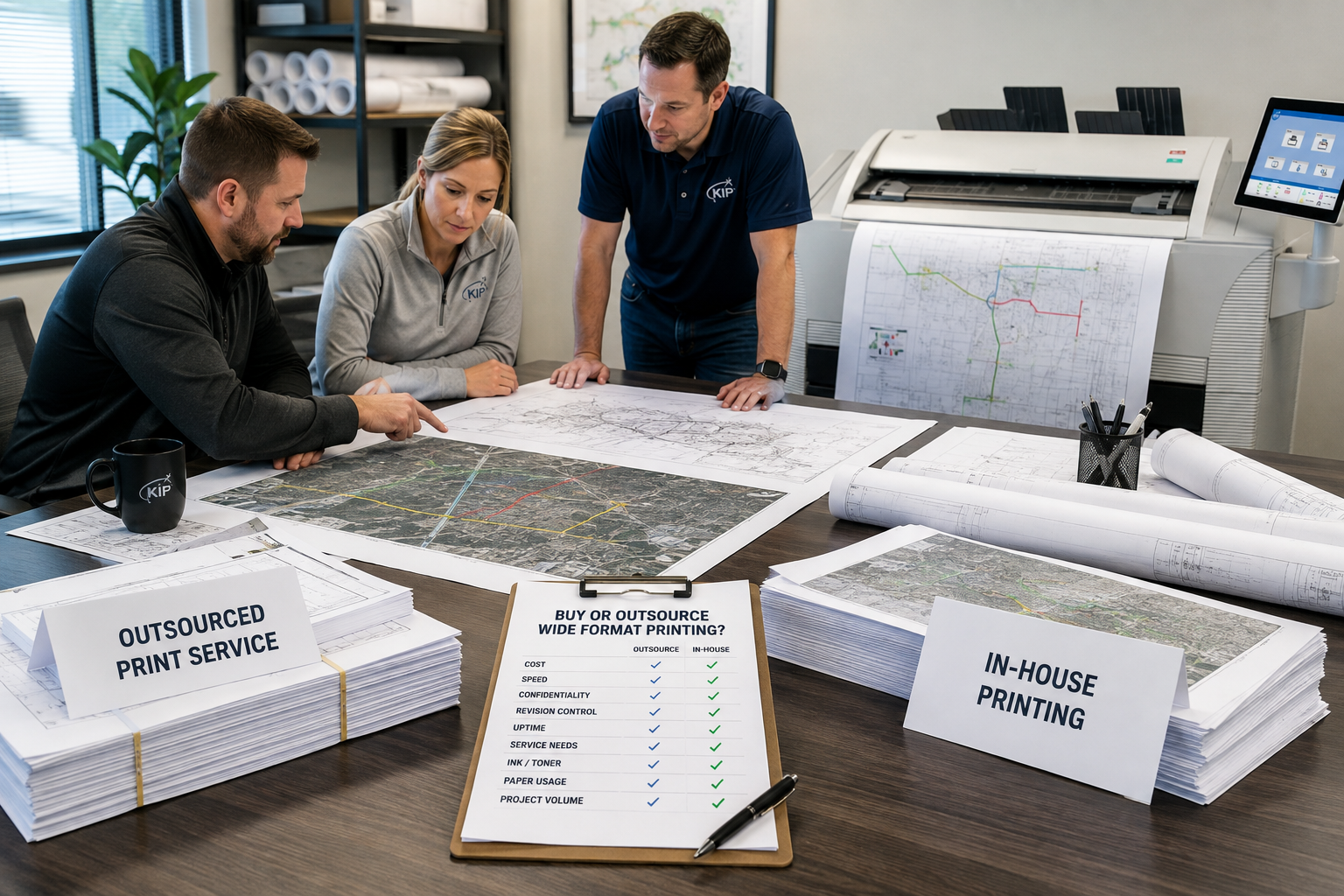
Buy or Outsource Wide Format Printing? Telecom Guide
Buy or outsource wide format printing is one of the most practical questions telecom companies, fiber contractors, engineering firms, utilities, and broadband deployment teams face when project volume starts growing. At first, outsourcing large-format prints may seem simple. Send the files to a print shop, wait for the plan sets, pick them up, and distribute them to the team. But as fiber maps, GIS plans, construction drawings, permit sets, utility markups, and as-built revisions increase, the decision becomes more complicated.
Telecom projects move quickly. A fiber route changes. A permit set needs revision. A field crew needs updated drawings before the morning deployment. A contractor meeting requires large printed maps. A project manager needs new redline copies. A municipal reviewer requests a revised plan set. When every update depends on an outside print schedule, printing can become a bottleneck.
That does not mean every telecom team should immediately buy a plotter or lease a wide format printer. Outsourced wide format printing can still be the right fit for low-volume or occasional project needs. The best choice depends on turnaround time, revision frequency, confidentiality, print volume, budget, service needs, color requirements, scanning needs, and how often crews rely on printed field documents.
For telecom companies, fiber contractors, broadband deployment teams, and engineering firms in St. Louis, St. Charles, Columbia, the Metro East, Belleville, Edwardsville, Collinsville, and Southern Illinois, this guide compares in-house wide format printing, leased plotters, and outsourced print service models so your team can choose the most practical path.
Quick Answer: Should Telecom Teams Buy or Outsource Wide Format Printing?
Telecom teams should buy or outsource wide format printing based on project volume, revision speed, confidentiality needs, field document deadlines, and total cost of ownership. Outsourcing may work well for occasional fiber maps, permit sets, or construction drawings. Buying or leasing an in-house wide format printer may make more sense when telecom teams print frequently, need same-day revisions, manage confidential network plans, scan redlines, or prepare field packets for active broadband deployment.
A telecom team may benefit from in-house wide format printing if:
- Fiber route maps are printed weekly or daily.
- Project drawings change often.
- Field crews need updated plans quickly.
- Confidential network plans should stay internal.
- Teams need to scan redlines and as-built drawings.
- Permit sets and crew packets are time-sensitive.
- Outsourced printing causes delays.
- Project managers need better print cost visibility.
- Multiple departments depend on large-format documents.
A telecom team may continue outsourcing if:
- Wide format print volume is low.
- Projects are occasional or seasonal.
- Deadlines are flexible.
- There is no internal staff to manage equipment.
- Scanning and redline capture needs are limited.
- Outsourced costs are predictable and manageable.
Da-Com can help telecom firms evaluate whether an in-house wide format printer, leased plotter, or outsourced print-service model is the best fit. Explore Da-Com’s wide format printer solutions for KIP systems, scanning, folding, print management, and service support.
Why This Decision Matters for Telecom Projects
Wide format printing is not just a back-office task in telecom. It directly affects how engineers, construction managers, permit teams, utility coordinators, field crews, and contractors communicate.
Telecom documents are often large, technical, and revision-heavy. A single fiber project may involve route maps, GIS layers, construction drawings, right-of-way details, utility markups, splice diagrams, cabinet placement plans, tower plans, site drawings, permit submissions, field packets, redlines, and as-built documentation.
When those documents are delayed, project communication slows down too.
Wide format printing supports:
- Pre-construction planning.
- Fiber route reviews.
- Municipal permit submissions.
- Utility coordination.
- Contractor meetings.
- Field crew briefings.
- Revision control.
- Construction closeout.
- As-built documentation.
- Emergency repair planning.
The FCC’s National Broadband Map displays where internet services are available across the United States based on provider-reported data submitted through the FCC Broadband Data Collection. Broadband planning teams may use map-based availability data as one input when evaluating service areas, deployment priorities, and network expansion. FCC National Broadband Map information
Because telecom work depends on maps and plans, the question is not only whether printing is needed. The question is whether your current printing model keeps up with the speed and complexity of your projects.
Buy or Outsource Wide Format Printing: Main Comparison
The easiest way to compare options is to look at the factors that affect telecom teams most: speed, cost, confidentiality, revisions, uptime, service, supplies, scanning, and project volume.
| Factor | Outsourced Wide Format Printing | In-House Wide Format Printer or Plotter |
|---|---|---|
| Turnaround speed | Depends on vendor schedule, file transfer, pickup, or delivery | Prints can be produced when the team needs them |
| Revision control | Frequent changes may require repeated submissions and delays | Updated versions can be printed immediately |
| Confidentiality | Network plans and project files are shared outside the organization | Fiber maps, GIS plans, and network documents stay internal |
| Cost structure | Per job, per sheet, per set, or per project | Lease or purchase cost, supplies, media, toner, service, and usage |
| Project volume | Best for occasional or low-volume needs | Better for frequent printing and active deployment work |
| Field readiness | Requires advance planning and vendor coordination | Crew packets, maps, and revised drawings can be printed quickly |
| Service needs | Print provider manages equipment | Your provider supports service, supplies, maintenance, and uptime |
| Scanning and as-builts | May require separate scan service | Wide format scanning can be part of the workflow |
| Control | Less control over timing and process | More control over output, timing, versions, and internal workflows |
There is no universal answer. A small contractor with occasional plan sets may not need an in-house system. A telecom team handling frequent fiber broadband deployment printing may lose too much time waiting on outsourced prints. The right decision depends on how printing supports the work.
When Outsourced Wide Format Printing Makes Sense
Outsourcing can be a practical option when wide format printing is occasional, predictable, and not central to the daily workflow. Some telecom teams only need large-format prints for specific milestones, permit submissions, client presentations, or occasional construction reviews.
Outsourcing may make sense when:
- Your team prints large-format documents only a few times per month.
- Project timelines allow for outside turnaround.
- You do not need frequent same-day revisions.
- Most field documents are handled digitally.
- Print costs are low and predictable.
- You do not need wide format scanning very often.
- Your team does not want to manage equipment, supplies, or maintenance.
The benefit of outsourcing is simplicity. Your team does not need to own a printer, stock media, order toner, train users, schedule service, or maintain equipment. For low-volume needs, that can be a good tradeoff.
Outsourcing can also provide access to specialty print services without an internal investment. If your telecom team occasionally needs unusual media, specialty finishing, or very large runs, a print provider may already have the equipment.
The downside is control. If your project changes often, outsourcing can slow your team down. Every revision becomes another file submission, another cost, another pickup or delivery, and another opportunity for version confusion.
When an In-House Plotter Makes More Sense
An in-house plotter or wide format printer becomes more attractive when printing is frequent, urgent, confidential, or tied directly to field work. Telecom teams that print fiber maps, permit sets, utility markups, GIS layers, and construction drawings every week may benefit from faster access and better internal control.
In-house wide format printing may make sense when:
- Field crews need updated maps quickly.
- Construction drawings change frequently.
- Permit revisions need fast turnaround.
- Project managers print multiple plan versions.
- Network documents should stay internal.
- Teams need to scan redlines and as-builts.
- Outsourced printing costs are rising.
- Print delays are affecting crew readiness.
- Multiple departments depend on large-format output.
- Your team wants project-based cost tracking.
Da-Com’s guide to in-house wide format printing explains how bringing large-format output in-house can help teams create, revise, and produce materials without waiting days for outside production.
For telecom teams, the biggest advantage is speed. If a fiber route changes the afternoon before a crew briefing, the team can print the corrected version in-house. If an inspector needs a revised plan set, the project manager can produce it quickly. If a field supervisor returns with redlines, the marked-up drawing can be scanned and routed back into the project record.
Wide Format Printer Lease vs. Purchase
For telecom companies that want in-house printing, the next question is whether to lease or buy. The U.S. Small Business Administration explains that businesses should first identify which assets and equipment they need, then decide whether to lease or buy based on cost, cash flow, and long-term needs. SBA guidance on buying assets and equipment
A wide format printer lease may make sense when a telecom team wants access to equipment without a large upfront purchase. Leasing can also make upgrades easier when technology changes or project demands increase.
A purchase may make sense when the team expects to use the equipment for a long time, has the capital available, and wants ownership of the asset.
| Option | Potential Advantages | Potential Considerations |
|---|---|---|
| Lease a wide format printer | Lower upfront cost, predictable payments, easier upgrade path, possible service alignment | Long-term cost may be higher, lease terms matter, early termination can be costly |
| Buy a wide format printer | Ownership, long-term use, possible lower lifetime cost if used heavily | Higher upfront cost, maintenance responsibility, future replacement planning |
| Continue outsourcing | No equipment management, simple for low-volume work | Less control, slower revisions, external file sharing, per-job costs |
The best option depends on print volume, cash flow, project deadlines, internal staffing, and service expectations. A local wide format provider can help compare the total cost of ownership instead of focusing only on the monthly payment or the per-sheet print charge.
Cost Questions to Ask Before You Buy or Outsource Wide Format Printing
Cost is usually the first concern, but the comparison should include more than the price of equipment or outsourced print jobs. Telecom teams should compare the full cost of each model.
For outsourced printing, consider:
- Cost per sheet.
- Cost per plan set.
- Color vs. black-and-white pricing.
- Rush fees.
- Pickup or delivery costs.
- Reprint costs when revisions change.
- Scanning costs for redlines and as-builts.
- Employee time spent preparing and sending files.
- Project delays caused by waiting.
For in-house printing, consider:
- Lease or purchase cost.
- Media and paper usage.
- Toner or ink.
- Service and maintenance.
- Training.
- Energy use.
- Device placement.
- Scanning and folding options.
- Print management software.
- Internal labor and workflow.
ENERGY STAR notes that certified imaging equipment can help save energy and money, and its imaging equipment category includes printers, copiers, scanners, multifunction devices, and related office equipment. ENERGY STAR imaging equipment guidance
When comparing the options, include the cost of waiting. If outsourced printing delays a field packet, a permit response, or a construction meeting, the true cost may be higher than the print invoice.
Confidentiality and Network Plan Control
Telecom teams often work with sensitive network information. Fiber routes, equipment locations, customer coverage areas, utility details, and infrastructure plans may not be documents the organization wants to share widely.
Outsourced printing requires project files to leave the organization. That does not automatically make outsourcing unsafe, but it does create another handoff. The team should understand how files are transmitted, stored, printed, and deleted by the outside provider.
In-house printing gives teams more control over:
- Who accesses network plans.
- Where files are stored.
- Who prints revised versions.
- How plan sets are distributed.
- How old versions are removed.
- How redlines are scanned back into the record.
- How confidential drawings are handled.
For projects involving sensitive infrastructure, customer data, private build plans, or competitive deployment strategy, document control may be a major reason to bring printing in-house.
Revision Control and Field Readiness
Revision control is one of the biggest reasons telecom teams outgrow outsourced wide format printing. Fiber deployment projects change. Routes shift. Utility notes are added. Permits get updated. Field conditions require adjustments. Crews return redlines. Engineers revise drawings. Project managers need to distribute the latest version quickly.
If revisions are frequent, outsourcing can create version confusion. One team may have yesterday’s route map while another has the updated plan. A crew packet may include an older right-of-way drawing. A permit set may not match the latest construction notes.
In-house wide format printing can improve revision control by making it easier to:
- Print the latest approved version.
- Label plan sets by date or project number.
- Remove outdated documents quickly.
- Produce replacement field packets.
- Print redline copies for review.
- Scan marked-up drawings back into the system.
- Support same-day construction changes.
Da-Com’s article on wide format printers for project teams explains how large-format output can support maps, technical drawings, field use, collaboration, and project communication.
Service, Uptime, and Plotter Maintenance Near Me
If your team brings wide format printing in-house, service matters. A plotter or wide format printer becomes part of the project workflow. If the device is down when crews need maps, the team can lose the speed advantage that made in-house printing attractive in the first place.
Before choosing equipment or a lease, ask about:
- Local service response.
- Preventive maintenance.
- Supplies and media availability.
- Training for users.
- Support for scanning and folding accessories.
- Print management setup.
- Service contract terms.
- Replacement parts availability.
- Support for multiple locations.
Da-Com’s Wide Format page highlights KIP systems with fast media installation, auto roll switching, KIP System K Print Management Suite, accounting and cost center capabilities, scanning solutions, folding systems, and local support through St. Louis and Columbia offices. Review Da-Com Wide Format printer options
For telecom teams searching for plotter maintenance near me or large format printer service, the key question is not only who can sell the equipment. It is who can support the equipment after installation.
Wide Format Scanning, Redlines, and As-Builts
Telecom teams should not evaluate printing without thinking about scanning. Field crews often return with redlined drawings, marked-up route maps, revised utility notes, and as-built corrections. Those changes need to make their way back into the project record.
Wide format scanning can support:
- Digitizing redline markups.
- Capturing as-built drawings.
- Sharing field revisions with engineering.
- Archiving old network plans.
- Reducing paper storage.
- Improving document retrieval.
- Supporting closeout documentation.
- Maintaining current project records.
If scanning is frequent, an in-house wide format system may provide more value than a print-only comparison suggests. A team that outsources printing but also needs frequent scanning may still face document delays after field work.
Da-Com’s Wide Format page includes KIP scanning systems designed for high-resolution image quality and production-speed capture, which can help teams manage redlines, archival drawings, and large technical documents. Explore Da-Com Wide Format scanning solutions
Decision Checklist: Buy or Outsource Wide Format Printing
Use this checklist to decide whether your telecom team should buy, lease, or outsource wide format printing.
Outsourcing May Be Better If:
- You print large-format documents only occasionally.
- Deadlines are flexible.
- Revisions are rare.
- Print costs are predictable.
- You do not need frequent scanning.
- You do not want to manage equipment.
- You have a reliable outside provider with fast turnaround.
Leasing or Buying May Be Better If:
- You print fiber maps, GIS plans, or construction drawings often.
- Field crews need updated documents quickly.
- Revisions happen frequently.
- Project files should stay internal.
- Outsourced print delays are affecting work.
- You need wide format scanning for redlines and as-builts.
- You need project-based cost tracking.
- You want more control over print quality and timing.
- You have multiple departments using large-format documents.
Questions to Ask a Wide Format Provider
Before deciding whether to buy or outsource wide format printing, ask a provider questions that connect the equipment to your actual workflow.
- How much wide format printing do we need each month?
- Which documents do we print most often?
- Do we need color GIS map clarity?
- Do we need black-and-white technical drawing speed?
- How often do revisions happen?
- Do field crews need same-day plan updates?
- Do we need scanning for redlines and as-builts?
- Would folding improve crew packet organization?
- How much are we spending on outsourced prints now?
- What is the total cost of leasing or buying?
- What service and supplies are included?
- How quickly can support respond if the system is down?
- Can the provider support St. Louis, Columbia, Missouri, Illinois, and Southern Illinois locations?
The right provider should help your team compare real print usage, not just equipment specs.
Common Mistakes Telecom Teams Make When Comparing Printing Options
Only Comparing Equipment Price to Print Shop Invoices
That comparison is too narrow. Include labor time, revision delays, pickup or delivery, rush fees, scanning, confidentiality, and field readiness.
Ignoring Revision Frequency
If drawings change often, in-house printing may save time even if outsourced printing looks cheaper per sheet.
Forgetting About Scanning
Redlines and as-builts need to come back into the system. Scanning should be part of the decision.
Not Considering Service
An in-house printer only helps if it is reliable. Local service, supplies, and training matter.
Choosing a Printer Without Understanding Workflow
The best device depends on the documents your team actually prints, scans, folds, and distributes.
Frequently Asked Questions About Buying or Outsourcing Wide Format Printing
Should telecom companies buy or outsource wide format printing?
Telecom companies should buy or outsource wide format printing based on print volume, revision frequency, confidentiality, deadline pressure, scanning needs, and total cost. Outsourcing works well for occasional needs. In-house printing may be better for frequent fiber maps, GIS plans, and field documents.
When does an in-house plotter make sense for telecom projects?
An in-house plotter makes sense when telecom teams need fast revisions, frequent fiber route maps, permit drawings, construction plans, redline scanning, confidential network document control, or field packets for active deployment work.
Is a wide format printer lease better than buying?
A wide format printer lease may be better when a business wants lower upfront cost, predictable payments, and an easier upgrade path. Buying may be better when the team expects long-term heavy use and wants to own the equipment.
What should telecom teams compare before outsourcing wide format printing?
Telecom teams should compare turnaround time, per-sheet cost, rush fees, revision delays, confidentiality, pickup or delivery time, scanning needs, and the cost of waiting when field crews need updated plans.
Why is revision control important for telecom printing?
Revision control is important because telecom construction drawings, fiber maps, and permit sets change often. Crews need current documents to avoid rework, confusion, and delays.
Can wide format printers scan redlines and as-builts?
Some wide format systems include scanning or can be paired with wide format scanners. This helps teams digitize redlines, field markups, archived drawings, and as-built documentation.
What is the best wide format printer for a telecom company?
The best wide format printer for a telecom company depends on document volume, color map needs, technical drawing accuracy, scan and copy needs, media size, service expectations, and total cost of ownership.
Can Da-Com help telecom teams decide whether to buy, lease, or outsource?
Yes. Da-Com can help telecom firms, fiber contractors, engineering teams, and project groups compare in-house wide format printers, leased plotters, scanning systems, folding options, supplies, service, and outsourced print-service models.
The Bottom Line: Choose the Model That Keeps Projects Moving
The decision to buy or outsource wide format printing should come down to how your telecom team works. If large-format printing is occasional, outsourcing may be enough. If fiber maps, GIS plans, construction drawings, permit sets, crew packets, redlines, and as-builts are part of daily or weekly project delivery, an in-house wide format printer or leased plotter may provide more control, speed, and confidence.
Telecom projects depend on clear documentation. The right print model should help your team reduce delays, control revisions, protect confidential network plans, support field crews, and keep broadband deployment moving.
To learn more about whether your team should buy or outsource wide format printing for telecom projects in St. Louis, St. Charles, Columbia, the Metro East, Belleville, Edwardsville, Collinsville, or Southern Illinois, contact Da-Com today. Da-Com can help your team compare in-house wide format printers, leased plotters, large format printer service, scanning systems, folding options, supplies, and print workflows for fiber maps, GIS plans, construction drawings, and field deployment documents.




Leave A Comment