
Cyber Insurance Requirements in 2026: What SMBs Must Know
Cyber insurance requirements have changed significantly over the past few years. For many small and mid-size businesses, cyber liability insurance is no longer something they can obtain with a short application and a general statement that they take cybersecurity seriously.
Today, insurers want proof. They want to know whether specific security controls are in place, whether those controls are enforced, whether they are monitored, and whether the business can provide documentation if a claim is filed.
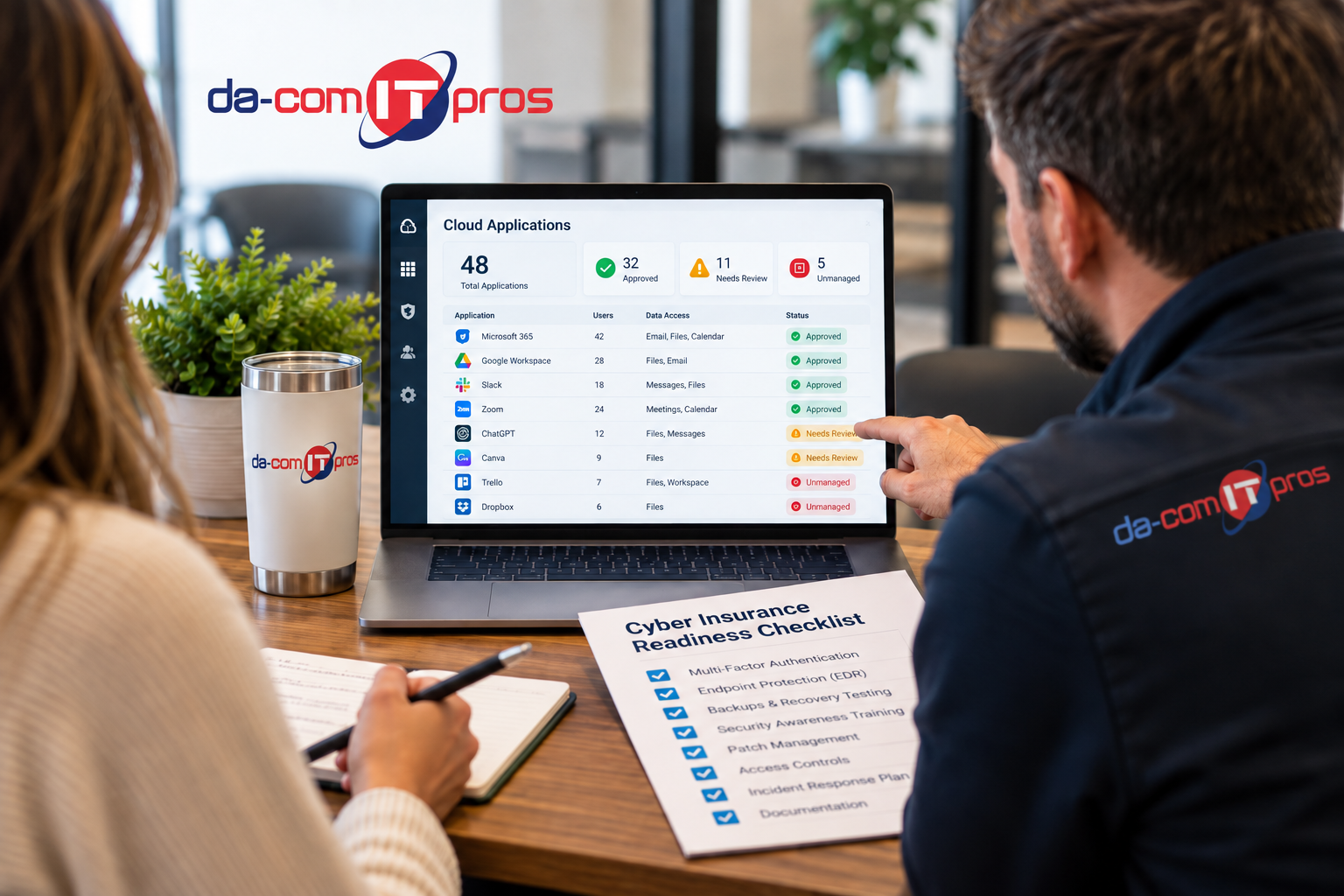
That shift can surprise business owners at renewal time. A company may assume its current policy will renew without issue, only to find that the insurer now asks detailed questions about multi-factor authentication, endpoint detection and response, backup testing, patch management, security awareness training, incident response planning, and access control.
The issue is not only whether a business can qualify for coverage. The larger concern is whether the security program described on the insurance application actually matches the security program in place. If there is a gap between what a business attests to and what it can prove after an incident, coverage can become complicated when it matters most.
Da-Com IT Pros helps businesses across St. Louis, St. Charles, the Metro East, and Southern Illinois understand what cyber insurance requirements demand, close security gaps, and maintain the documentation needed to support renewals, audits, and claim readiness.
Quick Answer: What Are Cyber Insurance Requirements?
Cyber insurance requirements are the cybersecurity controls, policies, procedures, and documentation that insurers expect businesses to have before issuing or renewing a cyber liability policy. Common requirements include multi-factor authentication, endpoint detection and response, tested backups, security awareness training, patch management, access control, incident response planning, and documentation proving those controls are active.
Most insurers want evidence that a business can protect against common causes of cyber claims, including compromised passwords, ransomware, phishing, business email compromise, unpatched systems, and weak backup recovery.
Common cyber insurance requirements may include:
- Multi-factor authentication on email, cloud apps, remote access, and privileged accounts.
- Endpoint detection and response instead of only basic antivirus.
- Tested backup and recovery procedures.
- Documented security awareness training.
- Formal patch management.
- Access control and employee offboarding processes.
- Incident response planning.
- Email security protections.
- Security documentation for renewal and claim review.
The goal is not only to satisfy an insurer. These controls also reduce the likelihood and impact of cyber incidents.
Da-Com IT Pros provides cybersecurity support for businesses that need practical protection across users, devices, email, cloud applications, backups, and daily operations.
Why Cyber Insurance Requirements Have Become More Strict
Cyber insurance carriers have tightened requirements because claims have become more frequent, more expensive, and more tied to preventable security gaps. Ransomware, business email compromise, credential theft, phishing, and wire fraud have shown insurers that weak security controls can quickly turn into major losses.
In the past, some applications focused mainly on whether a business had antivirus software, backups, or general IT support. Now, insurers often want more specific answers.
They may ask:
- Is multi-factor authentication enforced for all remote access?
- Is MFA required for email and cloud applications?
- Are administrative accounts protected separately?
- Do endpoints have EDR?
- Are backups immutable or protected from ransomware?
- When was the last restoration test?
- How quickly are critical patches applied?
- Do all employees complete security awareness training?
- Is there an incident response plan?
- Can documentation be provided?
CISA’s Cross-Sector Cybersecurity Performance Goals are designed to help organizations, including small and medium-sized businesses, prioritize cybersecurity practices with high-impact security outcomes. These goals align closely with many of the practical controls insurers now ask about.
NIST’s Cybersecurity Framework 2.0 Small Business Quick-Start Guide also gives SMBs a practical way to start building a cybersecurity risk management strategy.
What Cyber Insurance Requirements Actually Look Like in 2026
Every insurer and policy is different, but several cybersecurity controls have become common in cyber insurance applications and renewals. Small businesses should not wait until the renewal application arrives to start reviewing these areas.
Multi-Factor Authentication
Multi-factor authentication is one of the most common cyber insurance requirements because compromised passwords remain a major cause of cyber incidents. MFA adds another verification step beyond the password, making it harder for an attacker to access an account with stolen credentials alone.
Insurers may expect MFA to be enforced across:
- Email systems.
- Microsoft 365 or Google Workspace.
- Remote access tools.
- VPN access.
- Cloud platforms.
- Financial and accounting software.
- Administrative accounts.
- Privileged accounts.
Partial MFA may not be enough. If MFA is enabled for some users but not enforced consistently across high-risk systems, an insurer may still view the business as exposed.
CISA recommends requiring MFA and notes that it can block many common cyberattacks and reduce the risk of account compromise. CISA guidance on requiring MFA
Endpoint Detection and Response
Endpoint detection and response, often called EDR, has become a more common expectation than basic antivirus. Traditional antivirus usually looks for known malware signatures. EDR monitors endpoint behavior and can help detect suspicious activity based on what a device is doing.
EDR can help identify activity such as:
- Suspicious file changes.
- Unusual process behavior.
- Possible ransomware activity.
- Credential theft attempts.
- Malicious scripts.
- Unexpected administrative activity.
- Endpoint behavior that does not match normal use.
For insurance purposes, having the tool installed may not be enough. Businesses should also understand who monitors alerts, who responds, and how incidents are documented.
Tested Backup and Recovery
Backups are a critical control for ransomware and business continuity, but insurers increasingly want more than a statement that backups exist. They may ask whether backups are protected, separated from the main network, monitored, and tested.
Important backup questions include:
- Are backups running successfully?
- Are backups protected from ransomware?
- Are backups stored separately from the primary environment?
- Are backups immutable or otherwise protected from modification?
- When was recovery last tested?
- How long would restoration take?
- Who reviews backup reports?
- Is backup documentation available?
A backup log showing successful jobs is helpful, but it does not prove the business can recover. A restoration test gives stronger evidence that recovery is possible when needed.
Security Awareness Training
Security awareness training is another common cyber insurance requirement because phishing and social engineering continue to drive many incidents. Employees should know how to recognize suspicious requests, report concerns, verify payment changes, and avoid credential theft.
Training should be:
- Completed by all employees.
- Documented.
- Repeated regularly.
- Updated for current threats.
- Relevant to the business.
- Easy to prove during renewal or claim review.
The FTC recommends building cybersecurity awareness into employee training and keeping staff prepared for current tactics. FTC cybersecurity for small business
Patch Management
Patch management is the process of applying software and security updates consistently. Insurers may ask whether the business has a formal patching process, how quickly critical patches are applied, and whether patch status is tracked.
A strong patch management program should include:
- Inventory of devices and software.
- Monitoring for missing updates.
- Prioritization of critical vulnerabilities.
- Regular patch deployment.
- Exception tracking.
- Reporting and documentation.
NIST’s Small Business Cybersecurity Basics includes patching software and requiring MFA as practical cybersecurity steps for small organizations. NIST cybersecurity basics
Cyber Insurance Requirement Checklist for SMBs
Small businesses preparing for cyber insurance renewal should review the controls most likely to appear on an application.
| Requirement Area | What Insurers May Ask | What Businesses Should Prepare |
|---|---|---|
| Multi-factor authentication | Is MFA enforced for email, remote access, cloud apps, and admin accounts? | Proof of MFA settings, users covered, and enforcement policy. |
| Endpoint protection | Do endpoints have EDR or comparable monitored protection? | Deployment records, monitoring process, and alert response plan. |
| Backups | Are backups protected, separated, and tested? | Backup reports, restoration test results, dates, and recovery notes. |
| Security training | Do employees complete cybersecurity awareness training? | Training records, completion reports, topics covered, and dates. |
| Patch management | Is there a formal process for applying critical updates? | Patch policy, status reports, update timelines, and exceptions. |
| Access control | Are users reviewed, removed, and limited appropriately? | Offboarding records, access reviews, and administrative account controls. |
| Incident response | Does the business have a plan for responding to cyber incidents? | Incident response plan, internal contacts, escalation steps, and vendor contacts. |
| Documentation | Can the business prove controls are active? | Organized evidence that supports renewal answers and claim review. |
The Consequences of Not Meeting Cyber Insurance Requirements
Failing to meet cyber insurance requirements can create problems before and after a policy is issued. The most common consequences fall into three categories: renewal issues, claim issues, and business relationship issues.
Coverage Denial or Higher Premiums
If a business cannot demonstrate required controls, an insurer may decline coverage, limit coverage, increase premiums, or add exclusions. For businesses that need cyber coverage to satisfy clients, lenders, vendors, or contracts, this can create more than an insurance problem. It can affect business development and customer trust.
Claim Complications After an Incident
The most serious issue can happen after a cyber incident. If a business attested that certain controls were in place but cannot prove those controls were active, the claim process may become more difficult.
Examples include:
- The application says MFA is enforced, but some privileged accounts were not protected.
- The application says backups are tested, but no restoration test documentation exists.
- The application says employees receive training, but completion records are incomplete.
- The application says EDR is deployed, but not all endpoints are covered.
- The application says critical patches are applied quickly, but no patch reports exist.
The lesson is simple: cyber insurance answers should match reality. Good documentation helps prove that they do.
Lost Confidence From Clients or Partners
Cyber insurance is increasingly part of vendor review, client onboarding, and contract requirements. If a business cannot obtain or maintain coverage, clients may ask harder questions about cybersecurity readiness.
That is especially true for organizations that handle sensitive data, financial information, healthcare records, legal documents, education records, donor information, or customer systems.
How Managed IT Helps Businesses Meet Cyber Insurance Requirements
The controls required by cyber insurers are closely aligned with what a strong managed IT and cybersecurity program should already provide. A managed IT partner can help businesses implement, monitor, and document the controls that support coverage readiness.
Managed MFA Implementation
Turning on MFA is only the first step. Businesses also need MFA enforced for the right systems, applied to new users, reviewed for gaps, and protected from workarounds.
Da-Com IT Pros can help businesses evaluate MFA coverage across email, remote access, cloud applications, financial systems, and administrative accounts.
Monitored Endpoint Protection
Endpoint protection should not be a set-it-and-forget-it tool. EDR and endpoint monitoring are most valuable when alerts are reviewed and responded to.
Da-Com IT Pros helps businesses think through endpoint coverage, monitoring, escalation, and response so endpoint protection supports both security and insurance readiness.
Backup Monitoring and Recovery Testing
Backup strategy should answer two questions: are backups happening, and can the business actually recover?
Da-Com IT Pros helps businesses monitor backups, review backup status, document results, and plan recovery testing so leadership has more confidence in business continuity.
Da-Com’s guide to backup and continuity planning explains why backup strategy, recovery planning, and business continuity should be part of a proactive IT program.
Patch Management and Documentation
Patch management supports security, reliability, and insurance readiness. A managed IT provider can help apply updates consistently, monitor compliance, track exceptions, and provide documentation when needed.
Security Awareness Training
Training helps reduce phishing and social engineering risk, but it also creates documentation that may support insurance renewal. The key is making training recurring, trackable, and relevant to current threats.
Policy and Evidence Management
Documentation is often where businesses struggle. They may have some controls in place but lack organized evidence. A managed IT partner can help maintain records such as MFA coverage, EDR status, training reports, backup tests, patching results, and incident response plans.
Preparing for Your Next Cyber Insurance Renewal
Businesses should not wait until renewal week to review cyber insurance requirements. A pre-renewal assessment gives time to find gaps, fix them, and organize documentation before the underwriting process begins.
Start preparing six to twelve months before renewal when possible.
Step 1: Review the Current Policy and Application
Look at the last application and renewal questions. Identify what the business attested to and whether those answers are still accurate.
Step 2: Audit MFA Coverage
Review whether MFA is enforced across email, remote access, cloud applications, financial systems, and administrative accounts. Look specifically for exceptions, legacy accounts, shared accounts, and privileged accounts.
Step 3: Confirm Endpoint Protection
Check whether every active device is covered by appropriate endpoint protection and whether alerts are monitored.
Step 4: Review Backup and Recovery Evidence
Confirm that backups are running and that restoration has been tested. Organize backup reports and recovery test documentation.
Step 5: Gather Training Records
Make sure employee cybersecurity training records are complete, current, and easy to retrieve.
Step 6: Review Patch Management Reports
Confirm patch status, especially for critical vulnerabilities, operating systems, browsers, and business applications.
Step 7: Update Incident Response Plans
Make sure the business knows who to call, what to do first, how to preserve evidence, and how to communicate during a cyber incident.
What Happens When You File a Claim Without the Right Controls?
Many business owners focus on the application process, but claim time is where cyber insurance requirements matter most. After an incident, the insurer may review whether the controls described on the application were actually in place.
If the business cannot verify those controls, the claim process may become more difficult.
Common claim-time questions may include:
- Was MFA enforced for the account involved?
- Was endpoint protection active on affected devices?
- Were backups available and tested?
- Were critical patches applied?
- Did employees receive recent security training?
- Was there an incident response plan?
- Can logs, reports, and documentation be provided?
The best protection is to implement controls completely, monitor them continuously, and maintain documentation as part of normal IT operations.
Cyber Insurance Readiness Checklist
Use this checklist before your next renewal or cyber insurance application.
- Review the current cyber insurance policy.
- Compare application answers to the actual security environment.
- Confirm MFA is enforced for email, remote access, cloud apps, and admin accounts.
- Verify endpoint protection is deployed and monitored.
- Review backup status and restoration test results.
- Document security awareness training completion.
- Confirm patch management reports are available.
- Review employee offboarding procedures.
- Check access controls for privileged accounts.
- Update the incident response plan.
- Organize evidence before renewal.
- Work with managed IT to close gaps before underwriting.
Common Cyber Insurance Mistakes Small Businesses Make
Assuming Last Year’s Policy Requirements Are Still Enough
Cyber insurance requirements can change from one renewal to the next. Businesses should not assume last year’s answers will be accepted again.
Answering Based on Intent Instead of Proof
An insurer is not asking whether the business plans to implement a control later. The question is whether the control is active now and can be documented.
Thinking MFA on Email Is Enough
Email MFA is important, but insurers may also expect MFA on remote access, cloud platforms, financial systems, and privileged accounts.
Having Backups But No Recovery Testing
Backups are only useful if the business can restore from them. Recovery testing and documentation matter.
Installing Security Tools Without Monitoring Them
A security tool that no one monitors provides less value. Businesses should know who reviews alerts and what happens when something looks suspicious.
Waiting Until Renewal to Fix Gaps
Many gaps take time to close. Waiting until renewal can create stress, higher costs, or limited coverage options.
How Da-Com IT Pros Helps Businesses Become Coverage-Ready
Da-Com IT Pros helps businesses align cybersecurity practices with the controls insurers increasingly expect to see. We do not just help install tools. We help businesses build practical, documented, managed programs that support security and renewal readiness.
Da-Com IT Pros can help with:
- Cyber insurance readiness assessments.
- MFA implementation and enforcement.
- Endpoint protection and monitoring.
- Backup monitoring and recovery planning.
- Security awareness training support.
- Patch management.
- Access control and offboarding review.
- Incident response planning.
- Cybersecurity documentation.
- Managed IT support.
- Ongoing security review.
Da-Com’s Managed IT Services help businesses manage technology proactively, while our Cybersecurity Support helps strengthen the controls that reduce risk and support cyber insurance readiness.
Frequently Asked Questions About Cyber Insurance Requirements
What are cyber insurance requirements?
Cyber insurance requirements are the security controls, policies, procedures, and documentation an insurer expects before issuing or renewing a cyber liability policy. These may include MFA, endpoint detection and response, tested backups, patch management, security awareness training, access controls, and incident response planning.
Why do insurers require multi-factor authentication?
Insurers require multi-factor authentication because compromised passwords are a common cause of cyber incidents. MFA helps reduce the risk that a stolen password alone can give an attacker access to email, cloud systems, remote access tools, or administrative accounts.
Is antivirus enough for cyber insurance?
Many insurers now expect stronger endpoint protection than basic antivirus. Endpoint detection and response, or EDR, is often preferred because it monitors device behavior and can help detect suspicious activity that traditional antivirus may miss.
Why do cyber insurers care about backup testing?
Cyber insurers care about backup testing because backups only help if a business can restore from them. Restoration testing provides evidence that recovery is possible and that backup systems are more than just running in the background.
What documentation should businesses keep for cyber insurance?
Businesses should keep documentation for MFA enforcement, endpoint protection, backup reports, restoration tests, patch management, employee security training, access reviews, offboarding, and incident response planning.
When should a business prepare for cyber insurance renewal?
A business should begin preparing for cyber insurance renewal several months before the policy renewal date. This gives the team time to identify security gaps, implement controls, run recovery tests, complete training, and organize documentation.
Can a cyber insurance claim be denied because controls were missing?
A claim can become complicated if a business stated that certain controls were in place but cannot verify them after an incident. That is why application answers should match the actual security environment and documentation should be maintained.
Can Da-Com IT Pros help with cyber insurance requirements?
Yes. Da-Com IT Pros helps businesses in St. Louis, St. Charles, the Metro East, and Southern Illinois assess cyber insurance readiness, close security gaps, implement required controls, and organize documentation for renewal and claim readiness.
Get Coverage-Ready With Da-Com IT Pros
Cyber insurance requirements are no longer just paperwork. They are a practical test of whether a business has the controls, processes, and documentation needed to reduce cyber risk and support coverage.
Small businesses do not need to navigate this alone. With the right managed IT partner, cybersecurity controls can be implemented, monitored, documented, and maintained before renewal pressure begins.
To learn more about meeting cyber insurance requirements for your St. Louis, St. Charles, Metro East, or Southern Illinois business, contact Da-Com IT Pros today. We will assess your current security posture against what insurers commonly require, help close your gaps, and build the documentation program that supports your coverage readiness.
Explore our Cybersecurity Support and Managed IT Services to learn how Da-Com IT Pros helps businesses strengthen security, reduce risk, and prepare for cyber insurance renewals.


Leave A Comment