
Wide Format Printers for Manufacturing: Buy or Lease
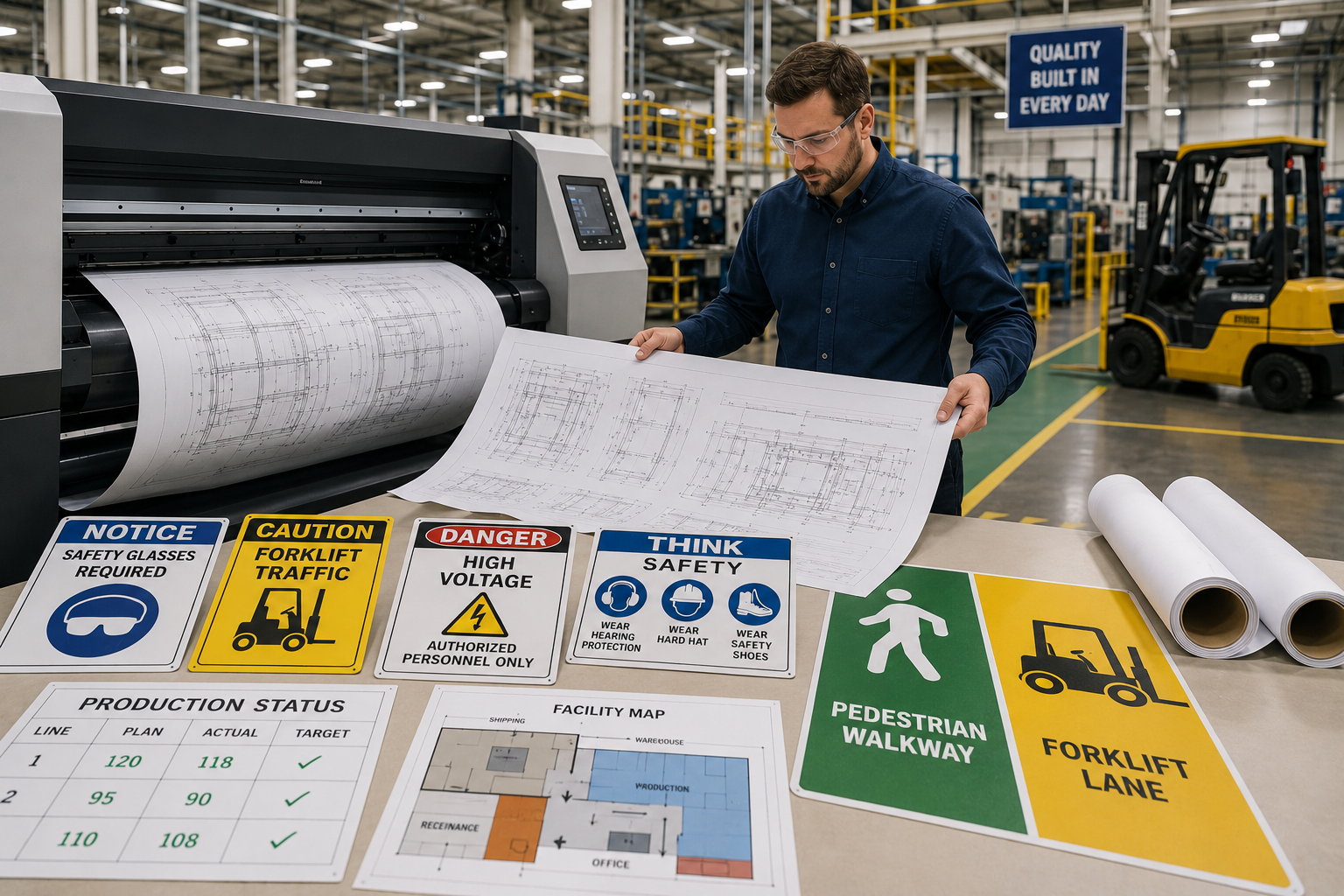
Wide format printers for manufacturing can support engineering drawings, safety signage, facility graphics, workflow boards, production visuals, and plant communication. But before a manufacturer invests in equipment, the bigger question is usually not just “Which printer should we buy?” It is “Should we buy, lease, or outsource this work?”
That decision matters because wide format printing is not just an office function in a manufacturing environment. It can affect engineering, maintenance, safety, quality, facilities, training, and operations. A delayed drawing can slow down a maintenance project. A missing sign can create confusion on the floor. An outdated workflow board can make shift communication harder. A facility graphic that does not match the current layout can frustrate employees and visitors.
Manufacturing leaders already have enough to manage. Production schedules, safety requirements, facility changes, customer deadlines, audits, workforce training, and equipment upgrades all compete for attention. The last thing a plant needs is a printing strategy that creates more work instead of making operations easier.
That is why the buy, lease, or outsource decision should be made through the lens of control, cost, speed, staffing, equipment support, and long-term flexibility.
This guide explains when buying wide format printers for manufacturing makes sense, when leasing may be the better choice, when outsourced printing services are the smarter option, and why many manufacturers use a hybrid strategy.
Quick Answer: Buy, Lease, or Outsource?
Manufacturers should consider buying a wide format printer when print volume is high, daily output is required, and long-term ownership provides the best value. Buying may be a good fit when engineering, maintenance, production, and facilities teams frequently need immediate access to large-format documents.
Manufacturers should consider leasing a wide format printer when they want predictable monthly costs, lower upfront investment, access to newer technology, and service support that may be included in the agreement. Leasing is often attractive for plants that need the equipment but want to preserve capital.
Manufacturers should consider outsourcing printing services when print needs are occasional, specialized, installation-heavy, or require materials and finishing capabilities that are difficult to manage in-house. Outsourcing is often best for floor graphics, specialty signage, wall graphics, exterior signs, and large one-time projects.
The best solution depends on print volume, speed requirements, materials, staffing, maintenance expectations, and how closely printing supports daily operations.
Da-Com’s wide format printer solutions support organizations that need large-scale output for signs, posters, graphics, technical drawings, maps, plans, and facility communication materials.
Why Manufacturers Use Wide Format Printers
Manufacturing facilities use wide format printers for far more than engineering drawings. While CAD drawings and facility layouts remain important, modern plants also rely on large-format visuals to improve safety, organization, training, communication, and audit readiness.
Common uses include:
- Engineering drawings.
- CAD documents.
- Facility layouts.
- Equipment installation plans.
- Safety signage.
- Facility labels.
- Compliance graphics.
- Lean manufacturing boards.
- 5S visuals.
- Production dashboards.
- Process maps.
- Training materials.
- Equipment graphics.
- Wayfinding signage.
- Recruiting displays.
- Customer tour graphics.
As facilities grow and evolve, these visual tools help keep communication clear and consistent. The plant floor changes quickly. A workstation moves. A new machine is installed. A forklift route changes. A safety process is updated. A customer visit is scheduled. Each change can create a need for new signs, labels, drawings, boards, or graphics.
That is why many operations leaders view wide format printing as part of the manufacturing process itself. It helps information move from the office to the floor, from engineering to maintenance, and from leadership to employees.
Da-Com’s managed print services help organizations gain visibility and control over print environments, which can be useful for manufacturers managing both office and production print workflows.
Wide Format Printers for Manufacturing: A Quick Comparison
Before deciding whether to buy, lease, or outsource, compare the operational impact of each option.
| Factor | Buy | Lease | Outsource |
|---|---|---|---|
| Upfront cost | High | Lower | None |
| Monthly expense | Lower after purchase | Predictable payment | Variable by project |
| Equipment ownership | Yes | No, unless buyout applies | No |
| Maintenance responsibility | Internal or service contract | Often included or bundled | Vendor responsibility |
| Technology updates | User responsibility | Easier upgrade path | Vendor responsibility |
| Speed of access | Immediate | Immediate | Depends on turnaround |
| Best for high volume | Excellent | Excellent | Less efficient |
| Best for occasional use | Weak fit | Moderate fit | Excellent |
| Specialized materials | Limited by equipment | Limited by equipment | Excellent |
There is no single right answer for every plant. A manufacturer that prints engineering drawings every day may need in-house equipment. A plant that only needs occasional floor graphics may be better off outsourcing. A growing facility may prefer leasing to preserve capital and upgrade more easily over time.
When Buying a Wide Format Printer Makes Sense
Buying wide format printers for manufacturing often works best when the facility has consistent print volume and needs long-term control over production. If your team prints engineering drawings every day or regularly updates internal signage and facility graphics, ownership may offer the strongest long-term value.
High Monthly Print Volume
Frequent printing often justifies ownership. The more the machine is used, the more value the facility receives from the investment. If engineering, maintenance, facilities, and safety teams all rely on large-format output, the printer may become a critical support tool.
Need for Immediate Access
Some facilities cannot wait for outside turnaround times. When engineers, maintenance teams, safety leaders, or production managers need documents immediately, in-house printing creates flexibility. A revised drawing can be printed in minutes. A temporary safety sign can be created the same day. A workflow board can be updated before the next shift meeting.
Long-Term Cost Savings
Over several years, ownership can become less expensive than recurring outsourcing expenses, especially for high-volume users. However, manufacturers should include maintenance, supplies, downtime risk, labor, and eventual replacement in the cost calculation.
Full Operational Control
Buying gives the plant more control over scheduling, priorities, file security, revision management, and print quality. For aerospace, defense, advanced manufacturing, and regulated environments, this control can be valuable.
NIST MEP’s equipment pre-purchase guide recommends that manufacturers assess equipment decisions carefully, including whether to buy or lease, and consider safety, security, quality, and efficiency requirements before acquiring equipment. You can review the guide here: NIST MEP equipment pre-purchase guide.
Challenges of Purchasing Equipment
Buying a wide format printer is not always the best fit. Ownership creates responsibility. The printer itself is only part of the equation. Someone still has to manage the device, supplies, service, users, files, and output quality.
Manufacturers should consider:
- Capital expenditure approval.
- Equipment maintenance.
- Operator training.
- Consumables management.
- Repair costs.
- Parts availability.
- Printhead or toner system maintenance.
- Color consistency.
- Media storage.
- Technology obsolescence.
- Device placement and environmental conditions.
A printer that looks like a good purchase on paper may create frustration if no one owns the workflow. Who loads rolls? Who orders supplies? Who calls for service? Who manages file versions? Who approves templates? Who checks print quality?
Buying makes sense when the plant has enough volume and a clear ownership plan. Without that plan, equipment can become one more thing the team has to chase.
When Leasing a Wide Format Printer Is the Better Choice
Leasing wide format printers for manufacturing can offer a strong balance between access and flexibility. It provides equipment without requiring a large upfront purchase, which can be helpful for facilities balancing capital spending, growth, and modernization projects.
Cash Flow Matters
Instead of a large upfront investment, leasing spreads costs across predictable monthly payments. This can make budgeting easier, especially for plants that want access to wide format printing without tying up capital.
Technology Changes Quickly
Wide format technology continues to evolve. Leasing can provide an easier path to upgrade when equipment reaches the end of its useful lifecycle or when the plant’s needs change.
Service May Be Included
Many lease agreements include or bundle maintenance, technical support, replacement parts, and service response. This can reduce internal workload and give the facility more confidence that the device will be supported.
Growth Is Expected
Facilities planning expansions often appreciate the flexibility leasing provides. If printing requirements increase, equipment can be upgraded more easily than if the plant is locked into owned equipment that no longer fits.
Leasing may also work well when multiple departments need access, but leadership wants predictable costs and a service plan attached to the device.
Questions to Ask Before Leasing
Leasing can be a smart option, but manufacturers should review the details carefully.
Ask:
- What is included in the monthly payment?
- Is maintenance included?
- Are supplies included or separate?
- What happens if the device goes down?
- How fast is service response?
- Can the equipment be upgraded during or after the term?
- What are the end-of-lease options?
- Is there a buyout option?
- Are usage limits included?
- Does the device support the materials and file types we need?
Leasing should make the workflow easier, not more restrictive. The right provider should explain the agreement clearly and help match the device to the plant’s real needs.
When Outsourcing Printing Services Makes Sense
Sometimes the best equipment decision is no equipment decision at all. Many manufacturers print less than they think, or their needs are too specialized to justify in-house production.
Outsourcing printing services works well when printing is occasional, project-based, installation-heavy, or highly specialized.
Common outsourced projects include:
- Safety signage.
- Floor graphics.
- Facility branding.
- Wall murals.
- Recruiting displays.
- Trade show graphics.
- Exterior signage.
- Vehicle graphics.
- Large compliance boards.
- Specialty labels.
- Mounted display boards.
- Customer tour graphics.
These applications often require materials, laminates, finishing equipment, installation skill, and durability knowledge that can be difficult to justify in-house.
Outsourcing can also reduce internal workload. The plant does not need to manage materials, device maintenance, specialty media, color matching, installation tools, or finishing equipment. For lower-volume or high-complexity work, outsourcing may be more efficient.
Da-Com’s article on wide format printers for project teams explains how in-house printing can support teams that need plans, signage, drawings, and large documents quickly. Manufacturers can use that same thinking to decide which work belongs in-house and which work should be handled externally.
The Hidden Costs of In-House Printing
Manufacturing teams sometimes compare equipment costs without considering labor and workflow. That can lead to incomplete decisions.
Before buying or leasing, ask:
- Who operates the printer?
- Who orders supplies?
- Who troubleshoots issues?
- Who maintains color consistency?
- Who manages file revisions?
- Who handles installation?
- Who cleans and maintains the equipment?
- Who coordinates service?
- Who stores media?
- Who decides which projects should be outsourced?
The true cost of printing is often higher than the equipment payment. A device may save time on engineering drawings while creating extra work for signage or graphics. Or the opposite may be true. A plant may outsource specialty graphics while printing CAD drawings in-house.
The goal is to understand total operational impact, not sticker price alone.
A Hybrid Printing Strategy Often Works Best
The most successful manufacturing organizations often combine in-house printing with outsourced support. This hybrid approach gives teams speed where they need it and specialized expertise where it matters.
In-House Printing Works Well For
- Engineering drawings.
- Daily CAD documents.
- Facility layouts.
- Maintenance drawings.
- Internal communication.
- Temporary signs.
- Workflow boards.
- Production visuals.
Outsourced Printing Works Well For
- Durable safety signage.
- Floor graphics.
- Exterior signs.
- Wall graphics.
- Facility branding.
- Specialty materials.
- Installation projects.
- Large campaigns.
- Customer-facing displays.
This approach allows teams to maintain speed where it matters most while using outside expertise for specialized applications. A hybrid strategy can also reduce pressure on internal staff. They do not have to turn the plant into a full production print shop, but they still have access to the materials they need quickly.
Wide Format Printers for Manufacturing and Safety Communication
Safety communication is one reason manufacturers evaluate wide format printing carefully. Plants need signs, labels, floor graphics, hazard notices, PPE reminders, and compliance visuals that are clear, consistent, and durable.
OSHA’s accident prevention sign standard defines signs as surfaces prepared to warn or provide safety instructions to workers or members of the public exposed to hazards. You can review the OSHA standard here: OSHA 1910.145 accident prevention signs and tags.
ANSI provides safety sign, color, symbol, and label standards that can help organizations create more consistent hazard communication. You can review ANSI’s safety sign standards here: ANSI Z535 safety signs, symbols, and labels.
Manufacturers should consider whether safety-related printing should be produced internally, outsourced, or managed through a standardized system. In-house printing may be helpful for quick updates and temporary signs. Outsourcing may be better for durable signs, specialty materials, and installation-heavy projects.
Questions Manufacturing Leaders Should Ask
Before choosing a buy, lease, or outsource strategy, manufacturing leaders should ask practical questions.
How Often Do We Print?
Daily needs often support buying or leasing. Occasional needs often favor outsourcing. Review actual print history instead of guessing.
How Quickly Do We Need Finished Materials?
Immediate access may justify in-house equipment. If delays affect engineering, maintenance, production, or safety communication, buying or leasing may make sense.
What Materials Are We Printing On?
Standard CAD drawings may be easy to print in-house. Durable floor graphics, exterior signage, specialty labels, and wall graphics may be better handled by an outside partner.
Who Will Manage the Equipment?
Ownership and leasing both require accountability. Someone needs to manage supplies, users, service, training, and file organization.
Are We Trying to Conserve Capital?
Leasing may provide flexibility when capital budgets are tight or when equipment upgrades are expected.
Do We Need Installation Services?
Many facility graphics projects require professional installation. Outsourcing can be helpful when placement, adhesion, surface preparation, or durability matters.
Do We Need File Security or Version Control?
Manufacturers working with sensitive engineering drawings, regulated processes, or controlled customer projects may need more control over files and reprints.
Why St. Louis, Columbia, and Southern Illinois Manufacturers Are Re-Evaluating Print Strategies
Manufacturing facilities throughout St. Louis, Columbia, and Southern Illinois continue investing in facility modernization, safety initiatives, workforce development, Lean manufacturing, aerospace production, and plant expansions.
As facilities evolve, visual communication needs increase. Plants need more signs, more drawings, more labels, more boards, and more facility graphics. At the same time, teams want to reduce delays, control costs, and avoid unnecessary complexity.
The National Association of Manufacturers reports that manufacturers contributed over $2.96 trillion at an annual rate to the U.S. economy in Q4 2025, underscoring the importance of manufacturing productivity and operational performance. You can review NAM’s resource here: NAM Facts About Manufacturing.
For regional manufacturers, the goal is not simply to print more. The goal is to communicate better. The right wide format printing strategy helps teams support production, safety, maintenance, engineering, and facility communication without creating more work.
Why Manufacturers Partner With Da-Com
Manufacturing leaders are not looking for more complexity. They want solutions that make operations easier.
That may mean helping a plant evaluate whether equipment ownership makes sense. It may mean designing a lease program that aligns with the budget. It may mean becoming an outsourced print partner for signage, floor graphics, facility visuals, and specialized applications. It may also mean supporting a hybrid strategy that combines in-house speed with outside production capabilities.
Da-Com helps manufacturers think through:
- Print volume.
- Engineering drawing needs.
- Safety signage requirements.
- Facility graphics projects.
- Equipment purchase options.
- Lease options.
- Outsourced print support.
- Service and maintenance.
- Supplies and media.
- Long-term scalability.
Da-Com’s About Da-Com page explains that Da-Com has been a customer-focused, family-owned company for more than 75 years. That local experience matters when manufacturers need practical recommendations, responsive service, and long-term support.
Frequently Asked Questions
Is it cheaper to buy or lease a wide format printer?
It depends on print volume, equipment lifespan, maintenance costs, and available capital. High-volume users may benefit from ownership, while leasing offers predictable monthly expenses and may make upgrades easier.
How much does a manufacturing wide format printer cost?
Costs vary widely based on print size, speed, color capabilities, scanning features, finishing requirements, and service needs. Manufacturers should evaluate total cost, including supplies, maintenance, labor, and downtime risk.
What types of manufacturers benefit most from in-house printing?
Facilities with frequent engineering drawings, production documentation, safety updates, internal signs, workflow boards, and recurring graphics needs often benefit most from in-house printing.
When should printing be outsourced?
Outsourcing is often best for specialty graphics, floor graphics, wall murals, exterior signage, vehicle graphics, mounted displays, large campaigns, and projects requiring installation or specialized materials.
Can manufacturers combine leasing and outsourcing?
Yes. Many facilities lease equipment for daily operational printing while outsourcing larger graphics, signage, floor graphics, and specialty projects.
What is the best first step before buying or leasing?
Start by reviewing what you print, how often you print, who needs access, how quickly materials are needed, and which projects require specialty materials or installation.
Choose a Printing Strategy That Fits the Plant
Choosing wide format printers for manufacturing can feel bigger than a printer decision because it is. The choice affects budget, workflow, response time, maintenance, staffing, and how quickly your team can get the information it needs.
Buying may be the right fit for high-volume facilities that need immediate access and long-term control. Leasing may be best for manufacturers that want predictable costs, service support, and upgrade flexibility. Outsourcing may be the strongest option for specialized graphics, low-volume needs, installation-heavy projects, or materials that are difficult to manage in-house.
Many manufacturers get the best results from a hybrid strategy. Print daily operational documents in-house. Outsource specialized graphics. Use leasing or service agreements to reduce support headaches. Review the strategy as the plant grows.
When your printing strategy fits the way your facility operates, everything becomes easier to manage. Drawings are available when teams need them. Signs stay current. Facility graphics support the plant. Production communication improves. Your team spends less time waiting and more time moving work forward.
If you are evaluating wide format printers for manufacturing operations in St. Louis, Columbia, or Southern Illinois, contact Da-Com today. Da-Com can help you compare the costs and benefits of buying, leasing, or outsourcing and build a wide format printing strategy that supports safety, productivity, and long-term operational success.




Leave A Comment