

AI-Powered Cybersecurity: 2026 SMB Guide
AI-powered cybersecurity is changing how businesses defend against modern threats. Cybercriminals are moving faster, using more convincing tactics, and adapting their attacks more often than traditional security tools were designed to handle. For small and mid-size businesses, this creates a serious challenge. You need strong protection, but you may not have a full internal security team watching every login, email, device, cloud account, and endpoint around the clock.
That is where AI-powered security tools can help. Artificial intelligence and machine learning can analyze large amounts of security data, identify unusual behavior, prioritize alerts, and help security teams respond faster. Instead of relying only on known malware signatures or manual review, AI-enhanced tools can look for patterns that suggest something is wrong, even when the attack does not match a known threat.
The goal is not to replace cybersecurity professionals. The goal is to give them better visibility, faster detection, and more useful information so they can protect businesses more effectively.
For businesses in St. Louis, Columbia, Southern Illinois, and surrounding communities, the value of AI is practical. It can help detect suspicious logins, flag unusual file access, improve phishing protection, support endpoint monitoring, reduce alert overload, and help identify threats before they spread.
This guide explains what AI-powered cybersecurity means, how it works, why traditional tools are no longer enough by themselves, how attackers are also using AI, and what small and mid-size businesses should ask before choosing a cybersecurity partner.
What Is AI-Powered Cybersecurity?
AI-powered cybersecurity uses artificial intelligence, machine learning, automation, behavioral analytics, and data correlation to help detect, prioritize, and respond to cyber threats.
Traditional cybersecurity tools often rely on rules or signatures. If a file, website, sender, or activity matches a known bad pattern, the tool blocks it. That approach is still useful, but it has limits. New malware, new phishing tactics, compromised legitimate accounts, fileless attacks, and unusual insider behavior may not match a known signature.
AI-enhanced tools work differently. They can learn what normal activity looks like across users, devices, applications, and networks. Then they can flag behavior that does not fit the normal pattern.
Examples may include:
- An employee account logging in from an unusual country or device.
- A workstation suddenly connecting to suspicious external destinations.
- A user accessing hundreds of files they normally never touch.
- An email that looks legitimate but uses unusual language, timing, sender behavior, or link structure.
- A device showing signs of credential theft, malware activity, or lateral movement.
- A cloud account creating unexpected forwarding rules or downloading large amounts of data.
These signals do not always prove an attack on their own. But they are the kinds of warning signs that deserve attention. AI-powered cybersecurity helps surface those warning signs faster so a security team can investigate and respond.
NIST’s AI Risk Management Framework is a helpful resource for understanding how organizations can think about AI in a structured, risk-aware way. AI can improve security, but it should be governed, monitored, and used with clear accountability.
Why Traditional Security Tools Are No Longer Enough
Traditional security tools are still important, but they are not enough by themselves. Many older tools were built for a simpler threat environment. They were designed to stop known malware, block known malicious websites, or identify suspicious activity based on rules written in advance.
Modern attacks are more dynamic.
Cybercriminals may use stolen credentials instead of obvious malware. They may compromise a real vendor account and send messages from a trusted email address. They may use fileless techniques that do not rely on a traditional malicious attachment. They may create new malware variants that do not match older signatures. They may use AI to write convincing phishing messages that are harder for employees to recognize.
This creates three major challenges for businesses.
1. Attacks Move Faster
Attackers can scan for weaknesses, send phishing emails, test stolen credentials, and move across systems quickly. If a business only responds after users report a problem, the attacker may already have gained access to data or systems.
2. Threats Change Constantly
New attack techniques appear regularly. Security tools that only look for known threats may miss new behaviors or unusual combinations of activity.
3. Security Data Is Too Large for Manual Review
Every business system creates security data. Firewalls, laptops, email platforms, cloud tools, endpoint protection, identity systems, remote access tools, and servers all generate logs and alerts. Human teams cannot manually review every event in real time.
AI-powered cybersecurity helps by analyzing large volumes of activity and identifying the events that deserve attention.
Da-Com’s cybersecurity essentials for SMBs resource explains why small and mid-size businesses need layered protection that includes monitoring, endpoint protection, email filtering, patch management, and incident response planning.
How AI-Powered Cybersecurity Detects What Traditional Tools Miss
AI-powered cybersecurity is especially valuable because it can look beyond known signatures. It can analyze behavior, context, timing, relationships, and patterns across multiple systems.
Machine Learning for Anomaly Detection
Machine learning can help identify activity that does not match normal behavior. For example, if an employee normally logs in during business hours from Missouri and suddenly logs in overnight from another country, the system can flag that activity for review.
Anomaly detection is useful because many attacks involve legitimate credentials. If an attacker has the right username and password, the login may look technically valid. Behavioral analysis helps identify when the activity behind that login does not make sense.
Natural Language Processing for Email Security
Email remains one of the most common attack paths. AI-enhanced email security can analyze the language, sender behavior, link patterns, attachment context, and message structure of incoming emails.
This can help detect phishing attempts that may not contain obvious spelling errors or suspicious formatting. Modern phishing emails can be polished, personalized, and convincing. AI can help identify subtle signals that a message may not be legitimate.
Endpoint Detection and Response
Endpoint detection and response, often called EDR, monitors workstations, servers, and devices for suspicious behavior. AI-enhanced EDR can help detect malicious process activity, credential theft attempts, unusual file changes, and possible lateral movement across systems.
If a threat is detected, EDR tools may help isolate the affected device, stop a suspicious process, or alert the security team for rapid investigation.
Security Event Correlation
A single security event may not look serious on its own. Several related events across multiple systems may tell a different story.
For example, a failed login attempt, an unusual endpoint process, a new cloud forwarding rule, and a small late-night data transfer may seem unrelated if viewed separately. AI-enhanced security tools can help connect events across systems and identify patterns that suggest a coordinated attack.
User and Entity Behavior Analytics
User and entity behavior analytics, often called UEBA, builds behavior profiles for users and devices. If activity changes significantly, the system can alert the security team.
This can help detect compromised accounts, insider threats, or unusual device behavior.
Da-Com’s managed IT and technology success services include cybersecurity, monitoring, support, backup planning, and technology management for businesses that need stronger protection without building a full internal IT department.
AI on the Attacker’s Side: Why the Threat Is Changing
AI-powered cybersecurity is important because attackers are also using AI. This is one of the biggest reasons businesses should not rely on outdated security practices.
AI can help attackers create more convincing emails, automate research, write better scams, and scale attacks faster. This does not mean every cybercriminal is highly advanced, but it does mean the quality and volume of attacks can increase.
AI-Generated Phishing
Older phishing emails were often easier to spot because they had awkward grammar, strange formatting, or generic messages. AI-generated phishing can be more polished. It can use natural language, reference public information, and sound more like a real business message.
For employees, this makes phishing awareness harder. A message may look professional and still be dangerous.
More Personalized Social Engineering
Attackers can use public information from websites, LinkedIn profiles, press releases, job postings, and social media to make messages more believable. AI can help organize that information and turn it into targeted emails or scripts.
A fake request may mention a real project, real employee name, real vendor, or real business event. That makes verification processes more important.
Faster Vulnerability Research
AI can help attackers search for exposed systems, summarize technical information, and identify potential weaknesses faster. This compresses the time businesses have to patch vulnerabilities and improve controls.
Deepfake and Voice Fraud Concerns
AI-generated voice and video are becoming more realistic. Businesses should be cautious about approving payments, access changes, or sensitive requests based only on voice, video, or email instructions.
Verification should happen through trusted channels and established processes.
CISA provides artificial intelligence cybersecurity resources to help organizations understand secure AI development, deployment, operation, and AI-related cyber risk. These resources reinforce an important point: AI is useful, but it must be handled securely and thoughtfully.
AI-Powered Cybersecurity for Small and Mid-Size Businesses
Small and mid-size businesses often face the same kinds of cyber threats as larger organizations, but with fewer internal resources. A regional manufacturer, accounting firm, construction company, nonprofit, school, medical office, or professional services firm may have valuable data, but not a full security operations center.
That creates a gap. AI-powered security tools delivered through a managed IT or managed security provider can help close it.
For SMBs, AI-powered cybersecurity can support:
- Continuous monitoring without hiring a full internal team.
- Faster identification of suspicious activity.
- Improved email threat detection.
- Endpoint protection across workstations and servers.
- More consistent alert prioritization.
- Better visibility into user and device behavior.
- Support for incident response workflows.
- Reporting that helps leaders understand risk.
This matters because many small and mid-size businesses are attractive targets. They may hold financial data, client records, project files, payment information, employee data, healthcare information, tax records, or intellectual property. Attackers know smaller organizations may have weaker controls than larger enterprises.
AI does not make cybersecurity effortless, but it can make strong monitoring and detection more accessible to businesses that cannot build everything in-house.
AI-Powered Cybersecurity and Email Protection
Email protection deserves special attention because email is still one of the most common places attacks begin.
AI-enhanced email security can help detect:
- Phishing messages
- Business email compromise attempts
- Suspicious sender behavior
- Malicious links
- Dangerous attachments
- Impersonation attempts
- Unusual language patterns
- Messages that pressure employees to bypass normal process
However, technology should not be the only defense. Employees also need clear processes for suspicious messages, payment changes, password requests, and vendor communication.
A strong email security program should combine filtering, AI analysis, multi-factor authentication, user training, and payment verification rules.
For example, if a vendor sends new banking instructions by email, employees should verify the request through a known phone number already on file. If an executive asks for an urgent payment, there should be an approval process. If an email asks for credentials, employees should know how to report it.
AI can help identify suspicious messages, but process prevents people from acting too quickly when a message looks convincing.
Endpoint Detection and AI-Driven Response
Endpoints are the devices people use every day: laptops, desktops, servers, and sometimes mobile devices. They are often where attacks begin or become visible.
AI-enhanced endpoint detection can help identify suspicious actions such as:
- Unexpected script execution.
- Credential dumping attempts.
- Unusual file encryption.
- Suspicious PowerShell activity.
- Unauthorized software behavior.
- Attempts to disable security tools.
- Connections to suspicious external locations.
When endpoint tools detect suspicious behavior, they may support automated response actions such as isolating a device from the network, stopping a process, or sending an urgent alert to the security team.
Automated response can be valuable because speed matters during an incident. A ransomware event or credential theft attempt can spread quickly if no one responds.
Still, automation should be governed. Security teams should know which actions are automated, which require approval, and how alerts are reviewed. The best approach combines rapid containment with human investigation.
AI, Patch Management, and Vulnerability Reduction
AI-powered cybersecurity is not only about detecting attacks. It can also help reduce the chance that attacks succeed.
Patch management is a good example. Many attacks exploit known vulnerabilities that could have been patched. The challenge is that businesses often have many devices, applications, operating systems, browsers, and tools to maintain.
AI and automation can support patch management by helping identify missing updates, prioritize high-risk patches, flag devices that are not updating correctly, and report compliance status.
For SMBs, this is important because patching is often inconsistent when no one owns the process. A managed IT partner can help make patching more regular and measurable.
Da-Com’s proactive IT monitoring resource explains how continuous oversight helps businesses identify technology issues earlier and reduce downtime risk.
AI Security Should Be Part of a Layered Program
AI-powered cybersecurity is valuable, but it should not stand alone. It works best as part of a layered security program.
A layered program may include:
- Multi-factor authentication.
- Email filtering and phishing protection.
- Endpoint detection and response.
- Firewall and network security.
- Patch management.
- Backup and disaster recovery.
- Cloud security controls.
- Device management.
- Employee cybersecurity training.
- Incident response planning.
- Security reporting.
AI can improve monitoring and detection across these layers, but it does not replace the basics. In fact, the basics become more important because AI-enhanced attacks may exploit weak passwords, missing patches, poor access control, and unclear employee processes.
Business leaders should be cautious of any provider that presents AI as a one-tool solution. Real cybersecurity requires people, process, technology, and ongoing improvement.
How to Measure AI-Powered Cybersecurity Effectiveness
Investing in AI-powered security only matters if the program produces better outcomes. Business leaders should ask for reporting that translates technical activity into useful insights.
Useful cybersecurity metrics may include:
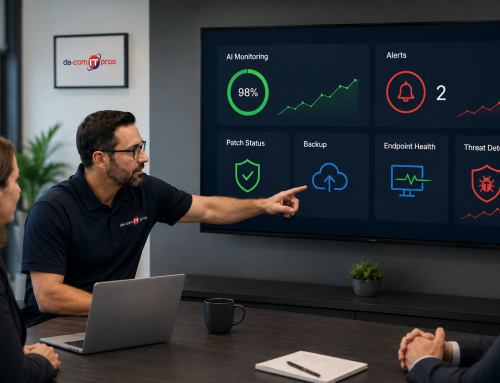
- Number of threats detected and blocked.
- Mean time to detect suspicious activity.
- Mean time to respond to critical alerts.
- Patch compliance rates.
- Endpoint protection status.
- Phishing simulation results.
- Suspicious login activity.
- Backup health.
- Security training completion.
- Open vulnerabilities or unresolved risks.
The goal is not to overwhelm leaders with technical dashboards. The goal is to help them understand whether risk is being reduced and where attention is needed.
A good provider should be able to explain what tools are finding, what actions are being taken, and what recommendations should come next.
Questions to Ask a Cybersecurity Provider About AI
As AI becomes more common in cybersecurity marketing, businesses should ask specific questions. A provider should be able to explain how AI is used and what outcomes it supports.
Ask questions such as:
- What AI-powered cybersecurity tools do you use?
- How do your tools detect behavioral threats?
- Do you use endpoint detection and response?
- How do you protect against AI-generated phishing?
- Who reviews AI-generated alerts?
- What response actions are automated?
- How do you prevent alert fatigue?
- How do you validate that alerts are accurate?
- How is client data protected inside AI-enabled tools?
- What security reports will leadership receive?
- How does AI fit into your broader cybersecurity program?
- What happens when a threat is detected after hours?
If the answer is only “we use AI,” keep asking. The label is not enough. The process, tools, response model, and reporting matter more.
AI Risks Businesses Should Understand
AI can strengthen cybersecurity, but it also creates new questions. Businesses should understand how AI tools are selected, configured, monitored, and governed.
Potential risks include:
- Too much reliance on automation without human oversight.
- False positives that create alert fatigue.
- False negatives that miss important activity.
- Data privacy concerns.
- AI tools connected to sensitive systems without clear controls.
- Employees using unauthorized AI tools with company data.
- Unclear responsibility when automated actions occur.
- Security tools that are not tuned to the business environment.
These risks do not mean businesses should avoid AI. They mean AI should be managed responsibly.
NIST’s AI Risk Management Framework can help organizations think about trustworthy and risk-aware AI use. CISA’s AI cybersecurity resources can also help leaders understand the security side of AI adoption.
How Da-Com IT Pros Helps Businesses Strengthen Cybersecurity
Da-Com IT Pros helps businesses across St. Louis, Columbia, Southern Illinois, and surrounding areas build practical cybersecurity programs that fit their size, risk, and industry. The goal is to help businesses improve protection without forcing them to become cybersecurity experts themselves.
AI-powered tools can strengthen that approach by supporting faster detection, better monitoring, smarter alerting, stronger endpoint visibility, and more consistent security workflows.
Da-Com helps businesses think through:
- Cybersecurity monitoring.
- Email security.
- Endpoint protection.
- Patch management.
- Backup and recovery.
- Incident response planning.
- Employee training.
- Cloud and account security.
- Security reporting.
- Managed IT support.
The value is not simply adding another security product. The value is building a managed cybersecurity program that combines modern tools, experienced professionals, clear processes, and ongoing support.
Build a Smarter Cybersecurity Foundation
AI-powered cybersecurity is becoming more important because modern threats are faster, more convincing, and harder to detect with traditional tools alone. Attackers are using automation, stolen credentials, targeted phishing, and AI-assisted tactics. Businesses need security programs that can keep up.
For small and mid-size businesses, AI-enhanced security can provide better visibility, faster detection, improved email protection, stronger endpoint monitoring, and more useful reporting. But AI should be part of a layered program, not a shortcut.
The strongest cybersecurity approach combines AI-powered tools with human expertise, clear policies, multi-factor authentication, patching, backups, employee training, and incident response planning.
To learn more about AI-powered cybersecurity, managed IT, threat detection, and security monitoring for your St. Louis or Southern Illinois business, contact Da-Com IT Pros today. Da-Com can help your business strengthen its security posture, improve visibility, and prepare for the modern threats facing SMBs.


Leave A Comment