

KIP Wide Format Systems: 2026 Deadline Guide
KIP Wide Format Systems can make a hard print deadline feel a lot less stressful for government teams. Public works, engineering, planning, GIS, facilities, transportation, sewer, water, and emergency management departments often work with fixed dates and very little room for print delays. A bid opening is scheduled. A council meeting needs clear boards. A contractor needs the right plan set before crews arrive. A map must be ready for a public meeting. A field team needs the latest revision, not the one from last week.
That kind of pressure is real.
When plans, maps, signs, and boards are late or wrong, the problem does not stay in the print room. It moves into the field. It moves into the meeting. It moves into a contractor call. It moves into a room full of residents who need clear answers.
That is why wide format printing should be viewed as more than paper, toner, and equipment. For government teams, wide format printing is part of the deadline chain. When that chain works, people can focus on the project. When it breaks, people notice quickly.
This guide explains how KIP Wide Format Systems can support government print workflows, why large-format deadlines matter, what features to compare, and how public sector teams can reduce stress around plan sets, maps, boards, scanning, security, and overflow work.
Why Wide Format Deadlines Matter in Government
A missed print deadline can look small from the outside. Inside a public agency, it can create a long list of problems.
A late bid set can slow down a contractor. A missing sheet can create confusion in the field. A blurry utility map can waste time. A wrong revision can create rework. A rushed public meeting board can make the whole project look less prepared.
Most government teams are already stretched. Staff may be handling inspections, calls, permits, budgets, council packets, public comments, project updates, weather events, road issues, utility work, grant deadlines, and citizen questions. They do not have extra hours to babysit a slow plotter, sort piles of sheets, chase file errors, or reprint a full set because one version was wrong.
That is where the right wide format system can help.
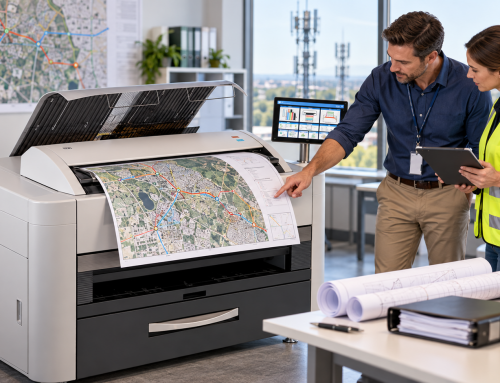
KIP Wide Format Systems can support many of the documents government teams need most often, including plan sets, construction drawings, as-builts, GIS maps, zoning maps, public meeting boards, facility plans, field maps, signage, scanned archives, and technical records.
The goal is simple: get the right file printed in the right size, in the right order, with the right finish, before the deadline hits.
Da-Com’s wide format printer solutions support organizations that need dependable large-format output for plans, drawings, maps, graphics, and technical documents.
How KIP Wide Format Systems Help Speed Up Plan Sets
Speed matters when a deadline is fixed. Bid openings, pre-bid meetings, council meetings, construction starts, public reviews, addendum deadlines, and field mobilization dates do not pause because the printer is slow.
KIP describes its wide format printing systems as high-speed systems with easy-to-use color touchscreen controls. For busy government teams, that matters because high-volume plan set work often comes in waves. One week may be calm. The next week may bring a road project, a public meeting board, a GIS map request, and a last-minute addendum.
Faster production can help when a project manager says, “I need this tomorrow morning.” It can help when the internal printer is backed up. It can help when multiple departments need plans at the same time. It can also help when a revised sheet arrives after everyone thought the files were final.
Fast output does not remove the deadline, but it can remove one of the biggest bottlenecks.
However, speed is only useful when paired with accuracy. A fast wrong set still creates problems. That is why speed, job control, file organization, and clear print instructions should work together.
Keeping the Right Version in the Right Hands
A wrong version can cause more damage than a late version. If a field crew uses the old drawing, work can slow down. If a contractor gets the wrong addendum, questions start. If a council packet has the wrong exhibit, the meeting becomes harder.
Version control is one of the quiet risks in government wide format printing.
A strong workflow should make it easy to confirm which file is current, which sheets changed, how many copies are needed, and who receives each set. KIP systems can support organized print workflows through touchscreen operation, job handling, and print management features, but the system still needs a clear process behind it.
The goal is not just to print fast. The goal is to print the right set.
For government teams, that means:
- Clear file names
- Clear job notes
- Clear revision labels
- Clear sheet order
- Clear delivery instructions
- Clear records of what was printed
- Clear responsibility for approving the final version
When the right version is in the right hands, your team spends less time answering preventable questions. Contractors can work with more confidence. Field crews can trust the documents they have. Project managers can respond faster when someone asks what changed.
Da-Com’s KIP large format printer guide explains when KIP systems make sense in-house, when outsourcing may be better, and how teams can reduce wrong-revision mistakes.
Public Meeting Materials Need a Different Kind of Clarity
Public meetings bring a different kind of pressure. The plans may be technical, but the audience is not always technical. Residents need to understand what is changing. Council members need to see the project clearly. Staff need to answer questions without digging through small sheets or confusing maps.
This is where wide format work becomes public communication.
KIP Wide Format Systems can help teams create large maps, project boards, posters, phasing exhibits, detour maps, zoning displays, facility layouts, and meeting visuals that are easier to see from across a room.
That matters because clear visuals can calm a room. People may still have concerns. They may still ask hard questions. But when they can see the project, the conversation starts from a better place.
A clean board can show which road is affected. A clear map can show which homes are inside a project area. A simple timeline can show when work is expected to happen. A large zoning map can help residents understand what is being discussed.
Public projects are not only technical. They are also public. The materials should help people understand the work, not make the conversation harder.
Helping Staff Spend Less Time Fighting the Printer
Your staff has better things to do than stand by a machine during a deadline week.
Engineers, inspectors, planners, GIS staff, administrative assistants, project managers, and department leaders are often pulled into print tasks because the deadline is close. They sort sheets. Fold sets. Reprint missing pages. Check scale. Label rolls. Run back and forth from the printer. Track who needs which copy. Answer questions about whether the job is finished.
That work has to get done, but it can drain a team quickly.
KIP Wide Format Systems are designed to support busy workgroups with printing, copying, scanning, and job management options. For government offices, that can help reduce the time staff spends on low-value print tasks and create a more predictable workflow.
The less time your team spends chasing sheets, the more time they can spend moving the project forward.
That can mean fewer internal delays, fewer repeat trips to the printer, fewer questions about whether a set has printed, and fewer situations where one employee becomes the unofficial print room during a deadline week.
Field-Ready Maps and Plans Need to Be Easy to Use
Field crews need documents they can use in real conditions. Not documents that only look good on a screen.
A field-ready plan set needs clear lines. A road map needs readable labels. A utility drawing needs enough detail to guide the work. A facility plan needs to be large enough to make sense under pressure. A detour map needs to be visible and understandable. A public works crew should not have to guess which sheet they are looking at.
When a sheet is hard to read, people slow down.
KIP 900 Color Series materials describe these systems as wide format solutions for a range of printing tasks that include architectural, engineering, and construction documents, as well as maps, posters, and signs. That range is helpful for government teams because the work changes from week to week.
A public works department may need plan sets one day and detour maps the next. A GIS team may need wall maps. A facilities team may need building plans. An emergency management team may need command center maps. A planning team may need public meeting exhibits.
The documents are different, but the need is the same. They must be clear, useful, and ready when people need them.
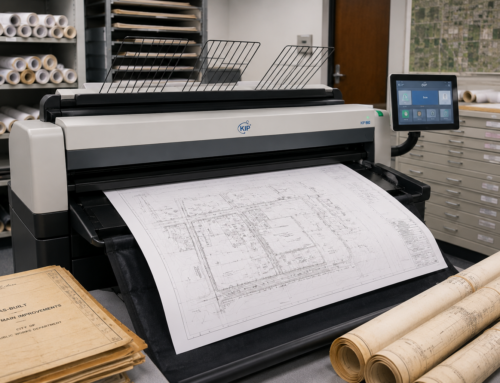
Scanning Old Drawings and Archives
Old drawings create quiet stress. They sit in tubes, flat files, cabinets, storage rooms, and back offices. Everyone knows they may be needed someday. No one wants to stop current work to organize them.
Then something happens. A building project starts. A pipe breaks. A grant application needs backup. A facility question comes up. A field crew needs an old drawing. Suddenly, someone is digging through paper under pressure.
KIP multifunction systems can include scanning options that help turn large-format paper documents into digital files. For government teams, scanning can be a major time saver.
Old drawings can become digital files your team can find, share, and reprint. Facility plans can be organized by building. Utility maps can be saved by project or location. As-builts can be stored for future use. Public works records can become easier to locate when the next question comes up.
The goal is not only to clean up storage. The goal is to make sure your team is not forced to hunt for old paper during the next urgent situation.
Scanning also supports long-term continuity. Government staff changes over time. Departments reorganize. Buildings are renovated. Projects move from design to construction to maintenance. Digital access to older plan records helps future teams understand past work more easily.
Secure File Handling for Government Wide Format Printing
Some government files should not be treated like ordinary print jobs. Facility layouts, school safety plans, public safety maps, utility maps, law enforcement materials, emergency response documents, and certain infrastructure plans may need extra care.
That does not mean every file is restricted. It means government teams need a print workflow that respects security.
A secure file workflow may include:
- Approved users
- Clear file names
- Controlled access
- Confirmed pickup or delivery
- Simple retention rules
- Secure network settings
- Limited access to sensitive print queues
- Clear instructions for handling restricted documents
The system matters. The process matters too.
A deadline-driven team should not have to choose between speed and control. A good workflow helps the right people get the right documents while reducing the chance that sensitive materials are sent to the wrong place, printed without tracking, or left in an open area.
For agencies that manage internal print environments, Da-Com’s managed print services can help improve visibility, support, and control across printing and document workflows.
Color Output When Color Actually Matters
Not every government print job needs color. Many plan sets are still black-and-white. Many field sets need line clarity more than anything else.
But some work is much easier to understand in color.
GIS maps, utility overlays, floodplain maps, zoning exhibits, detour maps, public meeting boards, phasing plans, park maps, trail maps, and emergency maps often benefit from color because color helps people distinguish areas, phases, routes, zones, utilities, hazards, and boundaries.
Color is not about making documents flashy. It is about making information easier to read.
A planning team may need color zoning maps. A public works team may need color phasing boards. A GIS team may need map overlays. A facilities team may need color-coded floor plans. An emergency management team may need maps that can be understood quickly during a stressful situation.
When color improves comprehension, the right wide format system can help teams communicate more clearly.
Rush Work, Overflow, and Deadline Spikes
Most agencies do not have a steady, predictable print load. The work comes in waves.
One week may be quiet. The next week may bring a bid set, two public meeting boards, a batch of GIS maps, a last-minute addendum, and a request for scanned archives.
That is when internal equipment gets tested.
A plotter that works fine for normal needs may not be enough during a deadline spike. It may be too slow. It may need service. It may run out of supplies. It may not handle the finishing your team needs. It may create a bottleneck right when the project needs speed.
KIP Wide Format Systems can help agencies handle higher print demand, especially when used as part of a planned print workflow. For some teams, that means an in-house KIP system for regular demand. For others, it means working with Da-Com for sales, service, supplies, and support. For many, it means setting up an overflow plan before the rush job hits.
The best time to plan for rush work is before the rush. That means knowing who can approve jobs, where files should go, how sets should be labeled, who needs delivery, and how billing should be handled.
When those details are already set, the next deadline feels less chaotic.
Procurement and Print Planning for Public Sector Teams
Government print work is not only about printing. It is also about process.
Purchase orders, project numbers, department codes, quotes, vendor setup, delivery records, invoices, bid documents, grant codes, file records, and approval steps all affect how smoothly a print job moves.
If those details are messy, the print job becomes harder than it needs to be.
That is why it helps to think about KIP Wide Format Systems as part of a larger plan. The system should support the way your agency works. The vendor should understand deadlines, public meetings, revisions, overflow needs, service response, supplies, and purchase-order friendly billing.
This matters in the St. Louis and Southern Illinois region, where public agencies may work through different procurement systems and rules.
For example, SAM.gov entity registration allows organizations to bid on federal contracts and apply for federal assistance. MissouriBUYS supplier registration is used for supplier registration in Missouri’s statewide eProcurement system. Illinois agencies and vendors may also use Illinois BidBuy for state procurement activity.
When vendor setup and print planning are handled early, your team is not stuck solving paperwork during a rush deadline.
What a Real Deadline Week Can Look Like
Think about a normal government deadline week.
A road project is moving toward bid. A public meeting is scheduled for Thursday. A council member asks for a larger exhibit. The engineer sends a revised sheet. The GIS team updates a map. The field crew needs two sets by morning. The internal printer is already tied up.
This is where small delays can stack up fast.
With a clear wide format workflow, your team can move with more control:
- Files are sent once.
- Revisions are labeled.
- Plan sets are printed in order.
- Maps are large enough to read.
- Boards are ready before the meeting.
- Field sets are rolled, marked, and delivered to the right place.
- Invoices match the project number.
- Nobody has to chase every step.
That is the real value. Not just faster printing, but less confusion, less staff time, fewer surprises, and more confidence before the deadline hits.
How to Know If Your Team Needs a Better Wide Format Workflow
Your team may need a better plan if any of these situations sound familiar:
- Your plotter is often backed up before meetings or bid dates.
- Your staff spends too much time sorting, folding, scanning, or reprinting.
- You worry about wrong versions reaching the field.
- Your maps are hard to read in public meetings.
- Your old drawings are difficult to find.
- Your departments print in different ways with no clear process.
- Your invoices do not line up cleanly with project numbers.
- Your rush jobs feel stressful every time.
- Your internal equipment is aging or unreliable.
- Your team needs more scanning, color, finishing, or overflow support.
These are not just print problems. They are workflow problems.
KIP Wide Format Systems can help, but the system should be matched to the way your team works. A small planning office does not have the same needs as a high-volume public works department. A GIS team may care most about color maps. A facilities team may need scanning. An emergency management team may need secure, fast map production. A public works team may need plan set speed and dependable field output.
The right setup should fit the deadline pressure your team actually faces.
Questions to Ask Before Choosing a KIP System
Before investing in a system or changing your workflow, it helps to ask practical questions.
- What types of documents do we print most often?
- How often do we print full-size plan sets?
- How often do we need half-size sets?
- Do we need black-and-white, color, or both?
- Do we need scanning for old drawings and archives?
- How often do rush jobs happen?
- Which departments will use the system?
- Who will manage supplies?
- Who will handle service issues?
- What security controls are needed?
- Do we need finishing, folding, stacking, or delivery support?
- What happens if the device is down before a deadline?
- Do we need overflow support for large projects?
- How should jobs be billed by project, department, or purchase order?
These questions help the conversation move from equipment features to real workflow needs.
Da-Com’s service and supplies support can help agencies think through the long-term support side of large-format equipment, including maintenance, supplies, uptime, and responsive service.
How Da-Com Can Help Make the Next Deadline Easier
Government deadlines do not leave much room for print problems. When a bid set, addendum, field map, facility plan, scanned drawing, or public meeting board is late or wrong, it can create stress for everyone. Staff feel it. Contractors feel it. Residents may see it. Leadership may ask about it.
Da-Com helps government teams make that process easier.
With KIP Wide Format Systems, Da-Com can help government teams in St. Louis, St. Louis County, St. Charles County, Jefferson County, Madison County, St. Clair County, Monroe County, the Metro East, and Southern Illinois build a wide format workflow that supports real deadlines.
That may include equipment planning, service support, supplies, scanning workflows, plan set printing, color map needs, secure file handling, and overflow planning.
The goal is not to make your team change everything. The goal is to make the next deadline easier.
If your agency depends on plans, maps, boards, signs, or scanned drawings, Da-Com can help you look at where the bottlenecks are and what kind of KIP system or wide format support makes the most sense.
Build a Better Wide Format Deadline Plan
KIP Wide Format Systems can help government teams produce clear, fast, field-ready documents when deadlines are fixed and the pressure is high. But the equipment is only one part of the answer. The strongest results come from pairing the right system with a clear workflow, reliable service, secure file handling, revision control, supply planning, and overflow support.
For public works, engineering, planning, GIS, facilities, transportation, sewer, water, and emergency management teams, wide format printing is part of keeping projects moving. It helps people see the work, understand the project, trust the latest version, and walk into deadlines better prepared.
To learn more about KIP Wide Format Systems for your St. Louis, Columbia, or Southern Illinois government team, contact Da-Com today. Da-Com can help your team stay prepared, protect deadlines, and keep the right documents in the right hands.



Leave A Comment