
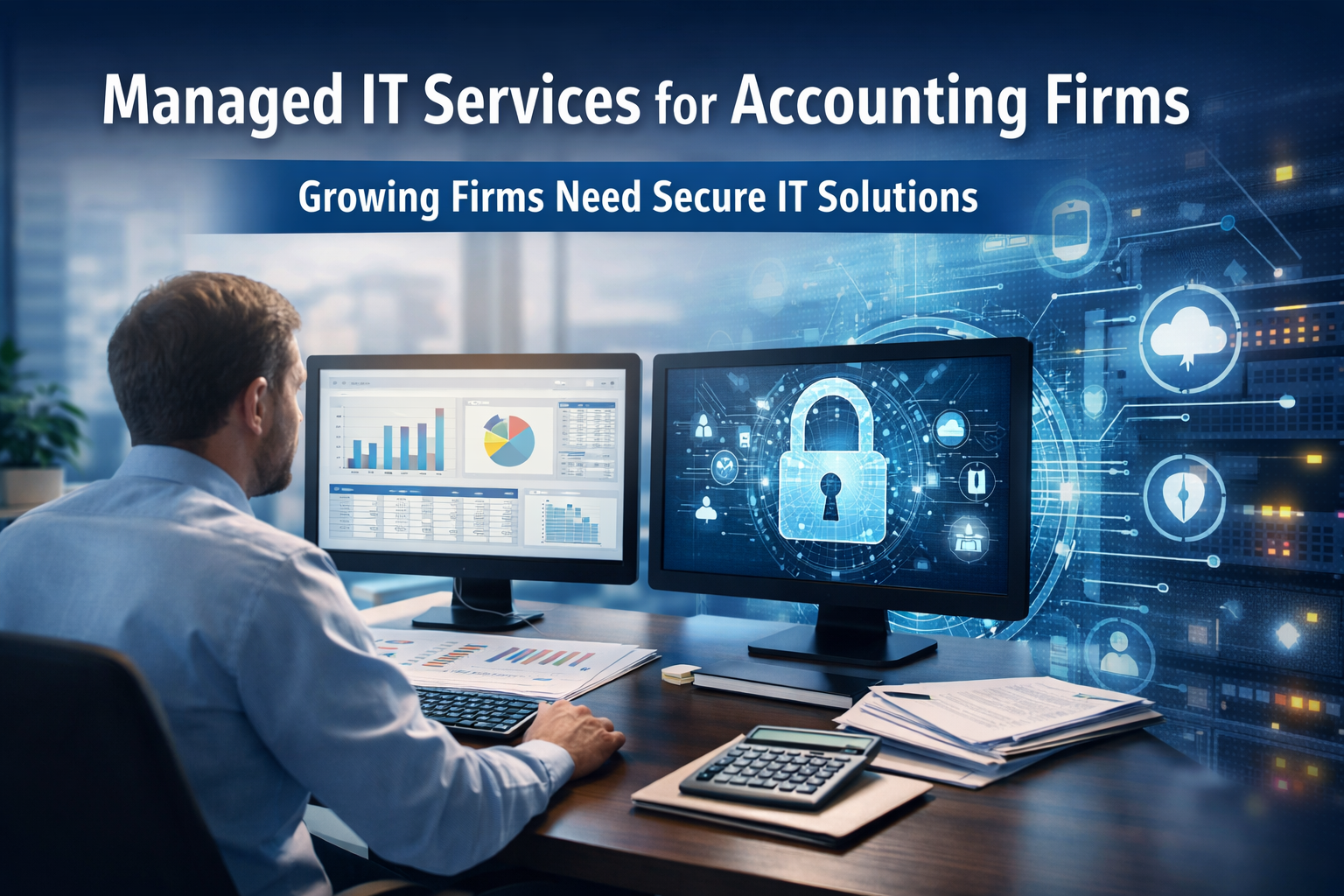
Managed IT Services for Accounting Firms: 5 Signs You’ve Outgrown DIY IT
Managed IT services for accounting firms are not just for large practices with in-house IT teams. In many cases, the firms that benefit most are small and midsize accounting practices that have grown steadily while their technology has stayed mostly the same.
What worked when your firm had a smaller staff, fewer devices, and a lighter workload can start to create friction as you grow. Systems become harder to manage. Security gaps become more serious. Everyday slowdowns start costing time during your busiest seasons.
That shift usually does not happen all at once. It shows up gradually through recurring issues that feel manageable at first, such as slow computers, Wi-Fi problems, remote access headaches, scattered software decisions, or growing concern about protecting sensitive client data.
This is why managed IT services for accounting firms are best viewed as an operational maturity step, not just a support purchase. A more proactive IT approach can help firms improve reliability, reduce risk, and create a clearer path for growth.
Here are five signs your accounting practice may have outgrown ad hoc or break-fix IT support.
Why Managed IT Services for Accounting Firms Become More Important as You Grow
Growth makes technology more complex. More employees need secure access. More devices need updates and protection. More files need to be stored, shared, and backed up. More workflows depend on systems being available when your team needs them, especially during tax season, audits, monthly close periods, and reporting deadlines.
Many firms reach a point where their IT environment was built for an earlier version of the business. Instead of following a plan, they have added tools, devices, and fixes over time as needs came up. That approach can work temporarily, but it often leads to inconsistent systems, security blind spots, and support challenges that get harder to manage every year.
For firms handling tax records, payroll data, financial statements, and other confidential client information, the stakes are even higher. Managed IT services for accounting firms can help create a more stable, secure, and scalable foundation.
1. Your Technology Is Slowing Down Daily Work
One of the clearest signs that a firm has outgrown its current setup is persistent slowness. Computers take too long to start. Practice management software lags. Shared files open slowly. Printing, scanning, or accessing documents becomes inconsistent. Staff spend more time waiting on systems than moving through work.
These issues are easy to normalize because they build gradually. But the productivity loss adds up quickly. If several employees each lose 20 to 30 minutes a day to slow systems, that becomes a meaningful operational cost over time.
In accounting firms, slow technology creates more than frustration. It can interfere with turnaround times, increase employee stress, and make deadline-driven work harder than it needs to be.
Often, the problem is not just aging hardware. It may also reflect weak network performance, inconsistent device standards, outdated lifecycle planning, or lack of proactive IT monitoring. This is where managed IT services for accounting firms can make a difference by improving visibility into system performance and helping firms plan ahead instead of reacting after productivity drops.
Common signs in this stage
- Staff regularly complain about slow computers or applications
- Shared files or cloud systems lag during busy periods
- Printers, scanners, or document workflows are unreliable
- Technology issues are affecting turnaround time or client service
2. You Do Not Have a Formal IT Security Plan
If your firm’s security approach is mostly based on antivirus, basic passwords, and the hope that nothing bad happens, that is a warning sign. Accounting firms hold exactly the kind of information cybercriminals want, including Social Security numbers, tax documents, payroll records, bank details, and private business financial information.
Security is not only about preventing cyberattacks. It is also about building a structured environment that reduces avoidable risk and supports responsible data handling. For many firms, growth happens faster than security planning, leaving controls inconsistent across users, devices, and applications.
A stronger approach typically includes secure access controls, multi-factor authentication, regular patching, endpoint protection, backups, user training, and a clear understanding of how the firm would respond to an incident.
Accounting practices should also stay aware of guidance and expectations from resources such as the FTC Safeguards Rule, IRS Publication 4557, and the NIST Cybersecurity Framework 2.0.
Managed IT services for accounting firms can support this by helping standardize and maintain the technical safeguards that many growing firms struggle to manage consistently on their own. Firms wanting a deeper look at industry-specific risks can also review Da-Com’s guide to cybersecurity for accounting firms.
A practical security baseline often includes
- Multi-factor authentication for email, cloud tools, and remote access
- Endpoint protection across laptops, desktops, and mobile devices
- Role-based access so employees only reach the data they need
- Reliable backups and tested recovery planning
- Employee training on phishing, suspicious links, and safe file handling
3. Remote Work Has Created Workflow and Security Gaps
Remote and hybrid work gave accounting firms more flexibility, but it also introduced new points of risk and inconsistency. Employees now connect from home networks, personal devices, and off-site locations. Files may move through more systems. Software access may depend on workarounds that were never designed to become permanent.
Without a clear plan, remote work can create hidden gaps in both security and efficiency. Staff may use whatever method feels fastest, even when it is not the safest or most reliable. Over time, that can lead to inconsistent access practices, uneven device protection, and confusion around where sensitive files should live.
This matters even more in accounting because busy seasons create pressure to move quickly. When secure workflows are too cumbersome, people naturally look for shortcuts.
Managed IT services for accounting firms can help by creating more consistent remote access, stronger device oversight, and clearer standards for how teams work securely from multiple locations.
Watch for issues like
- Employees accessing firm systems through unsecured home networks
- Inconsistent use of multi-factor authentication
- Personal devices interacting with firm data
- File sharing through unapproved or loosely managed tools
- Laptops missing updates or security checks outside the office
4. Your Firm Is Always Reacting Instead of Planning
Break-fix support can seem cost-effective at first because you only pay when something goes wrong. But as a firm grows, reactive IT often becomes more disruptive and more expensive than it appears on paper.
If your team only thinks about technology when something breaks, your IT strategy is probably not keeping pace with the business. Emergency support requests, surprise hardware failures, rushed purchases, and last-minute security fixes all point to a reactive environment.
This does not just create stress. It also makes budgeting harder, increases downtime risk, and leaves little room for strategic decisions about future needs.
Managed IT services for accounting firms shift the conversation from emergency response to ongoing planning. Instead of waiting for downtime or system failures, firms can work from a more predictable roadmap for hardware refreshes, support standards, security updates, and growth-related changes. This is also where proactive IT monitoring becomes important because it helps identify issues before they interrupt work.
Reactive IT often looks like this
- Problems are fixed only after they disrupt work
- Hardware stays in service until it fails
- There is no long-term technology roadmap
- Support costs are unpredictable
- New hires, new software, or office changes happen without IT planning
5. Your IT Cannot Scale With the Firm
One of the most important signs is when growth starts exposing the limits of your current setup. You add staff, and performance drops. You add clients, and permissions become harder to manage. You add applications, and no one is looking at how those tools fit together. You open another office or support more remote employees, and access becomes more complicated than it should be.
Scalable IT is not just about buying another laptop when someone joins the team. It is about building an environment that can support more users, more devices, more data, more locations, and more complexity without becoming fragile.
Managed IT services for accounting firms help firms move toward that kind of structure. The goal is not simply to keep up with growth, but to support it in a way that is more intentional and sustainable.
For firms comparing budgeting expectations as they grow, Da-Com also has a helpful resource on managed IT costs for financial firms.
Scalable IT for accounting firms should support
- More employees and user accounts
- More endpoints and applications
- More secure file access and data storage
- More remote and hybrid work needs
- More consistent support processes
- More planning around future growth
What to Look for in Managed IT Services for Accounting Firms
Not every IT provider is equally suited for an accounting environment. Firms in this space operate around trust, confidentiality, documentation, deadlines, and workflow continuity. That means the right support model should go beyond fixing isolated technical issues.
Managed IT services for accounting firms should ideally include proactive monitoring, patch management, endpoint protection, support for secure remote access, backup and recovery planning, lifecycle guidance, and strategic recommendations that align technology with the firm’s growth.
The best fit is usually a provider that helps the firm create consistency. That means fewer one-off decisions, fewer unmanaged exceptions, and more clarity around how systems are supported over time.
Many firms start by evaluating whether their provider can deliver managed IT services that are proactive, structured, and aligned with business goals rather than simply reactive when issues happen.
- Proactive monitoring to identify issues early
- Patch and update management across devices and systems
- Security controls that support safer access to sensitive data
- Backup and business continuity planning
- Strategic guidance for refresh cycles and future growth
- More standardized support for employees and locations
Frequently Asked Questions About Managed IT Services for Accounting Firms
When should an accounting firm switch from ad hoc IT to managed IT?
An accounting firm should start considering managed IT when recurring issues begin affecting productivity, security, or client service. Common indicators include slow systems, reactive support, remote work gaps, inconsistent security practices, and difficulty scaling technology as the business grows.
Are managed IT services only useful for large accounting firms?
No. Smaller and midsize firms often benefit the most because they handle sensitive financial data but may not have internal IT staff or a formal technology roadmap. Managed IT services for accounting firms can help bring structure and consistency without requiring a full in-house team.
How do managed IT services help accounting firms grow?
They help firms grow by improving system reliability, reducing downtime, supporting stronger security, and creating a more predictable approach to onboarding, software changes, device management, and long-term planning.
Can managed IT support compliance and risk reduction?
Yes. While compliance obligations vary, managed IT can support many of the technical and operational practices that help reduce risk, including secure access controls, device management, backup planning, patching, and documentation of important safeguards.
What is the difference between break-fix IT and managed IT?
Break-fix IT is reactive. Support is usually requested after something goes wrong. Managed IT is more proactive and focuses on ongoing monitoring, maintenance, planning, and risk reduction so issues are less likely to disrupt the business in the first place.
Final Thoughts
If your accounting firm is dealing with recurring slowdowns, security concerns, reactive support, remote work inconsistencies, or systems that no longer scale with the business, those are not just everyday frustrations. They are signs that your firm may have outgrown DIY or break-fix IT.
Managed IT services for accounting firms can help create a more stable foundation for growth by improving reliability, reducing avoidable disruption, and supporting a more consistent approach to security and operations.
For firms evaluating next steps, the most useful question is often not “Do we have a major IT problem right now?” but “Is our current approach strong enough for where the business is going next?”
If you’re in St. Louis or Southern Illinois and this sounds like your firm, contact Da-Com IT Pro’s today, or schedule a discovery call with one of our experts!




Leave A Comment