
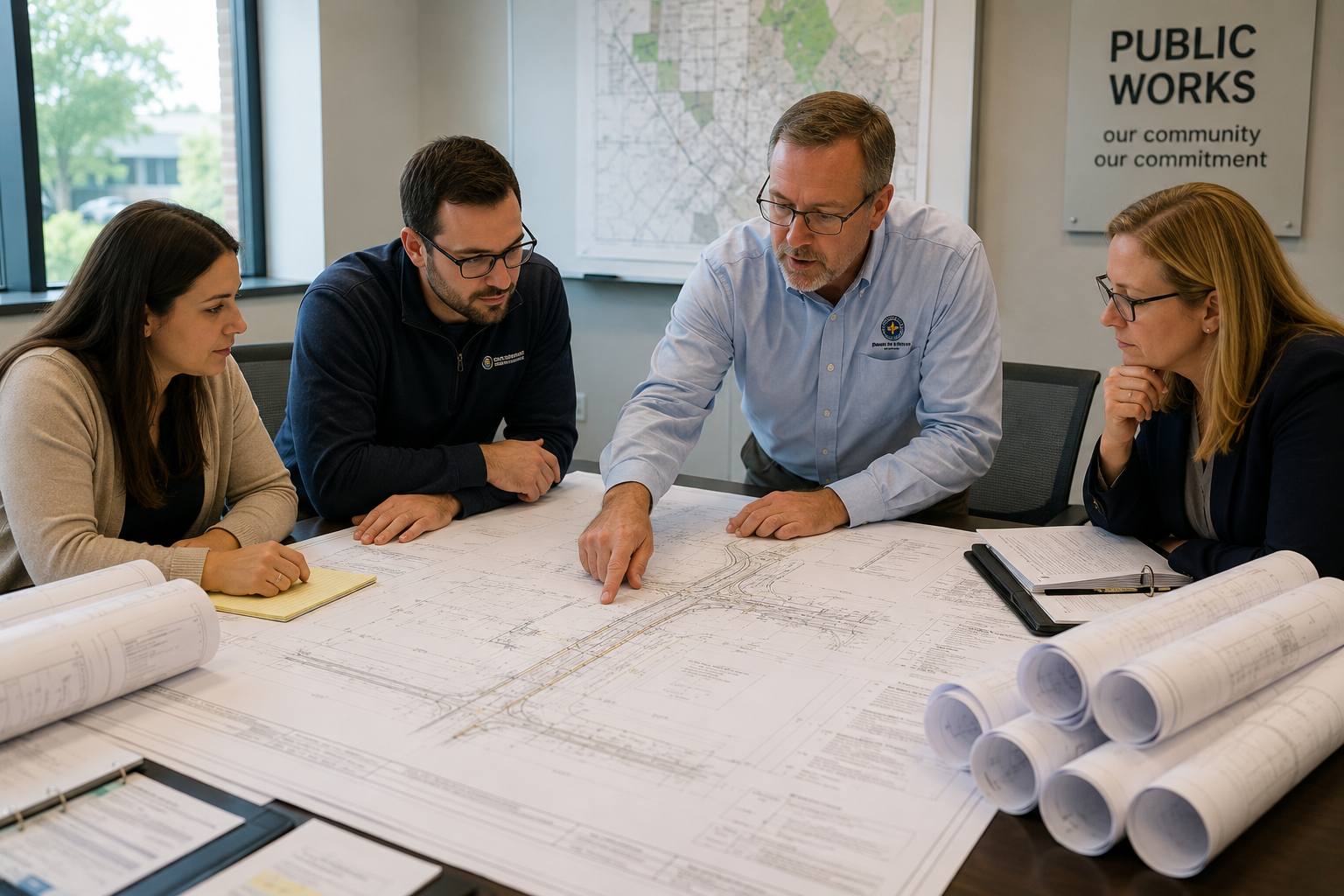
Government Plan Set Printing: 2026 Deadline Guide
Government plan set printing can be the difference between a calm project deadline and a stressful one. Public works, engineering, planning, transportation, sewer, water, facilities, and municipal teams often work around deadlines that cannot easily move. A bid opening is scheduled. A council meeting is on the calendar. A contractor is waiting. A field crew needs the correct sheets. A revision just came in. Everyone expects the documents to be ready, accurate, clear, and complete.
When everything goes right, most people do not notice the print workflow. When something goes wrong, everyone notices.
A missing sheet can slow down a contractor. A wrong revision can confuse the field. A blurry detail can create questions. A late plan set can make a department look unprepared. The print job may seem simple from the outside, but the pressure behind it is real.
For government teams, plan set printing is more than paper. It is part of the project workflow. It helps engineers answer questions. It helps purchasing track the job. It helps field crews stay aligned. It helps leadership walk into meetings prepared. It helps contractors work from the same information. Most of all, it helps public sector teams keep control when deadlines are tight.
This guide explains why government plan set printing matters, what a better workflow should include, how revision control reduces confusion, and what public works teams should look for in a dependable plan set printing partner.
Why Government Plan Set Printing Carries So Much Pressure
A plan set is not just a stack of drawings. It is a working document that connects many people to the same project. Engineers use it. Contractors use it. Inspectors use it. Field crews use it. Purchasing may need it. Council members may ask about it. Residents may see parts of it during public meetings or project updates.
That means one printing mistake can travel fast.
If the wrong version goes out, the project can lose time. If the sheets are out of order, people may question what changed. If the scale is wrong, field use becomes harder. If a set is missing pages, someone has to stop and fix it. If delivery is late, the pressure lands back on your internal team.
That is the part many people outside government do not see. The public works team may not have made the print mistake, but the department often takes the blame. A contractor may not say, “The print vendor missed the revision.” They may say, “The city gave us the wrong set.”
That is why accurate government plan set printing matters. It helps your team keep control of the details before those details become problems.
A good print workflow should answer the basic questions before anyone has to ask:
- Which file is final?
- Which sheets changed?
- How many full-size sets are needed?
- How many half-size sets are needed?
- Who gets the rolled sets?
- Who gets the bound sets?
- Where does the field set go?
- Which project number should appear on the invoice?
- Does the job require color, black-and-white, or both?
- When does everything need to be ready?
When those answers are clear, the whole process feels calmer. When they are unclear, the deadline becomes harder than it needs to be.
The Real Cost of Last-Minute Plan Set Problems
A late print job does not always look expensive at first. The invoice may be small compared with the total project budget. But the hidden costs can add up quickly.
Staff may lose hours checking, sorting, folding, or reprinting sheets. Project managers may have to chase updates instead of managing the work. Field crews may wait for corrected plans. Contractors may ask preventable questions. A public meeting may start with rushed materials. Purchasing may have to clean up invoice questions after the job is done.
That is a lot of time spent on something that should have been simple.
Most government teams are already stretched. Your staff may be handling permits, inspections, citizen calls, road issues, utility questions, weather events, grant deadlines, meeting packets, capital improvement updates, and daily service requests. They do not need to lose half a day fighting with a plotter or fixing a plan set that should have been right the first time.
The biggest cost is not always the print job itself. It is the time, attention, and confidence the mistake takes from your team.
A better process helps public works, engineering, and facilities teams avoid last-minute stress. The workflow should start before the rush. It should include clear steps for file submission, approval, revision control, finishing, delivery, billing, and support.
Da-Com’s wide format printer solutions support organizations that need dependable output for plans, drawings, technical documents, and large-format project materials.
What a Better Government Plan Set Printing Workflow Should Include
A better workflow does not need to be complicated. In fact, simple is usually better. Your team should be able to send the files, confirm the job, and trust that the right sets will be produced the right way.
A strong government plan set printing process should include clear steps.
1. File Confirmation Before Printing
The file should be confirmed before the job begins. That means checking that the correct file was received and that the job instructions match the deadline. If the file name is unclear or multiple versions exist, that should be resolved before printing starts.
2. Clear Revision Identification
If a new addendum, revised sheet, or updated drawing has been sent, the current version should be easy to identify. Revision confusion is one of the biggest causes of plan set stress.
3. Simple Set Counts
Your team should know how many full-size, half-size, color, black-and-white, rolled, folded, or bound sets are needed. Standardizing common job types can make repeat work faster and easier.
4. Finishing That Matches the Use
A field set may need to be rolled and clearly labeled. A review set may need to be bound. A contractor set may need to be separated by company or location. A council set may need to be neat, readable, and easy to review.
5. Clear Delivery Instructions
Plan sets may need to go to city hall, a job site, a public works office, a contractor, a field trailer, a board room, or a meeting room. Delivery instructions should be specific so the finished documents reach the right place on time.
6. Purchase-Order Friendly Billing
Public agencies often need project numbers, purchase orders, department codes, grant codes, or separate invoices. A good print workflow should support those requirements from the beginning.
When these steps are handled well, plan set printing stops feeling like a risk. It becomes a steady part of the project process.
How Clear Revision Control Reduces Field Confusion
Revisions are one of the biggest stress points in government plan set printing. A project can be moving along smoothly, then a sheet changes. A detail gets updated. A note gets corrected. An addendum comes through. A field issue leads to a new version. Suddenly, everyone needs the latest set, and no one wants the wrong one to slip through.
This is where confusion can grow quickly.
If people are unsure which version is current, they start asking questions. If two versions are printed, someone has to compare them. If the field gets the old version, the mistake may not show up until work is already moving.
A good process should make it easy to see what changed and what needs to be printed. Files should be named clearly. Sets should be labeled clearly. Old versions should not be mixed in with current ones. Addenda should be printed and sorted in a way that helps contractors and field teams use them.
This is not about making the process fancy. It is about helping people trust the set in their hands.
When crews know they have the right version, they can work with more confidence. When contractors receive clearly labeled sets, they ask fewer preventable questions. When your office knows exactly what was printed, your team can respond faster if someone calls.
That is the kind of calm government teams need during deadline weeks.
How Plan Set Printing Helps Public Works Teams Save Staff Time
Your team’s time is valuable. It should not be spent babysitting a print job.
Yet that happens often in government offices. Someone has to check the plotter. Someone has to reload paper. Someone has to sort the sheets. Someone has to rerun the missing page. Someone has to fold, staple, bind, roll, label, and separate sets. Someone has to make sure the right people get the right copies.
During a normal week, that may be inconvenient. During a deadline week, it can become a real problem.
Good government plan set printing removes those tasks from your staff’s plate. It helps your team send the files once and move on to the work that only they can do.
That matters for small municipalities. It matters for busy public works offices. It matters for counties with many active projects. It matters for facilities teams that manage older buildings. It matters for sewer, water, stormwater, and transportation teams that often need both office copies and field-ready sets.
When a print process is handled well, your team spends less time chasing paper and more time managing the project. That is the real value. Not just printed sheets, but less drag on your staff.
Why Internal Plotters Are Not Always Enough
Many government teams have an internal plotter. That can be helpful. But an internal plotter does not always solve the entire problem.
It may be too slow for a large rush job. It may be tied up when three departments need it. It may be down at the worst time. It may not handle the volume. It may not support every finishing need. It may take too much staff time to run, sort, and manage.
That does not mean the equipment is bad. It means one machine cannot always carry every deadline.
Many agencies get the best results from a blended approach. Your team can print simple daily needs in-house, then use outside support for overflow, rush jobs, large sets, scanning, finishing, delivery, or project-heavy weeks.
That gives your team a backup plan. Backup plans matter in government because bid dates, council meetings, and construction starts are often fixed.
When the deadline is set, your internal plotter should not be the thing that decides whether your team stays on schedule.
If your department is comparing in-house equipment with outside support, Da-Com’s KIP large format printer guide can help your team think through when in-house wide format equipment makes sense and when outsourced plan printing or overflow support may be the better fit.
Government Plan Set Printing for Bid Deadlines
Bid deadlines are some of the most stressful print moments. Everything has to line up. The plans must be complete. Addenda must be included. Contractors need access to the right documents. Purchasing may need records. The project team needs confidence that the bid package is clear.
A mistake at this stage can create calls, questions, delays, and avoidable confusion.
Government plan set printing helps make the bid process smoother when it is organized from the start. Full-size sets, half-size sets, contractor copies, review copies, and addenda should be handled in a way that makes the package easy to follow.
This helps your team look prepared. It also helps contractors work from the same information.
That does not mean questions will never come up. Public projects are complex. Bidders may still need clarification. But when the plan sets are clear, complete, and current, your team removes one source of confusion.
That matters when the clock is running.
Government procurement processes also have their own vendor and registration requirements. SAM.gov explains that entity registration allows organizations to bid on federal contracts and apply for federal assistance. You can review the resource here: SAM.gov entity registration. Missouri agencies and suppliers can also use MissouriBUYS supplier registration, while Illinois agencies and vendors may use Illinois BidBuy for state procurement activity.
Plan Set Printing for Council Meetings and Public Reviews
Not every plan set stays in the field. Sometimes plans need to support a meeting.
A council member may want to review a project. A board may need to understand a capital improvement. A public meeting may require clear displays. A staff report may need backup documents. A department head may need a clean set before presenting to leadership.
This is a different kind of deadline. The materials need to be clear, neat, and ready before the room fills.
A rushed or messy set can make the project feel less organized. A clean set can help the discussion feel more controlled.
For public-facing use, your team may also need maps, boards, phasing plans, route exhibits, detour graphics, utility diagrams, or project timelines. These materials help people understand what is happening without needing to read a full engineering set.
That is important because public projects are not only technical. They are also public. Residents want to know what will change, when work will happen, how traffic will be affected, and what the finished project should look like. Clear printed materials can help your team answer those questions with less stress.
The City of St. Louis Board of Public Service notes that its online project resources include requests for proposals, access to plans, project announcements, plan holders lists, and bidding procedures. You can view the resource here: City of St. Louis project bidding and plan room information.
Plan Set Printing for Field Crews and Inspectors
Field crews need plans they can use in real conditions. That means the set must be readable, organized, and prepared for the job.
A field-ready plan set should make it easy to find the right sheet. It should be printed at the correct size. Labels should be clear. Rolled sets should be easy to identify. If color is needed to show phases, utilities, or routes, the color should be clear. If black-and-white is enough, the line work should still be sharp.
Inspectors also need reliable documents. They may be moving between job sites. They may need to compare field conditions to drawings. They may need to answer contractor questions quickly. They may not have time to search through a confusing set.
A good print process helps keep crews and inspectors aligned. It reduces calls back to the office. It helps people trust the documents they have. And it helps the project move with fewer preventable slowdowns.
Secure File Handling Matters for Government Plan Sets
Not every plan set is sensitive, but some are. Facilities plans, utility maps, public safety layouts, school drawings, infrastructure details, and emergency-related documents may need extra care.
That is why file handling should never be an afterthought.
Your team should know how files are sent, who has access, where they are stored, how long they are kept, and how finished sets are delivered. This is especially important when plans include restricted or sensitive information.
Secure file handling does not have to make the process harder. It should make the process more controlled.
A clear workflow can help protect files while still allowing your team to meet the deadline. That may include approved contacts, secure uploads, named project folders, limited access, delivery confirmation, and clear file retention practices.
The goal is simple. The right people get the right documents. The wrong people do not.
St. Louis County’s open bids page notes that its resources include vendor self-service, bid search, and an online plan room with plans and documents for construction projects. You can review the resource here: St. Louis County open bids and plan room information.
Purchase-Order Friendly Printing Makes the Process Easier
Government teams do not only need fast printing. They need a vendor process that fits public rules.
That means quotes should be clear. Pricing should be understandable. Purchase orders should be handled correctly. Project numbers should be included when needed. Department codes should be tracked. Invoices should match the job. Delivery records should be easy to confirm.
When these details are handled poorly, the stress does not end when the plan sets are delivered. It moves to the paperwork.
That is why print support for government needs to be purchase-order friendly from the start.
A simple, clear process helps purchasing, project managers, administrative staff, and department leaders stay on the same page. It also makes it easier to use the same process again for the next job.
And there will always be a next job. A road project. A drainage job. A facility repair. A park improvement. A sewer project. A public meeting. A construction addendum. A map update.
When the billing process is easy, the print process feels safer to use again.
What to Look for in a Government Plan Set Printing Partner
A good plan set printing partner should make your team feel calmer, not busier. You should not have to train them on every part of government work.
They should understand that deadlines are real. They should know that versions matter. They should respect purchase orders. They should be able to handle full-size and half-size sets. They should know how to label jobs clearly. They should support rush work when possible. They should help your staff avoid wasted time.
Look for a partner who can help with:
- Accurate full-size and half-size plan sets
- Black-and-white and color sheets
- Clear revision handling
- Addenda printing
- Bid set assembly
- Field set labeling
- Rolling, folding, binding, and finishing
- Large-format scanning
- Project-number billing
- Purchase-order support
- Local pickup or delivery
- Overflow support when internal equipment is tied up
- Service support for in-house equipment when needed
The right partner should feel like a safety net, not another task to manage.
For agencies that also manage internal equipment, Da-Com’s service and supplies support helps keep devices and consumables moving so print workflows can stay productive.
How Managed Print Helps Public Sector Teams Control Costs
Government plan set printing is often connected to a larger print environment. A public works office may have a wide format device, office printers, multifunction systems, scanners, and department-specific equipment. If no one has visibility into usage, supply costs, service calls, and downtime, print spending can become difficult to manage.
Managed print can help public sector teams understand where printing happens, how often devices are used, which workflows create bottlenecks, and where equipment may need to be updated or consolidated.
This matters because plan set printing is not only a project issue. It is also part of the department’s broader document workflow. A team may need daily office printing, large-format plan output, scanning, digital archiving, and field-ready materials.
Da-Com’s managed print services help Missouri businesses and organizations gain visibility and control over print processes, which can be especially useful for teams trying to reduce waste, improve support, and manage print costs more clearly.
How Da-Com Helps Remove Deadline Stress
Da-Com helps government teams stay prepared before the pressure hits. That may mean helping your team print plan sets for a bid deadline. It may mean supporting overflow when internal equipment is backed up. It may mean scanning old drawings into digital files. It may mean helping with wide format systems, service, supplies, and support. It may mean creating a plan before the next rush job arrives.
The goal is not to make your process harder. The goal is to make it easier.
Your team should be able to send the files once, confirm the job, and know what happens next. Crews should have the right set. Project managers should stop chasing updates. Purchasing should have clear paperwork. Departments should walk into bid openings, council meetings, field work, and public reviews looking organized and ready.
That is what good government plan set printing should do. It should reduce stress. It should protect deadlines. It should help your team keep control.
Make the Next Plan Set Deadline Easier
You cannot remove every deadline from government work. But you can remove some of the stress around them.
A better plan set printing process can help your team avoid wrong versions, missing sheets, late sets, staff bottlenecks, and paperwork confusion. It can help your public works, engineering, planning, facilities, transportation, water, sewer, and field teams stay aligned.
Most of all, it can help your department feel ready before the deadline hits.
That matters because when the plans are right, the sets are ready, and the right people have the right documents, the project feels more controlled.
To learn more about government plan set printing for your St. Louis, Columbia, or Southern Illinois agency, contact Da-Com today. Da-Com can help your team protect deadlines, reduce staff stress, and keep the right plans in the right hands.


Leave A Comment