
AI Managed IT Services: What Small Businesses Should Expect
AI managed IT services are changing what small businesses should expect from their technology partners. For years, managed IT support was built around human-driven monitoring, scheduled maintenance, and reactive helpdesk response. A technician reviewed alerts, ran maintenance, checked logs, and responded when something broke or an employee needed help.
That model still has value, but it has limits. Small business technology environments now generate more data, more alerts, more security signals, and more operational complexity than manual review alone can keep up with.
AI changes that equation.
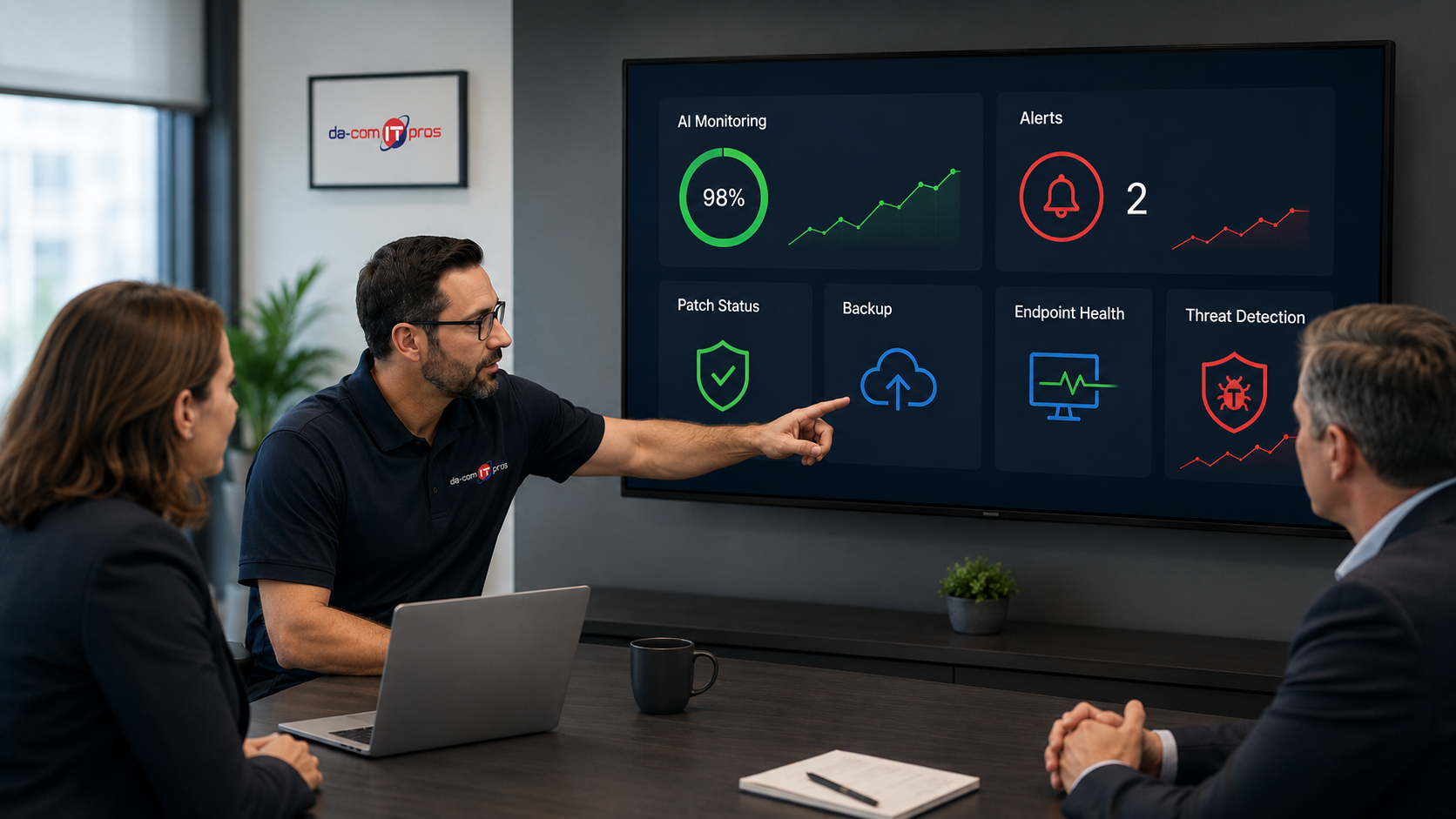
AI-powered monitoring tools can analyze system activity, endpoint behavior, backup status, patch levels, network traffic, user behavior, and security signals at a speed and scale no human team can match. AI-driven automation can handle routine maintenance tasks more consistently. Intelligent alerting can help separate urgent issues from background noise, allowing technicians to focus on the problems that truly need attention.
For small and mid-size businesses, that means managed IT should feel more proactive, more informed, and more focused on preventing problems before they interrupt work.
Da-Com IT Pros helps businesses across St. Louis, St. Charles, the Metro East, and Southern Illinois use smarter IT support, cybersecurity tools, monitoring, automation, and human expertise to keep technology aligned with business needs. This guide explains how AI is changing managed IT services, what small businesses should expect, and what questions to ask when evaluating whether your current provider is keeping pace.
Quick Answer: What Are AI Managed IT Services?
AI managed IT services use artificial intelligence, machine learning, automation, and human IT expertise to monitor systems, detect threats, prioritize alerts, manage patches, identify early warning signs, and support users more proactively. For small businesses, AI-powered managed IT can help reduce downtime, improve cybersecurity visibility, speed up issue detection, and make IT support more strategic instead of purely reactive.
AI managed IT services can support:
- Predictive maintenance for devices and infrastructure.
- AI-powered endpoint monitoring.
- Threat detection and anomaly detection.
- Automated patch prioritization and deployment.
- Backup monitoring and failure alerts.
- Helpdesk ticket routing and prioritization.
- Security alert analysis.
- Network performance monitoring.
- User behavior monitoring for suspicious activity.
- More proactive communication from the IT provider.
The best managed IT providers do not use AI to replace human expertise. They use AI to make human technicians, engineers, and security teams more effective.
Da-Com IT Pros provides Managed IT Services for businesses that need proactive support, cybersecurity guidance, monitoring, backup planning, and practical technology strategy.
How AI Is Changing What Managed IT Can Deliver
The practical value of AI in managed IT shows up in business outcomes. Small businesses want fewer unplanned outages, faster issue resolution, stronger cybersecurity, more reliable systems, and clearer communication from their technology partner.
AI can help managed IT providers deliver those outcomes by improving how they monitor, prioritize, and respond.
Predictive Maintenance
Predictive maintenance is one of the most valuable applications of AI managed IT services. Traditional IT maintenance often works on a schedule. Systems are checked periodically, updates are installed during planned windows, and hardware is replaced when it fails or reaches a certain age.
AI-powered monitoring can make that process more intelligent by continuously reviewing signals such as:
- Drive health.
- Device performance.
- Memory usage.
- Temperature readings.
- Error logs.
- Backup failures.
- Patch status.
- Endpoint behavior.
- Network performance trends.
Instead of waiting for a laptop, server, or device to fail, AI-powered tools can help identify early warning signs and give the IT team time to act before the issue becomes a business interruption.
Intelligent Threat Detection
Cybersecurity is one of the most important areas where AI is changing managed IT. Traditional security tools often look for known threats. AI-powered threat detection can look for unusual behavior, suspicious patterns, and activity that does not match what is normal for the environment.
This can help identify risks such as:
- Compromised accounts.
- Unusual login behavior.
- Suspicious file access.
- Potential malware activity.
- Abnormal network traffic.
- Endpoint behavior changes.
- Phishing-related account activity.
- Possible insider threats.
For small businesses that do not have an internal security operations center, AI-powered monitoring through a managed IT provider can help close the visibility gap.
CISA’s Cybersecurity Performance Goals are designed to help organizations, including small and medium-sized businesses, prioritize high-impact cybersecurity practices. AI managed IT services can support that kind of practical, risk-based approach by helping businesses identify, prioritize, and act on security issues faster.
Automated Patch Management
Patch management is another area where AI and automation can improve consistency. Manual patching can be time-consuming and easy to delay, especially when a business has many devices, different software versions, remote employees, and limited internal IT resources.
AI-enhanced patch management can help with:
- Inventorying devices and software.
- Identifying missing updates.
- Prioritizing critical security patches.
- Scheduling updates with less disruption.
- Verifying patch completion.
- Flagging devices that fail to update.
- Reducing manual follow-up.
For small businesses, this matters because unpatched systems can create preventable security and reliability risks. The FTC’s small business cybersecurity guidance recommends making security a priority when comparing services, and it points businesses to the NIST Cybersecurity Framework as a way to better understand and manage cyber risk. FTC cybersecurity for small business
AI Managed IT Services and Cybersecurity for Small Businesses
The most important use of AI managed IT services for many small businesses is cybersecurity. SMBs face sophisticated threats, but they often do not have large internal IT teams, security analysts, or enterprise security operations centers.
AI-powered managed IT can help small businesses improve security visibility without requiring them to build an internal security team from scratch.
Security-related AI managed IT capabilities may include:
- Endpoint detection and response.
- Behavioral threat detection.
- Email security analysis.
- Phishing pattern detection.
- Network anomaly monitoring.
- User behavior analytics.
- Automated alert prioritization.
- Vulnerability and patch prioritization.
- Backup monitoring.
- Security event correlation.
Verizon’s Data Breach Investigations Report continues to track cyber incidents and breaches across business sizes and industries, including small and medium businesses. For SMBs, the takeaway is clear: cyber risk is not limited to large enterprises. Smaller organizations need practical security visibility, strong access controls, backup planning, and fast response when something looks wrong. Verizon Data Breach Investigations Report
Da-Com IT Pros provides cybersecurity support for businesses that need practical protection across users, devices, cloud applications, email systems, backups, and daily operations.
What AI-Powered Managed IT Looks Like in Practice
AI-powered managed IT should not be vague. It should show up in the way your provider monitors, communicates, responds, and prevents problems.
For small businesses, AI-powered managed IT may look like:
- Your provider alerts you to a failing device before it stops working.
- A backup issue is detected before a recovery event happens.
- A suspicious login is flagged quickly because it does not match normal behavior.
- Security alerts are prioritized so real risks do not get buried in noise.
- Patch status is monitored continuously instead of checked only occasionally.
- Your provider explains what was prevented, not just what was fixed.
- Reports connect technical events to business impact.
- Technicians spend more time solving meaningful issues and less time chasing routine noise.
The difference between traditional IT support and AI-powered managed IT is not just the technology stack. It is the shift from reactive support to proactive prevention.
The Human and AI Partnership in Managed IT
A common concern about AI in managed IT services is whether AI replaces the human expertise that makes technology support valuable.
In a strong managed IT program, AI and human expertise work together.
AI is good at:
- Analyzing large volumes of system data.
- Identifying patterns.
- Detecting anomalies.
- Prioritizing alerts.
- Automating routine tasks.
- Monitoring continuously.
- Finding early warning signs.
Human IT experts are still essential for:
- Understanding business context.
- Communicating clearly with users.
- Making judgment calls.
- Designing the right technology strategy.
- Responding to complex issues.
- Explaining risk in plain language.
- Building trust with employees and leadership.
- Balancing security, budget, productivity, and user experience.
The best AI managed IT services combine both. AI helps surface the right information at the right time. Human technicians and engineers interpret that information, decide what matters, and support the business with context.
Traditional Managed IT vs. AI Managed IT Services
Not every provider using the word AI has truly changed how they deliver support. Small businesses should understand the difference between a provider that has added AI language to its marketing and a provider that uses AI-powered tools to improve outcomes.
| Area | Traditional Managed IT | AI Managed IT Services |
|---|---|---|
| Monitoring | Relies heavily on rules, thresholds, and periodic review. | Uses continuous monitoring, pattern recognition, and anomaly detection. |
| Maintenance | Often scheduled by calendar or manual review. | Can be prioritized by risk, device health, patch urgency, and system behavior. |
| Threat detection | Focuses on known threats and signature-based detection. | Can identify suspicious behavior and unusual activity patterns. |
| Alerts | May generate large volumes of noise. | Helps prioritize alerts based on urgency and context. |
| Support | Often reactive after users report problems. | More proactive, with issues surfaced before users notice them. |
| Reporting | May list technical events without business context. | Can support more meaningful reporting tied to risk, uptime, and business impact. |
| Human role | Technicians manually review more routine information. | Technicians focus more on judgment, resolution, strategy, and communication. |
What to Ask Your Managed IT Provider About AI
The language of AI is becoming common in managed IT marketing. That makes it important for business owners and leaders to ask specific questions.
Providers who have truly integrated AI into service delivery should be able to explain what tools they use, what outcomes those tools create, and how those tools are governed.
What AI Tools Are You Actually Using?
Ask your provider what specific AI or machine learning tools they use for monitoring, threat detection, patching, ticket routing, backup monitoring, and alert prioritization.
A strong provider should be able to explain:
- Which platforms are used.
- What those platforms monitor.
- What types of alerts they generate.
- How alerts are reviewed by humans.
- How the tools improve service outcomes.
- How client data is protected.
Vague language about “advanced technology” is not enough.
What Problems Have You Identified Proactively?
Ask for examples of recent issues the provider identified before they became bigger problems. A provider using AI-powered monitoring well should be able to describe situations where early detection helped prevent downtime, data loss, security escalation, or user disruption.
Examples may include:
- A failing device caught before it stopped working.
- A backup job that was silently failing.
- A suspicious login detected quickly.
- A patch gap identified before exploitation.
- A performance issue corrected before users complained.
- A risky configuration flagged during monitoring.
How Do Your AI Tools Handle Our Data?
AI monitoring tools may process telemetry, logs, alerts, device data, and security signals from your environment. Business owners should understand what data is collected, where it is stored, who can access it, and how it is protected.
Ask:
- What data is collected?
- Where is the data stored?
- Who can access it?
- How long is it retained?
- Is the data encrypted?
- Is it used to train external systems?
- How is client privacy protected?
- Can the provider explain this in plain language?
NIST’s Cybersecurity Framework 2.0 Small Business Quick-Start Guide helps SMBs think through cybersecurity risk management and can serve as a useful discussion prompt with managed IT or managed security providers.
How Do You Update AI Tools as Threats Change?
AI-powered tools must be maintained, tuned, and updated. A provider that deployed a tool years ago but has not updated detection models, policies, monitoring rules, or security training may not be keeping pace with today’s risks.
Ask how your provider:
- Updates detection models.
- Reviews new AI security threats.
- Tunes alerting rules.
- Improves automation workflows.
- Reviews false positives and false negatives.
- Updates employee security awareness training.
- Communicates new risks to clients.
AI Managed IT Services for Regulated and Data-Sensitive Businesses
AI-powered managed IT can be especially valuable for businesses that handle sensitive data or operate in regulated industries.
This may include:
- Healthcare offices.
- Financial services firms.
- Law firms.
- Accounting firms.
- Education organizations.
- Manufacturers with proprietary processes.
- Professional services firms.
- Nonprofits handling donor data.
For these organizations, IT support is not only about keeping devices running. It is also about protecting sensitive information, maintaining audit trails, supporting secure access, monitoring unusual activity, and documenting the controls that reduce risk.
AI-powered monitoring can help regulated or data-sensitive businesses by supporting:
- Continuous security visibility.
- Automated logging.
- Anomaly detection.
- Patch status reporting.
- Endpoint monitoring.
- Backup verification.
- Faster alert review.
- More consistent documentation.
Da-Com’s guide on proactive IT monitoring explains why continuous visibility matters for businesses that want to reduce downtime, identify risks sooner, and improve day-to-day technology reliability.
Common Mistakes Businesses Make When Evaluating AI Managed IT
Assuming AI Means Better Support Automatically
AI tools only create value when they are implemented thoughtfully. A provider must know how to configure, monitor, review, and act on AI-powered insights.
Focusing Only on Speed
Faster alerts are useful, but speed is not the only goal. The provider should also improve accuracy, prioritization, communication, and prevention.
Ignoring Data Handling
Any AI-powered monitoring tool that processes system data should be evaluated for privacy, storage, retention, and access controls.
Forgetting the Human Side of Support
AI can improve monitoring, but small businesses still need responsive people who understand their business, explain issues clearly, and help make decisions.
Accepting Vague AI Claims
Marketing language is not enough. Ask for specific tools, specific processes, and specific outcomes.
AI-Powered Managed IT Readiness Checklist
Use this checklist when evaluating your current managed IT provider or comparing providers.
- Can the provider name the AI-powered tools they use?
- Can they explain how AI improves monitoring?
- Do they use AI or automation for patch management?
- Do they use behavioral or anomaly-based threat detection?
- Do they monitor backups continuously?
- Do they prioritize alerts based on business risk?
- Can they provide examples of proactive issue prevention?
- Can they explain how client data is handled?
- Do they combine AI insights with human review?
- Do they communicate findings in plain language?
- Do they update tools and processes as threats evolve?
- Do they help connect IT performance to business outcomes?
- Do they provide cybersecurity support alongside managed IT?
- Do they help leadership plan strategically?
How Da-Com IT Pros Uses AI to Support Small Businesses
Da-Com IT Pros uses AI-enhanced tools as part of a broader managed IT approach built around proactive support, cybersecurity, automation, and clear communication.
Our goal is not to make IT more technical or harder to understand. Our goal is to use better tools to deliver better business outcomes.
Da-Com IT Pros helps businesses with:
- Proactive IT monitoring.
- Endpoint protection.
- Cybersecurity support.
- Patch management.
- Backup monitoring.
- Helpdesk support.
- Technology planning.
- Security awareness.
- AI-related IT strategy.
- vCIO guidance.
- Business continuity planning.
Da-Com’s guide on what a vCIO does for growing businesses explains how strategic IT leadership can help organizations make smarter decisions about technology, cybersecurity, budgeting, growth, and risk.
Frequently Asked Questions About AI Managed IT Services
What are AI managed IT services?
AI managed IT services use artificial intelligence, machine learning, automation, and human IT expertise to monitor systems, detect threats, prioritize alerts, manage patches, identify early warning signs, and support users more proactively.
How does AI improve managed IT support?
AI can improve managed IT support by analyzing large volumes of system data, detecting unusual behavior, identifying early warning signs, prioritizing alerts, automating routine tasks, and helping technicians resolve issues before they disrupt the business.
Does AI replace IT technicians?
No. In a strong managed IT program, AI supports technicians by surfacing important information faster. Human experts still handle judgment, communication, strategy, complex troubleshooting, and business-specific decision-making.
How does AI help with cybersecurity?
AI can help cybersecurity by identifying suspicious behavior, analyzing endpoint activity, detecting anomalies, prioritizing alerts, monitoring email threats, and helping security teams respond faster to potential attacks.
Are AI managed IT services useful for small businesses?
Yes. AI managed IT services can be especially useful for small businesses because they provide stronger monitoring, faster threat detection, and more proactive support without requiring the business to build a large internal IT team.
What should I ask a managed IT provider about AI?
Ask what AI tools they use, how those tools improve monitoring, what problems they have identified proactively, how client data is handled, how AI alerts are reviewed by humans, and how tools are updated as threats change.
Can AI managed IT services reduce downtime?
AI managed IT services can help reduce downtime by identifying early warning signs, monitoring system health continuously, prioritizing maintenance, detecting backup failures, and helping IT teams address issues before they become outages.
Does Da-Com IT Pros provide AI managed IT services?
Yes. Da-Com IT Pros helps businesses in St. Louis, St. Charles, the Metro East, and Southern Illinois use AI-enhanced managed IT, cybersecurity tools, proactive monitoring, automation, and human expertise to support more reliable technology operations.
Experience AI-Powered Managed IT With Da-Com IT Pros
AI managed IT services are changing what small businesses should expect from technology support. Managed IT should not only react when something breaks. It should help prevent issues, detect threats sooner, maintain systems more consistently, and communicate technology risk in a way business leaders can understand.
AI makes that possible, but only when it is paired with experienced people, clear processes, strong cybersecurity practices, and a provider that understands your business.
Da-Com IT Pros helps businesses across St. Louis, St. Charles, the Metro East, and Southern Illinois use AI-enhanced managed IT services to improve monitoring, cybersecurity, patching, support, and technology planning.
To learn more about AI-powered managed IT services for your St. Louis, St. Charles, Metro East, or Southern Illinois business, contact Da-Com IT Pros today. We can show you how our AI-enhanced approach helps deliver faster response, stronger security, and more reliable infrastructure than traditional reactive support models.
Explore our Managed IT Services and Cybersecurity Support to learn how Da-Com IT Pros helps businesses use technology safely and strategically.


Leave A Comment