
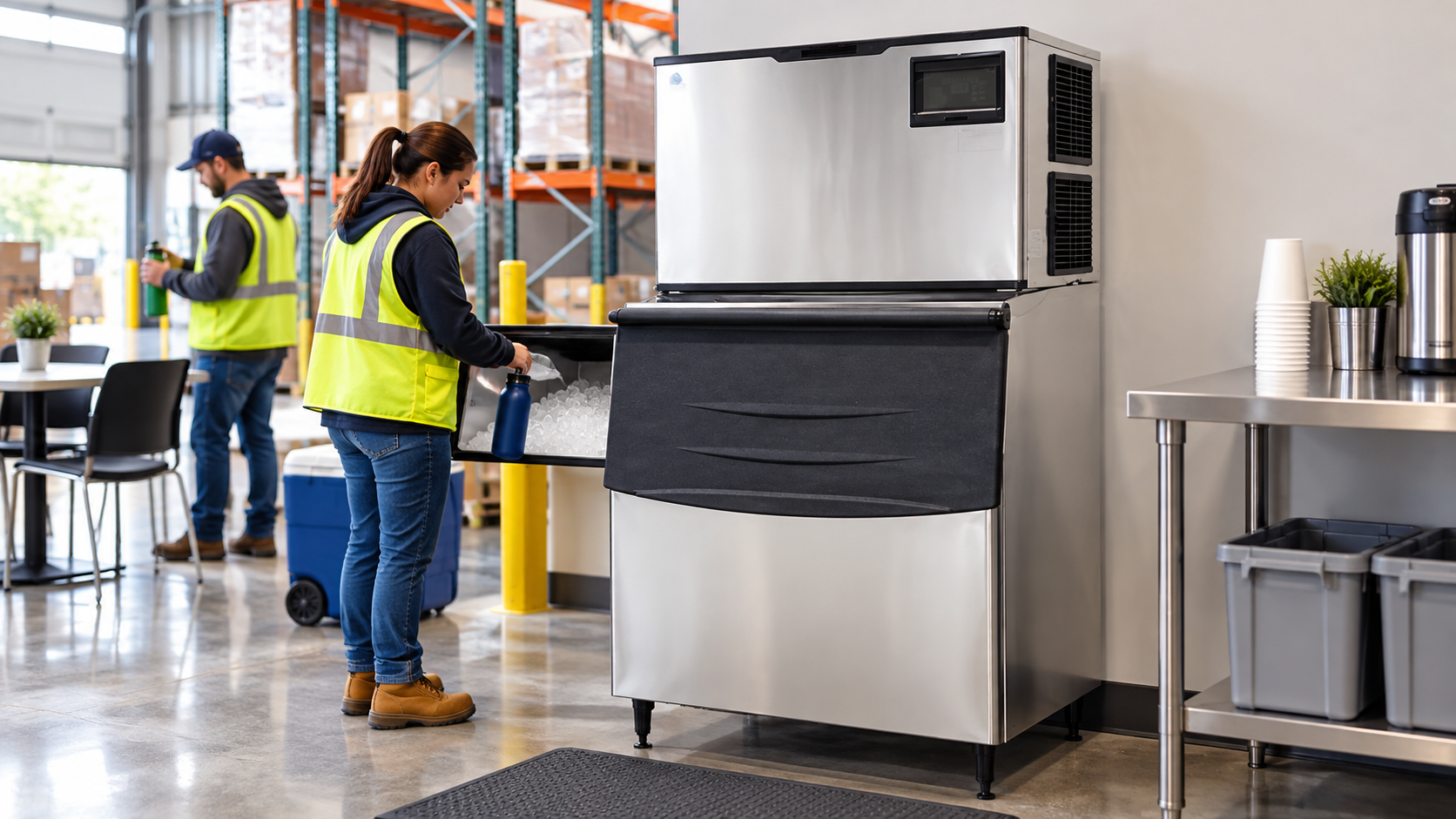
Commercial Ice Machine for Warehouses: How to Keep Crews Hydrated During Busy Shifts
A commercial ice machine for warehouse teams can make a major difference in how a busy workplace handles hydration, breakroom traffic, shift changes, summer demand, and employee convenience. Warehouses, distribution centers, manufacturing-adjacent facilities, service departments, and logistics operations often use more ice than a standard office because their teams are more physically active, more mobile, and more likely to need water and ice during concentrated windows of the day.
A small breakroom cooler or freezer bin may work for a quiet office. It may not work for a warehouse where employees fill bottles before a shift, stop by during breaks, pack coolers for jobsite work, or need ice during hot weather. When the setup is too small, someone ends up buying bags of ice, refilling coolers, restocking cases of bottled water, cleaning up melted ice, or answering complaints when the breakroom runs out.
That is why choosing a commercial ice machine for warehouse use should start with how the building actually operates. Average headcount matters, but it is not enough. Warehouses need to think about shift patterns, peak usage, employee bottle filling, ice storage, production capacity, placement, service, filtration, and whether scoop, dispensable, or touchless access makes the most sense.
Purity Source, a Da-Com company, provides purified water and ice solutions for businesses that want clean, great-tasting water and ice backed by practical service and support. For warehouse and distribution teams in St. Louis, St. Charles, the Metro East, Belleville, Edwardsville, Collinsville, Bethalto, and Southern Illinois, Purity Source can help evaluate commercial ice, purified water, placement, service, filters, and a hydration setup that can keep up with real workplace demand.
Quick Answer: What Size Commercial Ice Machine Does a Warehouse Need?
A commercial ice machine for warehouse use should be sized around peak demand, not just employee headcount. Warehouses should consider how many employees use ice during shift changes, how often workers fill reusable bottles or coolers, whether teams work in hot areas, whether ice is needed for service vehicles or employee events, and whether the workplace needs scoop, dispensable, or touchless access.
Many warehouse environments need more than a basic office ice setup because usage can spike quickly. A warehouse may need a higher-output commercial ice machine, a larger storage bin, or a dispensable ice and water setup depending on how employees use the station throughout the day.
Purity Source commercial ice options can support different usage levels, including:
- Touchless nugget ice units for smaller employee areas, such as 206HID and 315HID models.
- Higher-output dispensable commercial ice options for busy teams, including 350C, 550C, and 700C configurations with dispenser-style access.
- Scoop-only commercial ice options with larger storage bins for workplaces that need more stored ice available during peak periods.
- Undercounter ice options for smaller breakroom or support spaces where a full floor-standing bin is not needed.
The best answer depends on production capacity, storage capacity, traffic flow, placement, service expectations, and how much ice employees need during the busiest part of the day.
Why Warehouses Use More Ice Than Offices
Warehouses and distribution centers are not typical office environments. Even when there is an office area attached to the building, the day-to-day rhythm is different. Employees may be walking, lifting, loading, staging, picking, packing, operating equipment, moving between work areas, or working near dock doors and service bays.
That kind of work can create a stronger need for easy water and ice access.
A warehouse may use ice for:
- Reusable employee bottles.
- Breakroom cups.
- Coolers for approved workplace use.
- Shift-change hydration.
- Summer heat preparation.
- Employee appreciation days.
- Safety meetings and trainings.
- Service teams leaving the building.
- Outdoor or semi-outdoor work areas.
- High-traffic employee break areas.
CDC/NIOSH heat-stress guidance recommends providing adequate amounts of cool, potable water near work areas and encouraging workers to drink often when heat stress is a concern. CDC NIOSH heat stress workplace recommendations
A commercial ice setup does not replace a full heat-safety program, and it should not be treated as a safety program by itself. But water and ice access can be an important part of making hydration easier for employees who work in busy, warm, or physically active environments.
How Shift Changes Affect Ice Demand
One of the biggest reasons warehouses need a different hydration plan is the way ice demand can spike during shift changes. A quiet machine at 10:30 a.m. may be overwhelmed at 6:45 a.m., noon, 2:30 p.m., or right before a night shift starts.
Average daily use can hide the real problem. If 80 employees use the same station gradually throughout the day, the demand is manageable. If 40 employees fill large bottles and cups within a 20-minute window, the machine may struggle even though the total headcount looks lower.
Shift-change demand may happen when:
- Employees fill bottles before clocking in.
- Teams refill during scheduled breaks.
- Employees leave the building for delivery, service, or field work.
- Supervisors prepare coolers for crews.
- A second shift arrives before the first shift fully clears the breakroom.
- Hot weather increases ice use across the entire building.
A commercial ice machine for warehouse teams should be evaluated around the busiest 15 to 30 minutes of the day, not only the average number of employees on site.
Commercial Ice Machine Capacity: Production vs. Storage
Warehouse teams often compare commercial ice machines by production capacity, but storage capacity matters just as much. Production and storage are not the same thing.
Production capacity is how much ice a machine can make in a day under proper operating conditions. Storage capacity is how much ice is available in the bin or dispenser at one time.
This distinction matters because a machine can produce a large amount of ice over 24 hours but still run short during a busy shift-change window if it does not store enough ice for peak demand.
| Capacity Term | What It Means | Why It Matters in Warehouses |
|---|---|---|
| Daily production | How much ice the machine can make in a day. | Helps determine whether the unit can keep up with total daily demand. |
| Storage capacity | How much ice is available at one time. | Helps determine whether the unit can handle shift changes and peak usage. |
| Access style | How employees get ice, such as scoop, dispenser, or touchless. | Affects traffic flow, convenience, cleanliness perception, and speed. |
| Placement | Where the unit is installed in the building. | Affects whether employees actually use the station and whether lines form. |
| Service plan | Who handles filter changes, cleaning, and maintenance. | Helps keep the station reliable without adding more tasks to internal staff. |
For example, a smaller touchless dispenser may be perfect for an administrative breakroom, but a larger warehouse team may need a higher-output commercial ice machine with more storage. A high-production unit with a small dispenser storage area may not be the right fit for a warehouse that needs employees to fill bottles quickly during one short break.
That is why Purity Source evaluates both production and storage when helping businesses plan commercial ice and water setups.
Commercial Ice Machine Options for Warehouse Teams
Different warehouse environments need different ice setups. Some need a small, clean employee area with touchless nugget ice. Others need a large scoop bin that can hold enough ice for coolers, bottles, and heavy shift demand. Some need a dispenser-style setup that reduces mess and keeps traffic moving.
Touchless Nugget Ice for Smaller Employee Areas
Touchless nugget ice options such as the 206HID and 315HID can make sense for smaller employee breakrooms, front office areas, staff lounges, or shared hydration spaces where convenience and employee experience are the priority.
These units may be a good fit when:
- The employee area has moderate traffic.
- People fill cups or bottles throughout the day.
- A cleaner, touchless experience is preferred.
- The space does not need large bin storage.
- The ice station is part of a polished breakroom or office-adjacent area.
For a large warehouse floor, these units may not be enough on their own. But they can be useful in the right space.
Higher-Output Dispensable Commercial Ice
For busy warehouse teams that want dispenser-style access, higher-output options such as 350C, 550C, and 700C configurations with dispensable setups can help support heavier demand while keeping the access style more controlled than an open bin.
Dispensable commercial ice may make sense when:
- Employees fill bottles throughout the day.
- The business wants to reduce scooping in a shared area.
- The station serves a large breakroom or employee lounge.
- Traffic flow matters during breaks.
- The workplace wants ice and water to feel easier to manage.
Scoop-Only Commercial Ice With Larger Storage Bins
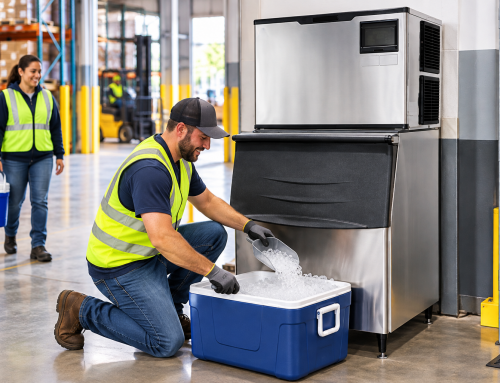
Scoop-only commercial ice machines with larger storage bins can be useful when the workplace needs a larger amount of ice ready at once. This may fit warehouses, manufacturing areas, back-of-house spaces, service departments, and teams that fill coolers or need more ice during concentrated timeframes.
Scoop ice may be a stronger fit when:
- Storage capacity is more important than touchless access.
- Employees or supervisors fill larger containers.
- Ice use spikes during specific shift windows.
- The unit is in a back-of-house or employee-only space.
- The team needs more stored ice available before production catches up.
The best option depends on how the ice will actually be used.
Where to Place a Warehouse Ice Machine
Placement can make or break the success of a commercial ice machine for warehouse employees. A strong unit in the wrong location can still create lines, mess, complaints, or low usage.
A warehouse ice station should be placed where employees naturally need it, but not where it creates traffic problems.
Common placement options include:
- Near employee breakrooms.
- Near time clocks.
- Near locker areas.
- Near loading or service areas when appropriate.
- Near shift-change traffic patterns.
- Inside warehouse office areas.
- Near employee entrance or exit routes.
- Near water bottle filling stations.
- Near team meeting or safety training areas.
When choosing placement, consider:
- Is plumbing available nearby?
- Is electrical access available?
- Will the station block traffic?
- Can employees form a line without crowding a hallway?
- Can a service technician access the unit?
- Is the surrounding area easy to clean?
- Will the station serve the employees who need it most?
- Does the location support cups, bottles, or coolers?
Da-Com’s high-traffic water station guide explains why busy workplaces should plan water and ice around peak demand, placement, service needs, and daily usage instead of simply guessing based on headcount.
Scoop, Dispensable, or Touchless: Which Access Style Fits?
Warehouse ice machines are not only different by size. They are also different by access style. The right choice depends on traffic, storage needs, employee habits, space, and the type of experience the business wants to create.
| Access Style | Best Fit | Warehouse Considerations |
|---|---|---|
| Touchless dispenser | Smaller shared employee spaces, offices, staff lounges, and areas where hands-free access is preferred. | Convenient for cups and bottles, but may have less storage than larger bin systems. |
| Dispensable commercial ice | Busy breakrooms, employee areas, and workplaces that want controlled dispensing with higher output. | Can help keep access simple and reduce open-bin handling in shared areas. |
| Scoop-only bin | Back-of-house spaces, warehouses, service departments, and teams needing more stored ice. | Can support larger storage needs, coolers, and peak shift demand, but requires proper scoop handling and cleaning practices. |
A customer-facing office area may benefit from a cleaner-looking dispenser. A warehouse floor or back-of-house space may benefit from a larger scoop bin. A warehouse office may need a smaller touchless unit for administrative staff and a larger commercial unit for the operations team.
There is no single right answer. The right access style depends on the space and the work.
Commercial Ice and Water Stations for Warehouse Hydration
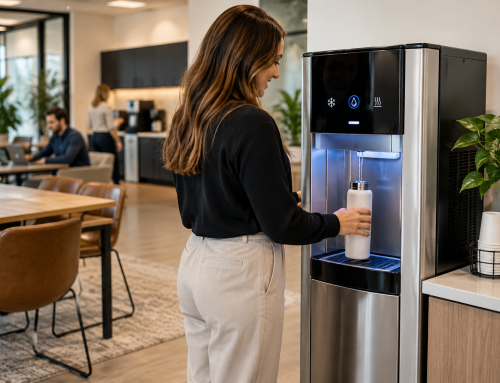
In many warehouses, the best solution may not be ice alone. A commercial ice and water station can support employee hydration more completely by giving teams access to both purified water and ice in one plan.
This matters because employees may need cold water, ice for bottles, ice for coolers, hot water for certain breakroom uses, or a combination of water and ice depending on the workplace.
A combined warehouse hydration station may support:
- Reusable bottle filling.
- Cold purified water.
- Ice for bottles and cups.
- Ice for employee coolers.
- Breakroom hydration.
- Visitor or vendor spaces near operations areas.
- Summer demand.
- Shift-change traffic.
Da-Com’s office water delivery vs. bottleless water guide compares the storage, lifting, delivery, and convenience differences between traditional delivery and a managed point-of-use approach. For warehouses, reducing bottled water storage and manual restocking can be especially useful when teams already manage supplies, inventory, shipments, and daily operations.
Service, Filtration, and Maintenance for Busy Warehouse Teams
A warehouse ice machine is only helpful if it works reliably. Heavy-use environments need clear ownership for filter changes, cleaning, maintenance, and service requests.
Busy warehouse teams should not have to wonder:
- Who changes the filters?
- Who handles cleaning?
- Who calls for service?
- What happens if ice production slows down?
- What happens if the unit runs out during shift change?
- Who checks water quality or taste issues?
- How often should the unit be serviced?
- What should employees report if something looks wrong?
Da-Com’s workplace ice quality guide explains how taste, odor, filtration, cleaning, and service affect whether employees trust the ice available at work. For warehouses, trust matters because employees are more likely to use the station when it looks clean, tastes good, and works consistently.
Da-Com’s office ice machine cleaning guide also explains why service schedules, cleaning, and ownership matter when ice equipment is used regularly.
Purity Source helps businesses think about ice as a managed workplace service, not just a machine purchase. That means evaluating the right equipment, but also planning for the support that keeps it useful.
Warehouse Ice Machine Buying Checklist
Before choosing a commercial ice machine for warehouse use, answer the questions that affect real-world performance.
- How many employees use ice daily?
- How many employees use the station during peak shift changes?
- Do employees fill cups, bottles, or coolers?
- Does ice use increase during summer?
- Are there hot work areas or physically active teams?
- Does the warehouse have multiple shifts?
- Does the station serve office staff, warehouse staff, drivers, vendors, or guests?
- Is ice needed for employee events, trainings, or safety meetings?
- Is storage capacity or production capacity the bigger issue?
- Would scoop, dispensable, or touchless access work best?
- Where should the unit be placed?
- Is plumbing and electrical access available?
- Who will handle service and filter changes?
- Who will clean around the unit?
- What happens if the business grows or adds another shift?
The best solution should keep up with the warehouse, not force employees or managers to work around it.
Common Mistakes Warehouses Make When Choosing Ice Equipment
Using Office Headcount Rules for Warehouse Teams
Warehouse employees may use more ice than office employees because work is more active, shifts create usage spikes, and hot weather can increase demand. Headcount alone does not tell the whole story.
Ignoring Shift-Change Spikes
A machine may seem large enough based on daily production but still struggle during the busiest 20 minutes of the day. Peak usage matters.
Confusing Production With Storage
Daily production and storage capacity are different. A warehouse may need both strong production and enough stored ice ready before breaks or shift changes.
Choosing the Wrong Access Style
A touchless dispenser, push-style dispenser, and scoop bin all solve different problems. The right choice depends on whether employees need convenience, more storage, cleaner-looking shared access, or larger cooler-filling capacity.
Forgetting About Service
Commercial ice machines need filtration, cleaning, maintenance, and support. The service plan should be part of the decision from the beginning.
Industries That May Need Warehouse Ice Machines
A commercial ice machine for warehouse use may fit more than traditional warehousing. Many businesses have warehouse-like spaces, service areas, field teams, or physically active employees.
Potential fits include:
- Warehouses.
- Distribution centers.
- Manufacturing-adjacent offices.
- Logistics operations.
- Equipment service departments.
- Commercial contractors.
- Automotive service departments.
- Parts departments.
- Field service teams.
- Municipal service facilities.
- Maintenance shops.
- Large employee breakrooms.
Each environment uses ice differently. A service department may need ice for employees moving between indoor and outdoor work. A distribution center may need bottle filling during shift changes. A maintenance shop may need a practical back-of-house ice setup with more storage. Purity Source can help match the equipment to the use case.
Frequently Asked Questions About Commercial Ice Machines for Warehouses
What size commercial ice machine does a warehouse need?
The right size depends on employee headcount, shift changes, peak demand, hot work areas, bottle filling, cooler use, storage needs, and access style. A warehouse should size a commercial ice machine around its busiest usage periods, not only total daily headcount.
How much ice do shift workers use?
Ice use varies by workplace, season, job type, and employee habits. Shift workers may use more ice during hot weather, physically active work, scheduled breaks, and shift changes. The best way to estimate need is to look at peak usage, bottle filling, cooler use, and how often the current setup runs out.
Is a scoop ice machine or dispenser better for warehouses?
A scoop ice machine may be better when the warehouse needs larger storage and employees fill coolers or large containers. A dispenser may be better when the business wants controlled access, cleaner-looking shared use, and easier bottle or cup filling. The right choice depends on the space and how employees use ice.
Where should a warehouse ice machine be placed?
A warehouse ice machine should be placed where employees naturally need it, such as near breakrooms, time clocks, locker areas, shift-change routes, or warehouse office areas. The location should support traffic flow, cleaning, plumbing, electrical access, and service technician access.
Can a small touchless ice dispenser work in a warehouse?
A small touchless ice dispenser can work in a warehouse office, administrative area, staff lounge, or smaller employee space. Larger warehouse teams or high-demand shift environments may need a higher-output commercial ice machine with more storage.
What is the difference between ice production and ice storage?
Ice production is how much ice a machine can make in a day. Ice storage is how much ice is available in the bin or dispenser at one time. Warehouses should consider both because peak usage can drain stored ice faster than the machine can replace it.
Does a warehouse ice machine need filtration and service?
Yes. Filtration, cleaning, service, and maintenance help support taste, reliability, and employee trust in the ice station. A managed service plan can reduce the burden on warehouse managers, office managers, HR teams, and operations leaders.
Does Purity Source serve warehouses in Southern Illinois?
Yes. Purity Source helps businesses in St. Louis, St. Charles, the Metro East, Belleville, Edwardsville, Collinsville, Bethalto, and Southern Illinois evaluate commercial ice machines, purified water, placement, service, filters, and workplace hydration needs.
Build a Better Hydration Setup for Your Warehouse
A commercial ice machine for warehouse teams should make the workday easier. It should help employees fill bottles, support shift changes, reduce last-minute ice runs, keep breakrooms stocked, and give busy teams a more reliable hydration setup.
The right choice depends on production capacity, storage capacity, access style, placement, service, filtration, and how your employees actually use ice throughout the day.
Purity Source can help warehouse and distribution teams evaluate:
- Commercial ice machine options.
- Scoop, dispensable, and touchless access styles.
- Ice production and storage capacity.
- Purified water and ice station planning.
- Shift-change demand.
- Summer and hot work area usage.
- Placement near breakrooms, time clocks, or service areas.
- Filter changes, cleaning, service, and support.
To learn more about choosing a commercial ice machine for your warehouse in St. Louis, St. Charles, the Metro East, Belleville, Edwardsville, Collinsville, Bethalto, or Southern Illinois, contact Da-Com today. Purity Source can help your team compare commercial ice machines, purified water options, service needs, and a right-sized hydration setup that keeps up with busy shifts.
Explore Purity Source purified water solutions, our high-traffic water station guide, and our office water delivery vs. bottleless water guide to learn more about building a better workplace water and ice setup.



Leave A Comment