

Touchless Water Dispenser for Office Shared Spaces
A touchless water dispenser for office shared spaces can make workplace hydration feel cleaner, easier, and more modern. In busy offices, breakrooms, waiting rooms, staff lounges, conference areas, and customer-facing spaces, employees and guests often use the same water station throughout the day. That shared use makes placement, dispensing style, filter changes, service, and user confidence more important than many businesses realize.
For years, office water was often treated as a basic convenience. Put a cooler in the corner, stack cups nearby, and call it done. But modern workplaces have different expectations. Employees bring reusable bottles. Visitors expect cleaner-looking shared spaces. Office managers want fewer restocking tasks. Facilities teams want service that does not rely on someone remembering a filter date. Business owners want a hydration setup that looks professional and works consistently.
That is where a touchless water dispenser for office use can help. It gives employees and visitors a simpler way to fill cups or bottles while reducing the need to touch shared handles, buttons, or dispenser surfaces. It can also support a more polished breakroom, lobby, waiting area, or staff space.
Purity Source, a Da-Com company, provides purified water solutions for businesses that want clean, great-tasting water backed by practical service and support. For organizations in St. Louis, St. Charles, the Metro East, Belleville, Edwardsville, Collinsville, Bethalto, and Southern Illinois, Purity Source can help evaluate purified water, touchless dispensing, placement, filter changes, and service needs for shared office spaces.
Quick Answer: Why Choose a Touchless Water Dispenser for Office Use?
A touchless water dispenser for office use can reduce shared touchpoints, support easier reusable bottle filling, modernize hydration areas, improve visitor and employee experience, and help shared water stations feel cleaner and easier to trust. It is especially useful in breakrooms, reception areas, waiting rooms, staff lounges, conference spaces, schools, medical offices, dealerships, nonprofits, churches, and other high-use shared spaces.
A touchless office water setup can help businesses:
- Reduce the need to touch shared dispenser handles or buttons.
- Make bottle filling easier for employees and visitors.
- Create a cleaner-looking breakroom or waiting area.
- Support reusable bottles and cups.
- Reduce bottled water storage and restocking.
- Improve the appearance of customer-facing hydration spaces.
- Keep filter changes and service responsibilities clearer.
- Support a more modern workplace beverage experience.
The goal is not to make medical or disease-prevention claims. The practical value is that touchless dispensing can make shared hydration areas feel easier to use, easier to maintain, and more aligned with how modern workplaces operate.
What Is a Touchless Water Dispenser?
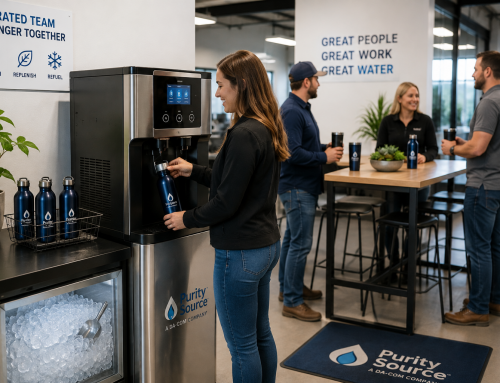
A touchless water dispenser is a water station that allows users to dispense water without pressing a shared handle or button. Depending on the unit, it may use sensor-activated dispensing, touchless bottle filling, foot pedal operation, or another hands-free activation method.
For office environments, a touchless water dispenser may include:
- Cold purified water.
- Hot water options, depending on the unit.
- Reusable bottle filling.
- Cup filling.
- Filtration or purification.
- Point-of-use, bottleless operation connected to a water line.
- A compact breakroom or lobby footprint.
- Service support for filters and maintenance.
A touchless water cooler is especially useful when the same station serves many people throughout the day. Instead of every user pressing the same lever or button, the dispenser can support a cleaner, more modern experience with fewer shared contact points.
In many workplaces, touchless water is part of a broader beverage station plan. Da-Com’s guide to creating an office beverage station explains how water, ice, sparkling water, coffee, hot water, and service planning can work together to improve the shared breakroom experience.
Why Shared Office Water Areas Need a Better Plan
Shared office water areas get more traffic than many businesses expect. A dispenser may serve employees, customers, vendors, job candidates, patients, parents, volunteers, board members, delivery drivers, and guests during the same day.
That means an office water dispenser should be planned around actual use, not just where it happens to fit.
Busy shared spaces may include:
- Employee breakrooms.
- Office kitchens.
- Reception areas.
- Waiting rooms.
- Staff lounges.
- Conference rooms.
- Training rooms.
- Warehouse offices.
- Customer service areas.
- Dealership waiting rooms.
- Church or nonprofit gathering spaces.
- School administrative offices.
- Healthcare office staff areas.
In these areas, water access should be convenient, clean-looking, and easy to service. A basic cooler may work in a low-traffic corner, but it may not create the experience a business wants in a shared or customer-facing space.
A touchless water dispenser for office spaces can help solve several practical problems at once: fewer shared touchpoints, easier bottle filling, less bottled water clutter, better presentation, and more predictable service.
Best Places to Use a Touchless Water Dispenser for Office Spaces
The right placement depends on who will use the station most often. A touchless dispenser should be easy to find, easy to access, and easy to service. It should also fit naturally into the workflow of the space.
Breakrooms and Office Kitchens
Breakrooms and office kitchens are often the best place to start. Employees may use the water station several times a day for cups, reusable bottles, coffee, tea, lunch breaks, and meetings.
A touchless dispenser in a breakroom can support:
- Daily employee hydration.
- Reusable bottle filling.
- Cleaner-looking beverage counters.
- Reduced bottled water clutter.
- Better support for coffee, hot water, and ice planning.
- A more modern shared breakroom experience.
Reception Areas and Waiting Rooms
Reception areas and waiting rooms are high-visibility spaces. A water dispenser in these areas is not only functional. It also affects the impression visitors have of the business.
A water dispenser for waiting rooms can be useful for:
- Medical offices.
- Dental offices.
- Professional services firms.
- Car dealerships.
- Service departments.
- Private schools.
- Church offices.
- Nonprofit offices.
- Customer service areas.
Touchless dispensing can make these areas feel more polished and easier for visitors to use without asking staff for bottled water or cups.
Conference Areas and Training Rooms
Meetings, trainings, board sessions, customer presentations, and employee onboarding events often require water access. Instead of putting out bottled water for every meeting, a touchless purified water dispenser nearby can support cups and reusable bottles with less storage and cleanup.
This can be especially helpful for businesses that host frequent meetings or customer visits.
Staff Lounges and Employee Areas
Staff lounges in schools, healthcare offices, service departments, warehouses, and nonprofits can see heavy daily use. A touchless water station can give employees a convenient way to refill bottles without relying on cases of bottled water, old coolers, or inconsistent breakroom setups.
Warehouse Offices and Service Departments
Warehouses, manufacturing offices, and service departments often have administrative areas connected to physically active work. Employees may need water access before shifts, during breaks, after field work, or when moving between the shop and office.
A workplace hydration station in these settings should be easy to reach and sized around actual traffic. Touchless dispensing may help make the shared station feel easier to use during busy parts of the day.
Customer-Facing Spaces
Any business that regularly welcomes customers, members, patients, parents, or guests should think about how water is presented. A modern purified water dispenser can make the space feel more intentional than a stack of water bottles or an older cooler in the corner.
Touchless Water Dispenser vs. Traditional Office Water Cooler
A traditional office water cooler can still work for some businesses. But for shared spaces, high-use areas, and customer-facing environments, a touchless dispenser may offer a better fit.
The right choice depends on traffic, placement, budget, service expectations, bottle filling needs, and the impression the business wants to create.
| Category | Traditional Office Water Cooler | Touchless Water Dispenser |
|---|---|---|
| Touchpoints | Users may touch handles, buttons, or dispenser surfaces. | Sensor-based dispensing can reduce shared touchpoints. |
| Bottle filling | May be less convenient depending on spout height and setup. | Often better suited for reusable bottles and cups. |
| Appearance | Can look dated in a modern breakroom or reception area. | Creates a cleaner, more modern hydration area. |
| Storage | Bottled setups may require jugs, cases, or delivery storage. | Bottleless options can reduce bottled water storage. |
| Best fit | Low-traffic or basic office needs. | Shared offices, waiting rooms, staff lounges, and high-use spaces. |
| Service needs | Still requires cleaning, delivery, or filter attention. | Should be paired with managed service and filter changes. |
The EPA offers practical guidance on reducing plastic waste, including reusing and reducing disposable products where possible. For workplaces that currently rely on bottled water, a bottleless purified water dispenser may help reduce storage, restocking, and disposable bottle clutter. EPA plastic waste reduction guidance
How Touchless Water Supports Employee and Visitor Experience
Employees notice the details of shared spaces. So do visitors. A water station may seem small, but it can affect how people feel about the breakroom, waiting area, or reception experience.
A touchless water dispenser for office shared spaces can support:
- Convenient hydration during the workday.
- A more modern breakroom experience.
- Reusable bottle filling.
- Guest hospitality.
- Cleaner-looking counters and shared areas.
- Less reliance on bottled water cases.
- Better confidence in shared hydration spaces.
CDC guidance encourages water as a practical beverage choice. For workplaces, the key is making water easy and appealing to access in the areas where people naturally need it. CDC water and healthier drinks
This is especially important in workplaces where people may not have time to leave the building for drinks or where guests may be waiting for appointments, service, meetings, or events.
Touchless Bottle Filling and Reusable Bottles
Reusable bottles have become a normal part of the workday. Many employees bring bottles to work, refill them during breaks, and keep them at their desks, in vehicles, or in meeting rooms.
A touchless bottle filling station can support that behavior better than a cooler designed mainly for small cups. Bottle filling needs enough clearance, simple dispensing, and a placement that does not create congestion during busy times.
Businesses should consider:
- How many people use reusable bottles.
- Whether the dispenser has enough bottle clearance.
- Whether the station is near the places employees actually take breaks.
- Whether cups are still needed for guests.
- Whether the area needs storage for bottles, cups, or supplies.
- How frequently the station will be used during peak periods.
For offices, schools, waiting rooms, dealerships, churches, nonprofits, and staff lounges, bottle filling is often one of the strongest reasons to consider touchless dispensing.
Service, Filter Changes, and Maintenance Matter
A dispenser is only as good as the service plan behind it. A modern unit can look great on day one, but shared office water stations need ongoing support. Filters need to be changed. Service questions need clear ownership. Placement may need to be adjusted. Usage can grow over time.
That is why service matters when choosing a touchless water dispenser for office spaces.
Important service questions include:
- Who changes the filters?
- How often are filters changed?
- Who handles service requests?
- What happens if water flow changes?
- What happens if the sensor needs attention?
- Who cleans around the unit?
- What does the office staff need to do?
- How quickly can support respond?
Da-Com’s office water filter changes guide explains why filter schedules, service ownership, and maintenance planning matter for workplace water systems. This is especially important when the dispenser serves a busy shared space.
Office managers, HR teams, facilities leaders, and administrators already have enough to manage. A water dispenser should not become another system that depends on someone remembering a filter date or troubleshooting an issue alone.
Workplace Drinking Water Access and Practical Planning
For businesses, water access is both a convenience issue and a practical workplace planning issue. OSHA’s sanitation standard includes requirements related to potable water in workplaces. Businesses should review applicable requirements and internal policies for their environment. OSHA 1910.141 sanitation standard
For most office planning, the practical questions are simple:
- Is water easy for employees to access?
- Is the station placed where people naturally need it?
- Does the dispenser support cups, bottles, or both?
- Does the area look clean and organized?
- Is the service schedule clear?
- Do employees and guests feel comfortable using the station?
A touchless purified water dispenser can help businesses answer those questions with a cleaner, more user-friendly setup.
What to Ask Before Choosing a Touchless Office Water Dispenser
Before choosing a dispenser, businesses should think through the space, the users, and the service plan. The best unit is not always the most expensive or the most advanced. It is the one that fits the shared space and the people using it.
Ask these questions before choosing a touchless water dispenser for office use:
- Where will the dispenser be placed?
- How many people will use it daily?
- Is the space mainly for employees, visitors, or both?
- Will people fill cups, reusable bottles, or both?
- Does the dispenser need hot water, cold water, or both?
- Is there enough bottle clearance?
- Is plumbing available nearby?
- Is electrical access available?
- Does the area need a drain, or can the unit operate without one?
- How much counter or floor space is available?
- Will the dispenser be used during peak breaks or events?
- Who will handle filter changes?
- What service schedule is included?
- Who should employees call if something needs attention?
- Does the dispenser fit the look of the space?
These questions help turn a product decision into a workplace experience decision. The right dispenser should support the people, traffic, and purpose of the space.
Touchless Water Dispenser Placement Checklist
Placement can make or break the success of a water station. A great dispenser in the wrong spot may still be ignored, crowded, or difficult to service.
Use this checklist before installation:
- Choose a location employees already pass during breaks.
- Keep the station visible but not in the way of traffic.
- Make sure there is enough room for bottle filling.
- Provide nearby cup or bottle storage if needed.
- Consider the impression guests will have in reception areas.
- Check plumbing and electrical access.
- Think about service technician access.
- Keep the surrounding counter or floor area easy to clean.
- Avoid locations that create hallway congestion.
- Plan for future usage if the team grows.
For busy offices, a touchless dispenser may be most successful when it is part of a larger shared space plan, not an afterthought placed wherever there happens to be room.
Common Mistakes to Avoid
Choosing Based Only on Appearance
A modern dispenser should look good, but appearance is not enough. Businesses should also evaluate traffic, bottle filling, filtration, service, and maintenance needs.
Ignoring Filter Changes
Even a touchless dispenser needs a clear filter-change plan. If filters are not maintained, the experience can suffer over time.
Putting the Unit in the Wrong Place
A dispenser that is too far from employees, too close to a crowded hallway, or hard for visitors to find may not get used as intended.
Forgetting About Guests
Reception areas, waiting rooms, and conference spaces may need a different setup than an internal breakroom. Visitor experience should be part of the planning process.
Treating Water as a One-Time Purchase
Office hydration is an ongoing service need. The dispenser, filters, support, placement, and usage should all be managed over time.
How Purity Source Helps With Touchless Office Water
Purity Source helps businesses evaluate purified water options based on how the workplace actually uses water. That includes the number of users, placement, shared spaces, visitor traffic, filter changes, bottle filling, service support, and long-term hydration needs.
Purity Source can help with:
- Purified water dispenser options.
- Touchless dispensing needs.
- Shared breakroom planning.
- Reception and waiting room hydration.
- Reusable bottle filling.
- Filter-change planning.
- Service and maintenance expectations.
- Water and ice planning.
- Modern workplace beverage areas.
Instead of asking office staff to manage bottled water, old coolers, filter schedules, and service questions on their own, Purity Source can help create a more practical managed water setup.
Frequently Asked Questions About Touchless Water Dispensers for Offices
What is a touchless water dispenser for office use?
A touchless water dispenser for office use is a water station that allows employees or visitors to dispense water without pressing shared handles or buttons. Depending on the unit, it may use sensor-based dispensing, bottle filling, filtration, hot and cold water options, or a bottleless point-of-use setup.
Why choose a touchless water dispenser instead of a traditional cooler?
A touchless dispenser can reduce shared touchpoints, support reusable bottle filling, create a more modern hydration area, reduce bottled water storage, and improve the experience in shared office spaces such as breakrooms, waiting rooms, conference areas, and staff lounges.
Where should an office place a touchless water dispenser?
An office should place a touchless water dispenser where employees or visitors naturally need water, such as breakrooms, kitchens, reception areas, waiting rooms, conference spaces, training rooms, staff lounges, or customer-facing areas. The location should allow easy access without creating congestion.
Can a touchless water dispenser support reusable bottle filling?
Yes. Many touchless water dispensers are well suited for reusable bottle filling, especially when the dispenser has enough clearance, simple activation, and convenient placement near break areas, reception spaces, or staff lounges.
Does a touchless office water dispenser need filter changes?
Yes. A touchless office water dispenser still needs filter changes and service based on the unit, usage, and provider recommendations. A managed service plan can help ensure filter schedules and maintenance are not left entirely to office staff.
Is touchless water useful for waiting rooms and reception areas?
Yes. Touchless water can be useful in waiting rooms and reception areas because it gives visitors a clean-looking, modern way to access water without asking staff for bottled water. It can also improve the overall appearance of the shared space.
Can Purity Source help service and maintain office water dispensers?
Yes. Purity Source can help businesses evaluate purified water dispensers, placement, filter changes, service needs, and ongoing support so the hydration station remains easier for employees and visitors to use.
Does Purity Source serve businesses in Southern Illinois?
Yes. Purity Source serves businesses in St. Louis, St. Charles, the Metro East, Belleville, Edwardsville, Collinsville, Bethalto, and Southern Illinois with purified water solutions and workplace hydration support.
Upgrade Shared Hydration With Purity Source
A touchless water dispenser for office shared spaces can support cleaner-looking hydration areas, easier bottle filling, fewer shared touchpoints, and a more modern workplace experience. For employees, it can make daily hydration more convenient. For visitors, it can make waiting rooms and reception areas feel more thoughtful. For office managers, it can reduce the clutter and restocking issues that come with bottled water.
The best solution is not just about choosing a dispenser. It is about choosing the right placement, service plan, filter schedule, and support model for the way your workplace actually operates.
To learn more about choosing a touchless water dispenser for office shared spaces in St. Louis, St. Charles, the Metro East, Belleville, Edwardsville, Collinsville, Bethalto, or Southern Illinois, contact Da-Com today. Purity Source can help your team evaluate purified water, dispenser placement, filter changes, service needs, and a hydration setup that supports employees, visitors, and busy shared spaces.



Leave A Comment