

Wide Format Printer for Telecom: Fiber Maps & Plans
Wide format printer for telecom projects is not just an equipment topic. It is a field communication topic. Telecom teams rely on large, accurate, readable documents to plan fiber routes, review network layouts, coordinate construction, support permitting, mark up revisions, and keep field crews aligned before work begins.
Digital tools are essential in telecommunications. GIS platforms, CAD files, cloud storage, tablets, project management systems, and mobile field applications all play a role in modern telecom work. But printed large-format documents still matter because network plans, fiber maps, utility drawings, tower layouts, and as-built documentation often need to be reviewed at a size that supports detail, collaboration, and field use.
When a crew is preparing for deployment, a small screen is not always enough. Route maps need to be reviewed across neighborhoods, corridors, easements, poles, handholes, right-of-way areas, cabinets, splice points, and construction zones. Engineering teams need room to compare revisions. Contractors need clear drawings before they go to the field. Municipal reviewers may need plan sets, permit documents, and construction drawings that are easy to read and mark up.
For telecom companies, fiber contractors, utilities, engineering firms, broadband deployment teams, and construction partners in St. Louis, St. Charles, Columbia, the Metro East, Belleville, Edwardsville, Collinsville, and Southern Illinois, the right wide format printer can help turn complex network information into usable field documentation.
Quick Answer: How Do Telecom Companies Use Wide Format Printers?
Telecom companies use a wide format printer for telecom work to print fiber route maps, GIS layers, network planning drawings, CAD files, construction documents, permit sets, tower plans, coverage maps, utility markups, redlines, and as-built network documentation. These large-format prints help engineering teams, construction managers, field crews, inspectors, contractors, and municipal stakeholders review complex details that are difficult to understand on standard letter-size paper or small screens.
Common telecom wide format printing applications include:
- Fiber route maps.
- GIS map layers.
- Network design plans.
- Construction drawings.
- Permit documents.
- Right-of-way drawings.
- Utility coordination maps.
- Field deployment packets.
- Tower and site plans.
- Coverage maps.
- Redline markups.
- As-built documentation.
- Large-format scanning for archived drawings.
Da-Com provides wide format printer solutions for teams that need reliable large-format printing, scanning, folding, and print management support for technical documents, construction drawings, maps, and project plans.
Why Telecom Teams Still Need Large Printed Documents
Telecom work is visual, technical, and location-specific. A fiber route may cross streets, poles, easements, properties, conduit paths, municipal boundaries, utility corridors, commercial districts, and residential neighborhoods. A network plan may involve cabinets, splice enclosures, handholes, building entries, towers, equipment rooms, and multiple construction phases.
Digital mapping tools are powerful, but large printed documents still provide a different kind of value. They allow teams to see the full picture, mark up changes quickly, compare plan versions, gather around the same document, and carry reference materials into meetings or field environments.
Printed telecom documents can support:
- Pre-construction meetings.
- Engineering reviews.
- Fiber route planning.
- Permit review conversations.
- Contractor coordination.
- Field crew briefings.
- Stakeholder presentations.
- Emergency repair planning.
- Construction closeout documentation.
- As-built updates.
The FCC’s National Broadband Map displays where internet services are available across the United States based on data reported by internet service providers through the Broadband Data Collection. The FCC also notes that the map is updated continuously to improve accuracy through verification efforts, provider updates, location data updates, and information from the public. Telecom teams working in deployment, coverage analysis, and planning often depend on map-based information like this when evaluating service areas, gaps, and expansion needs. FCC National Broadband Map information
Wide Format Printer for Telecom Fiber Route Maps
A wide format printer for telecom is especially useful when teams need clear fiber route maps. Fiber maps can include long routes, dense neighborhoods, utility corridors, underground pathways, aerial routes, splice points, cabinet locations, pole lines, and customer service areas. On a small screen, it can be hard to see both the detail and the full route at once.
Large-format fiber route maps help teams review:
- Proposed fiber paths.
- Existing infrastructure.
- Backbone routes.
- Distribution routes.
- Last-mile connections.
- Splice locations.
- Cabinet and handhole placement.
- Underground and aerial sections.
- Road crossings.
- Utility conflicts.
- Neighborhood build areas.
- Construction phases.
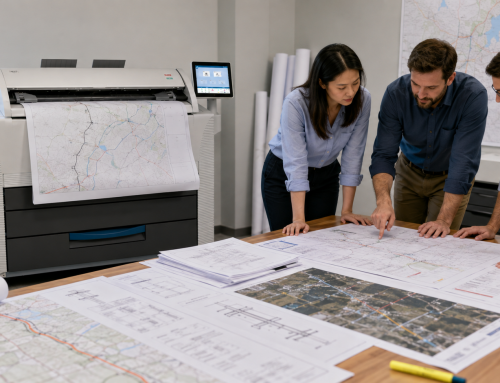
Printed fiber maps are helpful during planning meetings because multiple people can review the same route at the same time. Engineers, project managers, contractors, utility representatives, and field supervisors can stand around a large map, identify concerns, circle problem areas, and mark revision notes directly on the page.
For fast-moving telecom projects, having in-house printing can also reduce delays. If a route changes, the team does not have to wait for an outside print shop to produce the latest version. Updated drawings can be printed quickly for the next meeting, field visit, or crew packet.
Da-Com’s article on wide format printers for project teams explains how large-format output supports construction drawings, site plans, maps, signage, training materials, presentation boards, field use, and collaboration.
Telecom GIS Map Printing and Network Planning
GIS maps are central to telecom planning because network decisions depend on geography. Service areas, route options, customer density, pole locations, terrain, rights-of-way, utility infrastructure, and coverage gaps all affect deployment decisions.
Telecom GIS map printing can help teams review complex layers in a format that supports discussion and markup. A printed GIS map may include:
- Fiber routes.
- Service boundaries.
- Customer locations.
- Utility poles.
- Conduit paths.
- Roadways and parcels.
- Municipal boundaries.
- Construction zones.
- Network nodes.
- Coverage areas.
- Unserved and underserved locations.
- Environmental or permitting constraints.
When telecom GIS maps are printed at the right size, teams can review both broad patterns and detailed location information. That can help during network planning, broadband expansion, public funding discussions, municipal coordination, and field deployment.
A wide format printer for telecom should produce maps with crisp line detail, readable labels, consistent color, and enough media flexibility to support maps, drawings, and technical documents. For telecom teams, color can be especially important because GIS layers often rely on color coding to distinguish routes, utilities, boundaries, phases, and status.
Construction Drawings, Permit Sets, and Field Deployment
Telecom deployment often requires more than maps. Fiber installation, broadband construction, tower work, equipment placement, and network upgrades may involve construction drawings, permit documents, field plans, traffic control references, site plans, and utility coordination materials.
NTIA notes that local permitting for broadband deployments may include approvals, authorizations, easements, and right-of-way permits from towns, counties, and other municipal entities. Those permitting and approval requirements often create documentation needs that go beyond a simple map. NTIA broadband permitting resources
Telecom teams may need to print:
- Construction plan sets.
- Right-of-way drawings.
- Permit drawings.
- Utility markups.
- Site plans.
- Traffic control references.
- Safety signage.
- Tower plans.
- Equipment room layouts.
- Splice diagrams.
- Field crew maps.
- Revision-controlled document packets.
In these situations, print quality and document control both matter. Crews need to know they are working from the correct version. Project managers need updated drawings quickly. Municipal reviewers need readable plan sets. Contractors need documents that can be marked, carried, posted, or reviewed in the field.
A wide format printer for telecom helps teams produce the large-format documentation needed before deployment, during construction, and after project closeout.
How Printed Plans Help Telecom Field Crews
Telecom field crews often work in environments where paper still has practical advantages. Tablets and mobile apps are helpful, but they can be limited by screen size, battery life, glare, connectivity, weather, and the need for quick group review.
Printed large-format documents help field crews:
- Review route details before leaving the office.
- Carry clear construction drawings to the jobsite.
- Mark up field changes quickly.
- Compare planned routes with real site conditions.
- Coordinate with contractors, inspectors, and utility partners.
- Identify splice points, cabinets, poles, and handholes.
- Document changes for as-built updates.
- Support emergency repairs and outage response.
Printed documents are especially useful when several people need to look at the same plan at the same time. A foreman, field technician, contractor, and inspector can all review one printed route map together. That can reduce misunderstandings and help the team make faster decisions.
A printed plan also creates a simple place for redlines. When a crew identifies a change in the field, they can mark it on the drawing and return it for engineering updates or as-built documentation.
Wide Format Scanning and As-Built Documentation
Printing is only one part of the telecom document lifecycle. Wide format scanning is also important because telecom teams often need to digitize marked-up drawings, old plans, field revisions, as-built documentation, and archived network maps.
As-built drawings are especially important because they show what was actually installed, not only what was planned. In telecom construction, field conditions can change. Routes may shift, infrastructure may differ from expectations, and crews may adjust plans based on utility conflicts, access issues, or construction realities.
Wide format scanning can support:
- Digitizing redline markups.
- Archiving as-built drawings.
- Sharing field revisions with engineering.
- Preserving older network plans.
- Reducing paper storage.
- Improving document retrieval.
- Supporting project closeout packages.
- Creating searchable digital records when paired with document workflows.
Da-Com’s Wide Format page includes scanning solutions designed for high-resolution image quality and production-speed scanning, which can help teams manage large documents, archival needs, and technical drawings. Explore Da-Com Wide Format solutions
What to Look for in a Wide Format Printer for Telecom
Choosing a wide format printer for telecom should not be based only on print width or equipment price. Telecom teams should consider how the device will support maps, drawings, revisions, field documentation, scanning, and service needs over time.
Line Accuracy and Detail
Telecom drawings often include small labels, route lines, splice details, utility references, and dense map information. The printer should produce crisp, readable output so crews and reviewers can trust the details.
Color Map Clarity
Color matters for GIS layers, route status, utility differentiation, construction phases, coverage maps, and stakeholder presentations. A printer that handles color clearly can make maps easier to understand.
Fast Output
Telecom projects often move quickly. Engineering changes, permit updates, and field revisions may need same-day printing. Fast production can help reduce bottlenecks.
Roll-Fed Media Support
Fiber maps, engineering plans, and network drawings may require different media sizes. Roll-fed systems can support large sheets and long technical drawings more efficiently than standard devices.
Scan and Copy Capability
Teams that work with redlines, as-builts, and archived plans may need scanning and copying as much as printing. A multifunction wide format system can support the full document cycle.
Print Management and Cost Tracking
Telecom projects may involve multiple departments, jobs, clients, or project codes. Print management tools can help track usage, control access, and better understand costs.
Service Response and Uptime
A wide format printer becomes more valuable when it is reliable. Telecom teams should ask about service response, preventive maintenance, supplies, training, and local support.
Da-Com’s Wide Format page notes that KIP systems include print management tools, accounting and cost center capabilities, touchscreen operation, fast media installation, auto roll switching, and consistent print quality. These features can matter for teams that need dependable large-format output during active projects. Learn more about Da-Com Wide Format equipment
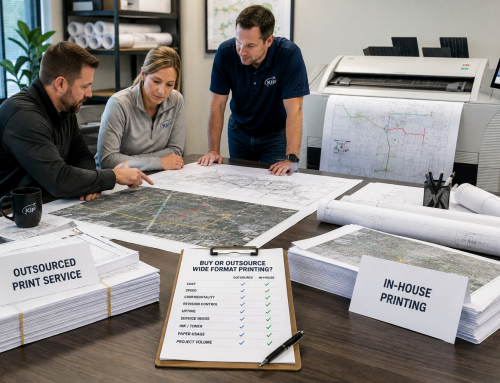
In-House Printing vs. Outsourcing for Telecom Maps
Some telecom teams outsource large-format printing. Others bring printing in-house. The right choice depends on project volume, turnaround needs, confidentiality, revision frequency, and budget.
| Factor | Outsourced Wide Format Printing | In-House Wide Format Printing |
|---|---|---|
| Turnaround time | Depends on vendor schedule | Prints available when the team needs them |
| Revision control | Multiple file transfers may create delays | Updated versions can be printed quickly |
| Confidentiality | Project files are shared externally | Maps and network plans stay internal |
| Cost structure | Pay per job or per sheet | Equipment, supplies, service, and usage costs |
| Field readiness | May require planning ahead | Crews can get last-minute packets faster |
| Best fit | Low-volume or occasional print needs | Frequent maps, revisions, permit sets, and field documents |
For teams that print only occasionally, outsourcing may still make sense. For teams printing fiber maps, plan sets, GIS layers, and as-builts every week, an in-house wide format printer for telecom may improve speed, control, and productivity.
Da-Com’s guide to in-house wide format printing explains how in-house output can help teams create or revise large-format materials without waiting days for outside production.
Telecom Use Cases for Wide Format Printing
A wide format printer for telecom can support many departments and project stages. The same system may be used by engineering, construction, operations, field teams, permitting, sales engineering, and leadership.
Network Engineering
Engineering teams use large-format prints to review route designs, utility details, equipment locations, splice diagrams, and network layouts.
Construction and Deployment
Construction teams use printed plan sets, right-of-way drawings, utility markups, crew maps, safety signs, and revision-controlled field documents.
Permitting and Municipal Coordination
Permit packages may require readable site plans, route maps, construction drawings, and right-of-way documentation for review by towns, counties, and local agencies.
Field Operations
Field crews use printed maps and drawings for route verification, outage response, redlines, daily assignments, and on-site coordination.
As-Built and Records Management
After construction, printed redlines and scanned as-builts can help keep network records accurate for future maintenance, expansion, and troubleshooting.
Common Mistakes Telecom Teams Make With Large-Format Documents
Printing Too Late in the Process
If field crews receive documents at the last minute, errors may not be caught until work is already underway. Printing earlier can support better review and coordination.
Relying on Small Prints for Complex Maps
Fiber routes, GIS layers, and utility drawings often lose clarity when reduced to standard paper sizes. Large-format output helps preserve detail.
Not Controlling Revisions
Telecom work changes quickly. Without clear version control, crews may use outdated maps or plan sets. Print workflows should identify dates, versions, and project references clearly.
Ignoring Scanning Needs
Teams that print drawings also need a plan for scanning redlines and as-builts back into the digital record.
Choosing Equipment Without Considering Service
A printer is only useful if it works when projects need it. Service, supplies, training, and support should be part of the buying decision.
Questions to Ask Before Choosing a Wide Format Printer for Telecom
Before investing in a wide format printer for telecom, ask questions that connect the equipment to real project needs.
- How often do we print fiber route maps, GIS maps, or construction drawings?
- How quickly do field crews need updated documents?
- Do we need color for GIS layers and route status?
- Do we need black-and-white technical drawings at high volume?
- Do we need wide format scanning for redlines and as-builts?
- Do we need folding for plan sets or field packets?
- How many users or departments will print from the system?
- Do we need project-based cost tracking?
- Will confidential network plans stay internal?
- What service response do we need?
- Should we buy, lease, or continue outsourcing?
- Can the provider support St. Louis, Columbia, Missouri, Illinois, and Southern Illinois locations?
The best solution depends on volume, deadlines, project complexity, field needs, document security, and total cost of ownership.
Why Local Wide Format Support Matters
Telecom projects are time-sensitive. When field deployment is waiting on drawings, route maps, or revised plan sets, print downtime can delay more than a document. It can delay crews, contractors, permit responses, and project communication.
Local support matters because teams need answers quickly. A local provider can help evaluate equipment, service current systems, supply media and toner, support scanning, train users, and respond when the printer becomes critical to project delivery.
Da-Com supports wide format printer needs across St. Louis, Columbia, Missouri, the Metro East, and Southern Illinois. For telecom teams, that regional support can help reduce delays and keep network documentation moving.
Frequently Asked Questions About Wide Format Printers for Telecom
What is a wide format printer for telecom?
A wide format printer for telecom is a large-format printing system used to produce fiber route maps, GIS maps, network planning drawings, construction documents, permit sets, tower plans, redlines, and as-built documentation for telecom projects.
Why do telecom companies need wide format printing?
Telecom companies need wide format printing because fiber maps, GIS layers, CAD drawings, construction plans, and network documents often require large, readable formats for planning, field deployment, permitting, and stakeholder coordination.
What telecom documents are printed on wide format printers?
Common documents include fiber route maps, construction drawings, right-of-way plans, permit sets, utility markups, tower plans, coverage maps, splice diagrams, crew maps, redlines, and as-built drawings.
Do telecom crews still need printed maps if they use digital GIS tools?
Yes. Digital GIS tools are essential, but printed large-format maps are still useful for field crews, construction meetings, permit reviews, markups, emergency repairs, and group coordination.
Is color important for telecom GIS map printing?
Color can be important because GIS layers often use color to show routes, utilities, phases, service areas, boundaries, and project status. Clear color output can make maps easier to understand.
Should telecom companies buy, lease, or outsource wide format printing?
The best choice depends on print volume, turnaround needs, confidentiality, revision frequency, budget, and service expectations. High-volume teams with frequent revisions may benefit from in-house printing or leasing.
Can wide format printers scan as-built drawings?
Some wide format systems include scanning or can be paired with wide format scanners. This helps teams digitize redlines, archived drawings, and as-built documentation.
Does Da-Com support wide format printers for telecom teams?
Yes. Da-Com supports wide format printing, scanning, folding, supplies, service, and equipment planning for businesses and project teams in St. Louis, Columbia, Missouri, the Metro East, and Southern Illinois.
The Bottom Line: Telecom Teams Need Clear Field Documentation
A wide format printer for telecom helps turn complex network information into clear, usable documentation. Fiber maps, GIS layers, construction drawings, permit documents, tower plans, coverage maps, and as-builts all play a role in how telecom teams plan, build, revise, and maintain networks.
Digital tools are not going away, but printed large-format documents still help teams collaborate, mark up changes, review full routes, support field crews, and reduce confusion during deployment. The right equipment can improve speed, clarity, revision control, and project communication.
For telecom companies, fiber contractors, utilities, engineering firms, broadband deployment teams, and construction partners, wide format printing should be part of the workflow conversation, not just an equipment purchase.
To learn more about wide format printer options for telecom projects in St. Louis, St. Charles, Columbia, the Metro East, Belleville, Edwardsville, Collinsville, or Southern Illinois, contact Da-Com today. Da-Com can help your team evaluate wide format printers, plotters, scanning systems, folding options, supplies, service, and the best workflow for fiber maps, GIS plans, field deployment, and as-built documentation.




Leave A Comment