
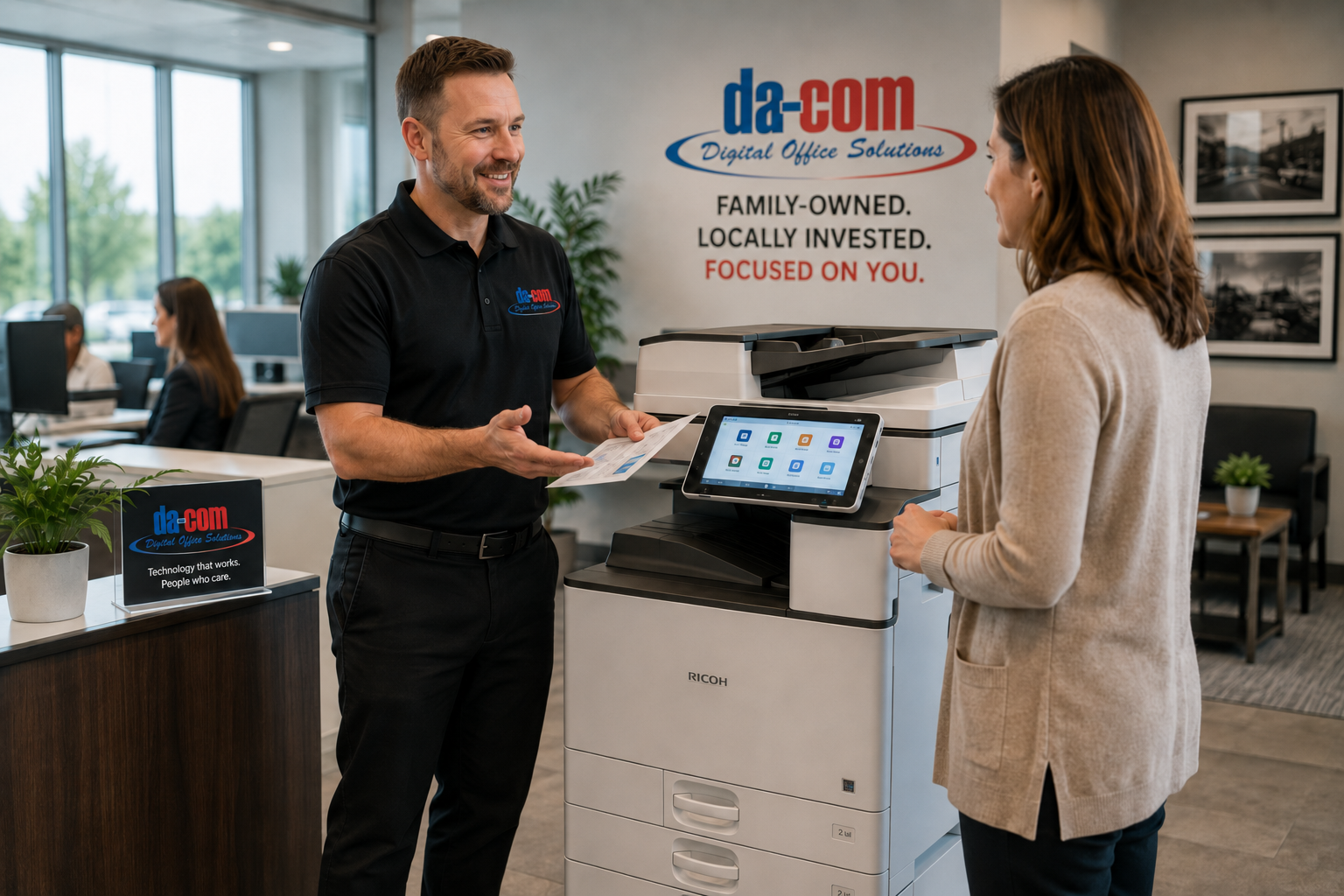
Family-Owned Copier Company: Why Local Still Wins
Family-owned copier company support still matters because office technology is not only about machines, contracts, and monthly lease payments. It is about trust, response time, accountability, and whether your provider is still involved after the copier is installed.
Most businesses do not think about their copier, printer, scanner, or multifunction device until something goes wrong. The copier jams before a client presentation. The accounting team cannot scan invoices. A school office cannot print registration forms. A medical office cannot scan patient paperwork. A manufacturing office cannot print shipping documents. A legal team cannot prepare a packet on time. Suddenly, what looked like a simple copier issue becomes a workflow problem.
That is when the provider relationship matters.
A national provider may have a recognizable name, a large support structure, and broad coverage. But many St. Louis, Columbia, Metro East, and Southern Illinois businesses still prefer working with a local, family-owned technology partner because the service experience can feel different. Communication is more direct. Relationships last longer. Technicians know the customer environment. Support feels more personal. Accountability stays closer to home.
This guide explains why a family-owned copier company still matters, how local copier service affects productivity, what to consider before signing a copier lease, and why businesses should compare providers based on long-term support, not just the first proposal.
Quick Answer: Why Choose a Family-Owned Copier Company?
A family-owned copier company can give businesses more responsive service, stronger local accountability, clearer communication, and long-term relationship support compared with providers that operate through distant call centers or highly centralized service models. For many organizations, the biggest advantage is not only the copier itself. It is knowing who will answer, who will show up, and who will stay involved after the lease is signed.
A family-owned copier company may be a strong fit if your business wants:
- Responsive local copier service.
- Copier leasing guidance based on actual workflow.
- A provider that understands the St. Louis, Columbia, and Southern Illinois market.
- Direct accountability after installation.
- Long-term service relationships.
- Less bureaucracy when issues happen.
- Practical recommendations instead of unnecessary upgrades.
- One local partner for office equipment, managed print, IT, document management, and workflow support.
Da-Com’s About Da-Com page explains that Da-Com is an award-winning, customer-focused, family-owned company that has been in business for more than 75 years. That history matters when businesses want a provider that is invested in local service, long-term customer relationships, and practical office technology support.
Why Family-Owned Technology Companies Still Matter
Technology keeps changing. Copiers now scan to email, connect to networks, support secure print release, integrate with document workflows, and serve as shared office hubs. Managed print programs track usage, supplies, service needs, and fleet performance. Businesses now expect equipment providers to understand security, productivity, service response, and workflow, not just hardware.
Even with all that change, one thing has not changed: people still want a partner they can trust.
Businesses still want someone who answers the phone. They want a technician who understands their equipment. They want a sales representative who recommends the right fit, not just the biggest machine. They want a provider who stays involved when service questions come up. They want local accountability when something interrupts the workday.
Family-owned technology companies matter because they are often built around relationships. Reputation is not abstract. It is tied to the community, the customer base, and the service experience people talk about after the sale.
That relationship-based approach can be especially important in a business community like St. Louis, where local trust and word-of-mouth still carry real weight.
Family-Owned Copier Company vs. National Provider
Not every national provider delivers poor service, and not every local provider is automatically better. The point is not that bigger is always worse. The point is that copier service depends heavily on responsiveness, communication, and accountability.
When a copier goes down, most businesses do not care how large the provider is. They care how quickly the issue is acknowledged, how clearly next steps are communicated, and how soon the office can get back to work.
| Category | National Provider | Family-Owned Local Provider |
|---|---|---|
| Support experience | May route through centralized systems | Often more direct and relationship-based |
| Service familiarity | Technicians may vary by ticket or region | Local teams may know the customer environment better |
| Accountability | Can involve multiple layers | Accountability often stays closer to the customer |
| Copier recommendations | May follow standardized sales models | Can be more consultative and right-sized |
| Local knowledge | May be less familiar with regional needs | Understands local business expectations and service areas |
| Long-term relationship | Can feel transactional | Often built around retention and trust |
For small and midsize businesses, the difference often becomes most visible after installation. That is when customers discover whether they purchased equipment or gained a partner.
The Difference Between a Vendor and a Partner
Many copier companies can sell equipment. Fewer stay engaged after installation.
A vendor may focus on the transaction. A partner focuses on the relationship. A vendor may quote a copier lease and move on. A partner asks how employees print, how much scanning happens, what departments share the device, which workflows matter most, how supplies are managed, what service response looks like, and whether the equipment fits the business long term.
The difference shows up in questions like:
- Does the provider understand your workflow?
- Do they explain lease terms clearly?
- Do they recommend equipment based on real usage?
- Do they stay involved after installation?
- Do technicians know your environment?
- Is service easy to request?
- Does someone communicate when there is an issue?
- Does the provider help prevent repeat problems?
- Do they help with supplies, reporting, and long-term planning?
The right family-owned copier company should make office technology feel easier to manage, not more complicated.
Why Local Copier Service Matters When Problems Happen
Every office eventually has a copier, printer, scanner, or multifunction device issue. The real question is what happens next.
A copier problem can affect:
- Reception and front desk teams.
- Accounting departments.
- Human resources.
- Medical and dental offices.
- Schools and administrative offices.
- Legal teams.
- Manufacturing and warehouse offices.
- Construction and AEC firms.
- Nonprofits and community organizations.
- Customer service teams.
When local copier service is responsive, the office feels supported. When service is slow or confusing, employees lose time and office managers carry the frustration.
Da-Com’s article on fast copier repair in St. Louis explains how copier downtime can affect printing, scanning, document workflows, customer service, and office productivity. It also notes that service quality should be part of every copier lease decision because the lease is often a multi-year service relationship.
The best local copier service providers do more than repair a device. They communicate clearly, understand urgency, help identify recurring issues, and support the customer after the immediate problem is fixed.
Copier Leasing in St. Louis: Why Local Accountability Matters
Copier leasing can be a practical way for businesses to access modern office technology without a large upfront purchase. But leasing should not be evaluated by monthly payment alone.
The U.S. Small Business Administration explains that businesses should identify the assets and equipment they need and decide whether to lease or buy based on business needs, cost, and long-term planning. The SBA also notes that leasing can require less cash upfront and may include maintenance in some cases. You can review the SBA resource here: SBA Buy Assets and Equipment.
For copier leasing, that means businesses should evaluate both the equipment and the support relationship. A copier lease may last several years. If the provider is difficult to reach, slow to respond, or unclear about service expectations, the lowest monthly payment may not feel like a good deal later.
Before signing a copier lease, ask:
- What is included in the monthly payment?
- Are maintenance, parts, labor, and toner included?
- What are the service response expectations?
- Are technicians local?
- How are urgent service issues handled?
- What happens if the device repeatedly fails?
- How are supplies managed?
- Is installation and training included?
- Does the provider review usage over time?
- Will the equipment still fit the business near the end of the lease?
Da-Com’s St. Louis copier company lease checklist explains why businesses should compare provider service, lease terms, support response, supply management, workflow needs, security settings, and long-term productivity before signing a copier agreement.
Why the Right Copier Recommendation Matters
One of the biggest frustrations businesses face when comparing copier companies is feeling oversold. Some providers lead with the biggest machine, the newest feature set, or the most expensive lease option. But most organizations do not need the largest device. They need the right fit.
A family-owned copier company often has a stronger incentive to build trust over time. That can lead to more practical recommendations based on customer need rather than short-term sales pressure.
The right provider should ask about:
- Monthly print volume.
- Color vs. black-and-white usage.
- Scanning volume.
- Number of users.
- Department workflows.
- Secure print requirements.
- Finishing needs such as stapling or booklet making.
- Document management needs.
- Network and IT considerations.
- Budget expectations.
- Future growth.
A medical office may need reliable scanning and privacy-conscious workflows. A school may need high-volume copying and simple user access. A law firm may need fast scanning and secure document handling. A manufacturer may need dependable office printing tied to shipping, invoices, and operations. A marketing team may need stronger color output.
The goal is not the most impressive machine. The goal is the machine that fits the work.
Managed Print Services and the Local Partner Advantage
Copiers and printers are easier to manage when they are part of a broader print strategy. Many businesses have too many devices, unclear supply usage, unpredictable service needs, and limited visibility into what printing actually costs.
Managed print services can help businesses bring that environment under control. Da-Com’s Managed Print Services page explains that managed print helps Missouri businesses gain visibility and control over printing processes, identify inefficiencies, improve the current environment, and reduce print-related expenditures.
A managed print program may include:
- Printer and copier fleet inventory.
- Device usage analysis.
- Automatic toner and supply replenishment.
- Service and repair support.
- Preventive maintenance.
- Print volume reporting.
- Fleet optimization recommendations.
- Cost control recommendations.
- Security configuration support.
- Ongoing account reviews.
Working with a local partner can make managed print feel more practical because the provider can review the actual environment, talk through employee pain points, and recommend changes based on how the business really works.
Why St. Louis Businesses Continue Choosing Local Providers
St. Louis has always been a relationship-driven business community. Local reputation matters. Referrals matter. Responsiveness matters. Businesses want providers that understand the region and care about keeping local relationships strong.
When local organizations choose local providers, several things can happen:
- Communication becomes more personal.
- Service accountability is easier to maintain.
- Local jobs and local expertise stay in the region.
- Community relationships strengthen.
- Support teams better understand regional business needs.
- Customers can build long-term relationships with the same provider.
The U.S. Census Bureau’s 2025 release on business owner characteristics notes that U.S. employer and nonemployer businesses represented $50.0 trillion in receipts in 2023, which reinforces how important businesses of all sizes are to the broader economy. You can review the Census release here: U.S. Census Bureau Business Owner Characteristics.
For local buyers, the value of a family-owned provider is not only economic. It is also practical. When something goes wrong, local relationships can help reduce confusion and speed up communication.
The Hidden Cost of Choosing the Wrong Copier Company
The wrong copier company can create problems that last for years because copier leases and service agreements are not short-term decisions. If a provider is hard to reach, the business may struggle every time a device has an issue. If the equipment is oversized, the business may pay too much for features it does not need. If the equipment is undersized, employees may deal with slow output, repeated jams, or bottlenecks.
The hidden costs may include:
- Lost employee time.
- Missed deadlines.
- Delayed invoices.
- Frustrated office managers.
- Customer service interruptions.
- Repeated service calls.
- Supply confusion.
- Workflow workarounds.
- Lease surprises.
- Reduced confidence in office technology.
The wrong provider can make a copier feel like a constant headache. The right provider can make it feel like one less thing to worry about.
Beyond Copiers: One Local Partner for the Modern Office
One reason businesses choose Da-Com is that office technology now crosses categories. A copier may connect to the network. A scanner may support document workflows. Print security may involve IT. A managed print program may connect with supplies, service, reporting, and user behavior. A document management project may affect accounting, HR, and customer service.
Working with separate vendors for every technology category can create vendor fatigue. One company handles copiers. Another handles printers. Another handles IT. Another handles cybersecurity. Another handles document workflows. Every issue becomes another phone call, another support ticket, and another invoice.
Da-Com supports multiple areas of office technology, including:
- Office copiers and printers.
- Managed print services.
- Managed IT services.
- Cybersecurity.
- Document management.
- Wide-format printing.
- Office supplies.
- Workplace solutions.
Da-Com’s St. Louis business technology services page highlights office equipment, production equipment, print management, large format, managed IT, purified water solutions, document management, and office supplies as part of the broader technology support available to local businesses.
That broader relationship can help businesses spend less time chasing answers and more time focusing on operations.
How to Evaluate a Family-Owned Copier Company
Not every provider uses the phrase “family-owned” the same way. Businesses should still evaluate the service model, response expectations, equipment recommendations, contract terms, and customer support process carefully.
Ask these questions before choosing a provider:
- How long has the company served the local market?
- Are technicians local?
- What brands and equipment types do they support?
- How do they recommend the right copier?
- What is included in the lease or service agreement?
- How do service calls get submitted?
- What are typical response times?
- How are supplies handled?
- How does the provider manage recurring issues?
- Is training included after installation?
- Can the provider support managed print?
- Can the provider help with networked device issues?
- Can they support multiple locations?
- Do they provide ongoing account reviews?
- Will they help plan future upgrades?
The answers should feel clear and practical. A strong provider should explain the process in plain language and help the business understand what support will look like after installation.
Family-Owned Copier Company Benefits by Business Type
Professional Offices
Law firms, accounting firms, insurance agencies, financial offices, and consulting companies rely on dependable print and scan workflows. Local copier service can help reduce frustration when deadlines, client documents, and secure workflows matter.
Healthcare and Dental Offices
Medical and dental practices often depend on scanning, forms, insurance documents, schedules, and administrative paperwork. Responsive support can help staff avoid delays during busy patient days.
Schools and Nonprofits
Schools and nonprofits often need high reliability, predictable costs, and strong service without unnecessary complexity. A local provider can help recommend practical solutions that fit budget and usage.
Manufacturing and Distribution
Manufacturers and distributors may use office equipment for invoices, work orders, shipping documents, quality forms, and purchasing. Copier downtime can affect both office and operational workflows.
Multi-Location Businesses
Businesses with locations across St. Louis, Columbia, the Metro East, and Southern Illinois may need consistent equipment, consolidated service, and a provider that can support multiple teams without creating more vendor complexity.
Common Mistakes to Avoid When Choosing a Copier Provider
Choosing Based on Price Alone
A lower monthly payment may not create better value if service is slow, supplies are confusing, or the device does not fit the workflow.
Ignoring Service Terms
Service response, maintenance, parts, labor, toner, and escalation procedures should be clear before signing.
Not Asking About Local Technicians
Local service availability can make a major difference when a device is down and employees are waiting.
Accepting an Oversized Recommendation
The biggest machine is not always the best machine. The provider should recommend equipment based on print volume, scanning needs, users, workflows, and budget.
Forgetting About the End of the Lease
Lease return requirements, upgrade timing, renewal options, and end-of-term terms can create surprises if they are not reviewed early.
Frequently Asked Questions About Choosing a Family-Owned Copier Company
What are the benefits of using a family-owned copier company?
A family-owned copier company often provides responsive service, local accountability, personalized recommendations, and long-term relationship support. Many businesses value working with a provider whose reputation is tied directly to the community it serves.
Is a local copier company better than a national provider?
It depends on the business, but many small and midsize organizations prefer a local copier company because communication may be more direct, service may be more responsive, and the provider may better understand the customer’s environment.
Why does local copier service matter?
Local copier service matters because copier downtime can affect printing, scanning, invoices, HR documents, customer service, school materials, medical forms, legal packets, and office productivity. Faster service can reduce disruption.
Is copier leasing better than buying?
Copier leasing can be a good option for businesses that want predictable monthly costs, easier upgrades, and reduced upfront expenses. Buying may make sense for some organizations. The right choice depends on budget, usage, service needs, and long-term plans.
What should I ask before signing a copier lease?
Ask what is included, whether maintenance and toner are covered, how service calls are handled, whether technicians are local, what response times look like, and whether the equipment fits your actual print and scan volume.
Does Da-Com provide copier service outside St. Louis?
Yes. Da-Com supports businesses throughout the St. Louis region, St. Charles County, Columbia, the Metro East, Southern Illinois, and surrounding communities with office equipment and related technology services.
Why should service matter as much as the copier?
A copier lease is often a multi-year service relationship. If support is slow or unclear, the equipment can become a daily frustration. Reliable service helps protect productivity and reduce stress.
Can Da-Com support more than copiers?
Yes. Da-Com supports office copiers and printers, managed print services, managed IT, cybersecurity, document management, wide-format printing, office supplies, and other workplace technology solutions.
The Bottom Line: Local Relationships Still Matter
A family-owned copier company still matters because technology decisions are not only technical. They are relational, operational, and long term.
When office technology works, people rarely think about it. When it fails, everyone notices. That is why choosing the right provider matters. Businesses need more than a lease agreement. They need a partner who understands their workflow, responds when problems happen, communicates clearly, and recommends solutions that fit.
For many St. Louis, Columbia, Metro East, and Southern Illinois organizations, family-owned local support offers something national providers may struggle to match: relationship-based accountability.
If your business is looking for a family-owned copier company, local copier service, copier leasing in St. Louis or Columbia, managed print services, or a broader office technology partner, contact Da-Com today. Da-Com can help your organization evaluate office equipment, service needs, print workflows, copier lease options, and technology support that makes your office easier to run.



Leave A Comment