
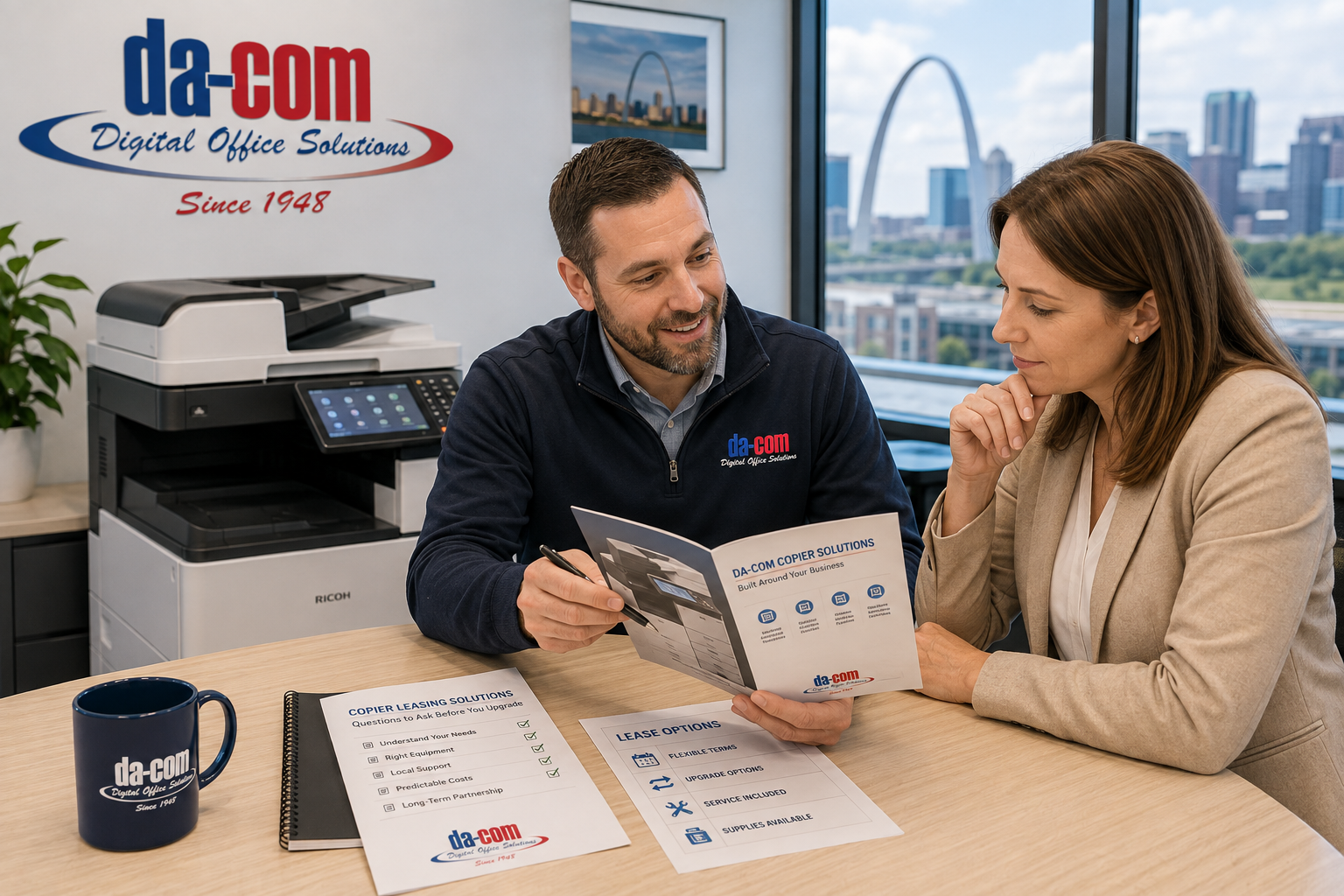
Copier Leasing in St. Louis: Questions to Ask Before You Upgrade
Copier leasing in St. Louis can be a smart way for businesses to upgrade office technology, improve document workflows, reduce downtime, and access modern copier equipment without a large upfront purchase. But not every copier lease, copier provider, or equipment recommendation is the same.
Before signing a copier lease, businesses should ask clear questions about total cost, service response, lease flexibility, equipment recommendations, support after installation, security features, print volume, scanning needs, and future growth. The right copier lease should solve problems, not create new ones.
For many organizations in St. Louis, St. Charles, Columbia, the Metro East, Edwardsville, Belleville, O’Fallon, Southern Illinois, and the surrounding Midwest region, the most important question is not only which copier to choose. It is which company will stand behind that copier after it is installed.
A trusted local copier provider can make the difference between years of smooth operation and years of frustration. When your team depends on printing, copying, scanning, and document workflows every day, local support matters.
This guide explains the most important questions to ask before upgrading your copier, how to compare copier leasing companies, and why Da-Com is a trusted copier provider for businesses throughout Missouri and Southern Illinois.
Quick Answer: What Should You Ask Before Signing a Copier Lease?
Before signing a copier lease, ask what problems the upgrade should solve, what is included in the lease, how fast service response is, whether supplies and maintenance are covered, how the copier supports security, whether the equipment can grow with your business, and what happens after installation. The best copier leasing in St. Louis should include more than equipment. It should include clear pricing, reliable support, local service, honest recommendations, and a provider that understands your workflow.
Good copier leasing questions include:
- What problems are we trying to solve with this upgrade?
- Will this copier still meet our needs three to five years from now?
- What happens after installation?
- How fast is service when something breaks?
- What is included in the copier lease?
- Are toner, supplies, service, and training included?
- How will this copier improve daily operations?
- How secure is this copier?
- Is this provider local?
- Is the provider focused on relationships or transactions?
Da-Com provides office copier and printer solutions for businesses that need dependable equipment, practical recommendations, and responsive local support.
Upgrading a Copier Should Make Life Easier
Most organizations do not start looking for a new copier because they are excited about office equipment. They start because something is no longer working.
The copier is breaking down. Employees are waiting on documents. Scanning has become unreliable. Support is slow. Print quality is inconsistent. The lease is ending. Or the business has simply outgrown its current equipment.
When these issues happen, the burden usually lands on one person:
- The office manager.
- The operations director.
- The IT manager.
- The business owner.
- The administrator who gets called every time technology interrupts work.
At that moment, the goal is not just finding a copier. The goal is finding relief.
The right copier upgrade should help reduce interruptions, improve reliability, simplify scanning, support secure workflows, and make the office easier to run. That is why asking the right questions before upgrading matters.
Why Copier Leasing Remains Popular for St. Louis Businesses
Many organizations choose copier leasing in St. Louis because it allows them to access modern equipment without a large upfront purchase. Leasing can also make budgeting easier because costs are spread over time.
Copier leasing may offer:
- Predictable monthly costs.
- Access to newer technology.
- Service and maintenance options.
- Easier budgeting.
- Upgrade flexibility.
- Scalability as organizations grow.
- Potential support for supplies and training.
For schools, healthcare providers, law firms, manufacturers, nonprofits, churches, financial institutions, government offices, and local businesses, leasing often creates more flexibility than purchasing copier equipment outright.
However, not all copier leases are created equal. The monthly payment is only one part of the decision. Businesses should also understand service, support, supplies, usage, contract terms, security, and what happens when needs change.
Da-Com’s related guide on whether to lease or purchase a copier can also help businesses compare the financial and operational side of each option.
Question 1: What Problems Are We Actually Trying to Solve?
This sounds simple, but it is often overlooked.
Many organizations begin shopping based on machine specifications. They compare print speed, paper capacity, monthly volume, finishing options, toner cost, and touchscreen features. Those details matter, but they should not be the starting point.
Before comparing copier models, ask:
- Why are we replacing the current copier?
- What frustrates employees most?
- Where are workflows slowing down?
- Are we having issues with printing, scanning, copying, or all three?
- Are service calls increasing?
- Is the current device too slow for our volume?
- Are we losing time because of paper jams or downtime?
- Are employees creating workarounds because the copier is not meeting their needs?
The best copier upgrade addresses operational challenges, not just equipment features. A trusted copier provider should spend time understanding your workflow before recommending a device.
Example: The Real Problem May Not Be Printing
A business may think it needs a faster copier when the real issue is unreliable scanning. A school may think it needs more devices when the real issue is poor placement. A healthcare office may think it needs a lower-cost copier when the real issue is document security and workflow delays.
A consultative provider should help identify the real issue before recommending equipment.
Question 2: Will This Copier Still Meet Our Needs Three to Five Years From Now?
Businesses grow. Departments change. Technology evolves. A copier that works today may become a limitation before the lease ends.
Before signing a copier lease, ask:
- Can this device handle future print volume?
- Will it support hybrid work environments?
- Can additional users be added easily?
- Does it integrate with document management systems?
- Can it support future scanning workflows?
- Can it handle new security requirements?
- What happens if we add another office, department, or team?
Many businesses make the mistake of choosing equipment based only on current needs. The better approach is selecting a copier solution that supports future growth without overspending today.
That balance matters. You do not want to lease equipment that is too small for your team, but you also do not want to pay for capacity your business will never use.
Question 3: What Happens After Installation?
This may be the most important question of all.
Many providers are highly responsive during the sales process. Then communication slows down after the paperwork is signed. That is one of the biggest concerns business leaders have when choosing a copier lease company in St. Louis.
Ask your provider:
- Who handles service requests?
- How do we request support?
- What are average response times?
- Will we have a dedicated account manager?
- Is support local?
- Who trains employees after installation?
- How are toner, supplies, and maintenance handled?
- What happens if we have recurring issues?
When your staff is waiting, support matters. The right provider should be clear about what happens after the copier is delivered, installed, and connected.
Da-Com supports businesses with office equipment, managed print, document management, managed IT, cybersecurity, and related workplace technology services, which helps organizations reduce vendor complexity and get support across more of their technology environment. You can learn more about Da-Com’s broader office technology services on the About Da-Com page.
Question 4: How Fast Is Service When Something Breaks?
Every copier provider promises service. Not every provider delivers it consistently.
When evaluating local copier leasing companies, ask for clear answers about service response. Businesses should not have to wonder when help will arrive.
Ask:
- What is the average response time?
- Are technicians local?
- Do you provide remote support?
- How quickly can on-site service be scheduled?
- What happens during urgent issues?
- Do you stock common parts and supplies locally?
- How are repeat problems escalated?
Service speed is important because copier downtime affects more than printing. It can interrupt billing, client communication, HR documents, student forms, patient paperwork, legal files, shipping documents, and internal processes.
If you are comparing copier leasing near me searches, remember that local support can be a major advantage. A copier lease is not only about monthly cost. It is about how quickly your team can get back to work when something goes wrong.
Question 5: What Is Included in the Copier Lease?
Copier lease agreements vary significantly. Before comparing monthly payments, make sure you understand what each proposal actually includes.
| Lease Component | Questions to Ask |
|---|---|
| Equipment | Which copier model is included, and why is it being recommended? |
| Service | Are repairs covered, and how are service requests handled? |
| Supplies | Is toner included, and how is it ordered or replenished? |
| Training | Will employees receive training after installation? |
| Installation | Is setup, delivery, and network connection included? |
| Software | Are workflow tools, print management, or scanning features included? |
| Upgrades | What happens if your needs change during the lease? |
| Billing | Are there overage charges, hidden fees, or separate support costs? |
| End of lease | What are your options when the lease term ends? |
Transparency matters. A trustworthy copier provider should explain everything clearly.
No surprises. No confusing language. No hidden costs.
Da-Com’s guide on how to navigate a copier lease agreement provides additional context for businesses reviewing lease terms, service expectations, and copier agreements.
Question 6: How Will This Copier Improve Daily Operations?
The best copier upgrades do more than print. Modern multifunction printers can help improve document workflows, scanning processes, digital filing, secure document sharing, mobile printing, and team collaboration.
Ask your provider one simple question:
What will be easier after this upgrade?
If the answer is not clear, keep asking questions.
A copier upgrade may improve daily operations by helping your team:
- Scan invoices faster.
- Route documents to the right folders.
- Reduce manual filing.
- Print securely.
- Support mobile printing.
- Reduce downtime.
- Improve document quality.
- Consolidate multiple devices.
- Reduce service calls.
- Support departments with different needs.
Technology should reduce work, not create more of it. The right copier leasing partner should connect equipment features to practical business improvements.
Da-Com’s document management services can also help businesses reduce manual paper handling, improve document access, and support more structured workflows.
Question 7: How Secure Is This Copier?
Most businesses do not realize that modern copiers are network-connected devices. That means copier security matters.
A multifunction copier may print, scan, copy, email, store files, connect to folders, route documents, authenticate users, and interact with business systems. For organizations handling sensitive information, copier security should be part of the leasing conversation from the beginning.
Ask about:
- User authentication.
- Secure print release.
- Hard drive encryption.
- Data overwrite or removal options.
- Firmware updates.
- Audit tracking.
- Permission controls.
- Network configuration.
- Secure scanning destinations.
- End-of-lease data handling.
Especially for healthcare, education, legal, financial, nonprofit, and government organizations, copier security is no longer optional.
The NIST Cybersecurity Framework is a useful authority resource for organizations thinking about cybersecurity risk, connected devices, access control, and data protection across their technology environment.
CISA also publishes guidance on secure technology practices for organizations, including risks around printing and remote work environments. You can review CISA resources through the CISA resource library.
Question 8: Is This Provider Focused on Relationships or Transactions?
This question may not appear on a proposal, but it becomes obvious during conversations.
Pay attention to whether the provider:
- Listens carefully.
- Asks questions.
- Understands your workflow.
- Respects your budget.
- Recommends right-sized solutions.
- Explains tradeoffs clearly.
- Talks about support after installation.
- Offers practical guidance instead of pressure.
The best providers act like partners. They do not recommend the most expensive device just because it has more features. They recommend equipment that fits your office, your users, your budget, and your long-term goals.
That relationship-focused approach matters because copier leasing is not a one-time transaction. A lease can last several years. During that time, your team may need service, support, supplies, training, workflow help, security guidance, and upgrade conversations.
Question 9: Is the Provider Local?
Local accountability matters, especially when problems occur.
National vendors often rely on centralized service structures that can feel disconnected from local businesses. A local copier leasing provider offers advantages such as faster support, familiar technicians, stronger accountability, better communication, and long-term relationships.
For organizations throughout St. Louis, St. Charles, Clayton, Chesterfield, Columbia, Edwardsville, Belleville, O’Fallon, the Metro East, and Southern Illinois, working with a local provider often means fewer headaches and faster resolutions.
A local copier company can also better understand regional business needs, school schedules, healthcare workflows, nonprofit budgets, local government requirements, and the urgency of keeping office technology running.
Da-Com’s related St. Louis copier company lease checklist can help businesses compare local copier providers and evaluate lease options before making a decision.
Copier Leasing in St. Louis: What to Compare Before You Choose
When comparing copier leasing in St. Louis, do not evaluate only the monthly payment. A lower payment may not be the better deal if service is slow, supplies are not included, the equipment is not right-sized, or the lease terms are confusing.
| Comparison Area | Why It Matters |
|---|---|
| Monthly cost | Helps determine budget fit, but should not be the only factor. |
| Service response | Affects downtime, employee frustration, and business continuity. |
| Equipment fit | Ensures the copier matches print volume, scanning, color, and workflow needs. |
| Lease flexibility | Matters if your business grows or needs change during the lease. |
| Supplies | Toner and consumables can affect ongoing operating costs. |
| Training | Helps employees use features correctly and reduce support calls. |
| Security | Protects sensitive documents, print jobs, scans, and stored data. |
| Local support | Improves accountability and can make service faster and easier. |
| Workflow support | Helps improve scanning, routing, document storage, and daily processes. |
The best copier lease is the one that fits your people, processes, budget, and service expectations.
Why Businesses Trust Da-Com for Copier Leasing in St. Louis
For more than 75 years, Da-Com has helped organizations throughout Missouri and Southern Illinois simplify office technology. Businesses choose Da-Com because they want responsive service, honest recommendations, long-term relationships, local accountability, and one technology partner for multiple workplace needs.
Responsive Service
When office technology breaks, businesses need help quickly. Da-Com focuses on responsive support that helps organizations reduce downtime and get back to work.
Honest Recommendations
Da-Com focuses on helping organizations find the right solution rather than the most expensive solution. That means reviewing workflows, print volume, scanning needs, budget, and long-term goals before recommending equipment.
Long-Term Relationships
Copier leasing is not only about installation. It is about support over the full lease term. Da-Com works to build long-term relationships with businesses, schools, healthcare offices, nonprofits, churches, manufacturers, government offices, and other organizations throughout the region.
Local Accountability
When help is needed, businesses want real people who understand their organization. Local accountability is one reason many organizations prefer working with a regional provider instead of a disconnected national vendor.
One Technology Partner
In addition to copier leasing, Da-Com provides Managed IT, cybersecurity, document management, managed print services, office equipment, office supplies, and workplace technology solutions. That can mean fewer vendors to manage and fewer headaches for your team.
Da-Com’s managed print services can help businesses gain visibility and control over printing processes, reduce waste, manage supplies, and simplify printer management.
Signs It May Be Time to Upgrade Your Copier
You may be ready for a copier upgrade if the current device is creating more problems than it solves.
Common signs include:
- Service calls are increasing.
- Employees complain about downtime.
- Print quality is declining.
- Scanning is unreliable.
- Parts are becoming difficult to find.
- Security concerns are growing.
- Business needs have changed.
- Productivity is suffering.
- The current lease is ending.
- The copier cannot support current workflows.
- Employees are creating workarounds.
- Mobile printing or secure printing is missing.
If any of these sound familiar, now may be the right time to evaluate copier leasing options.
Office Copier Leasing Checklist
Use this checklist before signing a copier lease agreement.
- Identify the problems your current copier is creating.
- Estimate monthly print and copy volume.
- Review scanning and workflow needs.
- Decide whether color printing is necessary.
- Ask what is included in the lease.
- Ask whether service, maintenance, and supplies are covered.
- Confirm how support requests are handled.
- Ask about local technician availability.
- Review security features.
- Ask about training after installation.
- Understand overage charges and billing terms.
- Ask about lease-end options.
- Confirm whether upgrades are possible if needs change.
- Compare the provider’s service model, not only the monthly cost.
- Choose a provider that understands your workflow.
Copier Lease Costs: What Affects the Monthly Price?
Copier lease pricing can vary based on equipment type, print volume, color needs, service coverage, lease term, supplies, accessories, software, and workflow requirements.
Factors that may affect copier lease cost include:
- Black-and-white vs. color output.
- Print speed.
- Monthly page volume.
- Paper capacity.
- Scanning speed.
- Finishing options.
- Security features.
- Managed print services.
- Service agreement structure.
- Toner and supply coverage.
- Lease length.
- Installation and training needs.
ENERGY STAR offers guidance for imaging equipment, including printers, scanners, copiers, and multifunction devices, and notes that efficient imaging equipment can support energy-saving features such as duplex printing and power management. ENERGY STAR imaging equipment resources
The U.S. Small Business Administration also provides general guidance for businesses evaluating equipment purchases and assets. SBA equipment guidance
Frequently Asked Questions About Copier Leasing in St. Louis
Is leasing a copier better than buying?
For many organizations, leasing provides lower upfront costs, predictable budgeting, access to newer technology, and service options. Buying may make sense for organizations that prefer ownership and have stable long-term equipment needs.
How long do copier leases typically last?
Most copier leases range from 36 to 60 months depending on equipment, usage, budget, and organizational needs. Before signing, ask what happens at the end of the lease and whether upgrade options are available.
What is included in a copier lease?
Copier leases may include equipment, service, maintenance, supplies, installation, training, and support options. Every agreement is different, so businesses should ask for a clear explanation of what is included and what costs extra.
Why choose a local copier leasing company?
A local copier leasing company often provides faster service, better communication, stronger accountability, and more personalized support than a provider with centralized or disconnected service.
What should I look for in a trusted copier provider?
Look for responsiveness, experience, customer reviews, transparent pricing, local support, clear communication, and a consultative approach that starts with your workflow rather than a generic equipment recommendation.
Can copier leasing support business growth?
Yes. The right copier lease can support growth by giving businesses access to scalable equipment, modern features, managed print services, secure workflows, and upgrade options as needs change.
How do I know if it is time to upgrade my copier?
It may be time to upgrade if service calls are increasing, employees are frustrated, scanning is unreliable, print quality is declining, security concerns are growing, or your current copier no longer supports daily operations.
Does Da-Com provide copier leasing in St. Louis?
Yes. Da-Com helps organizations throughout St. Louis, St. Charles, Columbia, Edwardsville, Belleville, O’Fallon, the Metro East, and Southern Illinois evaluate copier leasing, office equipment, managed print services, document workflows, and local support needs.
The Right Copier Provider Should Make Your Day Easier
A copier lease is not really about equipment. It is about confidence.
Confidence that your team will stay productive. Confidence that help is available when needed. Confidence that your provider understands your business. Confidence that you made the right decision.
When you choose the right local copier leasing partner, technology becomes one less thing you have to worry about.
Less stress. Fewer interruptions. More peace of mind.
Contact Da-Com About Copier Leasing in St. Louis
If you are considering a copier upgrade, Da-Com can help you evaluate your options.
At Da-Com, we help organizations throughout St. Louis, Chesterfield, Clayton, St. Charles, Columbia, Edwardsville, Belleville, O’Fallon, the Metro East, and Southern Illinois find copier solutions that fit their workflows, budgets, security needs, and long-term goals.
Contact Da-Com today to learn more about copier leasing in St. Louis and discover why so many organizations trust Da-Com as their long-term copier and office technology partner.


Leave A Comment