
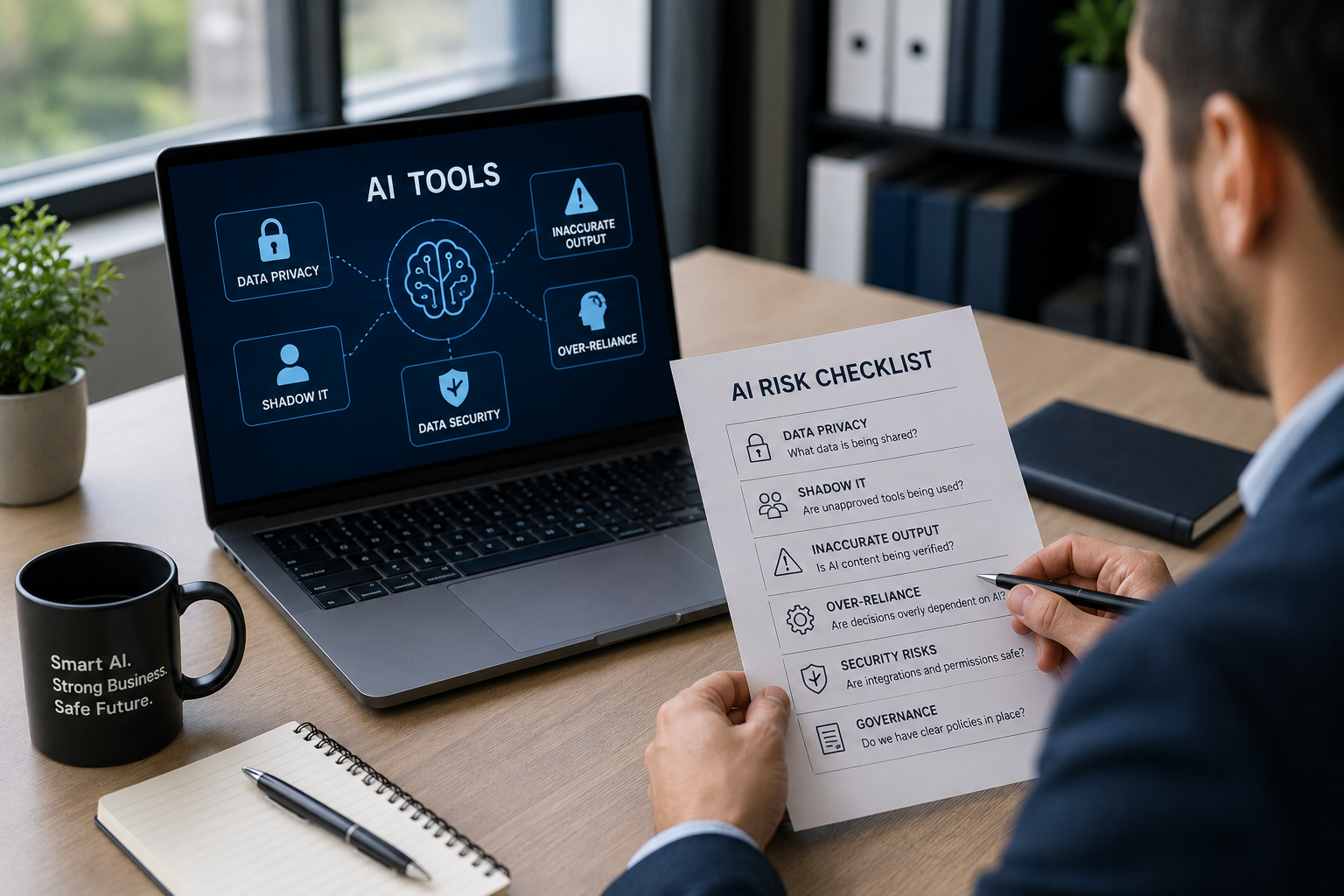
Risks of AI in Business: 2026 SMB Guide
Risks of AI in business are becoming more important for leaders to understand as employees adopt artificial intelligence tools faster than many organizations can manage. AI can help teams work more efficiently, write faster, summarize information, analyze data, automate repetitive tasks, improve customer communication, and support decision-making. Those benefits are real. But so are the risks.
For small and mid-size businesses, the biggest AI risk is often not a futuristic threat. It is everyday use without enough oversight. An employee uses a free AI tool to draft a client proposal. A manager uploads meeting notes that include financial details. A salesperson enters customer information to generate outreach ideas. A team member connects an AI tool to email, calendar, cloud storage, or a CRM without asking IT. These actions may feel harmless in the moment, but they can expose sensitive information, create compliance concerns, and introduce security gaps.
The challenge is that AI tools are easy to access. Many are free or inexpensive. Employees can start using them in minutes. That convenience creates a gap between what leadership thinks is happening and what employees are actually doing.
This guide explains the most common risks of AI in business, including data privacy, shadow IT, inaccurate outputs, cybersecurity exposure, over-reliance, weak governance, and employee misuse. It also explains how small and mid-size businesses can adopt AI safely with clear policies, technical controls, employee training, and the right IT partner.
Why the Risks of AI in Business Matter More in 2026
AI adoption has moved from experimentation to daily work. Employees are using AI tools for writing, research, summaries, spreadsheets, meeting notes, coding, customer service, marketing, data analysis, and administrative tasks. In many businesses, this has happened before formal policies were created.
That creates risk because AI tools are not all the same. Some are enterprise platforms with strong privacy commitments, administrative controls, and data protection features. Others are consumer tools that may not be appropriate for sensitive business information. Some tools store user prompts. Some may use submitted content to improve models, depending on settings and terms. Some integrate with business systems and request broad access. Some produce inaccurate information that sounds polished and believable.
Business leaders do not need to stop AI adoption. They do need to manage it.
NIST’s AI Risk Management Framework is designed to help organizations better understand and manage risks associated with artificial intelligence. NIST has also released a generative AI profile to help organizations identify risks unique to generative AI and consider actions that align with their goals and priorities. :contentReference[oaicite:4]{index=4}
For SMBs, the lesson is practical: AI should be treated like any other business technology that touches company data, customers, employees, operations, or decision-making. It needs evaluation, ownership, policies, security review, and ongoing oversight.
Data Privacy and Confidentiality Risks
One of the most significant risks of AI in business is the possibility that sensitive information will be shared with AI tools in ways leadership never intended.
Employees may paste confidential data into an AI tool because they are trying to save time. They may ask AI to summarize meeting notes, rewrite a contract paragraph, analyze a customer list, draft a proposal, clean up a spreadsheet, or create a marketing email. The intent may be productive. The risk depends on what data is entered, which tool is used, how the tool stores information, and whether the business has approved that use.
Sensitive information may include:
- Customer names, contact details, and purchase history
- Employee records or HR information
- Financial reports, budgets, or forecasts
- Client proposals or contract terms
- Trade secrets or proprietary processes
- Sales lists and CRM exports
- Medical, legal, insurance, or regulated data
- Internal meeting notes or board materials
- Cybersecurity information or system details
The FTC has warned AI companies that they must uphold privacy and confidentiality commitments. If a company promises not to use customer data for hidden purposes, such as training or updating models, failing to honor that promise can create legal exposure under FTC-enforced laws. :contentReference[oaicite:5]{index=5}
That guidance matters for businesses choosing AI tools. Leaders should not assume every tool handles data the same way. Before employees use an AI platform for business information, the company should understand the tool’s privacy terms, data retention settings, model training options, administrative controls, and contractual commitments.
How to Reduce AI Data Privacy Risk
Businesses can reduce AI privacy risk by creating clear rules around what data can and cannot be entered into AI tools. A practical policy should define approved tools, prohibited data categories, review requirements, and escalation steps.
For example, a business may allow employees to use an approved AI tool for public-facing marketing drafts, but prohibit entering customer lists, passwords, financial records, health information, contracts, or confidential client data without approval.
Da-Com’s cybersecurity essentials for SMBs resource explains why small and mid-size businesses need layered protection, clear processes, and security practices that match how employees actually use technology.
Shadow AI and Shadow IT Risks
Shadow IT refers to technology tools employees use without approval from IT or leadership. AI has made this problem much bigger because AI tools are easy to find, easy to use, and often helpful right away.
Shadow AI may include:
- Employees using personal AI accounts for work tasks
- Free AI writing tools used for client documents
- AI meeting assistants joining calls without approval
- Browser extensions that read web pages or emails
- AI tools connected to cloud storage or CRM systems
- Chatbots used to analyze confidential spreadsheets
- Unapproved AI transcription or note-taking apps
- AI design, coding, or research tools used without review
The risk is not that employees are trying to cause harm. In many cases, they are trying to work faster. The problem is that each unapproved tool creates a data flow the business has not evaluated.
When AI tools are used without oversight, leadership may not know:
- What data employees are sharing
- Where that data is stored
- Whether the tool uses prompts for training
- Whether accounts are protected by multi-factor authentication
- Whether the tool integrates with business systems
- Who can access the data inside the platform
- Whether the tool meets compliance requirements
- How data can be deleted or exported
Shadow AI is especially risky for small businesses because there may not be a formal software approval process. Employees may sign up for tools using work email addresses, reuse passwords, and connect business data before anyone has reviewed the risk.
How to Reduce Shadow AI
The best response is not simply saying “no AI.” That usually drives usage further underground. A better approach is to create a clear, simple approval process and provide employees with approved options.
An AI approval process should answer:
- How can employees request a new AI tool?
- Who reviews the tool?
- What data can be used in the tool?
- Which tools are already approved?
- Which use cases are prohibited?
- How will employees be trained?
Da-Com’s managed IT and technology success services help businesses evaluate technology tools, strengthen cybersecurity, improve oversight, and align IT decisions with business goals.
Over-Reliance and Accuracy Problems
AI tools can produce polished answers that sound confident, but that does not mean the output is always correct. One of the biggest risks of AI in business is over-reliance on AI-generated content without enough human review.
AI may generate inaccurate facts, outdated information, invented citations, incorrect calculations, weak legal language, incomplete summaries, misleading recommendations, or content that does not fit the business context. This is sometimes called hallucination, but the practical issue is simple: AI can be wrong in ways that look professional.
In a business setting, that can create real consequences.
Examples include:
- A proposal includes inaccurate statistics or unsupported claims.
- A contract summary misses an important obligation.
- A financial analysis includes incorrect assumptions.
- A policy draft sounds professional but does not match actual company practice.
- A customer email includes a promise the business cannot fulfill.
- A compliance summary leaves out important requirements.
- A technical answer is copied into a client deliverable without verification.
The risk increases when employees are under pressure. If AI saves time, people may be tempted to skip review. But AI output should usually be treated as a draft, not a final answer.
How to Reduce Accuracy Risk
Businesses should define review standards for AI-generated work. The more important the output, the more review it needs.
A practical policy might say:
- AI-generated client-facing content must be reviewed before sending.
- AI-generated legal, financial, HR, healthcare, or compliance content requires expert review.
- AI-generated statistics or claims must be verified against reliable sources.
- AI should not be the final decision-maker for hiring, firing, lending, medical, legal, or high-impact decisions without appropriate safeguards.
- Employees should disclose when AI materially contributed to certain types of work, depending on company policy.
AI can be a helpful assistant, but it should not become an unchecked authority.
Cybersecurity Risks of AI Tool Adoption
AI tool adoption can create cybersecurity risks if tools are not reviewed, configured, or monitored properly.
Credential and Account Risks
Employees may create AI accounts using work email addresses and weak or reused passwords. If that AI account is compromised, attackers may gain access to prompts, uploaded files, generated content, or connected integrations.
Businesses should require strong passwords and multi-factor authentication for approved AI platforms, especially if the tool handles company information.
Integration Risks
Some AI tools request access to email, calendars, cloud storage, messaging platforms, CRM systems, project management tools, or files. These integrations can be useful, but they also expand risk.
Before approving an integration, businesses should ask:
- What systems will the AI tool access?
- What permissions does it request?
- Can permissions be limited?
- Who can approve connections?
- Can activity be logged?
- How can access be revoked?
- What happens if the AI vendor is compromised?
Prompt Injection and AI-Specific Attacks
Prompt injection is an AI-specific risk where malicious instructions are hidden in content that an AI system processes. If an AI tool reads emails, documents, websites, or uploaded files, it may encounter instructions designed to manipulate its behavior.
This risk is especially important as businesses connect AI tools to more systems and allow them to take actions, summarize external content, or interact with sensitive data.
CISA provides artificial intelligence cybersecurity resources covering secure AI adoption, AI security guidance, and the cybersecurity implications of AI systems. CISA notes that AI security is tied to its mission of securing federal software systems and critical infrastructure. :contentReference[oaicite:6]{index=6}
Da-Com’s proactive IT monitoring resource explains how continuous oversight can help businesses identify unusual activity, improve visibility, and reduce technology risk.
Compliance and Legal Risks of AI Use
AI can create compliance concerns when employees use it with regulated, confidential, or contractual information. This can affect industries such as healthcare, financial services, legal services, insurance, education, manufacturing, government contractors, and professional services.
Potential compliance concerns include:
- Protected health information entered into an unapproved tool.
- Client financial information processed by a platform without proper safeguards.
- Contract terms shared with a tool that lacks confidentiality commitments.
- Employee data used in ways that violate privacy expectations.
- Customer data processed outside approved regions or retention policies.
- AI-generated advice used without appropriate professional review.
- Records created by AI tools that are not retained properly.
Legal risk may also arise from copyright, intellectual property, discrimination, advertising claims, consumer protection issues, or contractual obligations.
Businesses should involve leadership, IT, legal, HR, compliance, and department managers when creating AI policies. A policy created only by one department may miss important risk areas.
Reputation and Customer Trust Risks
AI misuse can damage trust. Customers, clients, patients, employees, and partners expect businesses to handle information responsibly. If sensitive data is entered into the wrong tool, inaccurate AI-generated content is sent to a client, or employees use AI in a way that feels deceptive, the business may face reputational harm.
Trust is especially important for SMBs because many rely on long-term relationships and local reputation. A data privacy incident or embarrassing AI-generated error can have an outsized impact.
Businesses should ask: “Would we be comfortable explaining this AI use to a client?” If the answer is no, the use case may need more review.
AI Vendor Risk and Tool Evaluation
Not all AI vendors are equal. Before approving an AI tool, businesses should evaluate the vendor and the specific use case.
Key questions include:
- What data does the tool collect?
- Does the vendor use customer data to train models?
- Can training on company data be turned off?
- Where is data stored?
- How long is data retained?
- Can data be deleted?
- Does the vendor support multi-factor authentication?
- Does the tool offer administrative controls?
- What integrations does it support?
- What permissions do integrations require?
- Does the vendor provide security documentation?
- Does the tool meet industry compliance requirements?
- Who owns the output?
- What happens if the vendor changes terms?
For SMBs, this can feel overwhelming. That is why AI tool evaluation should be part of technology governance, not left to individual employees.
Building an AI Acceptable Use Policy
An AI acceptable use policy gives employees clear guidance. It should be practical, easy to understand, and specific enough to prevent confusion.
A strong AI policy should include:
- Approved AI tools.
- Prohibited AI tools or use cases.
- Types of data that cannot be entered into AI tools.
- Rules for client-facing content.
- Review requirements for legal, financial, HR, healthcare, and compliance content.
- Approval process for new AI tools.
- Rules for connecting AI tools to business systems.
- Employee responsibilities for fact-checking outputs.
- Security requirements such as MFA and approved accounts.
- Reporting steps for suspected data exposure or misuse.
The policy should not be buried in a handbook and forgotten. Employees need training, examples, and reminders. They need to know what is allowed and what to do when they are unsure.
Creating an AI Governance Process for SMBs
AI governance does not have to be complicated. For small and mid-size businesses, it can start with a lightweight process that creates visibility and accountability.
A practical AI governance process may include:
1. Inventory Current AI Use
Start by asking employees what AI tools they already use. The goal is not to punish people. The goal is to understand the current environment.
2. Categorize AI Use Cases
Separate low-risk use cases from higher-risk ones. A public blog outline is different from a customer database analysis. A meeting summary of internal strategy is different from a generic grammar check.
3. Approve Tools by Risk Level
Some tools may be approved for general use. Others may be approved only for specific departments. Some may not be appropriate for company data.
4. Define Data Rules
Make it clear which data can be used with AI tools and which data requires approval or is prohibited.
5. Monitor and Review
AI tools change quickly. Policies should be reviewed regularly. New tools, features, integrations, and risks should be evaluated as they appear.
NIST’s AI Risk Management Framework emphasizes that AI risk management should be ongoing and adaptable. That approach is useful for SMBs because AI tools and business use cases will continue to evolve. :contentReference[oaicite:7]{index=7}
Employee Training for Safe AI Adoption
Employees need clear training that connects AI risk to real work. Training should avoid fear-based messaging and focus on practical decisions.
Useful training topics include:
- What data should never be entered into unapproved AI tools.
- How to request approval for a new AI tool.
- How to review AI-generated content before using it.
- How to identify inaccurate or unsupported AI outputs.
- Why AI meeting assistants and browser extensions need review.
- How AI tools can create cybersecurity and privacy risks.
- What to do if sensitive data is accidentally entered into a tool.
- How to use approved AI tools safely.
Employees are more likely to follow policy when they understand the reason behind it. The message should be: “We want to use AI well, but we need to protect company and client information.”
How Da-Com IT Pros Helps Businesses Manage AI Risk
Da-Com IT Pros helps businesses across St. Louis, Columbia, Southern Illinois, and surrounding communities adopt technology safely and strategically. As AI becomes more common in daily work, businesses need practical guidance that balances productivity with privacy, cybersecurity, compliance, and governance.
Da-Com can help businesses with:
- AI tool evaluation.
- AI acceptable use policy development.
- Shadow AI discovery and risk conversations.
- Cybersecurity controls for approved tools.
- Identity and access management.
- Multi-factor authentication planning.
- Vendor risk review.
- Employee cybersecurity and AI awareness training.
- Secure integration review.
- vCIO guidance for technology strategy.
For many SMBs, the goal is not to ban AI. The goal is to use it safely, consistently, and intentionally. That requires the right tools, clear rules, and a partner who understands both the opportunity and the risk.
Da-Com’s vCIO benefits for SMBs resource explains how strategic IT leadership helps businesses plan technology decisions, manage risk, and align IT investments with business goals.
AI Risk Checklist for Business Leaders
Use this checklist as a starting point for safer AI adoption:
- Create a list of AI tools employees are currently using.
- Identify which tools are approved, unapproved, or under review.
- Define what data cannot be entered into AI tools.
- Review AI vendor privacy and data retention terms.
- Require MFA for approved AI tools when available.
- Limit integrations between AI platforms and business systems.
- Create a process for requesting new AI tools.
- Train employees on accuracy review and fact-checking.
- Require expert review for legal, financial, HR, healthcare, or compliance-related AI outputs.
- Monitor for shadow AI usage where possible.
- Document AI use policies and review them regularly.
- Prepare a response plan for accidental data exposure.
Use AI With Confidence, Not Guesswork
The risks of AI in business are real, but they do not have to stop your organization from using AI. The businesses that benefit most from AI will be the ones that adopt it thoughtfully. They will define approved tools, protect sensitive data, train employees, verify outputs, manage integrations, and review vendors carefully.
AI can help your team work faster, but speed should not come at the expense of privacy, security, accuracy, or trust.
For SMBs in St. Louis and Southern Illinois, a safe AI strategy starts with visibility. Know what tools are being used. Know what data is being shared. Know which risks matter most. Then create a practical governance process your employees can actually follow.
To learn more about managing the risks of AI in business, building an AI acceptable use policy, and adopting AI safely for your St. Louis or Southern Illinois business, contact Da-Com IT Pros today. Da-Com can help your team evaluate AI tools, reduce shadow IT, strengthen cybersecurity, and use AI with more confidence.


Leave A Comment